I’ve joined @vercel as Chief of Staff for Product & Engineering!
Among (many) other things, I’ll be partnering with @tomocchino & @cramforce to improve the velocity and alignment of our engineering, product, and design organization.
Dan is spot on here.
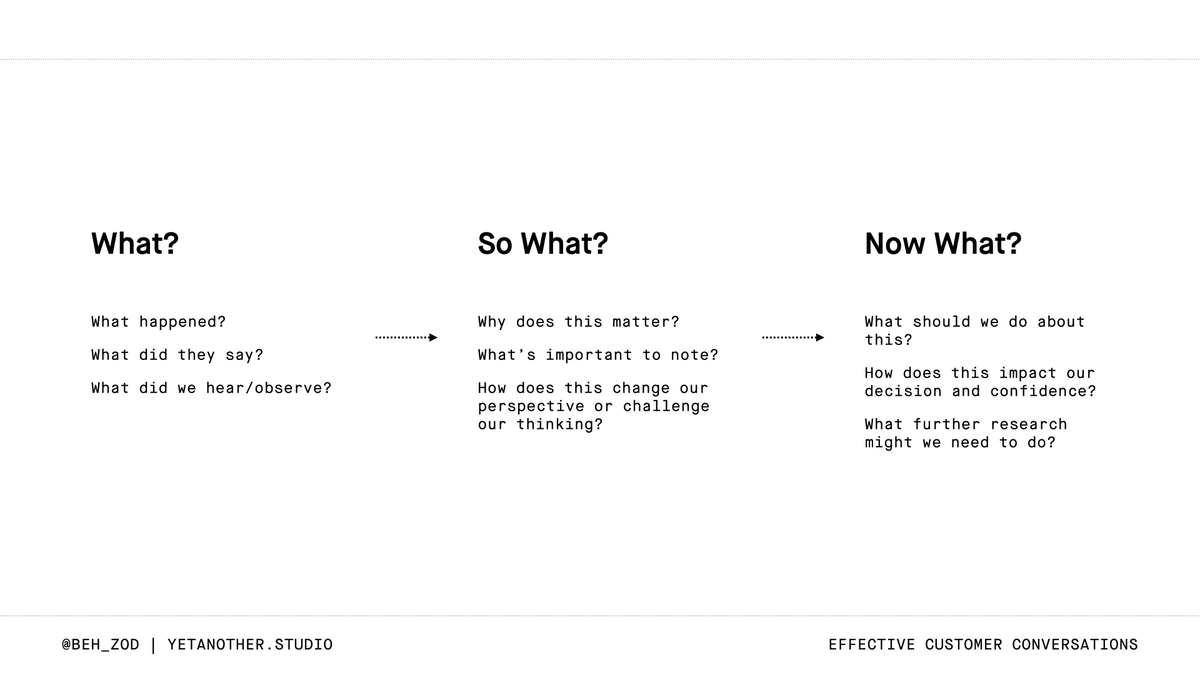
The most helpful and straightforward framework I've found for going from data -> action is:
- What?
- So What?
- Now What?
Makes it easy for teams to discuss/align on what they heard/observed, what it meant, and what you should do about it.
The scarce resource in almost every company is synthesis.
We are flooded with information: data, customer feedback, missing goals, beating goals, experiments that worked and didn't, competition emerging or changing tactics.
The most impactful people in every function can parse
"Talk to customers" is the same kind of advice as "lift weights" — it's directionally correct and also lacking sufficient detail to be useful.
In the same way that you can spend hours in the gym and see no results, you can spend hours with customers and get nothing out of it.
Consider this: if “talk to customers” is the biggest secret to product success, then why aren’t more products successful? Why are so many founders unsuccessful? What explains PMs who’ve been talking to customers 5 times a week for years, without ever making products that win?
I’m excited to launch researchersforhire.com and would love your help sharing it! 🙏🏻
Researchers For Hire is meant to be a resource where #uxresearchers who have been affected by COVID-19 layoffs can share their information and hiring managers can find them.
More info 👇🏻
This is the design industry's "I don't see race."
If you don't believe who someone is influences how they view/perceive/use your product, you have a hyper privileged and distorted view of the world.
In my experience, neither behavior nor demographics are useful as the primary determinators of test subjects, personas, or design. So I don’t pay them much attention. 2
Quick reminder about #usability research - whenever you’re asking a participant what they think, you should ask for their:
1. Expectation (about what will happen)
2. Reaction (to what happens)
3. Reflection (on the difference between 1 and 2)
Please do not forget #3.
"Schedule and manage your bandwidth, not your time" is probably the most important lesson I've learned over the last year as an independent.
Being intentional about when I do things and how much I do has paid dividends in terms of energy, happiness, and quality.
"Nonviolence" is a concept that Ta-Nehisi Coates and @ezraklein helped me realize I very much misunderstood.
Both through the conversation (1) and Klein's follow up (2), I've realized how much nonviolence is anti-violence.
1. vox.com/2020/6/5/21279…
2. vox.com/2020/6/17/2127…