Image

Clotty The Custom Period Tracker Can, Of Course, Run DOOM

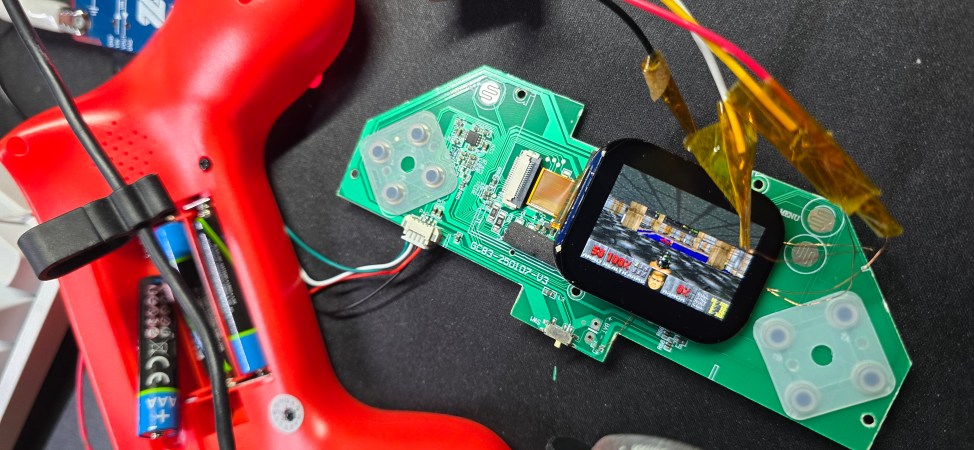
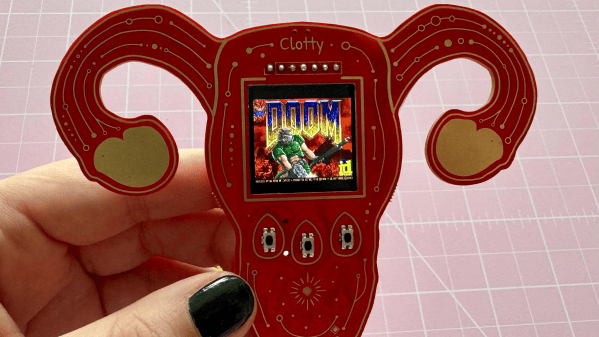
[kati]’s Clotty might run DOOM and game-ify the menstrual tracking process with a playful Tamagotchi-like aspect, but don’t let that distract you. It is, at its heart, a personal menstrual cycle tracking device that is defined as much by what it does do as what it doesn’t.

Image
Clotty brings a Tamagotchi-like playfulness to the table.

What doesn’t it do? Well, it will never quietly upload one’s menstrual tracking data to a remote server. Nor will it harvest, mishandle, disclose, or sell that same data. Shamefully, that alone sets it far apart from the wide range of period tracking services and apps out there. Also setting it apart is its cheerful lack of discretion. As [kati] puts it, she wanted Clotty’s design to scream “HELLO I AM A PERIOD TRACKING DEVICE” and at this she absolutely succeeded.

Clotty uses an RP2040, color LCD display, and a small variety of sensors built into a palm-sized, uterus-shaped PCB complete with touchpad ovaries. Right now it’s still in its early stages, and basically at the point that everything works hardware-wise and the essentials are there for software, but it’s still in active development. Keep an eye on Clotty’s GitHub repository for updates as features get fleshed out.

Of course, as [kati] observes, the core validity of a device can be defined by whether it can run DOOM, which of course Clotty can. You can find [kati]’s fork of RP2040-DOOM here.

[kati] has a knack for designing effective hardware that gamifies functions and incorporates a playfulness to the design that’s a delight to see. Take a moment to check out her Slightly Sentient D20 which is another excellent example of the kind of work she does.
Image

Running DOOM (Sort Of) On A Sonoff Smart Switch

It’s often said in this community that DOOM can be made to run on anything, and as time goes on, that’s becoming more and more accurate. We’re at the point now that every “normal” device seems to have some version of the iconic 1993 shooter, so now there’s nothing left but to start working on the more oddball targets.

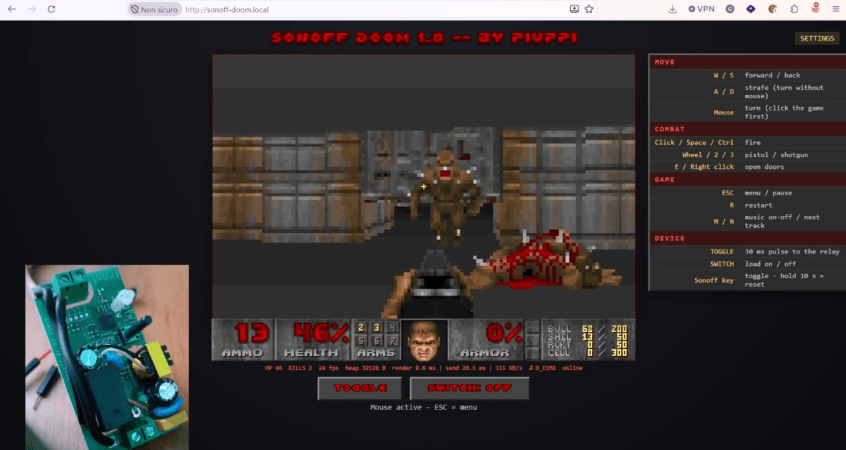
As a perfect example, [piuppi] recently wrote in to share their efforts to get DOOM — or at least something that looks like it — running on the Sonoff Basic R2 smart switch. We say something that looks like it because the game you’re seeing in the video below isn’t actually DOOM. In fact, it’s not even really a full game. It’s essentially a tech demo that’s capable of rendering graphical data pulled from the game, but only within the confines of simplistic map. Still, not bad for something designed to turn lamps on and off.

The GitHub repo includes excellent documentation should you want to rip and tear on your own Sonoff device. As you might expect the process is a bit involved, and does require you to provide your own copy of DOOM for the script to extract the necessary data from. After it’s setup, you can hit the switch from any browser on the local network and take out your frustrations on the state of modern home automation on some imps. The best part is, even after the game is installed and running on the switch, the device still actually works as a switch.

But don’t worry. Even in the unlikely event that we run out of devices that can be hacked to run DOOM, there’s still a whole world of gadgets out there that need their own port of Duke Nukem 3D.

Continue reading “Running DOOM (Sort Of) On A Sonoff Smart Switch” →

Image

The World’s Smallest TV Console Plays DOOM

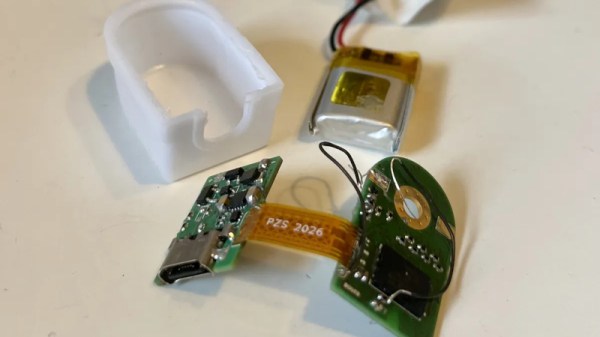
We’ve seen plenty of game console projects here, many of them that seek to produce a miniature game console. But this one from [RayTriangle] may break a new barrier entirely — it fits an entire TV game console that plays DOOM, including the battery, into a TV antenna plug.

There’s a type of antenna plug with screw terminals, originally intended for matching 300 ohm balanced feeder to 75 ohm co-ax. It provides a tiny project box if you look at it that way, and it’s in here that the console sits. It’s an ESP32-S3 that talks to a controller via Bluetooth, and he’s gone into some detail on how the RF for the TV is made. Some clever tricks such as a look-up table for the phase shifted chroma waveforms for each color allow the creation of a good quality composite signal through a resistor-ladder DAC, and this is modulated in a surprisingly old-fashioned way onto a carrier provided by the ESP’s clock generator.

The result as can be seen in the video below is a bit noisy, but we think that might be fixable with a little filter magic. It’s designed for PAL TVs with a VHF tuner, but we’re guessing some ingenuity could be brought into play to make it happen for UHF or NTSC. The hardware meanwhile is put on two boards either side of the battery, with a flexible PCB joining the two.

It’s true that gaming though an analogue RF input to a TV is probably less common in 2026, but we applaud the ingenuity in getting this into such a small space. For some reason it reminds us of the world’s smallest MIDI synthesizer.

Continue reading “The World’s Smallest TV Console Plays DOOM“ →

Image

Fly Brain Connectome Used To Trade Stocks And Play Games

Recently researchers finished mapping the central nervous system (CNS) connectome of not just the female Drosophila melanogaster (i.e. fruit fly) brain, but also that of the male D. melanogaster for a comparative analysis. Here the sexually dimorphic changes turned out to induce specific mating behavior that ensures that there will only be smooching between genetically fit D. melanogaster males and females, while the rest of the connectome remained effectively the same.

Of course, with this connectome in hand it led some people to ask themselves what else one can do with this connectome graph of about 160,000 neurons other than make a fruit fly into a fruit fly. So far we have seen [Nftechie] turn this connectome into a crypto stock trader with the Stonkfly project that uses the connectome’s reward circuits to potentially make profitable trades, though [Nftechie] says that they haven’t verified yet how good a fruit fly is at trading stocks, only that it does said stonks.

Over at [PC Gamer] they summarized a number of things that people have also done, including trying to make the connectome control a game of DOOM and Beat Saber. Each game frame stimulates sensory neurons, with the generated outputs then mapped to game controls, with dopamine-producing reward circuits wired in for reinforcement learning.

Although the D. melanogaster brain is only the merest fraction of the size of the human brain, it does provide us with a glimpse of what actual artificial intelligence research may lead to, as we unravel how even a 160,000 neuron connectome is enough to make these terrors of rotting plant matter do their wonderful things.

Image

Running DOOM On A Cheap 104-in-One Handheld

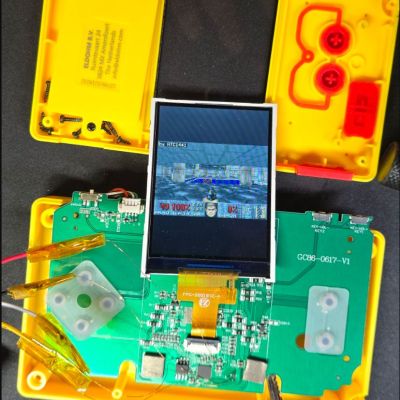
Taking a break from putting DOOM on devices that absolutely were never conceived for use as gaming devices, [Aaron Christophel] recently got enticed by some cheapo handheld gaming systems at his local Action budget store. One is a controller-shaped ‘mini game console’ with 104 games from the 1980s and 1990s, while the other is simply a Pac-Man handheld in a more typical rectangular form factor. Although this brings to mind basic blob chips and limited hacking potential, as it turns out they’re actually quite nice inside.

Image

As also covered in the demonstration video, rather than said nasty blob chip, both handhelds turned out to use the same unmarked MCU in QFN48 packaging. Some prodding and poking confirmed that it’s a typical ARM core, specifically a Cortex-M33 compatible STAR-MC1 ARMv8-M from an unknown manufacturer. Without a datasheet to go by, its limitations had to be discovered experimentally.

Of those, the biggest were a clock speed of 62 MHz – instead of the typical 194 MHz – as well as a lack of sound. This latter issue might be fixable with a better understanding of what appears to be a quirky DMA-fed DAC. Beyond this you’re also dealing with limited memory and of course just 4 MB of flash, though the chip for this might be upgradable if the MCU can map more. You do get a 320×240 display and a lot of buttons, which is admittedly nice.

As for the price difference of around $8/€7 for the Pac-Man version, this appears to be due to it running an officially licensed Bandai Namco arcade emulator as firmware, while the 104-in-one unit runs FlyThings/ZKSWE with a NES emulator.

Continue reading “Running DOOM On A Cheap 104-in-One Handheld” →

Image

DOOM Using Regular Expressions

Regular expressions (regexes) are an amazingly powerful way to perform operations on collections of e.g. text. Regexss can also be considered to be a programming language, even a Turing complete one. Ergo it’s perfectly acceptable to thus design a way to use regexes to run and play a game of DOOM, as [Artem Lytkin] recently did.

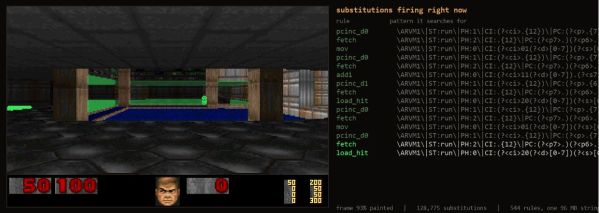
The GitHub project page can be found here, containing the Python-based code that allows the demonstration to run, as well as the other components, including the C runtime and the 96.6 MB text string that defines a CPU’s registers, RAM, a framebuffer, the DOOM engine compiled to this custom CPU’s instruction set and the WAD file for the game itself.

The C-based driver applies the fixed, ordered list of find-and-replace rules to this string, which after more than ten-thousand of such substitutions later results in a single frame of the game. At about 80,000 substitutions per second on the given test system, that gets you to a sort-of playable framerate, even.

Naturally, the practical value of playing DOOM like this is pretty low, but as a demonstration of why regexes are awesome it’s hard to beat.

Image

The Neo Geo Does Run DOOM After All

Demonstration of the DoomGeo port of Doom to the Neo Geo. (Credit: Sabino, GitHub)

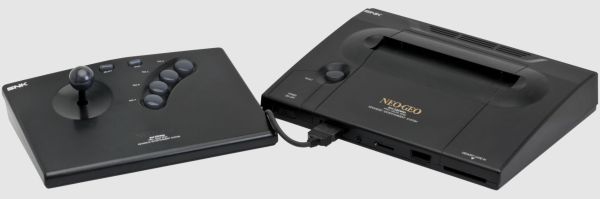
Perhaps the most ridiculous statement that anyone can make is that a computer system with clearly enough processing power ‘cannot run DOOM‘. This is why we accept the premise that a PDP-11 cannot run this game, but something on the order of a Neo Geo gaming console with its 68000 processor and for the time impressive GPU definitely ought to be able to.

The stated problem here is a lack of RAM for a framebuffer, with the CPU only having 64 kB to play with. This limitation now has seen two different approaches to try and circumvent it, as covered by [Modern Vintage Gamer].

The first project here is Doom64kB, which as the name suggests tries to somehow work with this system RAM limitation. It uses the Doom8088 port for the original IBM PC and similar Intel 8088-based systems. This had to massively reduce the feature list, including the lack of texture mapping for floors and ceiling, no saving or loading, and no music.

The other project is DoomGeo, which doesn’t try to bend the Neo Geo hardware to its will, but accepts the Neo Geo way of doing things: involving sprite strips, pre-baked graphics, fix-layer UI, and a minimum of runtime data. This of course drastically changes how the Doom game engine normally works, with its framebuffer-based rendering.

From this we can thus conclude that it’s not so much the processing power that limits where DOOM can run, but more of how framebuffer-friendly the system architecture is, yet with some ingenuity and a complete rewrite of the game engine even that is no major obstacle.

(Top image: Neo Geo AES console. Credit: Evan-Amos, Wikimedia)

Continue reading “The Neo Geo Does Run DOOM After All” →