Image

The Big Moon Plot

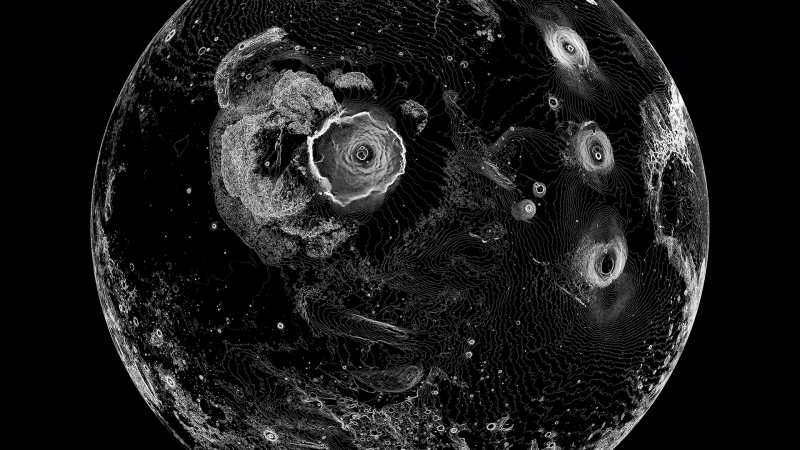
When you look into the night sky, you can’t help but wish to bring the outer worlds to your doorstep. One of the best ways to do that is to photograph the Moon’s surface to display in a frame. However, [Sebastian Lague] found a simple image too lackluster compared to something with a bit more style, such as a plotted image of the lunar terrain.

Why plotting? Well, the Moon is not defined in the same way with contrasting colors as Earth is. The Moon is peppered with craters and differing elevations that separate regions, so why not build an entire DIY plotter from scratch? [Sebastian Lague] did exactly this with a custom algorithm to take the elevation maps and create vector drawings which are plotted on his custom plotter.

Continue reading “The Big Moon Plot” →

Image

That’s No Moon… That’s An Exoplanet!

It wasn’t that long ago that a science teacher would have told students that there was no evidence of planets around other star systems. Even more recently, they might have said that while we’ve seen evidence of extra-solar planets, we would never be able to see them directly. But that’s all changed. [Jason Wang] has several videos that use images taken over years to visualize the orbit of several large exoplanets.

Of course, some extrapolation is involved. According to [Jason]:

We unfortunately do not have the luxury of watching these planets every night and record them. However, these planets move slowly, with orbital periods at least decades long, and predictably following Kepler’s laws. We can use a technique called motion interpolation to reconstruct what the image should look like using images taken before and after the date we are interested in. Motion interpolation is a technique commonly found in video editing and in modern TVs.

You have to be a patient photographer, apparently. One video has 30 images taken over 17 years, for example. Another has 10 images from the Keck Observatory taken over 12 years.

The work has fed scientific papers like this one or this one. While it might be more fun to see these star systems from the bridge of your favorite starship, this is probably as close as you are going to get.

We find both the prospect of exoplanets and the technology used to find them exciting

Image

Roman Telescope Saves Fuel, Doubles Mission

Contemplate the events that might end a space mission, and you might picture something dramatic: detonation on the pad, a dead guidance system, or micrometeoroids shattering delicate solar panels. More often, though, the ending is far more mundane. Plenty of perfectly healthy spacecraft have been retired simply because the fuel tanks ran dry. That’s why mission planners guard every kilogram of go juice so jealously, and why careful preparation in a mission is critical to long-term success.

Which brings us to NASA’s Nancy Grace Roman Space Telescope. Barely two weeks after its August 30 launch on a Falcon Heavy, the mission team announced that Roman now has enough fuel for at least 22 years of science operations. That’s well over double its original 10-year fuel budget. It’s a huge gain, so let’s explore how NASA pulled it off.

Continue reading “Roman Telescope Saves Fuel, Doubles Mission” →

Image

After Decades, NASA May Finally Replace Mars Relays

We’ve yet to find any definitive evidence that there’s biological life on present-day Mars, but to say it’s a dead planet isn’t exactly accurate. Since the first Viking lander touched down in 1976, a revolving cast of humanity’s robotic envoys have worked on and around the Red Planet — and as access to space becomes cheaper and more routine, the mechatronic population of Mars will continue to grow.

Given the number of landers, rovers, and orbiting spacecraft that have been sent to study Mars over the last 50 years, you might be surprised to find that the communications systems in place to transmit all that critical scientific data back to Earth aren’t nearly as robust as you’d think. While it’s understandable that the first craft to arrive at Mars had to operate in isolation, even the flagship Perseverance and Curiosity rovers carry their own high-gain radio systems so they can communicate directly with Earth. Given the incredible premium put on the mass of an interplanetary craft, each mission that needs to bring along its own link back to Earth effectively reduces its payload of much scientific equipment.

It’s not that satellites in orbit around the planet aren’t used to relay signals between Martian ground assets and their controllers back on Earth. In fact these relay links are used extensively for bandwidth-intensive tasks such as image transfers. But it’s also true that the craft currently available to act as intermediaries between the two planets aren’t terribly well suited to the task. The current fleet of Mars orbiters were conceived primary as research vehicles, and so every decision regarding their design and positioning around the planet was made with that goal in mind. What relatively limited capability they do have as communication relays is further hindered by the age of their hardware.

But after decades of false starts and shifting budgets, NASA is closer than ever to finally establishing the Mars Telecommunications Network, a dedicated high-bandwidth communication relay that will ensure current and future missions always have a way to phone home.

Continue reading “After Decades, NASA May Finally Replace Mars Relays” →

Image

Searching For Dark Matter With A Levitating Magnet

Much of science is performed through inference, with the readings on instruments, a flash of light in heavy water, or the results of parsing through terabytes of sensor data after a particle accelerator collision either backing up a proposed scenario or weakening its foundations.

Image

In the case of so-called dark matter, this is even more relevant, as we are talking about a proposed form of matter whose most pertinent feature is that it doesn’t interact with anything else except through gravity. This is where the wiggling of a levitating magnet may be the key to detecting it.

In this experimental setup by Rice University and Dutch researchers at the Leiden Institute, a tiny permanent magnet the size of a grain of sand is levitated above a superconductor, surrounded by highly sensitive detectors that should be able to spot even minuscule movements. So far, they have collected a month’s worth of data, with no conclusive results yet.

Even if they don’t detect any ‘knocks’ on this tiny levitating magnet, it will still help refine existing models of what dark matter’s properties might be. For the next phase of this research, they’ll add more of these sensors, which will also make it easier to distinguish background noise from any unusual readings.

We’ve previously talked about [Vera Ruben]’s contributions to the hunt for dark matter and the mysteries that prompted the idea that it might exist.

Image

Re-creating NASA’s Heat Shield Problem

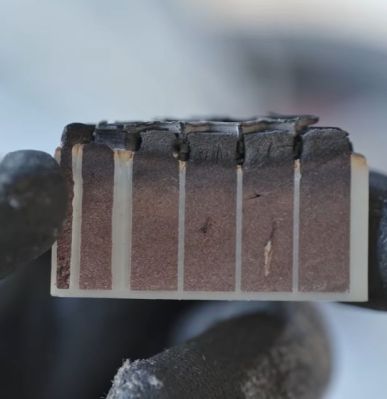
ImageAfter the Orion capsule of the Artemis I lunar mission returned to Earth, it was found that massive chunks of its heatshield had been ripped off, posing a serious risk to any future missions. In a recent video in which [polymatt] takes a break from repairing old laptop shells and the like, he tries to recreate the Orion’s heatshield using a variety of methods and materials.

For this test a number of samples were created, each using the same kind of segmented structure as the larger Orion heatshield. The filler was created from the published materials for the heat shield by NASA, requiring just serious mixing.

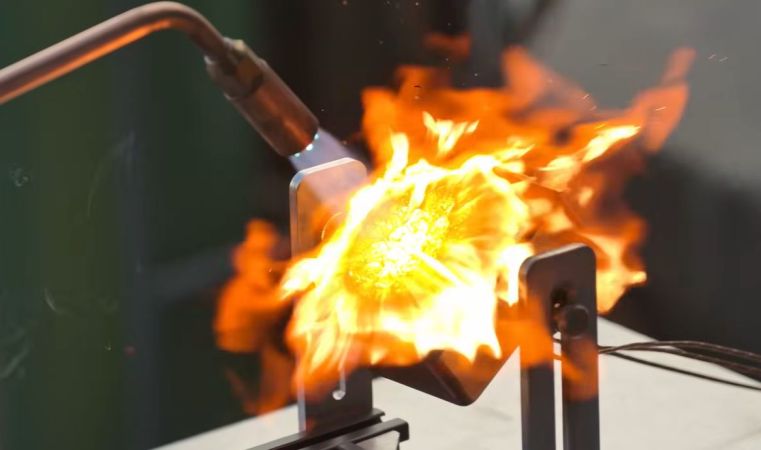
The resulting samples were then cured with thermocouples inserted, before they got blasted with the heat from a propane torch, trying to simulate the various re-entry patterns.

Perhaps unsurprisingly, the results matched the findings by NASA for why the Orion’s heat shield had failed, being the build-up of gases due to the sustained pyrolysis processes that eventually fractured the material. Despite some experimental flaws that injected residual heat from the copper structure, this still seems to be a pretty good setup to test ablative heat shields in DIY lab conditions.

Continue reading “Re-creating NASA’s Heat Shield Problem” →

Image

The Heavy Disco-Ball Satellite Designed To Do… Nothing

Launched in 1976, LAGEOS-1 (LAser GEOdynamic Satellite) is unusual in that it contains no instrumentation, no electronics, no power supply, and no means of propulsion. It’s spherical, weighs just under 407 kg, and looks a bit like a disco ball. It may not be accurate to say it does nothing, but unlike most satellites its role is entirely passive. It’s also one of the oldest scientific satellites still in service.

ImageThe lens-like objects covering the surface of LAGEOS-1 are corner cube retroreflectors, which have the nifty effect of always reflecting incident light right back towards its source.

Ground stations fire short laser pulses at it and measure the time it takes for the light to return, a form of time-of-flight ranging. Since LAGEOS-1’s orbit is highly stable, it provides a reliable reference point for measuring even tiny changes in the Earth itself. The size, shape, rotation, and more of our planet can be measured as a result. LAGEOS data (LAGEOS-2 was launched in 1992) has also been used in tests of general relativity.

Its orbit and construction were deliberately chosen so that atmospheric drag and other disturbances would be minimal. The simple, maintenance-free design combined with an extraordinarily stable orbit means LAGEOS is expected to circle our world for millions of years to come.

LAGEOS-1 also contains a message to the future in the form of two identical plaques prepared by Dr. Carl Sagan just in case there’s anyone around to find it some day. Check out the short 1975 video from NASA, embedded just below.

Continue reading “The Heavy Disco-Ball Satellite Designed To Do… Nothing” →