Web, Plugin
Crypto payment plugin development for a European crypto ecosystem


About the project
A Europe-based company actively expanding their crypto ecosystem reached out to Dinarys to develop a custom cryptocurrency payment plugin for popular ecommerce platforms and content management systems (CMSs), aiming to expand their crypto product ecosystem and make digital currency easier to accept for merchants worldwide.
Our task was to:

design and deliver a plugin that was secure, scalable, and easy to adopt without sacrificing compatibility or user experience

create a product that would support multi-cryptocurrency payments, integrate smoothly into native checkout flows, and meet high standards for documentation so that merchants could install and configure it in less than a day or choose it as a ready-to-use payment option from a CMS catalog

prepare the plugin and assume responsibility for its verification on the client’s chosen ecommerce marketplaces
More details on the project
Our client (NDA) is a Europe-based (specifically, operating across MACH and Nordic regions) crypto payments ecosystem that provides a crypto payment gateway; business wallets; and OTC desk, hot wallet, and SaaS services.
Jump to the stage of collaboration that interests you most:
Discovery and alignment:
Which ecommerce platforms and CMSs are the most suitable for the client’s business strategy?
Before writing a single line of code, we had to answer a fundamental question:
Which ecommerce and CMS platforms should the crypto payment plugin support first to deliver the most value and gain quick acceptance among stores?
This stage was not about building a store from scratch — it was about understanding the intersection between the client’s business strategy and the technical realities of crypto payment integrations. Our goal was to ensure that the first release would cover the platforms with the highest compatibility, user base relevance, and ROI potential.
We conducted a full-scale analysis of both CMSs and ecommerce markets, factoring in:

Market share &
adoption trends:
We focused on platforms with large, active merchant bases to maximize plugin reach.

Technical
openness:
We considered API availability, extension architecture, and flexibility for payment gateway integrations.

Regional and
industry relevance:
We looked for platforms that aligned with the client’s target geographies and merchant profiles.

Integration
complexity:
Potential blockers included rigid hosted solutions, strict payment policies, and lack of crypto-friendly tooling.

Based on this assessment, we created a shortlist of priority platforms where the crypto plugin could be both technically feasible and strategically impactful.
Each entry on the list came with a clear rationale — whether it was Magento’s flexibility for advanced merchants, WooCommerce’s large SMB market, or BigCommerce’s growing midsize merchant base and open API architecture.

CMSs:
Drupal, Joomla, Magento, OpenCart, PrestaShop, WordPress

ECOMMERCE PLATFORMS:
Magento, BigCommerce, WooCommerce, Squarespace, Shopware, Webflow, Duda
We presented the shortlist to the client, along with:
Advantages and risks
for each platform
Expected integration
effort for the first release
Roadmap recommendations
for future platform coverage

“A big part of our job in the discovery phase was avoiding wasted development effort on platforms where crypto support might get blocked by policy or technical limitations. This let us focus resources on platforms where the plugin could thrive, be maintained easily, and pass marketplace reviews without endless rework.”

Roman Fesko
CTO at Dinarys
Need professional assistance evaluating potential platforms for your product?
Our Chief Technology Officer will consult on business and technical nuances of different platforms. During the free consultation, we will:
Need professional assistance evaluating potential platforms for your product?
Our Chief Technology Officer will consult on business and technical nuances of different platforms. During the free consultation, we will:
01
Analyze platform fit for your product
02
Identify hidden technical risks and costs
03
Recommend a roadmap for implementation

Development process:
From concept to multi-platform launch
When our client approached us with the idea of enabling cryptocurrency payments for ecommerce stores across multiple platforms, we knew from the start that this project would require more than just coding a payment gateway. The plugin had to be secure, compliant, highly compatible, and easy to integrate for merchants without deep technical expertise.
We structured the project into clear stages to ensure we covered every technical and business-critical aspect:
Stage #1
Requirements gathering and technical architecture design
We started with a deep analysis of the client’s goals and the capabilities of target CMS and ecommerce platforms: Drupal, Joomla, Magento, OpenCart, PrestaShop, WordPress, BigCommerce, WooCommerce, Squarespace, Shopware, Webflow, and Duda.
Our architects then designed a modular architecture — the payment logic remained platform-independent, while integration layers adapted to each system’s API and payment flow.
Our approach to cost‑efficient
development in action:
Instead of developing separate codebases from scratch for each platform, we created a shared core library for encryption, transaction handling, and blockchain API communication. This drastically reduced future maintenance costs and made adding new platforms faster.
Stage #2
Security-first development
Given the nature of cryptocurrency transactions, security was a top priority. We implemented:

End-to-end encryption
for payment data

Hash-based Message Authentication Code (HMAC)-based request validation to prevent tampering
Stage #3
API-based integration with the client’s crypto platform for payment data exchange
We focused on establishing a reliable connection between ecommerce platforms and the client’s crypto payment API.
This included:

Sending payment requests from the store checkout to the API

Receiving transaction status updates and reflecting them in the store’s order system

Ensuring error handling and proper rollback if a payment failed
Stage #4
Cross-platform UI/UX development
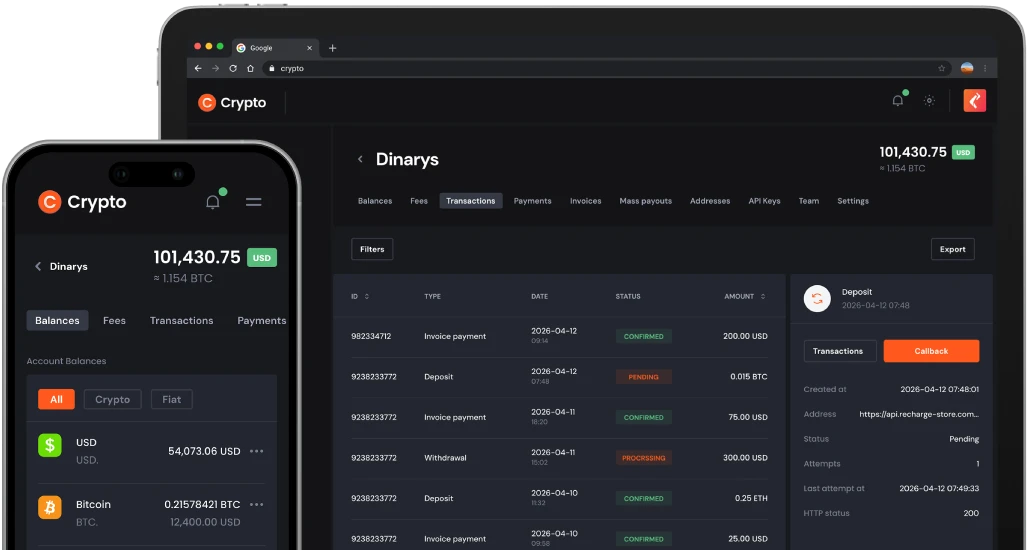
Instead of creating custom dashboards, we relied on native admin panel elements of each platform. This approach ensured that the plugin felt familiar to merchants and minimized the learning curve.
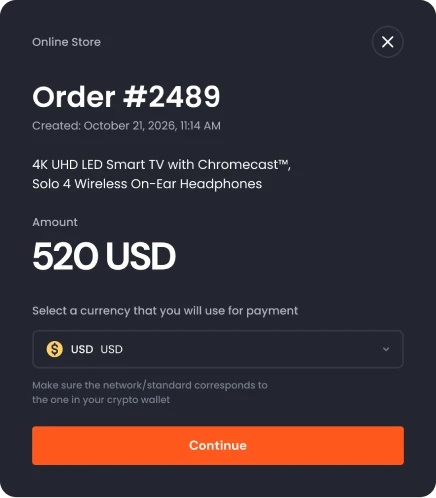
Merchants could configure API keys, payment options, and currencies directly through settings designed according to each platform’s standards, as well as manage and monitor invoices, transaction histories, and statuses via a user-friendly interface:

Stage #5
Testing and compliance checks
Testing focused specifically on crypto payment workflows rather than general QA processes. Our team conducted:

End-to-end payment simulations

Order flow validation
ensuring statuses updated correctly when payments were confirmed, pending, or failed

Platform-specific checks
to verify that the plugin worked smoothly across Magento, Opencart, PrestaShop, and WooCommerce

Edge case testing
for scenarios such as cancelled payments, incorrect wallet addresses, or expired transactions
Stage #6
Deployment and merchant onboarding
Once testing was complete, we helped the client navigate the verification process for the official marketplaces of the supported platforms (Magento Marketplace, Opencart Extension Store, PrestaShop Addons Store, WooCommerce Marketplace). After successful approvals, we published the plugin and provided extensive onboarding materials, plus live support for early adopters.
Development outcome:
The plugin now powers cryptocurrency payments for merchants in multiple regions, enabling them to attract new customer segments, reduce transaction fees compared to traditional processors, and future-proof their checkout process in light of the growing adoption of digital assets.
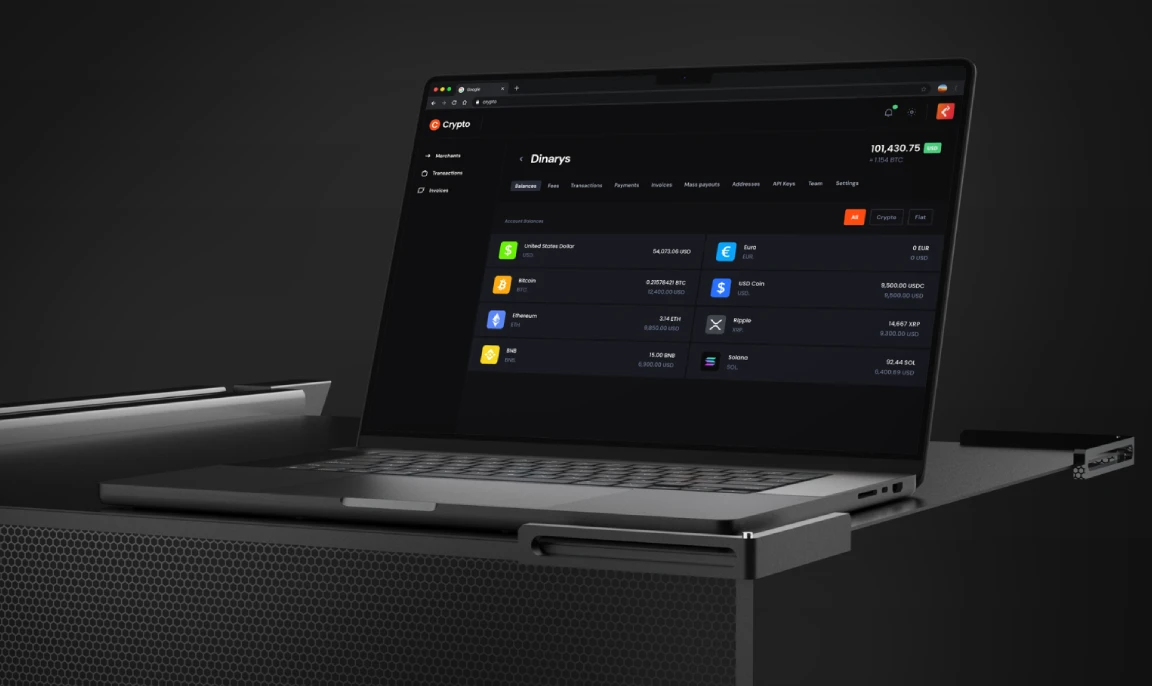
Order confirmation form example
Solving the plugin review and version adjustment challenges
One of the biggest technical hurdles came during adaptation of the plugin for different platform versions. Even minor version updates often introduced significant changes that required substantial time to support.
Our team tackled this by setting up dedicated environments for each required version. The process involved:

Deploying version-specific environments
to replicate real-world conditions for each target version

Installing and testing the plugin
to identify compatibility issues early

Debugging and implementing version checks
adding conditional logic inside the plugin to detect the platform version and apply necessary fixes dynamically

Ensuring cross-version compatibility
fine-tuning the code so that one plugin build could run seamlessly across multiple versions

“Sometimes a minor version update would break more than a major one — especially in payment processing or API behavior. We decided early on to build intelligent version detection directly into the plugin. That decision paid off: instead of supporting five separate builds, we maintained one flexible solution that adjusted itself based on the platform version.”

Roman Fesko
CTO at Dinarys
Facilitating verification on chosen ecommerce marketplaces
Once development was complete, the next challenge was getting the plugin listed on official ecommerce marketplaces. This step was just as demanding as the coding itself: every platform had its own rules, guidelines, and approval procedures, and each required a mix of technical accuracy and clear communication.

Magento Marketplace
For Magento Marketplace, the bar was especially high. Our team had to meet strict code quality standards, undergo a security validation process, and prepare extensive documentation before the extension could even be considered.

Opencart Extension Store
With OpenCart, the review was more about compatibility. We had to show that the plugin installed cleanly across multiple versions, adhered to file structure rules, and didn’t interfere with the platform’s core functionality.

PrestaShop Addons Store
PrestaShop placed equal weight on the technical and user-facing sides: beyond passing technical checks, we needed to provide screenshots, merchant-friendly documentation, and detailed feature descriptions that would make sense even to non-technical users.

WooCommerce Marketplace
When it came to WooCommerce, the requirements leaned heavily on WordPress coding standards and secure handling of API requests. GDPR compliance also came into play, and we needed to provide a working demo environment to validate everything.
Have a marketplace verification process ahead and can’t afford to fail?
Request a professional consultation from our CTO and get a clear roadmap to pass verification successfully with:
Have a marketplace verification process ahead and can’t afford to fail?
Request a professional consultation from our CTO and get a clear roadmap to pass verification successfully with:
Roman Fesko
CTO at Dinarys
01
Platform-specific preparation:
Align your plugin or app with platform requirements
02
A technical validation checklist:
Identify security, performance, and compatibility tests that must be passed before submission
03
Documentation and support readiness:
Get guidance on crafting merchant-friendly installation guides
Joining forces with the client’s business analysts to deliver full plugin documentation
We worked closely with the client’s business analysts to produce exhaustive documentation covering every aspect of the plugin’s functionality and lifecycle. The goal was to make the documentation a single, reliable reference for anyone involved in using, maintaining, or updating the solution.
It included:

Detailed
specifications review
A full breakdown of plugin features, supported cryptocurrencies, payment flows, and integration logic for each supported ecommerce/CMS platform

Technical
architecture
Setup instructions, compatibility notes for different platform versions, and architecture diagrams

Release
records
Complete version history, changelogs, and submission details for publishing on marketplaces
Support and
maintenance guidelines
Steps for troubleshooting, adapting to platform updates, and ensuring long-term operability
“We aimed to make the documentation so thorough that
it could serve as a blueprint for development, maintenance, and scaling —
even years down the line.”

Karina Khomutova
PMO and Project Manager at Dinarys
Results:
Contributing to mainstream digital currency adoption while expanding the B2C customer base
Rolling out a multi-platform crypto payment plugin wasn’t just a technical win — it gave merchants a simple, secure way to offer cryptocurrency payments to a much wider audience. The result was faster adoption of digital currencies in everyday ecommerce and a clear competitive advantage for our client’s B2C expansion.
Technical Results

Multi-platform readiness:
The plugin was successfully deployed on all targeted CMS and ecommerce platforms, with a single codebase supporting different APIs and payment flows.

Rapid installation:
Documentation and the setup process were clear enough for merchants to integrate the plugin in 1 business day without external help.

Scalable architecture:
The shared core library allows for updating API integrations in hours instead of weeks.
Business Results

Faster merchant onboarding:
Marketplace verification and ready-to-use documentation enabled smooth onboarding, cutting go-live time by up to 50%.

Expanded customer base:
Merchants reported attracting new buyers from crypto-friendly regions and communities, increasing order volume in the first months after launch.

Competitive differentiation:
Merchants can market themselves as early adopters of digital currency payments, appealing to tech-savvy and high-spending audiences.
“We deeply value the trust our client placed in us to deliver such a complex and sensitive product. Building a multi-platform crypto payment plugin that could withstand strict marketplace verification required true partnership and transparency on both sides.
Thanks to that collaboration, we didn’t just deliver a working solution — we helped open the door for more merchants worldwide to confidently adopt digital currencies in their everyday business.”

The Dinarys Team
Ready to bring your
payment solution to market?
Our team will help you navigate the full cycle:

Ready to bring your
payment solution to market?
Our team will help you navigate the full cycle:
Whether you need to build from scratch, modernize your current solution, or simply avoid pitfalls in distribution, we can guide you with technical expertise and a proven track record.
01
Discovery and architecture
to align business goals with technical requirements
02
Development and integration
to build a secure, modular solution that works across leading ecommerce platforms
03
Testing and validation
to guarantee smooth performance before release
04
Marketplace verification
to prepare for and pass strict review processes
05
Launch and long-term support
to ensure merchants can adopt your solution quickly
More projects to discover
ConnectPay
Creating payment modules for marketplaces
-
Developing new payment modules and enabling their management through the admin panel
-
Ensuring proper interaction between modules and the client’s APIs
-
Providing guides and instructions for configuring and managing modules on Magento and Shopware


Budu Sushi
Integrating online ordering and payment systems
-
Developing an online ordering system to enable customers to place orders directly on the website
-
Ensuring convenient and secure payment methods
-
Designing a responsive interface for seamless ordering and payment on web and mobile

Kontakt Home
Migrating to a newly build Magento-based CMS
-
Building custom frontend CMS functionality using React capabilities, with Magento as the API
-
Creating an admin panel, order management and processing system, and other core modules from scratch
-
Integrating the client’s system with third-party tools such as ERP software, 1C frameworks, and a credit calculator
