Image

BornHack Radio 102.8 FM, Playing Radio At A Hacker Camp

Over the years I have been to many hacker camps and done a lot of very cool things, but BornHack 2026 brought me something entirely new: Radio. By which I don’t mean radio in terms of amateur radio, LoRa, or whatever, but Radio. Broadcast radio, because the camp had a special event FM radio station for the first time. And because in a previous life I spent an inordinate amount of time in my university’s student radio station and have the Radio Voice to prove it, I was totally there for it.
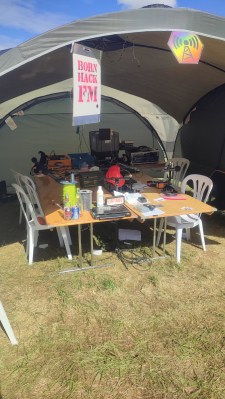
A view of a tent shelter in bright sunlight with studio equipment visible on a table in it. There's a sign: "BornHack FM".
The BornHack Radio nerve centre.

For a hacker camp, one of the special things about BornHack Radio was unexpected, that it was entirely analogue. No online streams, the only broadcast was over the air, 5 watts ERP from a vertical antenna stuck on a mast at the highest point of the Hylkedam scout camp site. I don’t know whether any of the residents of the isle of Funen listened, or what they made of it, but it certainly reached as far as the two closest towns.

The other unexpected feature of the station was that it had no music licensing. Personally I viewed this as an asset, because it forced the programming to be hacker-focused rather than suit the musical tastes of whichever people are enthusiastic enough to be DJs. I sincerely hope they don’t get a music licence at future events, speech-only gives it a special quality.

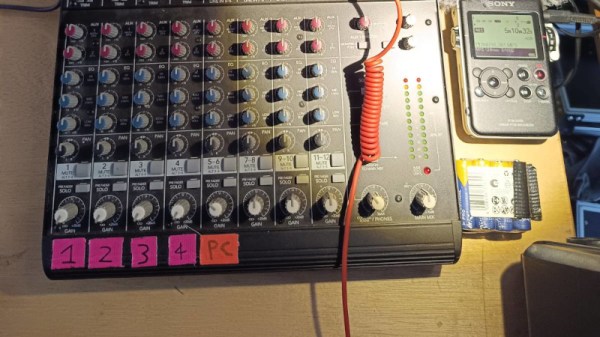
The studio for an analogue station like this one can be surprisingly simple, in that it’s a mixing desk to bring all the different microphones and other inputs together and set the levels, and not a lot else. the whole thing was in a Coleman shelter on the main drag through the camp, so as studios go it could have been quieter. Programming varied from talk shows through interview shows, a live feed from the speaker tent — is this the first ever Hacker Jeopardy broadcast? — and a beautifully done robotic numbers station which I suspect may also have been part of one of the on-camp games.

I brought two shows to the airwaves, both recorded, the first of which was a BornHack take on the Hackaday Podcast format, and the second a half-hour roving interview show. I believe I may be the first person ever to live-commentate a pixelflood screen in the style of Formula One coverage.

ImageThe thing that struck me most in my first foray into radio journalism was how straightforward it was. Wander the camp with microphone (complete with fluffy windshield and 3D-printed Hackaday cube), drop the results into Audacity, and a remarkably straightforward editing process compared to video. Last time I did this it involved 1/4″ tape and a razor blade.

So that was BornHack Radio, a new experience at a hacker camp both for those of us who ventured forth on the airwaves, and I hope also for the listeners. A format in which the live shows disappeared into the aether rather than having an online afterlife gave the whole thing a freedom rarely found in 2026. I really hope this isn’t the last time I break out the fluffy microphone at a hacker camp.

Thanks to [⁨Morel Sourvalley⁩] for the images.

Image

UDP Broadcasting And The Joys Of IPv4 Subnetting

In the previous installment on UDP broadcasting and service discovery, the basics of both were explored, including an implementation in the form of NyanSD and its protocol. Contained in the comment section was a very good demonstration of why one of the most exciting aspects of software development is the opportunity to share your latest creations with other people. This being the ability to get solid feedback on all the points – including any potential boneheaded omissions – that you really should address, whether intentional or accidental.

The most pertinent point raised was definitely that of broadcast addresses and IPv4 subnets, with the latter topic especially being something that the sysadmins at the office would talk about all the time, but which us software developers were always happy to ignore as something that didn’t concern us. Turns out the joke was on me and everyone else – like our esteemed readers – who thought that they could escape the fascinating world of subnets, as today we’ll take an in-depth look at what subnets are and how they are relevant to the world of UDP network discovery.

I somewhat alluded in the first article to the topic of ‘which broadcast address to use’ as being somewhat of a rough topic to figure out, which is clearly why I just stuck to a blatantly ‘works for me’ /24 subnet that usually will work on networks, until it does not.

Continue reading “UDP Broadcasting And The Joys Of IPv4 Subnetting”

Image

Soviet Wired Radio, How It Worked

At the height of the Cold War, those of us on the western side of the wall had plenty of choice over our radio listening, even if we stuck with our country’s monolithic broadcaster. On the other side in the Soviet Union, radio for many came without a choice of source, in the form of wired radio systems built into all apartments. [Railways | Retro Tech | DIY] grew up familiar with these wired radios, and treats us to a fascinating examination of their technology, programming, and ultimate decline.

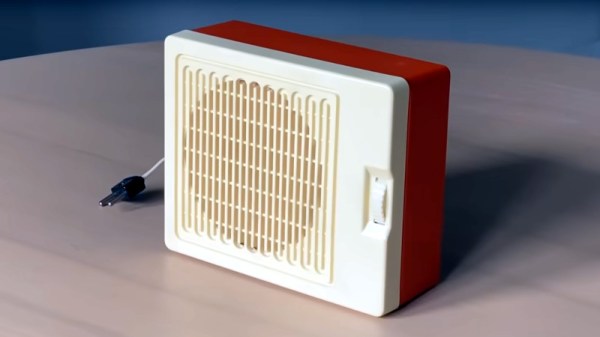
In a Soviet apartment, usually in the kitchen, there would be a “Radio” socket on the wall. Confusingly the same physical dimension as a mains socket, it carried an audio signal. The box which plugged into it was referred to as a radio, but instead contained only a transformer, loudspeaker, and volume control. These carried the centralised radio station, piped from Moscow to the regions by a higher voltage line, then successively stepped down at regional, local, and apartment block level. A later refinement brought a couple more stations on separate sub-carriers, but it was the single channel speakers which provided the soundtrack for daily life.

The decline of the system came over the decades following the end of communism, and he describes its effect on the mostly older listenership. Now the speaker boxes survive as affectionate curios for those like him who grew up with them.

You probably won’t be surprised to find twisted-wire broadcasting in use in the West, too.

Continue reading “Soviet Wired Radio, How It Worked”

Hackaday Links Column Banner

Hackaday Links: June 9, 2024

We’ve been harping a lot lately about the effort by carmakers to kill off AM radio, ostensibly because making EVs that don’t emit enough electromagnetic interference to swamp broadcast signals is a practical impossibility. In the US, push-back from lawmakers — no doubt spurred by radio industry lobbyists — has put the brakes on the move a bit, on the understandable grounds that an entire emergency communication system largely centered around AM radio has been in place for the last seven decades or so. Not so in Japan, though, as thirteen of the nation’s 47 broadcasters have voluntarily shut down their AM transmitters in what’s billed as an “impact study” by the Ministry of Internal Affairs and Communications. The request for the study actually came from the broadcasters, with one being quoted in a hearing on the matter as “hop[ing] that AM broadcasting will be promptly discontinued.” So the writing is apparently on the wall for AM radio in Japan.

Continue reading “Hackaday Links: June 9, 2024”

Image

AM Radio Broadcast Uses Phasor To Let Eight Towers Spray One Big Signal

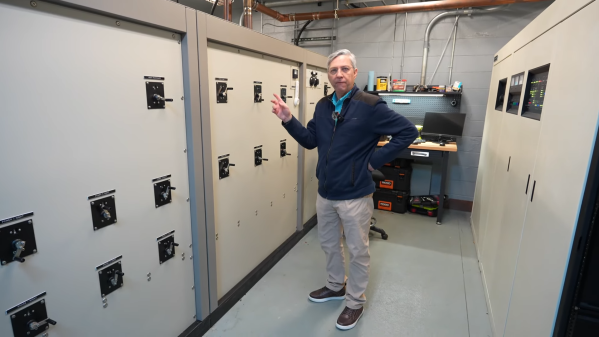
If you’re in the commercial AM radio business, you want to send your signal as far and wide as possible. More listeners means you can make more ad revenue, after all. [Jeff Geerling] recently visited a tower site for WSDZ-AM, which uses a full eight towers to broadcast its 20kW AM signal. To do that, it needs a phasor to keep everything in tune. Or, uh… phase.

The phasor uses a bunch of variable inductors and capacitors to manage the phase of the signal fed to each tower. Basically, by varying the phase of the AM signal going to each of the 8 transmitter towers, it’s possible to tune the directionality of the tower array. This allows the station to ensure it’s only broadcasting to the area it’s legally licensed to do so.

The tower array is also configured to broadcast slightly differently during the day and at night to account for the differences in propagation that occur. A certain subset of the 8 towers are used for the day propagation pattern, while a different subset is used to shape the pattern for the night shift. AM signals can go far farther at night, so it’s important for stations to vary their output to avoid swamping neighbouring stations when the sun goes down.

[Jeff’s] video is a great tour of a working AM broadcast transmitter. If you’ve ever wondered about the hardware running your local commercial station, this is the insight you’re looking for. AM radio may be old-school, but it continues to fascinate us to this day. Video after the break.

Continue reading “AM Radio Broadcast Uses Phasor To Let Eight Towers Spray One Big Signal”

Image

FM Radio, The Choice Of An Old Generation

Had the pandemic not upended many of this summer’s fun and games, many of my friends would have made a trip to the MCH hacker camp in the Netherlands earlier this month. I had an idea for a game for the event, a friend and I were going to secrete a set of those low-power FM transmitters as numbers stations around the camp for players to find and solve the numerical puzzles they would transmit. I even bought a few cheap FM transmitter modules from China for evaluation, and had some fun sending a chiptune Rick Astley across a housing estate in Northamptonshire.

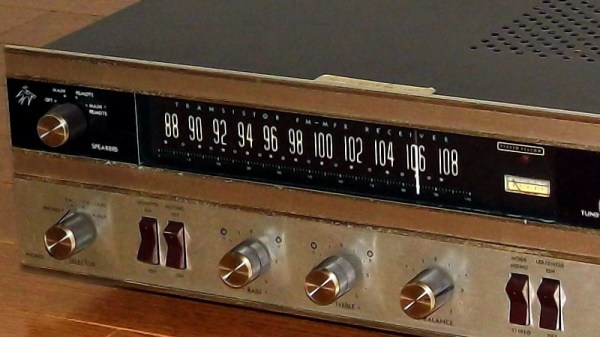
To me as someone who grew up with FM radio and whose teen years played out to the sounds of BBC Radio 1 FM it made absolute sense to do a puzzle in this way, but it was my personal reminder of advancing years to find that some of my friends differed on the matter. Sure, they thought it was a great idea, but they gently reminded me that the kids don’t listen to any sort of conventional broadcast radio these days, instead they stream their music, so very few of them would have the means for listening to my numbers stations. Even for me it’s something I only use for BBC Radio 4 in the car, and to traverse the remainder of the FM dial is to hear a selection of easy listening, oldies, and classical music. It’s becoming an older person’s medium, and it’s inevitable that like AM before it, it will eventually wane.

There are two angles to this that might detain the casual hacker; first what it will mean from a broadcasting and radio spectrum perspective, and then how it is already influencing some of our projects.

Continue reading “FM Radio, The Choice Of An Old Generation”

Image

Philo Farnsworth, RCA, And The Battle For Television

The parenthood of any invention of consequence is almost never cut and dried. The natural tendency to want a simple story that’s easy to tell — Edison invented the light bulb, Bell invented the telephone — often belies the more complex tale: that most inventions have uncertain origins, and their back stories are often far more interesting as a result.

Inventing is a rough business. It is said that a patent is just a license to get sued, and it’s true that the determination of priority of invention often falls to the courts. Such battles often pit the little guy against a corporate behemoth, the latter with buckets of money to spend in making the former’s life miserable for months or years. The odds are rarely in the favor of the little guy, but in few cases was the deck so stacked against someone as it was for a young man barely out of high school, Philo Farnsworth, when he went up against one of the largest companies in the United States to settle a simple but critical question: who invented television?

Continue reading “Philo Farnsworth, RCA, And The Battle For Television”