Image

BornHack Radio 102.8 FM, Playing Radio At A Hacker Camp

Over the years I have been to many hacker camps and done a lot of very cool things, but BornHack 2026 brought me something entirely new: Radio. By which I don’t mean radio in terms of amateur radio, LoRa, or whatever, but Radio. Broadcast radio, because the camp had a special event FM radio station for the first time. And because in a previous life I spent an inordinate amount of time in my university’s student radio station and have the Radio Voice to prove it, I was totally there for it.
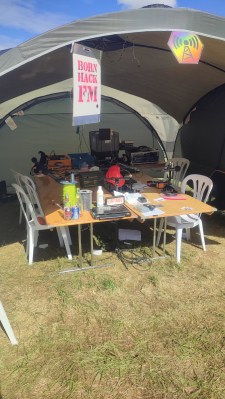
A view of a tent shelter in bright sunlight with studio equipment visible on a table in it. There's a sign: "BornHack FM".
The BornHack Radio nerve centre.

For a hacker camp, one of the special things about BornHack Radio was unexpected, that it was entirely analogue. No online streams, the only broadcast was over the air, 5 watts ERP from a vertical antenna stuck on a mast at the highest point of the Hylkedam scout camp site. I don’t know whether any of the residents of the isle of Funen listened, or what they made of it, but it certainly reached as far as the two closest towns.

The other unexpected feature of the station was that it had no music licensing. Personally I viewed this as an asset, because it forced the programming to be hacker-focused rather than suit the musical tastes of whichever people are enthusiastic enough to be DJs. I sincerely hope they don’t get a music licence at future events, speech-only gives it a special quality.

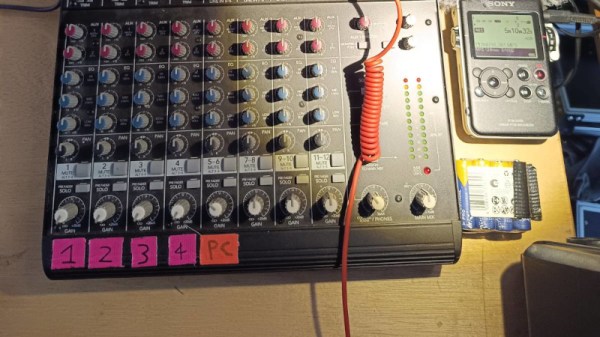
The studio for an analogue station like this one can be surprisingly simple, in that it’s a mixing desk to bring all the different microphones and other inputs together and set the levels, and not a lot else. the whole thing was in a Coleman shelter on the main drag through the camp, so as studios go it could have been quieter. Programming varied from talk shows through interview shows, a live feed from the speaker tent — is this the first ever Hacker Jeopardy broadcast? — and a beautifully done robotic numbers station which I suspect may also have been part of one of the on-camp games.

I brought two shows to the airwaves, both recorded, the first of which was a BornHack take on the Hackaday Podcast format, and the second a half-hour roving interview show. I believe I may be the first person ever to live-commentate a pixelflood screen in the style of Formula One coverage.

ImageThe thing that struck me most in my first foray into radio journalism was how straightforward it was. Wander the camp with microphone (complete with fluffy windshield and 3D-printed Hackaday cube), drop the results into Audacity, and a remarkably straightforward editing process compared to video. Last time I did this it involved 1/4″ tape and a razor blade.

So that was BornHack Radio, a new experience at a hacker camp both for those of us who ventured forth on the airwaves, and I hope also for the listeners. A format in which the live shows disappeared into the aether rather than having an online afterlife gave the whole thing a freedom rarely found in 2026. I really hope this isn’t the last time I break out the fluffy microphone at a hacker camp.

Thanks to [⁨Morel Sourvalley⁩] for the images.

Image

Receiving Radio Signals From Space Like It’s 1994

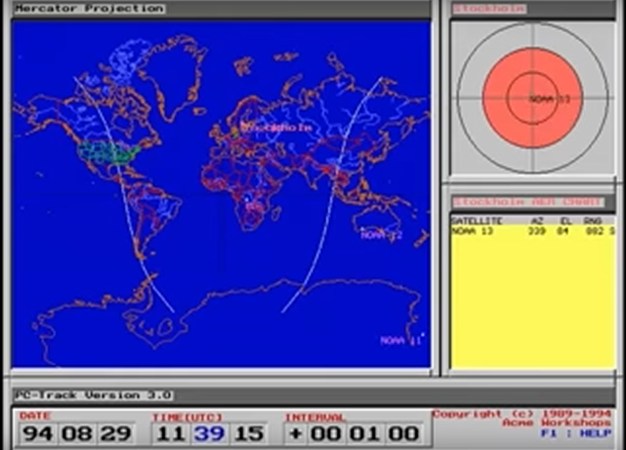
For certain situations, older hardware is preferred or even needed to accomplish a task. This is common in industrial applications where old machinery might not be supported by modern hardware or software. Even in these situations though, we have the benefit of modern technology and the Internet to get these systems up and running again. [Old Computers Sucked] is not only building a mid-90s system to receive NOAA satellite imagery, he’s doing it only with tools and equipment available to someone from this era.

Of course the first step here is to set up a computer and the relevant software that an amateur radio operator would have had access to in 1994. [Old Computers Sucked] already had the computer, so he turned to JV-FAX for software. This tool can decode the APT encoding used by some NOAA satellites without immediately filling his 2 MB hard drive, so with that out of the way he starts on building the radio.

ImageIn the 90s, wire wrapping was common for prototyping so he builds a hardware digitizer interface using this method, which will be used to help the computer interface with the radio. [Old Computers Sucked] is rolling his own hardware here as well, based on a Motorola MC3362 VHF FM chip and a phase-locked loop (PLL), although this time on a PCB since RF doesn’t behave nicely with wire wrap. The PCB design is also done with software from the 90s, in this case Protel which is known today as Altium Designer.

In the end, [Old Computers Sucked] was able to receive portions of imagery from weather satellites still using the analog FM signals from days of yore, but there are a few problems with his build that are keeping him from seeing perfectly clear imagery. He’s not exactly sure what’s wrong but he suspects its with the hardware digitizer as it was behaving erratically earlier in the build. We admire his dedication to the time period, though, down to almost every detail of the build. It reminds us of [saveitforparts]’s effort to get an 80s satellite internet experience a little while back.

Continue reading “Receiving Radio Signals From Space Like It’s 1994”

Image

Designing An FM Drum Synth From Scratch

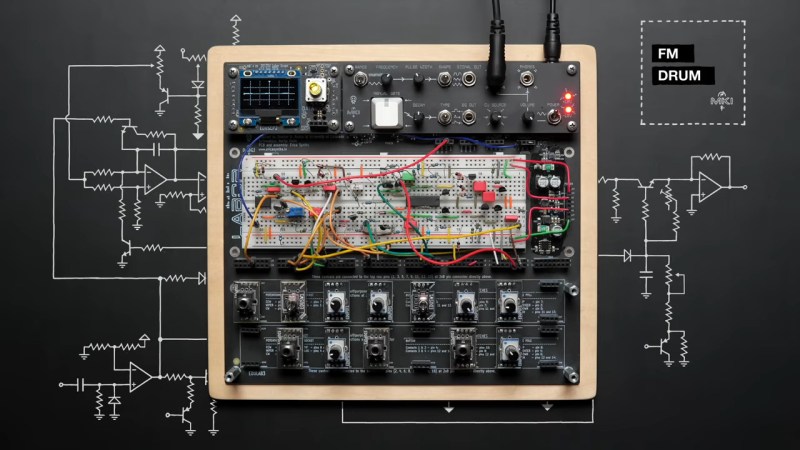
How it started: a simple repair job on a Roland drum machine. How it ended: a scratch-built FM drum synth module that’s completely analog, and completely cool.

[Moritz Klein]’s journey down the analog drum machine rabbit hole started with a Roland TR-909, a hybrid drum machine from the mid-80s that combined sampled sounds with analog synthesis. The unit [Moritz] picked up was having trouble with the decay on the kick drum, so he spread out the gloriously detailed schematic and got to work. He breadboarded a few sections of the kick drum circuit to aid troubleshooting, but one thing led to another and he was soon in new territory.

The video below is on the longish side, with the first third or so dedicated to recreating the circuits used to create the 909’s iconic sound, slightly modifying some of them to simplify construction. Like the schematic that started the whole thing, this section of the video is jam-packed with goodness, too much to detail here. But a few of the gems that caught our eye were the voltage-controlled amplifier (VCA) circuit that seems to make appearances in multiple places in the circuit, and the dead-simple wave-shaper circuit, which takes some of the harmonics out of the triangle wave oscillator’s output with just a couple of diodes and some resistors.

Once the 909’s kick and toms section had been breadboarded, [Moritz] turned his attention to adding something Roland hadn’t included: frequency modulation. He did this by adding a second, lower-frequency voltage-controlled oscillator (VCO) and using that to modulate the drum section. That resulted in a weird, metallic sound that can be tuned to imitate anything from a steel drum to a bell. He also added a hi-hat and cymbal section by mixing the square wave outputs on the VCOs through a funky XOR gate made from discrete components and a high-pass filter.

There’s a lot of information packed into this video, and by breaking everything down into small, simple blocks, [Moritz] makes it easy to understand analog synths and the circuits behind them.

Continue reading “Designing An FM Drum Synth From Scratch”

Image

Brush Up On Your Trade Craft With This Tiny FM Bug

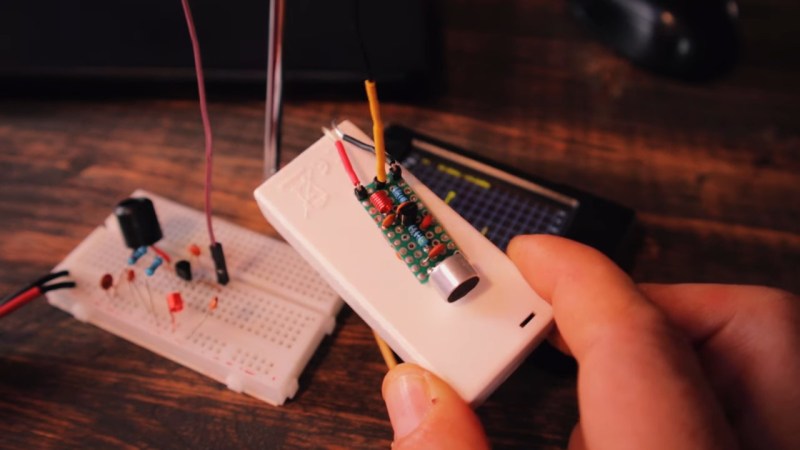
Would-be spooks and spies, take note: this one-transistor FM transmitter is a circuit you might want to keep in mind for your bugging needs. True, field agents aren’t likely to need to build their own equipment, but how cool a spy would you be if you could?

Luckily, you won’t need too many parts to recreate [Ciprian (YO6DXE)]’s project, most of which could be found in a decently stocked junk bin, or even harvested from e-waste. On the downside, the circuit is pretty fussy, with even minor component value changes causing a major change in center frequency. [Ciprian] had to do a lot of fiddling to get the frequency in the FM band, particularly with the inductor in the LC tank circuit. Even dropping battery voltage shifted the frequency significantly, which required a zener diode to address.

[Ciprian] ran a few tests and managed to get solid copy out to 80 meters range, which is pretty impressive for such a limited circuit. The harmonics, which extend up into the ham bands and possibly beyond, are a bit of a problem; while those could be addressed with a low-pass filter, in practical terms, the power of this little fellow is probably low enough to keep you from getting into serious trouble. Still, it’s best not to push your luck.

While you’re trying your hand at one-transistor circuits, you might want to try [Ciprian]’s one-transistor CW transceiver next.

Continue reading “Brush Up On Your Trade Craft With This Tiny FM Bug”

Image

A New Chinese Radio Breaks Cover, Is It Worth It?

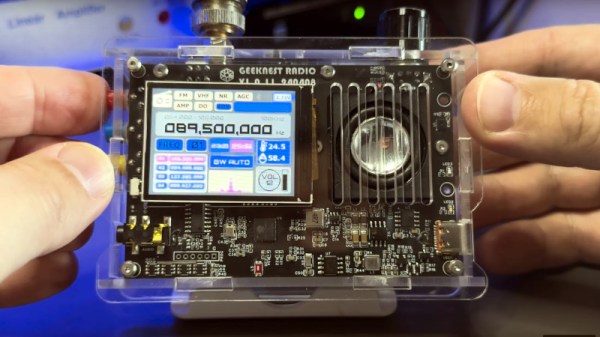
Scanning the firehose of new electronic kits and modules coming from the usual Chinese suppliers can be a rewarding experience, as sometimes among the endless breakout boards comes an item that looks interesting enough to try. As an example there’s a receiver kit being given a quick review by [Tech Minds], offering AM and HF multi-mode, FM broadcast, and air band alongside what appear to be digital streaming features.

Looking at it, though all the RF part is hidden under screening cans we’re guessing it might contain one of the Silicon Labs all-in-one receiver chips, but the whole appears to deliver a useful receiver with a comprehensive interface. The review isn’t quite technical enough so we can’t glean a lot more, but it looks as though it could be useful. We’d be tempted to snag one for review, but since with very few exceptions we pay for the stuff we review, it’s a mite expensive at $50+ for yet another radio.

There’s an ongoing question with all these cheap kits and modules though, first of all where did the design come from and are we freeloading on someone else’s hard work, but then whether or not what you’re getting is a knock-off using defective semiconductors or with bean-counting parts removal degrading performance. We’re guessing more will come out about this radio in due course, and we can all make our own judgement. Meanwhile this one can be found on AliExpress or Banggood, so take a look and see if you’re tempted.

Continue reading “A New Chinese Radio Breaks Cover, Is It Worth It?”

Image

Be Your Own DJ With QN8066 And An Arduino Library

The QN8066 is a fun little FM transmitter chip. It covers the full FM broadcast band and has built-in DSP. You would find this sort of part in car cell phone adapters before every vehicle included Bluetooth or an AUX port.  [Ricardo] has created an Arduino library to bring the QN8066 to the masses.

The chip is rather easy to use – control is handled with a common I2C interface. All the complex parts – Phase Locked Loop (PLL), RF front end, power management, and audio processing are all hidden inside. [Ricardo’s] library makes it even easier to use. One of the awesome features of the 8066 is the fact that it handles Radio Data System (RDS). RDS is the subcarrier datastream that allows FM stations to inject information like song title and artist into the signal. The data is then displayed on your radio screen.

You can find the source to [Ricardo’s] library on GitHub. Using it is as simple as picking it up from the Arduino IDE.

If you are looking for an RDS-enabled radio to test out your QN8066 design, you wouldn’t do too bad with this Gameboy cartridge receiver.

Click through the break for a video from [Ricardo] explaining his QN8066 design. Continue reading “Be Your Own DJ With QN8066 And An Arduino Library”

Hackaday Links Column Banner

Hackaday Links: July 7, 2024

Begun, the Spectrum Wars have. First, it was AM radio getting the shaft (last item) and being yanked out of cars for the supposed impossibility of peaceful coexistence with rolling broadband EMI generators EVs. That battle has gone back and forth for the last year or two here in the US, with lawmakers even getting involved at one point (first item) by threatening legislation to make terrestrial AM radio available in every car sold. We’re honestly not sure where it stands now in the US, but now the Swiss seem to be entering the fray a little up the dial by turning off all their analog FM broadcasts at the end of the year. This doesn’t seem to be related to interference — after all, no static at all — but more from the standpoint of reclaiming spectrum that’s no longer turning a profit. There are apparently very few analog FM receivers in use in Switzerland anymore, with everyone having switched to DAB+ or streaming to get their music fix, and keeping FM transmitters on the air isn’t cheap, so the numbers are just stacked against the analog stations. It’s hard to say if this is a portent of things to come in other parts of the world, but it certainly doesn’t bode well for the overall health of terrestrial broadcasting. “First they came for AM radio, and I did nothing because I’m not old enough to listen to AM radio. But then they came for analog FM radio, and when I lost my album-oriented classic rock station, I realized that I’m actually old enough for AM.”

Continue reading “Hackaday Links: July 7, 2024”