Showing posts with label corporate crime. Show all posts

Saturday, October 11, 2025

A SILENT FURY: The El Bordo Mine Fire, in case you wondered why Mexicans do not love the US

Image

A SILENT FURY: The El Bordo Mine Fire
YURI HERRERA
(tr. Lisa Dillman)
And Other Stories (non-affiliate Bookshop.org link)
$13.95 paperback, available now

Rating: 3.5* of five

The Publisher Says: On March 10, 1920, in Pachuca, Mexico, the United States Smelting, Refining and Mining Company―the largest employer in the region, and known simply as the Company―may have been guilty of murder.

The alert was first raised at six in the morning: a fire was tearing through the El Bordo mine. After a short evacuation, the mouths of the shafts were sealed. Company representatives hastened to assert that “no more than ten” men remained in the shafts at the time of their closure, and Company doctors hastened to proclaim them dead. The El Bordo stayed shut for six days.

When the mine was opened there was a sea of charred bodies―men who had made it as far as the exit, only to find it shut. The final death toll was not ten, but eighty-seven. And there were seven survivors.

Now, a century later, acclaimed novelist Yuri Herrera has carefully reconstructed a worker’s tragedy at once globally resonant and deeply personal: Pachuca is his hometown. His sensitive and deeply humanizing work is an act of restitution for the victims and their families, bringing his full force of evocation to bear on the injustices that suffocated this horrific event into silence.

I RECEIVED A DRC FROM THE PUBLISHER VIA EDELWEISS+. THANK YOU.

My Review
: Short, sharp bark of outrage at a century's remove. Corporate personhood was taking shape as this nightmarish dereliction of responsibility and duty of care took place; no punishment, no justice, not even the cold, uncaring offer of cash recompense was ever levied. Certainly none was offered.

Yuri Herrera's emotional recounting of these events is short, never easy to read, and quite possibly better in theory than practice. I agree with his points, and yet was feeling hectored by the read. Might better've been a novel, with the incandescent outrage presented from multiple PoVs.

As it is, this is an anticapitalist screed for those of us already on the pews.

Monday, December 30, 2024

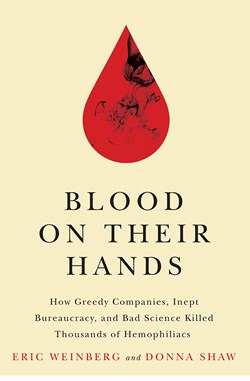
BLOOD ON THEIR HANDS, infuriating true story of the consequences of untrammeled greed

Image
BLOOD ON THEIR HANDS: How Greedy Companies, Inept Bureaucracy, and Bad Science Killed Thousands of Hemophiliacs
ERIC WEINBERG & DONNA SHAW
Rutgers University Press (non-affiliate Amazon link)
$26.95 Kindle edition, available now

Rating: 4* of five

The Publisher Says: By the mid-1980s, over half the hemophiliacs in the United States had become infected with HIV. Blood on Their Hands reveals the toxic combination of corporate greed, governmental complacency, and medical negligence that exacerbated this public health disaster.

A few short years after HIV first entered the world blood supply in the late 1970s and early 1980s, over half the hemophiliacs in the United States were infected with the virus. But this was far more than just an unforeseeable public health disaster. Negligent doctors, government regulators, and Big Pharma all had a hand in this devastating epidemic.

Blood on Their Hands is an inspiring, firsthand account of the legal battles fought on behalf of hemophiliacs who were unwittingly infected with tainted blood. As part of the team behind the key class action litigation filed by the infected, young New Jersey lawyer Eric Weinberg was faced with a daunting task: to prove the negligence of a powerful, well-connected global industry worth billions. Weinberg and journalist Donna Shaw tell the dramatic story of how idealistic attorneys and their heroic, mortally-ill clients fought to achieve justice and prevent further infections. A stunning exposé of one of the American medical system’s most shameful debacles, Blood on Their Hands is a rousing reminder that, through perseverance, the victims of corporate greed can sometimes achieve great victory.

I RECEIVED A DRC FROM THE PUBLISHER VIA EDELWEISS+. THANK YOU.

My Review
: I was there for the AIDS years. I lost the love of my life to AIDS. It was harrowing to see people who did not have the option to avoid infection (after we knew what transmitted the virus) by using condoms then contract and die horribly from the awful virus's depredations. Author Weinberg was a lawyer seeking compensation for families and what few survivors there were in the 1990s. If ever there was a class of truly innocent victims, this group is it.

The way the virus entered these unfortunate sufferers was inescapable. It is a requirement of life as a hemophiliac that, to survive long term, you received donated blood products from normal donors to enable your body to form normal blood. The path to infection of these victims ran right through the corporate boardrooms where for-profit blood banks chose to accept donations from people using drugs. I absolutely know of my own personal knowledge that gay men were unable to donate blood, which would've widened the pool of donors. It was inevitable that a blood-borne infection, one unscreened for and untested for in the blood products harvested, would eventually cause the infection all dreaded as a death sentence at that time.

In the name of profits, lives were gambled with; predictably, those lives were lost.

The "regulatory state" that the incoming (as of 2024) US administration rails against ignored the risks these greedy entities were taking with people who had no choice, no alternative, no voice in or power over the risks their continuing lives required them to take. Author Weinberg and his cohort of counselors acted to force the casino of lives to close, though it took a lot longer than it should have.

The stakes that were paid by the deaths by those without a say in the gambles they were forced to take are currently under threat of being made useless. We're being forced back into a time where we have no say in the rollback of regulations that save lives. Greed like that of the insurance industry currently making news is causing outrage. That's great.

BUT WE HAVE FOUGHT THESE FIGHTS, AND WON THEM, BEFORE. Those victories and protections are the ones in the sights of the profit-motivated incoming administration.

Do not sit idly by as the gains we've won, that have demonstrably saved lives, evaporate in the all-consuming heat of greed and lust for profits. Call your congressional office in the Capitol or the local constituent services office. I realize that takes effort, and the way to say what needs saying isn't in everyone's capabilities. Using 5calls.org will make the process as painless as it's possible to be. The needed numbers, even a script to follow if you're phone-phobic, are all there.

The stakes are too high to sit feeling helpless, or to think "I won't make a difference" or any other excuse. All voices count. Your representatives at every level are *required* to listen to you.

Make them earn their money. Just like you have to.

Friday, February 2, 2024

THE CANCER FACTORY: Industrial Chemicals, Corporate Deception, and the Hidden Deaths of American Workers

Image


THE CANCER FACTORY: Industrial Chemicals, Corporate Deception, and the Hidden Deaths of American Workers
JIM MORRIS

Beacon Press
$29.95 hardcover, available now

Rating: 5* of five

The Publisher Says: The story of a group of Goodyear Tire and Rubber workers fatally exposed to toxic chemicals, the lawyer who sought justice on their behalf, and the shameful lack of protection our society affords all workers

Working at the Goodyear Tire and Rubber Company chemical plant in Niagara Falls, New York, was considered a good job. It was the kind of industrial manufacturing job that allowed blue-collar workers to thrive in the latter half of the 20th century—that allowed them to buy their own home, and maybe a boat for the lake.

But it was also the kind of job that gave you bladder cancer.

The Cancer Factory tells the story of the workers who experienced one of the nation's worst, and best-documented, outbreaks of work-related cancer, and the lawyer who has represented the bladder-cancer victims at the plant for more than thirty years, as well as the retired workers who have been diagnosed with the disease and live in constant fear of its recurrence.

In doing so it tells a story of corporate malfeasance and governmental neglect. Workers have only weak protections from exposure to toxic substances in America, and regulatory breaches contribute to an estimated 95,000 deaths from occupational illness each year. Goodyear, and its chemical supplier, Dupont, knew that two of the chemicals used in the plant had been shown to cause cancer, but made little effort to protect the plant's workers until the cluster of bladder cancer cases—and deaths—was undeniable. Based on four decades of reporting and delving deeply into the scientific literature about toxic substances and health risks, the arcana of worker regulations, and reality of loose enforcement, The Cancer Factory exposes the sometimes deadly risks too many workers face.

I RECEIVED A DRC FROM THE PUBLISHER VIA EDELWEISS+. THANK YOU.

My Review
: The problems of a corporatized economy are multitudinous. One of the biggest is the existence of actual, unkillable zombies: the artificial persons we call corporations. The existence of corporations is not, by itself, evil or even provocative of evil. What happens, though, when one endows a legal fiction with personhood without accountability or mortality is that it never develops morality or empathy.

No entity that could look at the actual people whose lives were ruined, or ended, by the awfulness that is bladder cancer, know that the actions to prevent others from suffering like fates were within its power to enact, and not do it because it might hurt profits, has any business whatsover being given "rights" to free speech or anything else. But that is what the legal fiction of corporate personhood does. The managers and legal eagles who fought the enactment of even the most minimal safety regulations are actual people and can be held accountable. The corporation is the source of the culture that encouraged these people not to see the suffering of actual human beings as a reality to be valued as highly as they saw more money...money they would share in minimally, if at all. They, in their fiduciary duty to the corporation, did not see human life as more worthy of protection and duty of care than corporate profits, and as these corporations are not real people but only fictions, this is utterly outside any system of moral accountability.

Fines, sanctions, no kind of economic penalty can train a corporation not to see its eternal quest for MORE as evil and as detrimental to the world as it is, because it is a gestalt, a culture, not a human being. The human beings who make up the corporations' staff and management can all, plausibly, point to the fact they are just following orders.

So was Adolf Eichmann.

This book, using decades of reporting, writing, and reasearch of the author's own and also from many sources, makes the case for abolishing corporate personhood indirectly and compellingly by bringing to life the consequences of profits before people in a dangerous, necessary business through personal stories of its victims. There are no innocents here...people needed jobs and ignored the evident consequences to get the paychecks. The problem isn't one way only. The problem is the widely pervasive mindset that enables such oblivious, unchecked greed to flourish.

But what about the law, the regulations that exist to protect the people who handle dangerous chemicals? Yes, indeed...what about them. First, does the substance meet the standards to have a regulation in place to restrict who can handle it and how they can do it? The steps needed to prove that exact regulation is needed must take place in specific ways and have specific thresholds of evidence met for regulations to be drafted at all...that involves both the maker and the user of the substance, who have entire law firms lying, obfuscating, paying off whoever needs paying off to prevent the regulations from taking place for as long as it can be avoided while more profits are stockpiled. Then there are the regulators...subject to bought-and-paid-for politicians' oversight, aka interference, delaying and derailing as much as possible while more profits are stockpiled. More lives lost, more havoc rained on the workers, who don't leave their jobs desite the evident hazards because they need the paychecks, even though evidence mounts that the jobs are killing them...literally. All while more profits are stockpiled.

So a regulation finally, grudgingly, attenuatedly takes effect. Who enforces it? The corporation, and this obvious conflict of interest is lightly supervised by a staff of very very overstretched regulatory enforcers usually drawn from the regulated industry...as often as not from the violator corporation. All of whom answer to the corrupted-by-corporate-money politicians and their appointees.

Does the magnitude of the problem begin to dawn on you?

This book does what I can't do in a review. It marshals sources and resources for you to look at the facts and make your own judgments about the nature of the corporate entities, as they present themselves in relation to workers they can no longer deny harming. It's been established in courts of several levels of jurisdiction. The journalists, activists, and the lawyers who worked with the victims to get them justice and compensation for the abusive practices used by their employers are much to be lauded. They are not, however, teaching a human being by imposing consequences on them. They are inconveniencing entities that are without minds or consciences in their profit-taking, and in their one effectively attackable weak spot: public reputation.

Bad reputation is the one way to punish the entities who remorselessly, repeatedly, and knowingly enact all the harms detailed in this book. They have used giant, costly media campaigns...that you pay for with higher prices...to distract and misinform you as they move the plants that cause this havoc to powerless minority communities, or countries that have even less regard than the US for their peoples' health.

If there is a solution to this problem, I do not know of it.

Monday, October 4, 2021

THE BODY SCOUT, Lincoln Michel's big, fast racing machine of a sci-fi thriller

Image

THE BODY SCOUT
LINCOLN MICHEL

Orbit Books
$27.00 hardcover, available now

Rating: 4* of five

The Publisher Says: In the future you can have any body you want—as long as you can afford it.

But in a New York ravaged by climate change and repeat pandemics, Kobo is barely scraping by. He scouts the latest in gene-edited talent for Big Pharma-owned baseball teams, but his own cybernetics are a decade out of date and twin sister loan sharks are banging down his door. Things couldn't get much worse.

Then his brother—Monsanto Mets slugger J.J. Zunz—is murdered at home plate.

Determined to find the killer, Kobo plunges into a world of genetically modified CEOs, philosophical Neanderthals, and back-alley body modification, only to quickly find he's in a game far bigger and more corrupt than he imagined. To keep himself together while the world is falling apart, he'll have to navigate a time where both body and soul are sold to the highest bidder.

Diamond-sharp and savagely wry, The Body Scout is a timely science fiction thriller debut set in an all-too-possible future.

I RECEIVED MY DRC FROM THE PUBLISHER VIA NETGALLEY. THANK YOU.

My Review
: First, read this:
"We build better livers, and someone concocts stronger booze. We get sun treatments, then our chemicals burn up the ozone even more. Cure one disease, and another pops up. The pitcher juices up his throw, and the batter juices up his swing. On and on it goes."
–and–
“We’re all trapped in these forms, aren’t we? Our minds get poured into them without anyone even asking us. We grow and live in them, and yet in many ways they are as incomprehensible to us as the cosmos.”
–and–
"We've got 'em all. Mammoth burgers, teriyaki tyrannosaurs wings, saber-toothed gyro platters. Those cocksuckers thought they could avoid being eaten by going extinct. Bunch of buffoons. Didn't count on human ingenuity. We can eat anything these days. Eat the past, present or future."

The flavor of the writing is right there...wry, world-weary, ever so slightly facetious...and if that ain't your jam, baby, move along. Author Michel, whose story collection Upright Beasts earned praise from me, fails to shock me with his writing and planning chops. It's very clear why he offers writing advice for a living.

What would happen if Gattaca and Moneyball had a bastard love-child? This book. From the off, I loved the choices Author Michel made. Baseball is my only organized sport love. Having the Mets (my team since the 1969 Miracle Mets defeated the BodyMore Inc....I mean Baltimore!...Orioles in the seventh game of the World Series) owned by Monsanto was, while revolting, not entirely unthinkable. Choosing baseball for the body-modding corporate shills to play made perfect sense because there's so much more to work with in the prowess-enhancement department. Baseball players are required to specialize in this day and age...don't get me started about the designated-hitter rule!...and yet by the very nature of the game there is a constellation of skills they still need to possess to some degree, like running and fielding the ball. The development of modifying tech, driven by the need/want of the Big Pharma owners, gets laid right at present-day capitalism's (and its political stooge class's) door, as the present-day pandemic accelerated the mad dash for corporate ownership of everything into sports. It's not at all unlikely, given that corporations own teams in Japan....

But the fact that the world Kobo Zunz lives in, the one that allows him to modify his body to an absurd degree despite having become a talent scout thus no longer playing baseball, is chock-a-block with delightfully pointed choices embodied in other characters: Dolores ("sorrows" or "pains") is Kobo's friend/kinda-ex, a Deaf person who elected not to restore her hearing but to enhance her sight (GoogleGlasses-esque modifications to one eye that present speech translated into ASL); Natasha the Neanderthal, the Big Pharma enforcing muscle and that's not a nickname but a descriptive label as she's of the genetically engineered re-introduced Neanderthals; Lila, the Angry Young Girl who, like Greta Thunberg, is outraged into incandescence at the gigantic mess her elders are leaving for her to clean up. I love that, when Kobo the expert at foreseeing trends in body modification (always ask an addict to get an accurate vision of the addiction's course) is summoned to solve the gruesome and very public murder of his adopted brother, Monsanto Mets batting (aka "slugging") star JJ Zunz, it's by a manager whose only name is "the Mouth." Ha! Kobo's debts incurred in body modding will be paid in full...if he pins the very public, obviously message-sending murder on a particular rival team. That will get the scary, violent loansharks who have been funding his biomechanical enhancement addiction, Brenda and Wanda, off his terrifying-nightmares list.

So what am I saying about this read? Much delighted me, mentioned above. There are things that didn't delight me near so much. The length of the story, for example, would support more exploration of side characters who got little (JJ's mother, who adopted Kobo). But in all honesty I'd've been much happier if some of the amazing ideas and snarky asides had been held in RAM for a sequel, leaving a fizzier and more propulsive through-line. It's not like it's a slow read, or wasn't for me; it's just densely packed with irresistible shiny baubles and it could've been told in less time and at a more spanking pace. I presume this is not the start of a series because the publishers would've trumpeted that fact if it had been. If Author Michel chooses to make it into a series, which I really hope he will, quite a lot of the underexplored material will be very expandable.

What isn't expandable is the ending. A very weird change of tone takes place as we're coming in for our landing. It becomes...sweet. Kind of sentimental. This felt so very wrong to me, like Philip Marlowe got a hit of some opiods and turned into Ted Lasso.

What I will say is that you're going to love The Body Scout if you loved George Alec Effinger's Marîd Audran books, or the early William Gibson. I did; I do; and all cavils aside, I'd encourage any baseball fans, bleak/noir fiction lovers, and anti-capitalists to hop on board. A few bumps on the journey shouldn't detract from the way-cool scenery.

Thursday, January 7, 2021

THE STONE WĒTĀ and COME WATER, BE ONE OF US, never mistake short for weak

Image
THE STONE WĒTĀ
OCTAVIA CADE
Paper Road Press NON-Affiliate link to Amazon; the author published the book from New Zealand
$3.99 Kindle edition, available now

WINNER OF THE 2021 SIR JULIUS VOGEL AWARD FOR BEST NOVEL!

Rating: 5* of five

The Publisher Says: “We talk about the tyranny of distance a lot in this country. That distance will not save us.”

With governments denying climate science, scientists from affected countries and organizations are forced to traffic data to ensure the preservation of research that could in turn preserve the world. From Antarctica, to the Chihuahuan Desert, to the International Space Station, a fragile network forms. A web of knowledge. Secret. But not secret enough.

When the cold war of data preservation turns bloody – and then explosive – an underground network of scientists, all working in isolation, must decide how much they are willing to risk for the truth. For themselves, their colleagues, and their future.

Murder on Antarctic ice. A university lecturer’s car, found abandoned on a desert road. And the first crewed mission to colonize Mars, isolated and vulnerable in the depths of space.

How far would you go to save the world?

My Review: When the Revolution comes, it will be women leading it. Secular Saint Stacey Abrams will likely be honking the biggest horn and causing the biggest ruckus. But that's not because it's her M.O. It's because her cover's blown. There is no point in trying to sneak when every-damn-body knows your shoe size and when you cheat on your diet.

So here is a story I read last month about the Revolution led by women and made up of scientists who'll be damned to hell if they're going to make nice for no gain when the planet is dying:
Resistance was revolution, sometimes, blood and dramatic acts, but more often it was survival. More often it was preservation, and the data she carried with her was for preservation more than revolution.

This near-future Earth has gone well past tipping point. The vileness that is Capitalism is still spinning its lies and soothing its consumers to keep them buying while...to be honest I haven't the foggiest clue what they're thinking they can do that we can't, how they will survive the *actual* End of Days, but there it is. The lie-maker machinery behind the popular songs is still humming "Big Yellow Taxi" and cheerfully killing people who know it's all a lie and can't be arsed to do anything about it.
It was hard to be an astronaut and not be an environmentalist.
–and–
She’d seen the photos—Earthrise and The Blue Marble—known the watershed impact they’d had on the conservation movement.

The women in this resistance movement are identified in a clever, amusing way; I won't say, you should find out for yourself. Actually the biggest advantage to this technique is the flexibility it gives Author Cade in prefiguring the events of the chapters and sections. What she does with it is that sly, side-eye fun-making that you and at least one of your friends have, that one whose eye you cannot afford to meet when you're together but not in a safe place to fall out laughing at embarrassing moments. The story is one that today, the sixth of January, 2021, was so perfect in subject, in tenor, and resonance, that I had to re-read it. These women, these scientists, are all in flux and transition (!) and trying to protect the only home we have from the misguided and stupid who are deliberately trying to destroy it.

The challenges of doing that by concealing accurate data, the enemy of fascists and authoritarians everywhere. Do y'all remember my review of The Badass Librarians of Timbuktu? That culture of concealment for survival is mentioned here, alongside its increasingly popular young grandniece:
All those manuscripts, and Timbuktu a place of historic learning, of literacy and knowledge passing on. What it passed on now could be the lessons and skills of resistance, the ways of smuggling out and networking.
–and–
There was a tendency with so much digital to make all copies electronic, and rely on the internet for keeping multiple copies visible and tamper-proof. But any system could be hacked, any data deleted. The information she intended to facilitate had to be kept discretely, separate from any possible influence.

There is no hope for rebuilding from looming catastrophes—and there is a dilly of a disaster we see even before the collapse we're too soon to witness completing itself—without accurate, complete data hidden somewhere, cared for by someone with the skills to use it when it's finally safe to do so. Think of the world we might have had the religious nuts not burned the Library at Alexandria! So there's a precendent for Author Cade telling us this story, and a reason for you to spend the money to read it at this moment in US and UK history. Today's multiple klans of barbarians are doing their damnedest to finish burning the norms and conventions that have protected and enriched the greatest number of people. Author Cade tells us, and the evidence right now points to her prescience, that they won't stop even at murder to finish the destruction of whatever institutions, whatever systems and learning and techniques, prevent them from staying in complete control.

We've fought wars ostensibly to prevent that from happening, against an enemy whose words and iconography we saw used in the Capitol of the United States of America. One woman, identity as yet not revealed, has died from a gunshot wound received during the violence. It is eerie, then, to realize this is not so shockingly unthinkable. Author Cade thought it. She framed it, though, differently from the US news media, as what it is:
One person was such a small-scale loss, comparatively. (One person was enormous.)

+++++++++++++++++++++++++++++++++++++++++++++++++++++++++++++++++

Image
COME WATER, BE ONE OF US
OCTAVIA CADE

Strange Horizons magazine
Free to read online

Rating: 5* of five

We made the corporations people, but then we did the same to the rivers.

A fever dream of anti-capitalist and pro-planet activism. A simply told, easily understood explication of why it was such a *colossally* stupid thing to create the legal fiction of "corporate personhood."

People are greedy, selfish fucks, so why would one expect an atl-law-only person to be any different? But...here's the thing...bad ideas come with good uses. This one comes with the personification of Water in their riverine expression. If rivers are people, they have rights and they have legal standing; it then becomes possible, nay necessary, to act in their behalf. To give them the care and assistance necessary for them to thrive and prosper, just like all persons whether biological or legal.

Take THAT, capitalism.

Wednesday, April 5, 2017

BP BLOWOUT, a thorough analysis of the most expensive corporate-caused disaster in history

Image

BP BLOWOUT: Inside the Gulf Oil Disaster
DANIEL JACOBS

Brookings Institution Press
$23.00 hardcover, available now

Rating: 4* of five

The Publisher Says: BP Blowout is the first comprehensive account of the legal, economic, and environmental consequences of the disaster that resulted from the April 2010 blowout at a BP well in the Gulf of Mexico. The accident, which destroyed the Deepwater Horizon oil rig, killed 11 people. The ensuing oil discharge—the largest ever in U.S. waters—polluted much of the Gulf for months, wreaking havoc on its inhabitants and the environment.

A management professor and former award-winning Justice Department lawyer responsible for enforcing environmental laws, Daniel Jacobs tells the story that neither BP nor the federal government wants heard: how the company and the government fell short, both in terms of preventing and responding to the disaster.

Critical details about the cause and aftermath of the disaster have emerged through court proceedings and with time. The key finding of the federal judge who presided over the civil litigation was that the blowout resulted from BP’s gross negligence.

BP has paid tens of billions of dollars to settle claims and lawsuits. The company also has pled guilty to manslaughter in a separate criminal case, but no one responsible for the tragedy is going to prison.

BP Blowout provides new and disturbing details in a definitive narrative that takes the reader inside BP, the White House, Congress and the courthouse. This is an important book for readers interested in the environment, sustainability, public policy, leadership, and risk management.

THE PUBLISHER PROVIDED A REVIEW COPY AT MY REQUEST. THANK YOU.

My Review: At the very beginning of this infuriating book, the author makes this statement:
The federal government brought criminal charges against BP and four of its employees. The company pled guilty to manslaughter and other charges to resolve the criminal case, agreeing to pay a record $4 billion in fines and penalties. Two BP employees were acquitted, and two pled guilty to misdemeanors. No one will go to prison for the accident. In stark contrast, the federal government prosecuted hundreds of individuals for filing false claims against BP. Seventy-five were incarcerated.
And this was under the late, lamented Obama administration. Can you even imagine what would happen if this were to happen under the current kakistocracy? The peons would be out polishing BP's tankers, chanting how sorry they were for the trouble their childrens' deaths were causing the corporation, the US Army guarding them with live ammunition in their guns.

The book is a good case study, at a high level, for what lies at the root of the epic disaster that has spawned a CGI-fest of a film, though few other tangible results outside the Gulf Coast. The disaster is, in hindsight, apparent from the get-go. BP filed the paperwork to gain drilling rights to this piece of the Gulf of Mexico that was, shall we say, slipshod:
On March 19, 2008, BP purchased from the federal government for $34 million the lease rights to a nine-square-mile area off the coast of Louisiana anomalously named the Mississippi Canyon. After making the purchase, BP went through the process of submitting to federal regulators the necessary plans to obtain permission to drill a well in the area.

BP's lengthy Initial Exploration Plan (EP) for the Macondo well was submitted in February 2009. In the section entitled "Blowout Scenario," BP wrote that "a scenario for a potential blowout of the well from which BP would expect to have the highest volume of liquid hydrocarbons is not required for the operations proposed in this EP." In other words, the worst case scenario question was not applicable.

BP also submitted an Oil Spill Response Plan. It described the various species of wildlife that supposedly could be affected by an accident in the Gulf. In an indication that the Macondo plan was a cookie-cutter extract from another plan, some of the species identified in it (such as sea lions, sea otters, and walruses) exist not in the Gulf's warm waters but in frigid Alaskan waters. ... William Reilly, administrator of the Environmental Protection Agency at the time of the 1989 Exxon Valdez accident and later co-chair of the Presidential Commission investigating the BP disaster, said that he was "shocked" that BP was not better prepared than Exxon had been more than two decades earlier.
Sea lions in the Gulf. Man, I must have worse vision than I thought, living down there and going to the beach all those years and never so much as catching sight of one. So clearly we're not talking about a regulatory agency with much interest in the paperwork that's submitted to it. Not even the most cursory glance could possibly have been given to this farrago and had it pass muster.

And yet it did pass, like intestinal gas, and it's symptomatic of a far nastier problem that was fixing to blow. BP has a long history of taking the easiest way to get to its profits. It has been fined many times for careless operations resulting in human and environmental problems. Nothing, however, has yet been seen to equal the explosion and subsequent sinking of the Deepwater Horizon. The event itself is largely offstage for most of the book, forming the backdrop for the author's primary focus: and then what happened? The answer is, for all that it's contained in under 200 pages, admirably complete. Author Jacobs is in his element when relating the details of the disaster to the people and places they describe:
The National Institute of Environmental Health Sciences, part of the National Institutes of Health, is conducting the GuLF Study, the largest ever study of the potential health effects associated with exposure to oil. The study plans to follow more than 30,000 members of the affected communities (cleanup workers and local residents) for ten years.
Preliminary results, reported in 2014, revealed that cleanup workers were 30 percent more likely to suffer from depression or anxiety. Results reported in 2015 showed that the incidence of wheezing and coughing in cleanup workers was 20-30 percent higher than normal.
After noting the clarity of Author Jacobs' presentation of the facts, I'll note their worrisome content and fret over the likelihood of the current administration's having cut or eliminated the funding for this study and its eventual report. The data would, I have little doubt, be very useful to the anti-oil lobby and will most likely be sent to live with the three-eyed, five-finned fishes around Macondo.

An issue that arises in almost every debate I've ever had with right-wing radicals is the stupidity of charging corporations with other-than-civil-law crimes. A corporation isn't a person, I've trapped a few into saying; if that's so, I counter, why does the law treat the corporation as a person? And after a horrible event like the Macondo well blowout that was primarily caused by the careless actions and reckless inactions of BP, can the fact of criminal culpability really not be considered and assigned?
What purpose is served by pursuing a corporation criminally instead of civilly when the primary sanction to be imposed in either case is a monetary penalty? The company itself cannot be sent to prison, and its directors, officers, and employees cannot be punished for the company's own ctiminal acrs. ... Reasonable minds differ on the question, with some legal scholars taking the view that the criminal justice process is wasted on corporations when civil sanctions are available. Although the concept of double jeopardy does not bar the government from seeking both criminal and civil penalties for the same transgression, arguably there is some overkill in its doing so.

In BP's case, however, there was very little overlap between the criminal offenses and the civil violations. Of the criminal charges brought against BP, the only negligent discharge count also constitutes a civil violation under the Clean Water Act. Moreover, when a company is responsible for such a huge calamity as the BP disaster, arguably it should be subject to both civil and criminal enforcement actions.
The nightmare that millions of people will continue to endure, in the form of a radically degraded environment that most likely will continue to suffer consequences of BP's bad business practices, seems to me to call for assignment of criminal culpability. Luckily, the courts agreed; also luckily, BP itself realized it was in new territory here and pled guilty to and/or settled almost all the suits brought against it.

This was not cheap, and it will continue to be not cheap for quite some years to come:
The nation's worst offshore oil discharge has resulted in what appears to be the world's most expensive manmade corporate disaster. At $61.1 billion, BP's estimate of its total costs broke all known records.

Significantly, the taxpayer bears all the risks of any unknown natural resource damage costs that exceed [a court mandated] $700 million cap. Depending on those potential costs—as well as how other societal costs are valued—all told the cost of the disaster might wind up growing substantially.

No matter how one values the costs of the BP disaster, they were enormous. Enormous for the company, its shareholders, the American taxpayer, and society as a whole. BP may have all but closed its books on the disaster, but the taxpayer and society may be left holding the bag.
BP's share price took a big hit after the Macondo disaster. The company used accounting chicanery to disguise the fact that, as a whole, it has yet to break a sweat paying the bills from their collective wrongdoing. They're profitable in spite of a lower market valuation. They're still drilling in US waters, in fact. Earning money from robbing the same nest they've already epically fouled. So their shareholders, from state pension funds down to index-fund shareholders, aren't in danger of losing real as opposed to fantasy money. That hasn't stopped a plethora of shareholder lawsuits from being filed. Some well-intentioned, suing to prevent the corporation from abusing the value of their shares by taking stupid risks, down to stupid stuff meant to be just annoying enough to get the suing parties a go-away payoff.

Ain't greed grand.

Author Jacobs advocates for a retreat from that kind of shareholding, described as shareholder-value management. The central presumption of this system is that managers have an affirmative legal duty to place the maintenance of shareholder value above any and all other concerns insofar as no laws are broken. There's a wink in there. No *important* laws, meanong ones that anyone can enforce expensively to the company's detriment. He cites a distinguished Cornell law professor, Lynn Stout, who claims that's a self-serving myth, "[c]hasing shareholder value is a managerial choice, not a legal requirement." Author Jacobs continues:
[Stout] maintains that BP shareholders do not necessarily want to raise share value to the exclusion of any other interest. "Real human beings own BP's shares, either directly or indirectly through pension and mutual funds, and real human beings care about much more than jusr whether BP stock rises."

A more enlightened current view of a corporation's purpose is known as the stakeholder theory. It teaches that a corporation owes a duty not just to its shareholders but to all of its stakeholders. These stakeholders include its business partners, customers, employees, and communities, among others. ...[M]any of BP's stakeholders were adversely affected by the BP blowout. They included BP's shareholders, whose stock plummeted. [The CEO]'s focus on being [primarily] an "operating company" backfired from any perspective.
The operating company that was supposed to save value for the shareholders by cutting corners has, with this disaster, received its death blow in my opinion. The current U-turn in social thinking will, I am confident, be short-lived. Too many people understand what it means and oppose its efforts.

Chapter 12, "Have We Learned or Only Failed?", is probably the most iportant part of the book. The question as phrased contains a big clue to the author's apparent purpose in writing this careful, complete overview of the Deepwater Horizon's death while drilling the Macondo well: Is past prologue, as it almost always is? "It depends," says Author Jacobs. It always depends. This book came out mere weeks before the 2016 election. The somewhat dubious tone of chapter 12 might have turned apocalyptic had it been published even a month later. The quoted paperwork above, filed by BP in pursuit of profits from the Macondo well, might be appalling but the agencies now in charge of licensing and inspecting oil drilling are not going to get larger or better funded now. The past is prologue. This time even the preface hasn't changed. It will most likely get worse before it gets better.

Sleep well.

Friday, July 15, 2016

THE DEVIL'S COMPANY, third Benjamin Weaver historical thriller

Image

THE DEVIL'S COMPANY (Benjamin Weaver #3)
DAVID LISS

Random House
$17.00 trade paper, available now

Rating: 3.5* of five

The Publisher Says: The year is 1722. Ruffian for hire, ex-boxer, and master of disguise, Weaver finds himself caught in a deadly game of cat and mouse, pitted against Jerome Cobb, a wealthy and mysterious schemer who needs Weaver’s strength and guile for his own treacherous plans.

Weaver is blackmailed into stealing documents from England’s most heavily guarded estate, the headquarters of the ruthless British East India Company, but the theft of corporate secrets is only the first move in a daring conspiracy within the eighteenth century’s most powerful corporation. To save his friends and family from Cobb’s reach, Weaver must infiltrate the Company, navigate its warring factions, and uncover a secret plot of corporate rivals, foreign spies, and government operatives. With millions of pounds and the security of the nation at stake, Weaver will find himself in a labyrinth of hidden agendas, daring enemies, and unexpected allies.

With the explosive action and scrupulous period research that are David Liss’s trademarks, The Devil’s Company, depicting the birth of the modern corporation, is the most impressive achievement yet from an author who continues to set ever higher standards for historical suspense.

I RECEIVED AN ARC FROM THE PUBLISHER. THANK YOU.

My Review
: Seriously ugly jacket.

Book is, well, book is...really well plotted, filled with characters whose ideas and motivations I get and even support, and told in a very engaging way.

Liss's trademark business angle is very much in evidence in this book. It's set partially within the confines of the East India Company, and quite a lot of the action takes place around the various business concerns of the characters; all handled in such a way as to make it clear that this story arises from those concerns, driving each actor to his or her next action. It's enviable, the way Liss can see the story in the business and not just the business in the story.

I like this book. I like the hero. I like the way early capitalist London is presented to our senses, and how the author brings us along in our readerly sense of how the sleuth is going to develop across the series.

So why a mingy three-and-a-half?

Because: 1) Several people die, one of whom I know to be a real blow to the future of the series, and in each case the event with its aftermath is curiously flat. The sleuth's response is well-enough drawn, but it's not...the stakes aren't *there* for the (or this) reader. And the quite, quite startling aftermath of one quite important death is announced and left for later, while some very exciting other plot stuff happens.

See? I shouldn't be able to type that sentence without the Nasty Fairy whackin' me a good one, sayin' "too far, boy!" But his whackin' wand is not raised.

2) A surprise reveal late in the chase portion of the story falls sort of flat as well, and a character whose character we are given no reason to admire is revealed to be so amoral as to have—gasp, say it isn't so—slept with men and women both, and for profit! Wouldn't even cause an eyeblink if this were not a) the only time this concept has ever been brought up in the series, and b) a trait presented as somehow amplifying the character's extant perceived vileness.

Full marks for fairness: Benjamin, the sleuth and a self-described vigorously straight man (yawn) does some surprising soul-searching about his sodomitical revulsion. The whorehouse madam makes a pretty good case for the sodomites she serves being pretty much just like the rest of the world. And in the end, a straight man who doesn't write pure scary-o-types when discussing the more fluid borders of sexuality is more to be praised than not. It just doesn't sit right in this case.

3) The Love Interest. Oh god. We now reach the portion of our series where the sleuth must Fall In Love, and with a worthy adversary. Just once, one lousy time, I'd like to see a likable hero like Benjamin Weaver make it through an entire series without a Love Interest. I know it's what the market likes, but yeesh. I content myself with observing that she's a interesting character in her own right.

I like the sleuth, I like the series, and I will buy the next one. You should too.

Recommended for Anglomanes, for business buffs, and for puzzle people; historical fanciers will hyperventilate at some of Liss's more atmospheric passages; and international intrigue fans...stay tuned....