Image

VFD Clock Runs On A Single AA

There are lots of different ways to build a clock. [Sciter_] came into the possession of some old calculator parts, and decided to reuse them for just such a project.

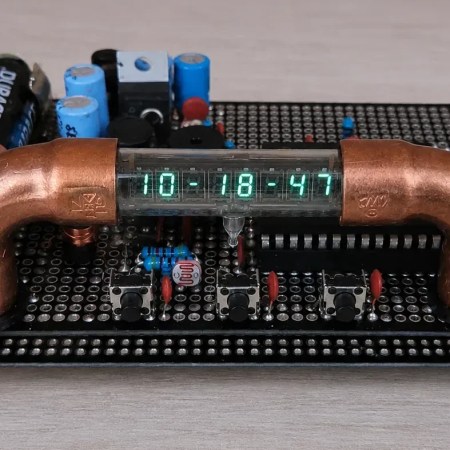
The heart of the build is an ATmega328P microcontroller, running off of a 32.768 kHz crystal. This allows the chip’s counters to neatly divide down the frequency to get a steady 1 Hz pulse for accurate timekeeping. Time is displayed on a vacuum fluorescent display (VFD) harvested from an old calculator. These displays need rather high voltages to run, which in this case are produced by a HV5812 driver chip and supporting circuitry. The display itself is neatly cradled in a pair of copper pipe elbows for a stylish look, with some addressable RGB LEDs present to provide some charming underglow.

Power for the device comes from a single AA battery, using a transformer-based low voltage converter. Alternatively, it can run off a USB 5 V power supply, which also charges the NiMH AA cell while available with the aid of an LM2576-ADJ buck converter.

Overall, it’s a neat homebrew clock that taught [Sciter_] plenty during its construction, and not the first time we’ve seen somebody put together a clock with second-hand VFDs. If you’re finding fun ways to reuse old display tech, don’t hesitate to let us know on the tipsline.

Image

This Alarm Clock Has The Capacity To Wake You

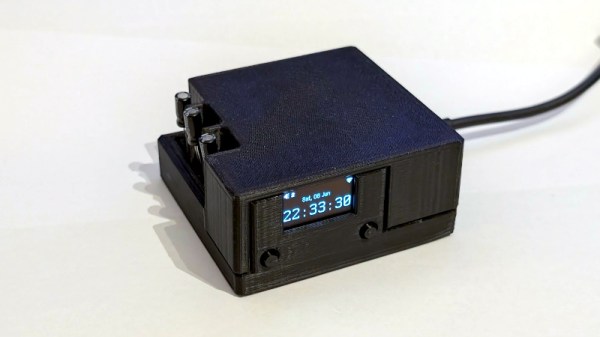
Every now and then a project comes into the Hackaday feed that has so many levels of wrong about it that you really shouldn’t do it at home, but is amusing enough to feature anyway with a warning. So it is with [ArcaEge]’s Capacitor Alarm Clock, which wakes up its unfortunate owner by blowing up electrolytic capacitors with reverse voltage. If you survive, you’ll certainly be awake!

It’s inspired unsurprisingly by an [ElectroBoom] video, and the premise is simple enough. An ESP32 serves as the clock, and triggers a relay for the alarm, which in turn overloads a suitably low-voltage electrolytic capacitor in a socket. The resulting explosion which appears in a video we’ve placed below the break, wakes the slumberer.

We don’t have to tell you that this is not the safest of hacks, and is presented here only for your entertainment. But it does provide a few points of interest, for example in identifying the difference between capacitors with a vent, and those without.

This isn’t the first time we’ve seen a project based around exploding capacitors, and that one maybe was a don’t-do-this-at-home too.

Continue reading “This Alarm Clock Has The Capacity To Wake You”

Image

A Diffraction Grating Makes This Clock Readable

We’ve seen just about every possible way to make a clock here at Hackaday over the years. So it’s rare to have a first, but here we are with [Twisted & Tinned], who’s made a novel clock with a diffraction grating.

The display of the clock looks for all the world like a jumble of LEDs, that is, until you place the grating in front of it. Those LEDs are addressable multi-color parts, and each digit is generated at a different color all on top of each other. The grating splits out these colors, resulting in a magical set of floating LED figures.

Behind those LEDs is a Pi Pico, but that’s just one of many microcontrollers that could have powered this project. It’s the use of the diffraction grating in a novel way with those LEDs that makes the difference, and we rather like it. He’s also managed to get the grating pattern in the 3D printed surround for a shimmering look, by printing directly onto a diffraction grating sheet. That in particular is a technique we’ve looked at before in detail.

Continue reading “A Diffraction Grating Makes This Clock Readable”

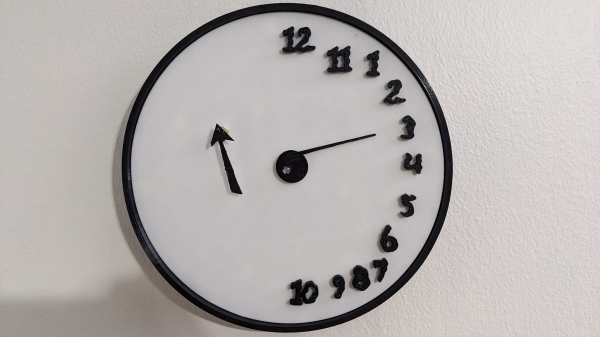
A black-and-white clock face is shown. The numerals are ranged around the right edge of the clock. One pointer extends from the center of the clock, and one is on the left side of the face.

A Clock Inspired By Failed Cognitive Tests

One simple screening tool for cognitive impairment is the clock-drawing test (CDT): the patient is provided with a printed circle and asked to draw a clock face with the hands pointing to a certain time. Depending on how the clock is drawn, this could indicate a variety of different disorders, particularly dementia, with a particular deformity in the drawing sometimes pointing to a specific issue. These failed tests inspired [John Silvia] to create a clock with a unique, disordered face.

The numerals in this clock face are placed exclusively along the right half of the clock (in the test, this can be a sign of damage to the right parietal lobe, or of executive dysfunction caused by dementia), and out of order. The hour hand is controlled by a servo motor, and the minute hand is mounted on a separate, commercially-purchased clock mechanism on the left-hand side of the face.

The frame for the clock and the face are 3D-printed, and the servo motor is controlled by an ESP32-C3 with an RTC module. To minimize power draw, a MOSFET disconnects the servo motor from power except for the once-per-hour position update. Once per month, the ESP32 connects to Wi-Fi to synchronize to NTP time, otherwise remaining in a low-power state – even its indicator LEDs are disconnected to save power. These efforts paid off: when the servo isn’t active, it draws only about 160 µA, and a set of three AA NiMH cells lasts about a year.

Since the servo motor draws most of the power budget, it wouldn’t make much difference, but the ESP32’s co-processor can also be used for ultra-low-power projects. For a happier take on a drawing-related clock, check out one of these projects.

Image

Building An Analog Meter Watch

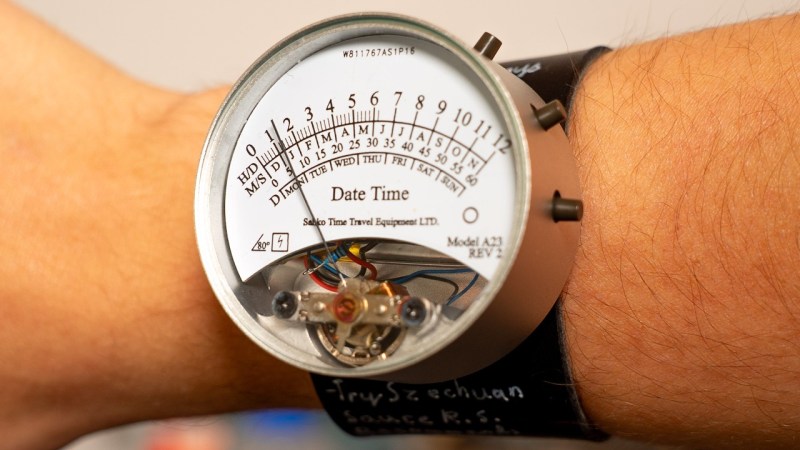
Most conventional analog watches have two or three hands, covering hours, minutes, and seconds (where present). [Sahko] has built a different kind of analog watch that creatively displays the time with just one. 

The build is based around a simple analog coil meter, which, at its heart, just sweeps its needle across a scale based on the voltage input to the device. A Raspberry Pi Pico is employed to drive the meter through a digital-to-analog converter. Pressing the buttons on the outside of the device tells the watch to display hours, minutes/seconds, or the current month or day of the week. With a single needle, only one parameter can be displayed at a time, but that’s just a compromise you accept for having a cool unique analog dial watch.

Another cool touch in the design is that the dial backer isn’t just a printed piece of paper—it’s a custom PCB, which has a much nicer, hardier finish. The case of the watch is also CNC milled out of aluminum and bead blasted for a quality surface finish, adding a nice industrial touch to the build.

This is a great example of a custom watch with quality fit and finish. The attention to detail really pays off in terms of feel. We’ve seen other watch projects use similar construction techniques before, too.

Continue reading “Building An Analog Meter Watch”

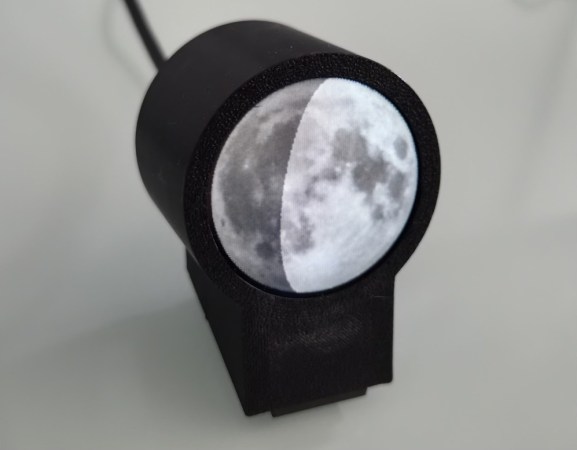
A render of the moon, on a circular display.

Put The Moon On Your Desk

Most people take the Moon for granted, not considering its slow cycle where the sun gradually illuminates different parts of it. A recent project from [Karsten Mueller] helps you keep our nearest celestial neighbor in mind by putting a tiny version on your desk. (German)

The device itself is made with a circular display, an ESP32-S3, and a simple 3D printed case. But the interesting part is the software — it’s not just a moon phase display, it actually takes your local time, latitude and longitude into account. The resulting image is an approximation of what the moon looks like if you were to look at it, even if you wouldn’t actually be able to see it, such as when it is obscured by the Earth or barely visible during the daylight sky. Initially the project actually used a photograph of the Moon that [Karsten] personally snapped, but there’s also an option to pull the imagery from NASA.

The original write-up is in German, but there’s also an English page for the project on Hackaday.io, and the source is available on GitHub if you’d like to put one together yourself.

Image

Voltmeter Clock Has The Time Dialled In

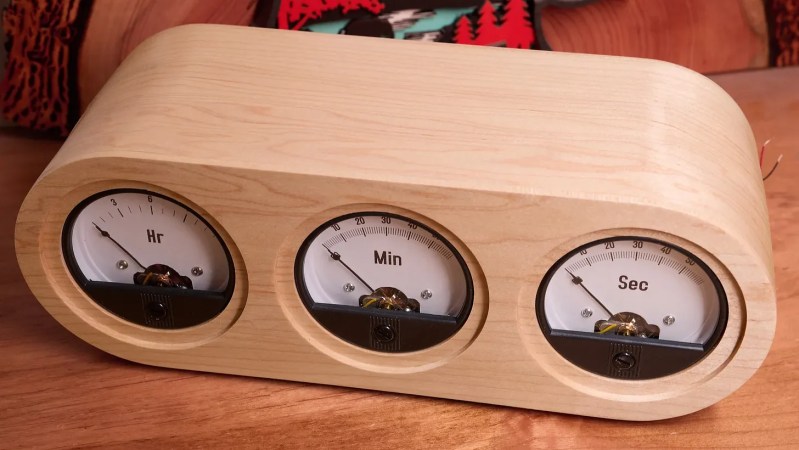
You could make a clock with three hands spinning about nested central shafts. If you did that, we probably wouldn’t publish it on Hackaday unless you really found a way to make it interesting. Make a clock out of voltmeters, however, and that usually catches our eye. [lcamtuf] has done just that.

The heart of the build is an AVR128DB28 microcontroller, an 8-bit microcontroller that is still currently in production. It runs at 8MHz, and drives a series of three Baomain 65C5 voltmeters to display hours, minutes, and seconds. Each has a custom printed face with the correct number of 13 or 61 divisions as needed. The voltmeters are driven by a continuous stream of 1-bit pulses with a software-controlled duty cycle determining exactly how far the needle moves. Yes, it’s using simple pulse width modulation, coded by hand by [lcamtuf] to do the job. All the components are wrapped up in a beautiful wooden case, with delicately kerf-bent panels to create the attractive curved lines.

We’ve featured similar builds before, too. As it turns out, hackers just really love clocks and old-school dials. Video after the break, which is worth watching for the rollover behaviour alone.

Continue reading “Voltmeter Clock Has The Time Dialled In”