Image

VFD Clock Runs On A Single AA

There are lots of different ways to build a clock. [Sciter_] came into the possession of some old calculator parts, and decided to reuse them for just such a project.

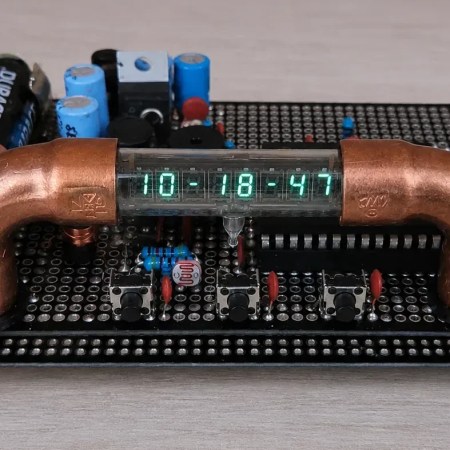
The heart of the build is an ATmega328P microcontroller, running off of a 32.768 kHz crystal. This allows the chip’s counters to neatly divide down the frequency to get a steady 1 Hz pulse for accurate timekeeping. Time is displayed on a vacuum fluorescent display (VFD) harvested from an old calculator. These displays need rather high voltages to run, which in this case are produced by a HV5812 driver chip and supporting circuitry. The display itself is neatly cradled in a pair of copper pipe elbows for a stylish look, with some addressable RGB LEDs present to provide some charming underglow.

Power for the device comes from a single AA battery, using a transformer-based low voltage converter. Alternatively, it can run off a USB 5 V power supply, which also charges the NiMH AA cell while available with the aid of an LM2576-ADJ buck converter.

Overall, it’s a neat homebrew clock that taught [Sciter_] plenty during its construction, and not the first time we’ve seen somebody put together a clock with second-hand VFDs. If you’re finding fun ways to reuse old display tech, don’t hesitate to let us know on the tipsline.
Image

3D Printed Clock Just Taps It In

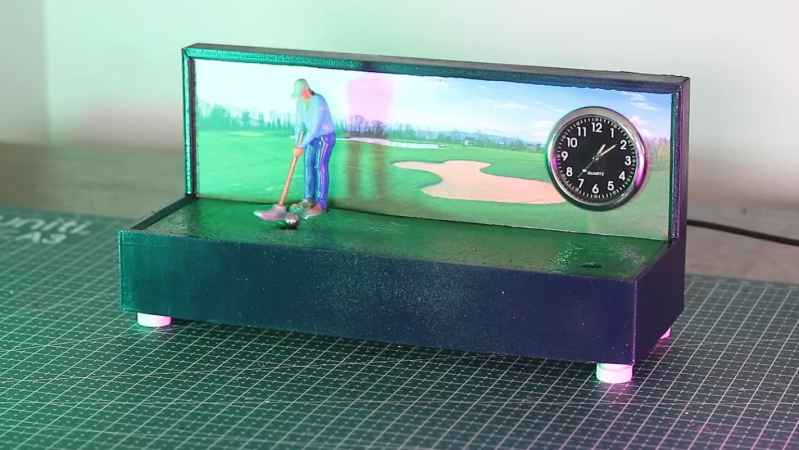
The famous cuckoo clock, with its moving, chirping mechanical bird indicating various divisions of time, has been around since at least the 1600s. The most famous of them come from the Black Forest area of Germany, and are still being made worldwide even today. Other clocks with different themes take their inspiration from the standard bird-based clocks from history, and thanks to modern 3D printing and other technologies we can make clocks with almost any type of hour indicator we’d like with relative ease like [Jason]’s golf clock.

While the timekeeping mechanism is a fairly standard analog clock, the hour indicator mechanism in this build is a small figure which putts a golf ball into a hole once every hour. It uses an ESP32-C3 at its core, which controls a pair of servos. One controls the miniature golfer, and the other lifts the ball up into position on the green at the appointed time. Once the ball is in place, the figure rotates, striking the ball towards the hole. Although it looks almost like the ball is guided by a magnet of some sort at first glance, the ball naturally finds its way into the hole by the topography of the green alone.

Almost all of the parts in this build are 3D printed, including the green, the golfer, the frame, and a number of the servo components. There’s also a small sensor that detects if the ball has actually made it into the hole and back to the lifting mechanism, and to that end there’s also a number of configurations that can be made in the software to ensure that the servos controlling everything all work together to putt the ball properly.

While not a cuckoo clock in the strict sense, we always appreciate a unique clock around here, but if you demand your clocks have ideological purity we’ll point you to this cuckoo clock built into a wristwatch.

Continue reading “3D Printed Clock Just Taps It In”

Image

2025 One-Hertz Challenge: Shadow Clock

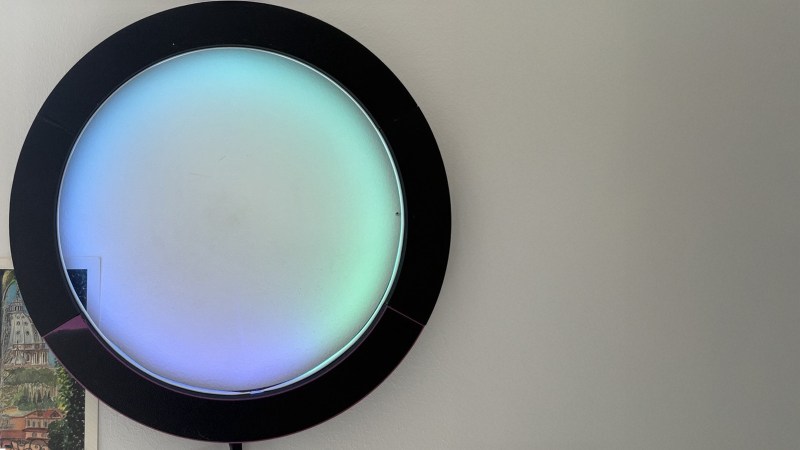
You can buy all kinds of conventional clocks that have hands and numbers for easy reading. Or, like [Fabio Ricci], you could build yourself something a little more esoteric, like this neat shadow clock.

The heart of the build is an ESP8266 microcontroller, which gets the current time via Wi-Fi by querying an NTP time server. It also uses a DS3231 real-time clock module as a backup, keeping accurate time even when a network connection is unavailable.

Time is displayed via a 60-pixel ring of WS2812B addressable LEDs. These 60 LEDs correspond to the usual per-minute graduations that you would find on a regular clock. Current hour is displayed by lighting the corresponding LED red, while minutes are shown in blue and seconds in white. It’s called a “shadow clock” because of its method of activation. IR distance sensors are used to activate the time display when a hand or finger is placed near the clock. As Fabio puts it, “shadow play” will make the clock display the time. Otherwise, it switches to be a simple round device on the wall that displays colorful animations.

It’s a neat build that looks quite unassuming as a decor piece, and yet it also serves as an easy-to-read timepiece. We’ve seen LEDs put to all sorts of good uses in clock builds around these parts. Meanwhile, if you’ve found your own unique way to display the time—either in readable fashion, or totally oblique—don’t hesitate to let us know.

Image

Gimbal Clock Relies On Servos For Its Cool Movements

In the annals of human history, clocks got boring there for a while. Most were just variations on hands spinning in a circle, with the occasional tweeting bird mechanism to liven things up. These days, we’re treated to all kinds of original and oddball designs, like this neat gimbal clock from [Twisted&Tinned].

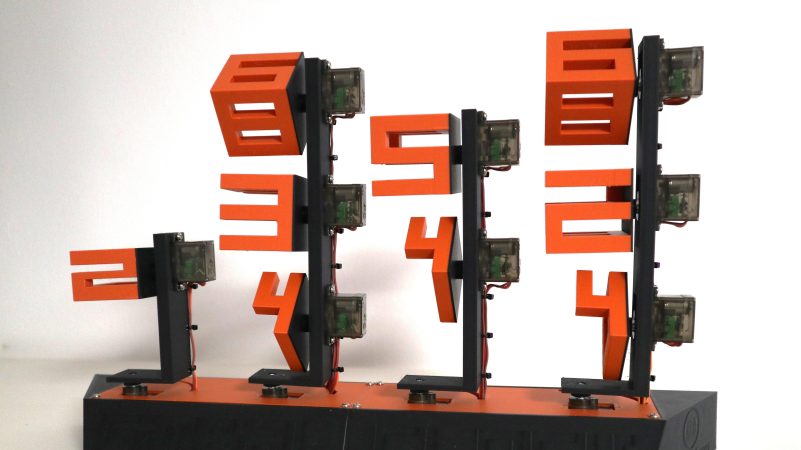
The concept of the build is straightforward enough. It has four main vertical arms, each with a servo at the base that rotates about a vertical axis. Upon each arm are between one and three servos which rotate 3D printed structures in the shape of numbers. A Wemos D1 Mini microcontroller commands the servos to the correct positions to display the current time. It also uses its WiFi connection to get accurate time updates directly from a network time server.

It’s quite an artistic build—and it’s rather enjoyable to watch this one flex and twist its way into displaying the right time. It’s also easier to read at a glance than some of the more unintelligible designs out there. Indeed, we see all kinds of neat and innovative clocks around these parts.

Continue reading “Gimbal Clock Relies On Servos For Its Cool Movements”

Image

Globe-Shaped World Clock Is A 3D-Printed Mechanical Marvel

Time zones are a complicated but necessary evil. Humans like the numbers on the clock to vaguely match up with what the sun is doing in the sky outside. To that end, different places in the world keep different time. If you want to keep track of them in a very pretty fashion, you might consider building a fancy and beautiful World Clock like [Karikuri] did. 

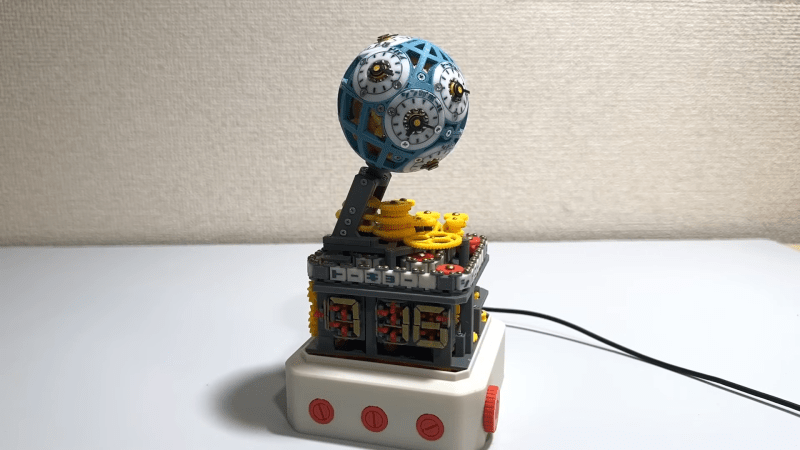
The design is based around a globe motif, mimicking the world itself. Only, on the surface of the globe, there are clock faces instead of individual countries. Each clock runs to its own time, directed by a complicated assemblage of 3D-printed gears. Mechanical drive is sent to the globe from a power base, which itself carries a mechanical seven-segment display. This too can display the time for different regions by using the controls below. It’s also useful for setting the clock to the correct time.

It’s a little difficult to follow the build if you don’t speak Japanese. However, quality subtitles are available in English if you choose to enable them.

We’ve seen [Karikuri’s] work before. We’ve also featured a great many world clocks over the years, including this particularly beautiful example that tracks night and day. Just don’t expect it to keep track of moon time. Video after the break.

Continue reading “Globe-Shaped World Clock Is A 3D-Printed Mechanical Marvel”

Image

Climate Change May Make Days Longer

For those who say there’s never enough time in a day, your wish for more time is getting granted, if ever so slightly. Scientists have now found a new source of our days getting longer — climate change.

You may have already been aware that the length of the day on Earth has been getting longer over time due to the drag exerted on our planet by our friendly neighborhood Moon. Many other factors come into play though, including the Earth’s own mass distribution. As the Earth warms and polar caps melt, the water redistributes to the Earth’s equator causing it to slow more rapidly.

In the worst-case scenario, RCP8.5, it would result in climate-related effects to planetary rotational velocity even larger than those caused by lunar tides. Under that scenario, the earth would probably be a less pleasant place to live in many other ways, but at least you’d have a little more time in your day.

While we’re talking about time, we wonder what ever happened to getting rid of Daylight Savings in the US? If you long for a simpler time, perhaps you should take up repairing mechanical watches and clocks?

Image

Saving A Clock Radio With An LM8562

Smart phones have taken the place of a lot of different devices especially as they get more and more powerful. GPS, music and video player, email, and of course a phone are all functions tied up in these general-purpose devices. Another casualty of the smart phone revolution is the humble bedside alarm clock as its radio, alarm, and timekeeping functionalities are also provided by modern devices. [zst123] has a sentimental attachment to the one he used in the 00s, though, and set about restoring it to its former glory.

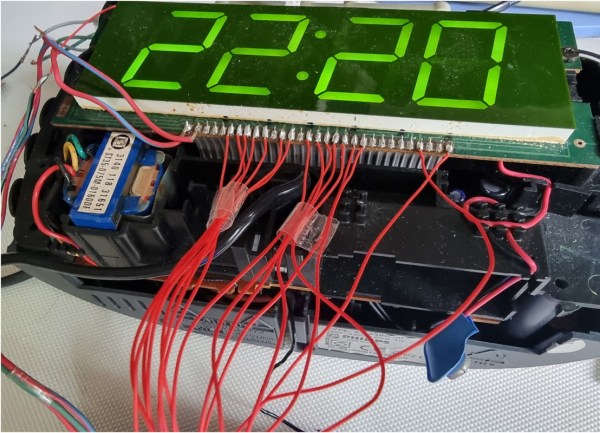
Most of the issue with the clock involved drift with the timekeeping circuitry. Since it wasn’t accurately keeping the time anymore, losing around 10 minutes a day, the goal to save it was to use NTP to get the current time and a microcontroller to make the correction automatically. Rather than replace everything in the clock except the display, [zst123] is using the existing circuit board and adding an ESP8266 to grab the time from the Internet. A custom driver board reads the current time displayed on the clock directly from the display itself and then the ESP8266 can adjust it by using the existing buttons through a relay wired in parallel.

Using the existing circuitry was certainly a challenge especially since the display was multiplexed, but the LM8562 that came with these clock radios is a common and well-documented chip for driving displays like this, giving [zst123] a leg up over something unlabeled or proprietary. Using NTP is certainly a reliable and straightforward way of getting the current time too but there are a few other options for projects like these like using GPS or even a radio signal.