Image

A More Convenient IButton Reader

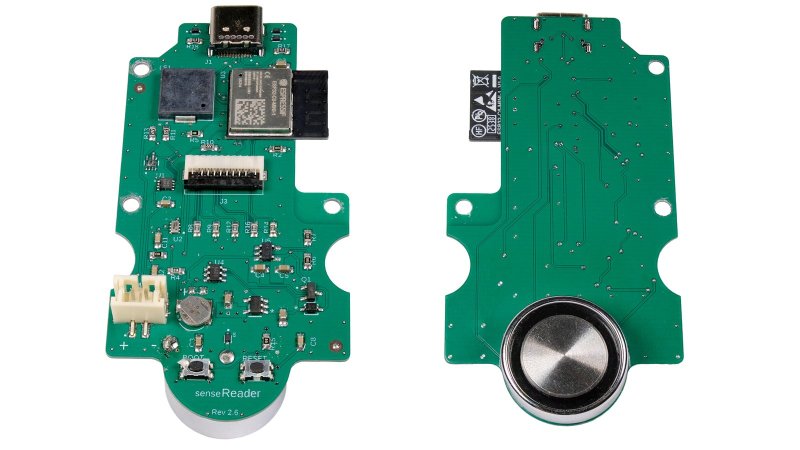
iButtons are microchips housed in small, round, metal containers, and are similar to coin cell batteries in appearance. Among other things, they’re used for logging data in industrial contexts, particularly where it’s desirable to track parameters like temperature over time. [Geoffrey Wells] has worked with these sensors, and decided that the aging solutions for reading these devices are too cumbersome and out-of-date. Thus, he designed ChillPoint as a more modern solution.

As you might have guessed by the name, [Geoffrey] was inspired to build a rig specifically for inspecting iButton data loggers in cold chain logistics applications. It’s built around an ESP32-C6, which has a 1-Wire probe on the front for communicating with the target device. On contact, the reader dumps all the data, storing it on its own flash storage. The data can then further be accessed by connecting to the ChillPoint handheld device over its own WiFi access point, upon which it hosts a web UI for access. The handheld can be used for scanning iButtons single-handed, while a smartphone, tablet, or laptop can be used as a screen to monitor the results live.

The project is nearing completion, and [Geoffrey] says both the hardware and software will be open source once it’s all said and done. Anyone interested in adding a ChillPoint to their toolbox should keep an eye out for its upcoming CrowdSupply campaign.

If you find yourself working with these devices on the regular, this project may be appealing to you. We’ve looked at iButtons many times over the years. The Java Ring was probably the coolest.

SDS-Remote

SDS-Remote Brings Power-User Features To Siglent Scope

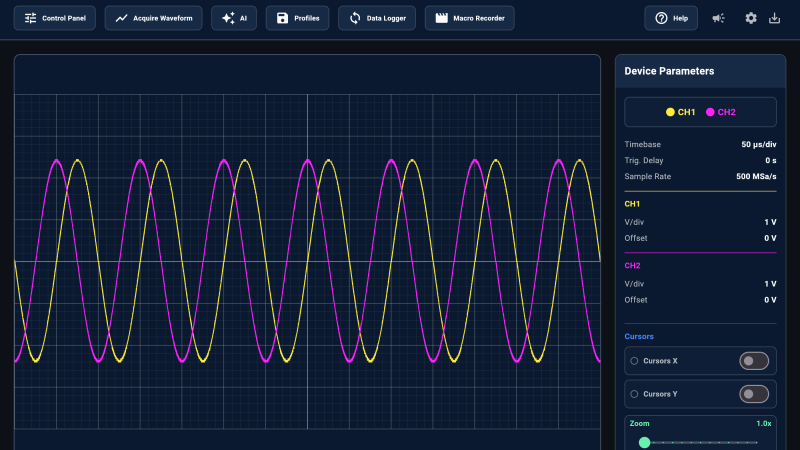
Many oscilloscopes have provisions to be connected to a computer and used remotely, but most of those interfaces are fairly rudimentary. To address this, [Winfried] has developed the SDS-Remote, a remote interface for the Siglent SDS 1000X-E series oscilloscopes.

The 1000X-E series oscilloscopes have both USB and network interfaces, and the SDS-Remote can use either (though the USB interface is still somewhat experimental). SDS-Remote allows for remote controlling the oscilloscope, capturing waveforms super handy as it lets you export a CSV file of the waveforms for further analysis. You can also capture screenshots of the scope through the web interface, making it much easier to compare waveforms as you’re working on a project. The built-in data logging lets you run long experiments and save out their results. The macro recorder lets you automate complex tests using SCPI commands and brings basic scripting to the interface without needing to run separate code. There’s also a mechanism to integrate an AI LLM to help translate common language into the correct scope configuration.

Thanks [Winfried] for sharing this awesome web interface for the oscilloscope no doubt it’ll be a welcome upgrade for those already remote controlling their Siglent scope. Head over to his GitHub page and check it out for yourself! Have you written any improved user interfaces for your equipment? Be sure to let us know what you’ve done so we can share with others who may find use in an interface that offers more than came with the product.

Continue reading “SDS-Remote Brings Power-User Features To Siglent Scope”

Image

Converting A Scanning Electron Microscope Into A TEM Is Surprisingly Easy

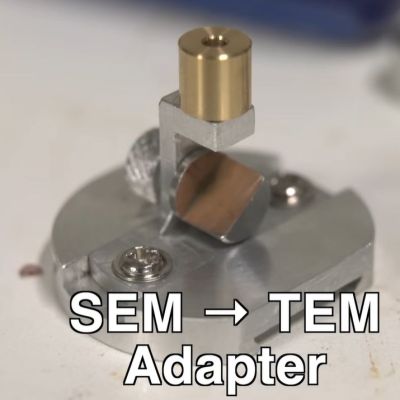
Although both a SEM and a TEM are electron microscopes, their working principles and images are very different. Whereas an SEM uses secondary electrons ejected after bombarding a sample’s surface with primary electrons, a TEM works more like an X-ray machine, with a sensor placed behind the sample to record primary electrons after they pass through said sample. It is, however, possible to turn a SEM into a TEM with some creativity, as [ProjectsInFlight] recently did with his SEM.

We previously covered how the SEM in the video was saved from being scrapped and subsequently revived, and now it is getting a pretty nice upgrade. That said, this SEM to TEM change isn’t anything new, with so-called STEM imaging having been possible for ages using a rather simple reflecting adapter. The problem here is that such adapters cost enough to make you dread filing a budget request, yet they are simple enough that you might be able to DIY one.

Image

The main concern with the DIY adapter was clearance between the sample holder and the fragile components inside the chamber. This turned out to be a hair under 14 mm (0.55″), giving not a lot of space to work with, but that was relative to the standard bulky sample holder. With a thinner sample plate machined out of aluminum, significantly more space became available, including for the primary electron mirror and shield for the secondary electrons.

Some more lathe, milling, and tapping work later, the entire sample holder came together. During testing a hack was implemented to enable adjusting the mirror angle while in the evacuated vacuum chamber so that the adapter could be dialed-in. Subsequently, a first sample was imagined in the form of gold nanoparticles, which revealed a leaky secondary electron shield due to bypassing.

Further testing revealed that the shield needed to extend much higher to meaningfully block secondary electrons, after which the TEM image massively improved. Subsequently, a previously expired mosquito graciously donated its wings to science, with TEM imaging clearly revealing the delicate structures within these wonders of evolutionary design.

The next challenge will be to TEM image biological cells, which require substantial preparation.

This isn’t the first STEM converter we’ve seen. The SEM has a long checkered history that we’ve talked about before, too.

Continue reading “Converting A Scanning Electron Microscope Into A TEM Is Surprisingly Easy”

Image

Hydraulic Drive For Your Lawn Tractor

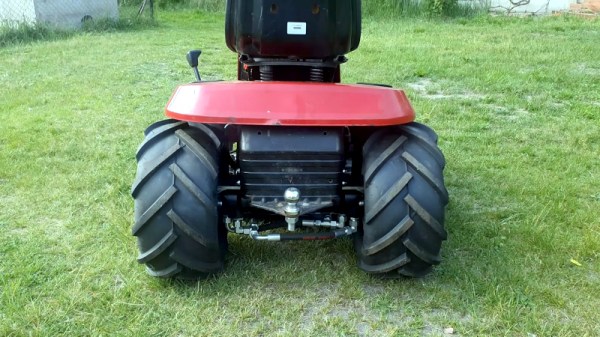
Most larger ride-around landscaping machinery has a similar transmission, a transaxle containing a gearbox, or in some cases, a continuously variable drive. [Made In Garage] has a Toro lawn tractor with just such a setup, and when the transaxle failed he replaced it with a hydraulic drive.

The video below is a classic bit of workshop porn, as he fabricates both the hubs and the rear frame to fit a pair of hydraulic motors. The throttle pedal is a hydraulic valve with the lever swapped for a pedal, and the hydraulic reservoir, in a nice touch, is an old fire extinguisher.

We’re not so sure about the pipework in such an exposed position under the machine as we think it would inevitably be damaged, but you can’t argue with the results. Having used a rough service mower with a hydraulic drive in the past, we appreciate always being exactly at the right ratio for the engine.

We think perhaps he should complement it with a loader.

Continue reading “Hydraulic Drive For Your Lawn Tractor”

Image

A Special Type Of Mower For Rocky Fields

Ever since wealthy European landowners started displaying vast, unused swaths of turfgrass as status symbols, regular folk have been chasing that perfectly mown and tended lawn for similar reasons. In the modern era, most mowers used to maintain these spaces use a spinning blade attached to a motor of some sort, but this can be dangerous especially on rocky fields like [Greenhill Forge] needs to mow. For these fields it’s best to use a different type of mower, and he’s built one from scratch.

This type of mower is called a flail mower, which has hinged, sharpened hammers attached to a central rotating drum. Since the flails have less rotational speed at the ends, they are less dangerous if they strike solid objects like rocks. To build one, he first builds the central drum and flails, then the enclosure to mount it to his tractor, and then a drivetrain to attach it to the tractor’s PTO. Since everything is getting built in [Greenhill Forge]’s metalworking shop, many of the parts needed to be fabricated from scratch, which involved several jigs for the plasma cutter as well as forging some steel to make some of the thicker parts.

Although not many of us have fully-stocked metalworking shops like this, it shows that almost anything can be built with the right tools. A forge is actually fairly accessible for those looking to start smithing; we’ve seen them built from little more than an off-the-shelf unmodified microwave or from a propane torch and some cookware.

Image

See Aerodynamics In Action With A Desktop Wind Tunnel

While most of us don’t design aircraft or racing cars, it’s likely that we’re still fascinated by some of the aerodynamic studies behind them. But a full-sized wind tunnel is going to cost a small fortune, so how can we experiment? Never fear, because [luisengineering] is here with a 3D printable desktop wind tunnel.

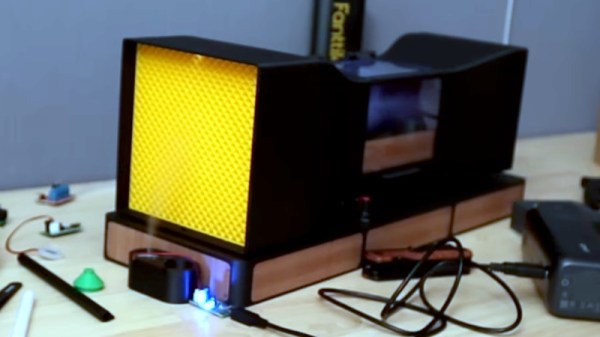
There’s a build video that we’ve embedded below, and if you can sit through the continuous shilling of random tools, it’s an interesting watch. It’s an open design in that air is not recirculate through it, instead it passed through the machine from left to right. On the right is the fan, on the left the intake with a rectifier to ensure laminar flow. Then a constriction compresses and speeds up the air past the stage for the model under test, and an expansion slows it down again for the fan.

A wind tunnel needs a smoke generator to easily spot turbulence, and in this case a vape is called into action. The result is surprisingly effective, as we see with a demonstration using a small model car. Meanwhile if you’re interested in wind tunnels at this size, it’s not the first one we’ve brought you.

Continue reading “See Aerodynamics In Action With A Desktop Wind Tunnel”

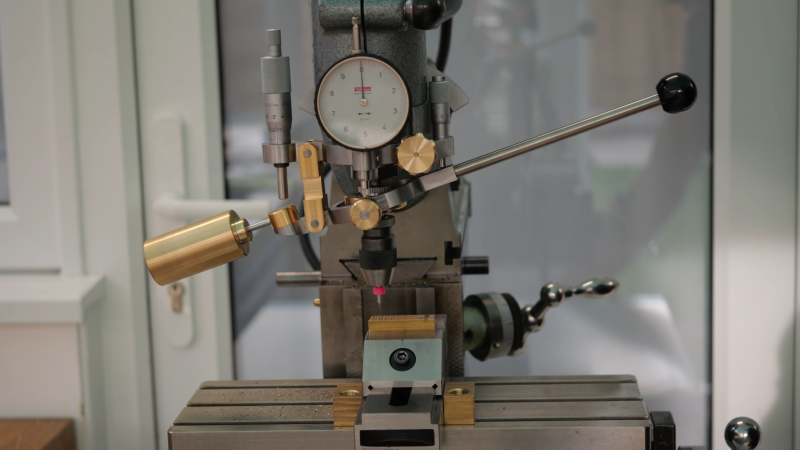
A mechanism made of brass and steel is attached to a milling machine. It has a long lever extending from the right side, a counterweight attached to the left side, and an indicator gauge in the middle.

A Precision Drill Press For Tiny Bits

Anyone who’s worked with even a 1 mm bit knows that while a drill press is all but essential, it isn’t proof against broken bits. Working with a 0.1 mm drill bit seems, therefore, all but impossible, which is why [Mike] of Chronova Engineering built this mechanism to simplify such drilling.

The mechanism is an attachment for a milling machine, and in principle it just needs to move the rotating drill bit up and down. It needs to be extremely precise, though. For context, a good-quality chuck normally has a runout of 30 to 50 microns, which is approaching half the diameter of the drill bit. The mechanism has a collet mounted in the milling machine’s spindle, which transfers rotation to a second spindle. The second spindle is mounted to a runout-compensating drill chuck, and is connected to a lever and counterweight which allow the user to make small, low-force movements. A dial indicator lets the user see how far the bit’s descended.

Most of the parts were machined out of steel or brass, with the handle being made of titanium for lower weight. When the finished device was mounted to the milling machine, the measured runout was severe. After much investigation and reworking, however, the problem turned out to be a damaged collet locating pin, not an issue with the drilling mechanism. As a first test, [Mike] drilled a 0.1 mm hole 1.8 mm deep, then as a challenge drilled six 0.1 mm holes in the end of a thin steel wire. The results weren’t quite as uniform as he wanted, but it took a scanning electron microscope to even see the imperfection.

It won’t help much with very fine drill bits, but if you need a very precisely-placed hole, check out this periscopic drilling camera. If you do break a drill bit in the workpiece, you might be able to dissolve it with alum.

Continue reading “A Precision Drill Press For Tiny Bits”