Image

Bambuddy Says Bye To Bambu Lab Cloud Services

If you have a Bambu Labs printer and aren’t keen to send your files to Bambu’s servers with each print job, then check out Bambuddy, an open-source, self-hosted, cloud-free central command that offers a local alternative for managing Bambu Labs printers. It acts as a replacement for the official cloud services, allowing you to slice, print, and monitor with full local control and zero reliance on Bambu Labs’ servers. Continue reading “Bambuddy Says Bye To Bambu Lab Cloud Services”

Image

Behold A 60 Hz Refresh Rate E-ink Monitor

E-ink displays have a number of advantages over other display types, but their refresh rate isn’t one of them. But what exactly makes them slow? According to [Wenting Zhang], it’s not an inherent limitation of the technology. It’s mainly the controller, and this limitation can be overcome to create a high-resolution 60 Hz refresh rate E-ink display, totally suitable for use as a computer monitor.

ImageThe reason E-ink displays are so slow is simple. For a long time, they existed for only one purpose: to be screens for e-readers. They had to work on devices that were generally low power, with limited interfaces and slow processors. Accommodating these factors was the primary driver behind the high latency and slow refresh rates associated with these displays.

It was actually the limited interface options rather than the slow refresh that initially led to a custom controller, because [Wenting] wanted to use an E-ink display on a laptop build. But it quickly became apparent that a custom controller could do considerably more than E-ink was known for.

Initial tests with fast refresh rates were so positive that it led to a Hackaday Supercon 2024 talk on how to make E-ink go fast, and more recently has culminated in the Modos Flow, a fully open-source, user-repairable 13.3″ portable E-ink monitor.

The development path from proof of concept to finished product has been a long one for [Wenting]. Not only did a lot of optimization and feature work need to be crafted from scratch in order to effectively balance appearance with responsiveness in different display modes, but the usual hassles of development and bad timing were also in full force. On top of it were wasteful vendor shenanigans, as well.

Check out the story in the video, embedded just below. If you’d like to buy one, there are monochrome and color versions offered through Crowd Supply.

Continue reading “Behold A 60 Hz Refresh Rate E-ink Monitor”

Image

After The Dust Settles: Building Pebble Apps

For a piece of wearable technology, Pebble has had a fairly “rocky” history. One of the most successful Kickstarters of its era, it went on to get acquired by FitBit, quietly shelved by them, then acquired by Google and open-sourced, where it’s now somewhat back in the hands of its original creator. Its new open source nature means that regular people can develop for these popular watches again, and [Coconauts] have developed a guide for these watches, new and old.

The original watches had to be coded using C, which is a fundamental language but one that generally isn’t used much in the modern world outside of embedded systems and other areas where efficieny is important. C does much less hand-holding than modern languages, so there are a number of things to keep an eye on when coding for these watches that languages like Rust, Go, and Python handle on their own. Regardless, the two-person team recently built a pair of apps for the Pebble platform as part of an app-making contest, one which notifies the user that the watch is charged to 80%, and another that shows an interactive kitten on the watch’s face.

Both of the apps are available from the Pebble app repository, and from there the source code can be found on respective GitHub pages if you’re looking for some examples to dust off old C skills. If you happen to have an old Pebble watch or always wanted one but didn’t want to deal with FitBit, now might be a good time to get them out and start tinkering around with it since it’s now in the open-source domain.

Image

Retro Open Source Camera Straight From The ’90s

In our modern society, we have started to take the humble camera for granted. Perhaps because of this, trendy standalone cameras have started to take off. Unfortunately, most of the time these cameras are expensive and not any better than those in our everyday smartphones. If only there were some open-source solution where you could build and customize your own standalone device? [Yutani] has done just that with the SATURNIX.

Simple microcontrollers and cameras meant for Raspberry Pis are a dime a dozen these days. Because of this, it’s no surprise to hear that the SATURNIX is based on recognizable hardware, a Raspberry Pi Zero 2W and an Arducam 16MP sensor. The Pi Zero powers both the sensors’ capture abilities and the interactive LCD display.

Continue reading “Retro Open Source Camera Straight From The ’90s”

Image

Playful ‘Space Dice’ Kit Shows Off Clever Design

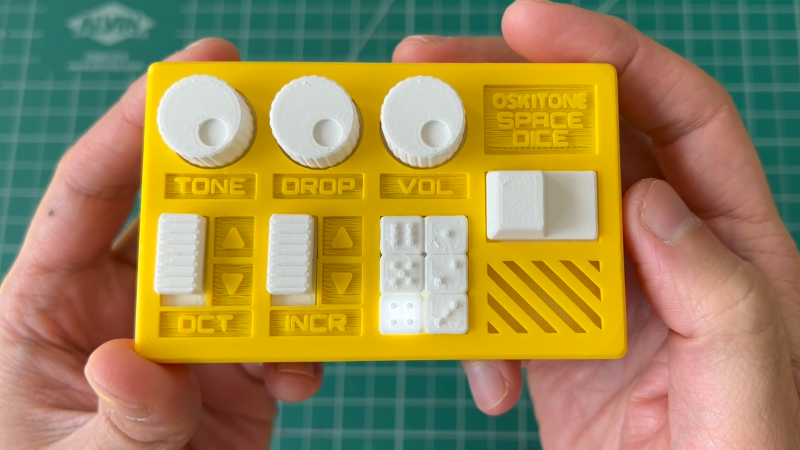
[Tommy] at Oskitone has been making hardware synth kits for years, and his designs are always worth checking out. His newest offering Space Dice is an educational kit that is a combination vintage sci-fi space laser sound generator, and six-sided die roller. What’s more, as a kit it represents an effort to be genuinely educational, rather than just using it as a meaningless marketing term.

There are several elements we find pretty interesting in Space Dice. One is the fact that, like most of [Tommy]’s designs, there isn’t a microcontroller in sight. Synthesizers based mostly on CMOS logic chips have been a mainstay of DIY electronics for years, as have “electronic dice” circuits. This device mashes both together in an accessible way that uses a minimum of components.
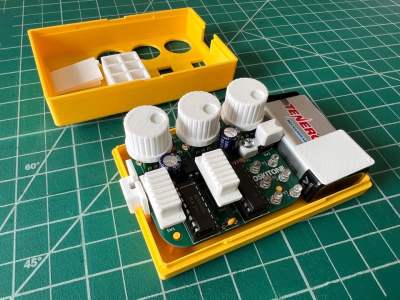
ImageThere are only three chips inside: a CD4093 quad NAND with Schmitt-trigger inputs used as a relaxation oscillator, a CD4040 binary counter used as a prescaler, and a CD4017 decade counter responsible for spinning a signal around six LEDs while sound is generated, to represent an electronic die. Sound emerges from a speaker on the backside of the PCB, which we’re delighted to see is driven not by a separate amplifier chip, but by unused gates on the CD4093 acting as a simple but effective square wave booster.

In addition, [Tommy] puts effort into minimizing part count and complexity, ensuring that physical assembly does not depend on separate fasteners or adhesives. We also like the way he uses a lever assembly to make the big activation button — mounted squarely above the 9 V battery — interface with a button on the PCB that is physically off to the side. The result is an enclosure that is compact and tidy.

We recommend checking out [Tommy]’s concise writeup on the design details of Space Dice for some great design insights, and take a look at the assembly guide to see for yourself the attention paid to making the process an educational one. We love the concept of presenting an evolving schematic diagram, which changes and fills out as each assembly step is performed and tested.

Watch it in action in a demo video, embedded just below. Space Dice is available for purchase but if you prefer to roll your own, all the design files and documentation are available online from the project’s GitHub repository.

Continue reading “Playful ‘Space Dice’ Kit Shows Off Clever Design”

Image

Slug Algorithm For On-GPU Rendering Of Fonts With Bézier Curves Now In Public Domain

The Slug Algorithm has been around for a decade now, mostly quietly rendering fonts and later entire GUIs using Bézier curves directly on the GPU for games and other types of software, but due to its proprietary nature it didn’t see much adoption outside of commercial settings. This has now changed with its author, [Eric Lengyel], releasing it to the public domain without any limitations.

Originally [Eric] had received a software patent in 2019 for the algorithm that would have prevented anyone else from implementing it until the patent’s expiration in 2038. Since 2016 [Eric] and his business have however had in his eyes sufficient benefit from the patent, making it unnecessary to hold on to it any longer and retain such exclusivity.

To help anyone with implementing their own version of the algorithm, there is a GitHub repository containing reference shader implementations with plenty of inline comments that should help anyone with some shader experience get started.

Although pretty niche in the eyes of the average person, the benefits of using on-GPU rendering of elements like fonts are obvious in terms of rendering optimization. With this change open source rendering engines for games and more can finally also use it as well.

Thanks to [Footleg] for the tip.

Image

One Sailing Pulley To Rule Them All

When thinking of humanity’s ability to harness wind energy, many people will conjure images of windmills from places like The Netherlands or Persia. But people have been using wind energy for far longer than that in the form of sailing ships. Using the wind for transportation goes back another four thousand years or so, but despite our vast experience navigating the seas with wind alone there is still some room for improvement. Many modern sailboats use a number of different pulleys to manage all of the rigging, but this new, open-source pulley can replace many of them.

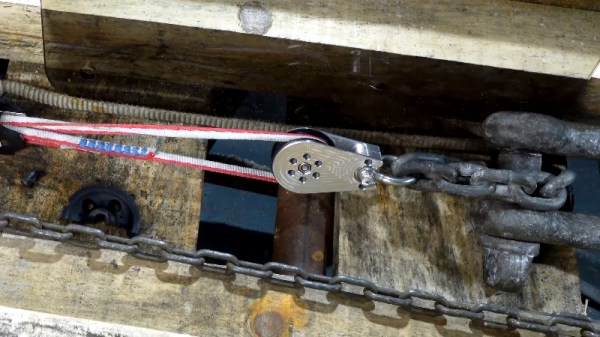
The pulley, or “block” as they are sometimes called, is built with a polymer roller made out of a type of nylon, which has the benefit of being extremely durable and self-lubricating but is a bit expensive. Durability and lack of squeakiness is important in sailing applications, though. The body is made from CNC-machined aluminum and is composed of two parts, which pivot around the pulley’s axis to allow various ropes (or “lines”) to be inserted without freeing one end of the rope. In testing, this design outperformed some proprietary stainless steel pulleys of similar size.

Another perk of this design is that it can be set up to work in many different applications on a sailboat, whether that’s for hoisting a mainsail or pulling in a jib or any other task a pulley could be used for. It can also be stacked with others in many different configurations to build custom pulleys of almost any type, and can support up to 14 mm lines. For a sailor this could be extremely valuable, because as it stands each pulley on a ship tends to be used in only certain applications, and might also be proprietary from a specific company. This pulley is being released into the open-source world, allowing anyone to create them who wants one.

Thanks to [Keith] for the tip!

Continue reading “One Sailing Pulley To Rule Them All”