Theory and practice of NEXTION HMI programming: The Sunday Blog is an almost weekly publication for NEXTION HMI users by our technical writer Thierry. He is a French-German mathematician and musician and an active Nextion HMI developer, specialized in interfaces for electronic music.

We develop didactical projects. The idea behind is to show advanced programming techniques in NEXTION language. Or to learn more about communication between the NEXTION HMI and various MCUs, like for example Arduino, STM, ESP, or Teensy.

We always explain the theoretical and sometimes historical background first. That’s the theory of NEXTION HMI programming. Then, sometimes over several episodes, we’ll show the practice of NEXTION HMI programming. You may then re-use these practical examples or adapt them to your needs. All HMI project example code is available for download either in the NEXTION Forums or directly inside the article.
22 06, 2026

The Nextion Web Serial Framework is alive – and online!

By |2026-06-22T06:14:53+08:00June 22nd, 2026|Categories: The Sunday Blog|Comments Off on The Nextion Web Serial Framework is alive – and online!

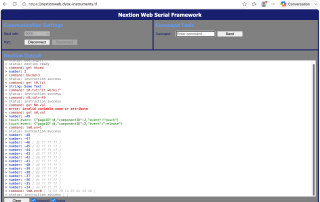
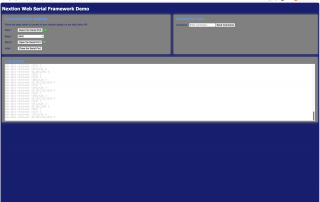
As promised in my last blog, here a first release of the Nextion Web Serial Framework! It allows to interact with all "classic" Nextion HMIs, be it the Basic, the Enhanced, the Intelligent, the Discovery, or the Edge series without having to install the Nextion Editor. A computer running Windows, macOS, or Linux and a web browser with Serial Api support. The current releases of Mozilla Firefox, Google Chrome, Microsoft Edge, and Opera will do the job. I understand that you can't wait to try it out, but please continue reading, first, I'll give you the URL of the live version and the GitHub repo below!

8 06, 2026

Control your Nextion HMI from (almost) any web browser

By |2026-06-08T05:14:46+08:00June 8th, 2026|Categories: The Sunday Blog|Comments Off on Control your Nextion HMI from (almost) any web browser

In the beginning, there was an email from a reader who asked if there was a stand-alone version of the Nextion upload tool, which is normally integrated in the Nextion Editor. The reader had created a commercial project around a Nextion HMI, and sold several hundreds worldwide. The problem now is updates. Many of his customers are not really ok with installing the whole Nextion Editor just for flashing a new tft file. Thus his request, which we couldn't yet satisfy. But recently, I stumbled over an amazing thing which is in the world for some time. It's called the Web Serial API which allows to access local serial ports from a web page via Javascript. In the beginning, there was not much browser support, but now, there are Chrome, Edge, Opera, and Firefox which support it. And the initial security concerns (access local resources from the web???) are also solved: the user has to select and authorise the serial port access each time the page with the web serial application is loaded.

26 05, 2026

How to develop Open Nextion projects natively on Mac

By |2026-05-26T04:10:08+08:00May 26th, 2026|Categories: The Sunday Blog|Comments Off on How to develop Open Nextion projects natively on Mac

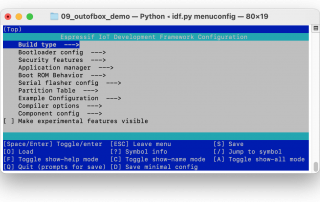
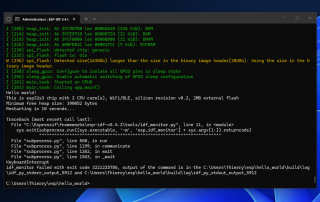
Most Nextion enthusiasts are used to developing with a comfy IDE, that's why I started blogging about the Genius series HMI and the underlying Open Nextion standard using the Arduino IDE and VS Code (part II here), using the corresponding plugins. The underlying framework, the ESP-IDF, provided by Espressif, the manufacturer of the ESP32s3, the heart of the Genius series HMI, is a huge collection of command line software, comprising libraries, compiler, linker and additional tools. Thus, the side behind the mirror for most of us. Nevertheless, I learned how to deal with it and wrote about my experience under Windows here. Afterwards, I found that it was less complicated as I had feared, and I decided to repeat the experience on one of my Macs.

11 05, 2026

“Bare Metal” coding for Open Nextion with the ESP-IDF

By |2026-05-11T06:02:10+08:00May 11th, 2026|Categories: The Sunday Blog|Comments Off on “Bare Metal” coding for Open Nextion with the ESP-IDF

The new Open Nextion programming model and the new Genius series HMI have come to market a few weeks ago, and the user community doesn't stop asking questions... Again, Open Nextion and the Genius series HMI will NOT replace the other series and their easy and convenient developing with the Nextion editor. These will remain in production as promised by the long term availability guarantee. Open Nextion and Genius are an extension of the product range. If you are unsure what to choose, depending of your project specifications, read my blog from last Sunday!

4 05, 2026

Your questions about Open Nextion – and my answers

By |2026-05-04T02:40:19+08:00May 4th, 2026|Categories: The Sunday Blog|Comments Off on Your questions about Open Nextion – and my answers

Since I started writing about Open Nextion and the new Genius series HMI, I got many emails from readers of this Nextion Sunday blog, all asking more or less similar questions. So, I allow today to publish this compilation of your questions and my answers. If you are unsure if you should move over from the classic Nextion HMI to Open Nextion, please read the conclusion towards the end of this article, after the questions and answers.

27 04, 2026

Coding for Open Nextion on the next level: VS Code – Part II – getting ready!

By |2026-04-27T06:38:20+08:00April 27th, 2026|Categories: The Sunday Blog|Comments Off on Coding for Open Nextion on the next level: VS Code – Part II – getting ready!

Coding for Open Nextion on the next level: VS Code – Part II - getting ready! In last week's blog, we started installing the free VS Code IDE and to add the ESP IDF extensions. It's a long process at the beginning, but almost everybody who moved from the Arduino IDE to VS Code feels

Go to Top