Log inSign up
Stuart Hameroff
4,591 posts
user avatar
Stuart Hameroff
@StuartHameroff
I am a retired Anesthesiologist and Professor, and active consciousness researcher at The University of Arizona.
Tucson, Arizona
quantumconsciousness.org
Joined December 2010
173
Following
27.5K
Followers
  • user avatar
    Stuart Hameroff
    @StuartHameroff
    Jun 9, 2025
    Ilya Sutskever is wrong on this. The brain is not a digital computer and not really a computer at all, more like a quantum orchestra. Biology is based on organic carbon which supports quantum processes and self-similar dynamics in hertz, kilohertz, megahertz, gigahertz and
    user avatar
    Yuchen Jin
    @Yuchenj_UW
    Jun 9, 2025
    Ilya Sutskever, in his speech at UToronto 2 days ago: "The day will come when AI will do all the things we can do." "The reason is the brain is a biological computer, so why can't the digital computer do the same things?" It's funny that we are debating if AI can "truly think"
    Image
    00:00
    Image
    Consciousness, Cognition and the Neuronal Cytoskeleton - A New Paradigm Needed in Neuroscience -...
    From pubmed.ncbi.nlm.nih.gov
    637K
  • user avatar
    Stuart Hameroff
    @StuartHameroff
    Nov 12, 2025
    Microtubules are actual biological structures in every and all cells which utilize automata functions, classical and quantum to orchestrate living matter to have conscious moments. I told Stephen Wolfram about it in late 80s at Los Alamos.
    Image
    user avatar
    Jaime
    @jaimeojedas
    Nov 11, 2025
    Replying to @StuartHameroff
    Maybe consciousness is just geometry learning to feel. Hameroff finds it in microtubules. Wolfram maps it in automata. Oxygen might be where both converge.
    42K
  • user avatar
    Stuart Hameroff
    @StuartHameroff
    Jul 24, 2025
    Dinner last week with Roger Penrose in Oxford. He discussed new findings in CCC theory, twistors and Eschermatics. I tried to convince him his OR prompted the origin of life.
    Image
    22K
  • user avatar
    Stuart Hameroff
    @StuartHameroff
    Oct 24, 2024
    Consciousness in the brain is a hologram generated by interference among quantum oscillations in spacetime geometry from laser-like coherence in microtubules in cortical pyramidal neurons.
    user avatar
    Deepak Chopra
    @DeepakChopra
    Oct 24, 2024
    The brain is the form consciousness assumes to appear as the universe ⁦@StuartHameroff⁩ ⁦⁦⁦@davidchalmers42⁩
    Image
    00:00
    Image
    Frontiers | Consciousness, Cognition and the Neuronal Cytoskeleton – A New Paradigm Needed in...
    From frontiersin.org
    177K
  • user avatar
    Stuart Hameroff
    @StuartHameroff
    Aug 5, 2025
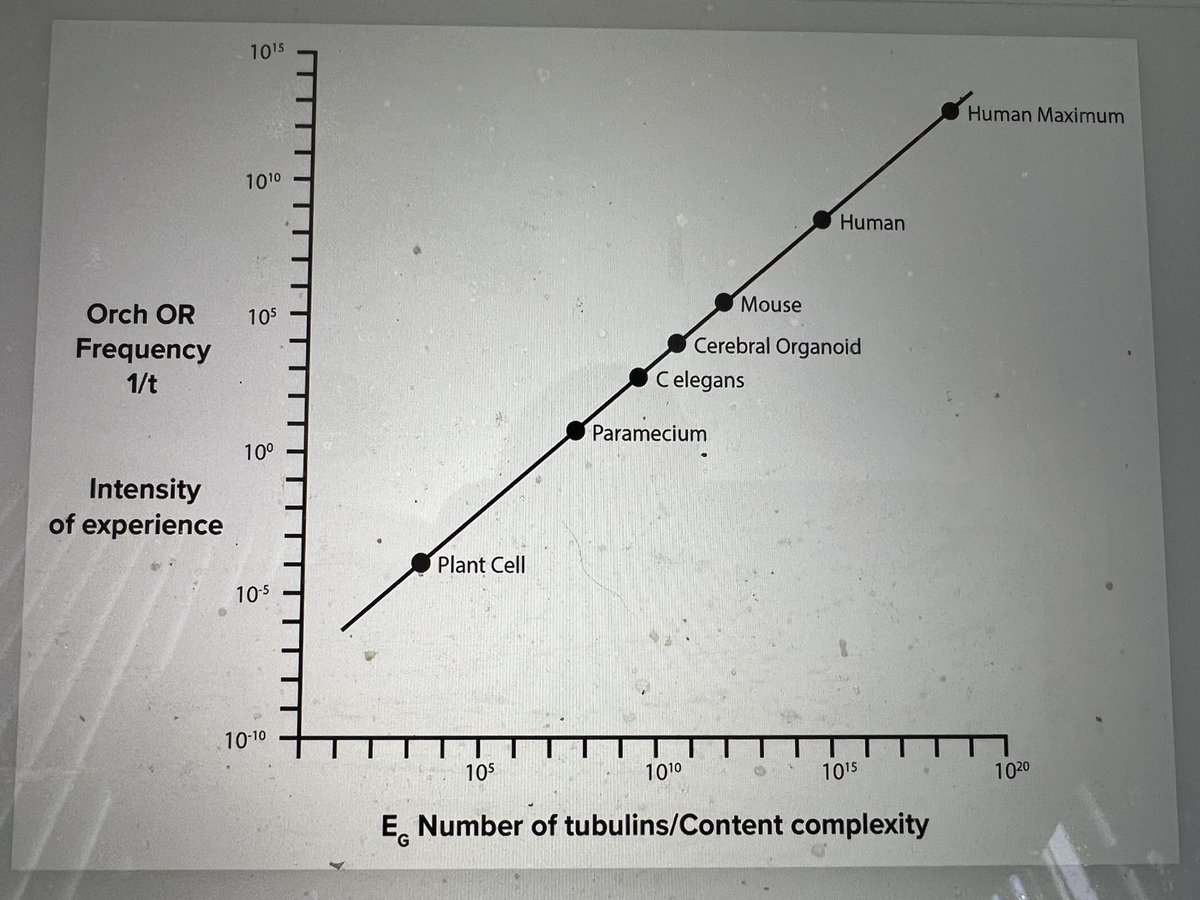
    All animals and plants have microtubules and are conscious, just at lower frequencies, intensity and content. We humans have 10 million Orch OR moments per second. A sunflower a few per minute.
    user avatar
    Rowan Brad Quni-Gudzinas
    @RowanQuni
    Aug 4, 2025
    Replying to @StuartHameroff
    Why are we still making a distinction between consciousness and any other physical or biologic process? This is anthropocentrism at its core. But we're just not that important as humans.
    29K
  • user avatar
    Stuart Hameroff
    @StuartHameroff
    Jun 13, 2024
    Plants have microtubules and their phototropism is inhibited by anesthesia. They probably have ten conscious moments per minute. We have 10,000,000 per second.
    Image
    user avatar
    Anita Leirfall
    @anitaleirfall
    Jun 12, 2024
    Do plants have minds? Can we see past our soul-blindness to recognise plant minds? In the 1840s, the iconoclastic scientist Gustav Fechner made an inspired case for taking seriously the interior lives of plants aeon.co/essays/can-we-… (via @aeonmag)
    59K
  • user avatar
    Stuart Hameroff
    @StuartHameroff
    Oct 23, 2024
    Fungi make intelligent decisions. No neurons, but lots of microtubules (MTs). Quite likely MTs oscillate, entangle and have Orch OR conscious moments, far less frequent or intense than ours. (Though some fungi have psilocybin.) @jackieappel
    Image
    Fungal ‘Brains’ Can Think Like Human Minds, Scientists Say
    From popularmechanics.com
    28K
  • user avatar
    Stuart Hameroff
    @StuartHameroff
    May 9, 2024
    According to this graph, plants have one conscious moment every few minutes. Most humans have them 10 million per second. You, I’m not sure.
    Image
    user avatar
    Crispin Cowan 🇺🇦
    @CrispinCowan0
    May 9, 2024
    Replying to @Shaktidass18 @CloserToTruth and 3 others
    Plants are not conscious.
    61K
  • user avatar
    Stuart Hameroff
    @StuartHameroff
    Apr 28, 2025
    Consciousness got bored and invented life as a vehicle, according to the Upanishads
    user avatar
    Fractal Sentience
    @RecusiveMind
    Apr 28, 2025
    Replying to @StuartHameroff
    Very much agree that life and consciousness are marginally discernible, particularly when biology is viewed as a vehicle for the expression of awareness rather than its origin.
    30K
  • user avatar
    Stuart Hameroff
    @StuartHameroff
    Jan 15, 2025
    I sat outside the studio during Roger’s interview. @joerogan Joe didn’t want to talk to me. Maybe because I’d say mainstream neuroscience, AI and philosophy are clueless about how the brain works. It’s not a complex computer of cartoon neurons. It’s a quantum orchestra of
    user avatar
    Sterling Cooley
    @SterlingCooley
    Jan 15, 2025
    Roger @penrose discusses Microtubules being brought to his attention by @StuartHameroff on the @joerogan podcast Microtubules are becoming a hotter and hotter topic by the month And we have these radical dudes to thank for that 🙏
    42K
  • user avatar
    Stuart Hameroff
    @StuartHameroff
    Apr 29, 2025
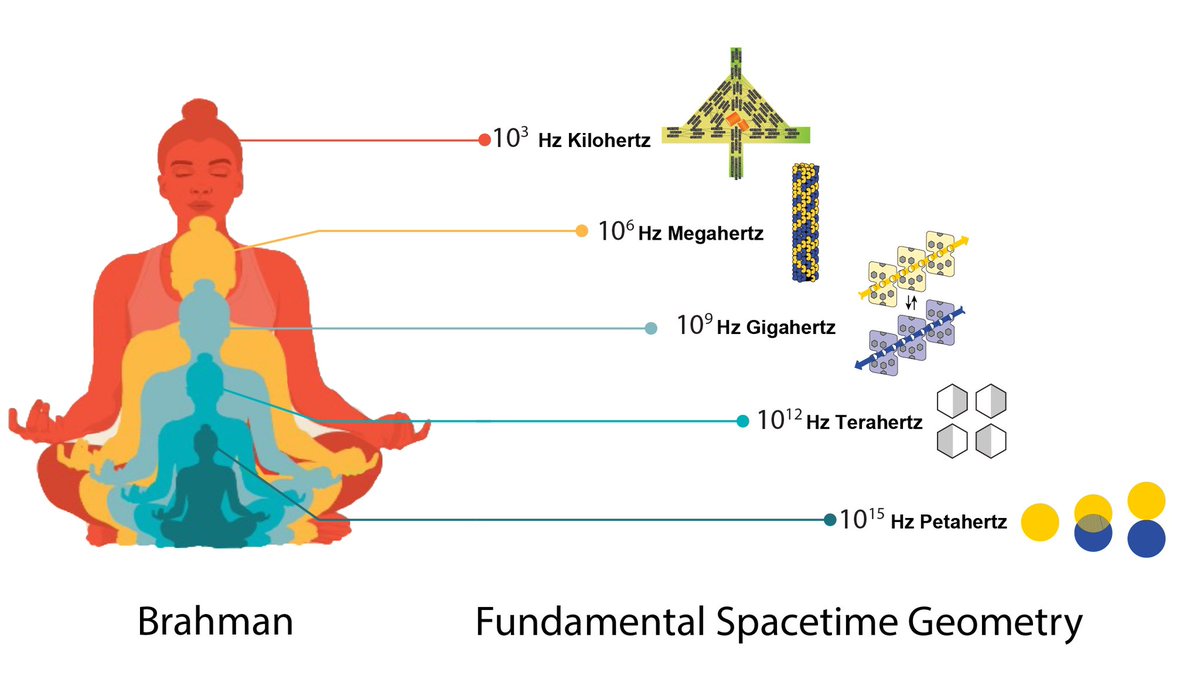
    Indian knowledge system 5 Koshas kinda matches Anirban’s microtubule time crystal hierarchy.
    Image
    user avatar
    Suzanne Gildert
    @suzannegildert
    Apr 29, 2025
    Replying to @geo_anima and @StuartHameroff
    Agree! 💯
    32K
  • user avatar
    Stuart Hameroff
    @StuartHameroff
    Mar 30, 2025
    Consciousness didn’t evolve. It preceded life and prompted its origin and evolution. Feelings drive behavior.
    user avatar
    Rational Pantheism
    @RationalPanthe1
    Mar 30, 2025
    Replying to @tahoppe05404 and @StuartHameroff
    Evolution doesn't involve novel things supernaturally springing into being, it instead involves gradual change via weak emergence.
    Image
    galileocommission.org
    The Quantum Origin of the Life: How the Brain Evolved to Feel Good
    The Quantum Origin of the Life: How the Brain Evolved to Feel Good   book chapter in On Human Nature   Stuart Hameroff, 2017 To download a pdf, please click here. Introduction: Which Came First,...
    33K
  • user avatar
    Stuart Hameroff
    @StuartHameroff
    Aug 12, 2025
    Consciousness can be defined as what goes away under general anesthesia and returns when the anesthesia is gone. You might complain that’s too restrictive to biology, but consciousness depends on organic carbon chemistry essential to life. Organic carbon brings the quantum in
    user avatar
    Rizwan Virk
    @Rizstanford
    Aug 12, 2025
    Replying to @StuartHameroff
    Not sure if AI can become conscious, but: if it acts just like it's conscious, how would we know or prove that it isn't? We'd need a non-behavioral definition of consciousness that could still be tested but wasn't so restrictive it could only apply to biological entities.
    44K
  • user avatar
    Stuart Hameroff
    @StuartHameroff
    Jun 4, 2025
    The ‘higher level’ communication @MichaelLevin studies is almost certainly related to higher frequency megahertz and gigahertz oscillations and entanglement among microtubules in different cells. Michael uses static fields, a special zero frequency case for microtubule time
    user avatar
    Vicky Verma
    @Unexplained2020
    Jun 2, 2025
    This will totally blow your mind. This Man found in his compelling study that our cells use higher-level systems to talk to each other and organize what they do. One of those higher-level systems is bioelectricity — a kind of electrical communication that happens not just in
    Image
    Image
    journals.physiology.org
    Electrophysiology using coaxial atom probe array: live imaging reveals hidden circuits of a...
    Since the 1960s, it is held that when a neuron fires, a nerve spike passes only through the selective branches, the calculated choice is a key to learning by rewiring. It is argued by chemically...
    38K

New to X?

Sign up now to get your own personalized timeline!

Create account

By signing up, you agree to the Terms of Service and Privacy Policy, including Cookie Use.

Terms·Privacy·Cookies·Accessibility·Ads Info·© 2026 X Corp.
Don't miss what's happening
People on X are the first to know.
Log inSign up
Advertisement
Advertisement