Latest from Asymco

  • History says yes.

    The global smartphone market is facing structural pressure from rising memory prices. In particular, the spread of AI technology is sharply increasing demand for high-performance memory, tightening supply and pushing prices up quickly. As a result, some Android manufacturers have raised prices on new products, and low-margin budget models could shrink in the market. The industry also sees the trend as potentially leading to a contraction in the overall Android market size.

    Against this backdrop, Apple has chosen a strategy of keeping prices for its main models unchanged. Pu’s analysis said the iPhone 18 Pro is likely to start at $1,099 and the Pro Max at $1,199, maintaining the existing price range. That would be the same as the previous model. It is interpreted as a strategy to secure price competitiveness even if Apple accepts some margin decline to defend market share.

    Apple is also expected to pursue a two-track strategy that considers both price accessibility and profitability. It would keep base-model prices to lower the barrier to entry, while raising prices for higher-end models with larger storage capacity to offset profits. It has also been suggested that an ultra-premium iPhone 18 Ultra could be added, and the overall average selling price (ASP) is expected to rise.

    Ultimately, Apple’s strategy aims to exploit weaknesses in the Android camp, which is under pressure to raise prices. While rivals face demand contraction from higher prices, Apple could keep prices relatively stable and expand user inflows. A recent rise in demand from Android users switching to iPhones has also been detected, raising the likelihood that Apple will strengthen its influence in the premium market through this strategy.

    Source: 디지털투데이 via Analyst: Jeff Pu

    NB: There is always a huge surprise when Apple does the same thing it always does.

    (more…)
  • Measuring how far India will go in production.

    According to The Economic Times, citing unnamed sources, “Tata Electronics has expanded its workforce to 75,000, surpassing Taiwanese rival Foxconn’s headcount in the country, making it Apple’s largest contract manufacturer by headcount currently.” The report added that the expansion has been driven primarily by its large-scale Hosur facility in Tamil Nadu.

    Supply-chain sources said the company’s workforce growth marks a sharp increase from about 15,000 in 2023, reflecting an aggressive scaling strategy supported by major capital investment, factory acquisitions, and rapid capacity buildout. The expansion includes its 500-acre Hosur campus, which has become the core hub of iPhone assembly in India.

    Tata Electronics has combined acquisitions of Taiwanese contract manufacturers’ Indian assets with greenfield investment to accelerate entry into Apple’s supply chain. It acquired former Wistron(3231.TW) and Pegatron(4938.TW) facilities, while simultaneously expanding its Hosur plant, which began iPhone assembly operations in 2025.

    In addition to assembly, the company is also moving upstream into semiconductor assembly and test (OSAT) and component localization, supported by large-scale funding injections in recent fiscal years. These investments aim to build a vertically integrated electronics manufacturing base spanning assembly, packaging, and supply chain services.

    The reported figure of 75,000 employees reflects both direct and acquired operations across Tata Electronics’ manufacturing footprint in southern India. One source noted that the rapid scale-up has enabled the company to meet Apple’s production requirements while overtaking Foxconn(2317.TW) in local headcount, although industry participants expect rankings to fluctuate as other facilities ramp up.

    Source: Source

    NB: If we add Tata and Foxconn, we are probably in the 200,000 range this year. The comparable China model is …

    (more…)
  • Asked by Jay Goldberg

    Q: Do you think Apple will start investing heavily in AI data centers?

    There’s rumors and actually statements from Apple saying that they’re working on a server chip. Google has a server chip. Amazon’s got a server chip. These are effectively aimed at Nvidia. And if you can make something, you tend to do it. Now, of course, there’s some protection — Nvidia’s got other special sauce, but their margin is everybody’s opportunity. They have a huge margin. And everybody’s writing huge checks. As I say, hyperscalers are just handing over their entire cash flows to Nvidia. And that means their shareholders’ entire wealth is being handed off to Nvidia shareholders. So there’s a transfer of wealth happening right now. Presumably, because we’re going to get some benefit later, but if that’s happening and people are irritated by it, they’re going to find a way to do what Nvidia does.

    And Apple, of course, can and will do that. Now, whether that’ll get deployed at the edge or in Apple’s own cloud — because they probably also don’t want to write checks to Nvidia, and they’ll say, well, we can do it, and we won’t necessarily sell them, like Google wants to. They’ll probably just use them themselves. And that’s something certainly they’re capable of.

    The question I was always asking is how many are we talking about? Because if it’s in the tens of millions, or even single-digit millions — for Apple, single digits. Is it worth it to develop your own designs? There’s a limit to how many you can deploy. And probably you’re going to have to replace them every so often, so there’s a question about how much it costs to keep on the treadmill.

    But it is an interesting question, and I think everybody’s capable of doing what Nvidia’s doing. But it’s about execution, timing, delays. Look at what happened with the Qualcomm chip — how long it took Apple to finally deploy the communications chip relative to the amount of grief it had to deal with. First, of course, it moved out of Intel. It moved out of Qualcomm now, and now the question is, is it going to move out of the server supplier chain? And that’s a complex decision. But again, Apple’s not doing it because they want to be in that business. It’s more that they want to avoid dependency.

    This was one of the questions asked by the participants in Asymco’s May 2026 Office Hours live Q&A sessions, open to Asymco One subscribers.

    See also: May 2026 Office Hours

  • Office Hours question asked by Frederich H. on May 1, 2026.

    Q: Any thoughts on the breakdown of R&D, with that big jump?

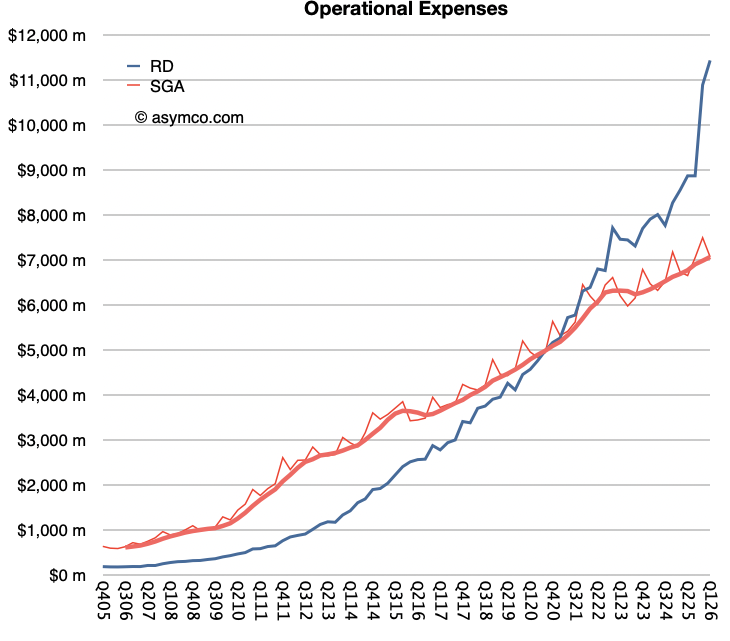
    It’s hard to tell. I do think they’re buying — that does include some hardware. A lot of hardware. I think they’re building quite a bit of capacity in order to implement their versions of AI. They’re not for deployment, but they’re for testing and experimenting. They’re hiring people as well, obviously that’s included. But I do think it used to be they bought equipment for testing — I don’t know, radio frequencies, and testing the iPhones, and semiconductors, and testing a lot of things like that. But I do think probably there’s a lot more spending now on the stuff that feeds AI. It’s not on the level that a hyperscaler’s doing, because they’re building it for scale, and Apple’s maybe building it for testing.

    We’re talking about here, look, $11 billion in R&D, that’s in one quarter. So that goes out to about $40 billion a year.

    Mostly, I think this is people, but there is some equipment involved. It’s just maybe different ways of capitalizing it, because capital equipment is a complex story.

    It seems like a big jump, but it’s only $2 billion more compared to the prior period. It’s recurring though. And the reason that this stays steady and keeps growing is because people are on the payroll. And so if there’s more and more people, that’s paid every period — the reason, by the way, you see SG&A being seasonal is because there’s temporary people in the stores. That involves people who are hired for the holidays in the Apple stores. So that’s where you see some less than steady. But engineering people are more steady. But if there’s a spike, there might be something going on where there was some equipment involved.

    See also R&D Acceleration section of Apple 2026 FQ2 Presentation.


    Editor’s Note: This is a lightly-edited revision of a question asked by participants in Asymco’s May 2026 Office Hours live Q&A sessions, open to Asymco One subscribers.
  • An Office Hours question asked by Fred S., May 1, 2026

    Q: Ever since Johny Srouji started talking about Apple Silicon and the power consumption for the performance and the unified memory, and now we’ve seen the Mac mini surge, I just wonder about high-end computing. The whole area of where that Mac architecture may go beyond its success as an individual consumer computing product. From all the high-end workloads that might be coming their way.

    The story of Apple is one of personal computing. It’s not a story of servers, it’s not a story of clouds, it’s not a story of centralized computing. They’ve tried once or twice to make a server product, and they abandoned it. They’ve even abandoned the high-end Pro product, and created the almost-as-fast Studio product.

    Now, that does not mean they’re shying away from high-power computing. They’re just saying, we’re going to put that high-power computing in a desktop, or in the laptop, or even in the phone. Everyone who’s grown up throughout the personal computer era can remember Moore’s Law, and how exponential growth has driven computation to levels that seemed impossible just a few years earlier. We’ve hit some slowdowns, but fundamentally, the potential exists.

    And by the way, it’s not even a classic computational CPU problem. We’re dealing with AI. We’re mostly dealing with high bandwidth, large data, and we’re dealing with simple calculations on it in parallel, which means the architecture is much more around large matrix computations. This is why Nvidia came from graphics. Graphics was the same problem — a graphics accelerator is a matrix problem. And so is machine learning. So different variations of these have come in as a sort of a parallel to the CPU, the general computation problem.

    The idea Apple has is that they’re going to catch up with whatever is done on the server, they’re going to do it on the device. You can call it Edge, you can call it personal — the old term was personal computing.

    I may be naive, but I think we’ll get very powerful desktop computers that can do what is essentially AI, but for the individual. The other aspect here is that Apple is a consumer company, not a B2B company — it’s a B2C. They want to bring that power to as many people as possible. And they’re certainly delivering hundreds of millions of computers a year. Nvidia’s making tens of millions of computers a year. Apple is capable of doing orders of magnitude more.

    So I think they’re going to affect the disruption in AI. It’s not going to be that there’s no profit in AI, it’ll be that it’ll be done with Edge more, especially as it doesn’t have to be a world model — it can be a personal model. If you want to look up something globally, you can use the cloud, but if you want to deal with tasks in your world, you’re going to work with Apple computers.

    It may take years to get there. But in the meantime, I don’t think a centralized service — these OpenAI, or Anthropic, or Microsoft, who are trying to make us a singular superintelligence — is necessary for everyone. It’ll be a good reference, but it’s not how you want to handle your personal information. So I think that’s what the future is, and I think Apple’s very much planning for it.

    It sounds cliche, but when Apple started, it was IBM that dominated computing. And IBM was about centralized computing, and their thesis was everything we now call “the cloud” — but it was all in one big computer that served the entire organization, whether that organization is a government or a big company. And then we went to mini computers, then we went to desktop computers, then we went to portable computers.

    Then, fast forward 25 years and we had Google. Well, now central computing is the internet. In the internet, everything needs to be indexed to be able to be found. So they created an index in the cloud. And then a lot of companies moved that computing they used to have locally into the cloud, as a shared resource from Amazon, AWS, and others, and that became cloud compute. Even now, those are the drivers for growth for Microsoft and Amazon and Google.

    The AI part of that is tiny — there’s revenue from AI, but there’s a lot of revenue from cloud. That still is valuable. But that’s not a job for consumers. You do some things in the cloud — you store things, you search, you communicate in messages and so on. But most of the data that matters to you will get also indexed locally, so you can pull up your photos, pull up these things, and it’ll be a blend of the two.

    So that’s where Apple lives, and I don’t see anything fundamentally changing about this, because computation tends to commoditize. Software tends to be replicated. Algorithms tend to be replicated. In fact, even the AIs we have today were all because people publish papers, and one company invents it, another implements it, as was the case with the transformer. As far as I understand, it was Google who actually wrote the paper on it.


    Editor’s Note: This was one of the questions asked by the participants in Asymco’s May 2026 Office Hours live Q&A sessions, open to Asymco One subscribers.
  • An Office Hours question by J.P. answered on May 3, 2026.

    Q: With the ascension of John Ternus becoming the new CEO — will it lower the criticism from the perennial Apple haters and critics?

    No, no, of course not. Of course not, come on. You should know better than this. If anything, it’ll amplify.

    I wrote a piece about this. Titled, “John Ternus will have left big shoes to fill.” This is his epitaph. This would be when, in 2040, he’ll retire, and this is the article that will get written then. And the criticisms he will have faced will be the same.

    We mustn’t forget that when Steve was around and was the CEO, the amount of abuse he got was worse, in my opinion, than what Tim got. The criticisms of his incompetence, of his lack of ethics, morals, and overall bad decision-making were legend. I think he was accused of criminal behavior, even.

    So we tend to forgive and give peace to the deceased. But while they’re alive they will be skewered. I think John will be as criticized as any [Apple] CEO. And you can use your imagination for the reasons and all the failures and all the bad, all the things he’ll miss, all the things he’ll do wrong, all the incompetence. That he doesn’t know how to run anything. It’s time for a change. Inevitable.


    Editor’s Note: This is a lightly-edited question by an Asymco One participant answered during our May 2026 Office Hours live Q&A sessions.

  • A transcript of the May 1, 2026 Asymco One Office Hours, recorded one day after Apple’s Fiscal Q2 2026 earnings call. Horace Dediu presents his analysis of the quarter and takes questions from Asymco One subscribers. Hosted by Horace Dediu and Farshad Nayeri.


    Horace Dediu: So I’ll do a short presentation, and then we’re going to open it up for questions. We are speaking approximately one day after Fiscal Second Quarter 2026 earnings call. Let’s dig into it and see if we can understand it even better.

    First, I think that there was a comfortable beat from already a highly elevated expectation.

    (more…)
  • Join us live for a comprehensive review of Apple’s FQ2 2026 Earnings Report by Horace Dediu during our May 2026 Asymco Office Hours.

    What we’ll cover:

    📅 Friday, May 1, 2026 · 12:00pm ET / 9:00am PT

    (more…)
  • Below are Horace’s live commentary during the release of Apple FQ2 2026 Earnings, lightly edited. For an in-depth look, and a discussion of what turned out to be a record-breaking quarter, join uss at Asymco Office Hours: Apple Live Q&A.

    Transcript: Friday 30 April 2026, 4:30pm-6pm EST | asymco@mastodon

    Apple will release earnings at 4:30PM ET and conference call begins half hour later and lasts for one hour. I will try to make some comments as I process the news. This might be the 75th Apple conference call I listen to.

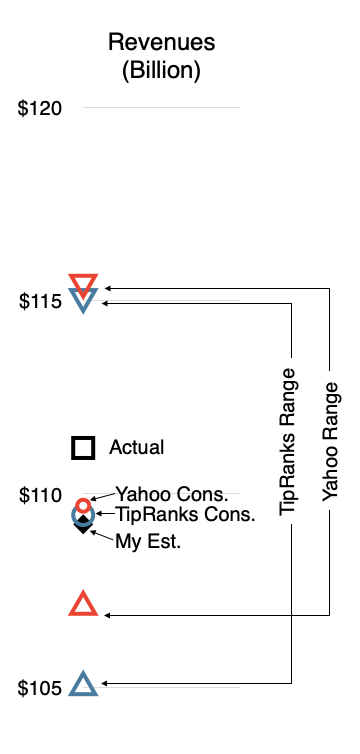
    My estimates: EPS $1.98 Rev. $109.2b iPhone Rev 55.716684 Mac Rev 8.640 iPad Rev 6.9552 Wearables & Home Rev 7.522 Services Rev 30.3753

    iPhone revenue came in at $56.99 billion. My estimate was $55.71b.

    Here is a graph of the expectations vs. actual Revenue results.

    Image

    iPhone revenues grew 22%. Extraordinary. The growth barely slowed from 23% the previous quarter.

    Mac revenue growth was 6%. Slightly less than I expected.

    Revenues were up 17%, earnings per share were up 22%.
    Best March quarter ever.

    The board of directors has declared a cash dividend of $0.27 per share of the, an increase of 4 percent. Repurchase program authorized for up to $100 billion for the next 12 months. No surprises here.

    Greater China growth was 28%.

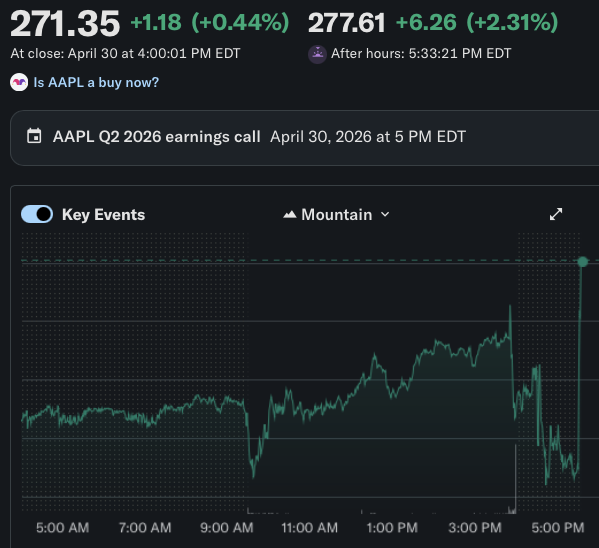
    Apple shares are down 0.6% after-hours. Normal drop when company beats on the top and bottom. The big drop comes when the CFO talks guidance.

    John Ternus will join the call for a few remarks.

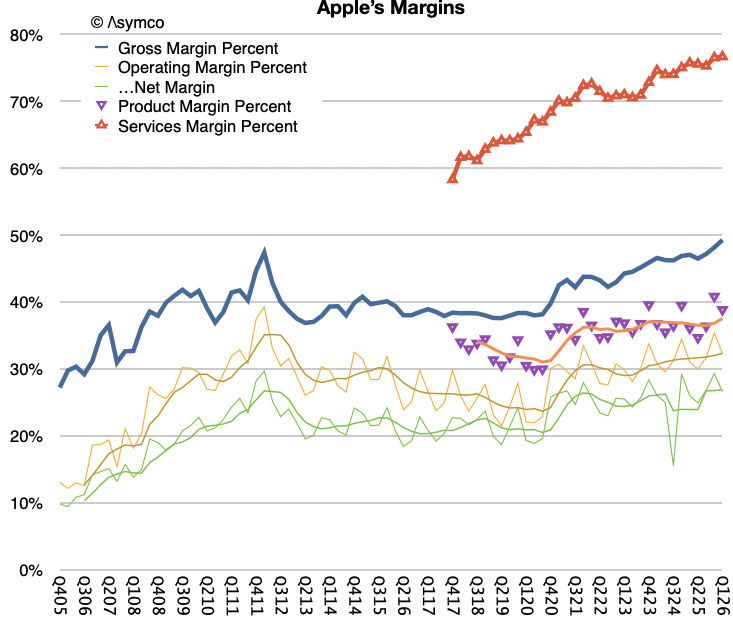
    Gross margin came in at a record high of 49.3%. This is three months after the great memory panic of 2026 was declared.

    Shares fall 0.81% after John Ternus remarks.

    Apple reports double digit growth in every emerging market.

    Mention of Mac Neo leads to more drops in the share price as the pain of share growth sinks in. Now down 1% after hours.

    iPhones went to the moon, stock not mooning.

    “Our strong business performance during the March quarter generated over $28 billion in operating cash flow and drove new March quarter records for both operating cash flow and EPS,” The fact that Apple did not turn over this cash flow t…

    5% in Wearables and Home. Modest growth is shameful growth. Compounding shompounding.

    Apple has 6 stores in India. So much more to do there.

    Supply constraints mean that the growth could have been higher —CFO.

    Active iPhone install base grew to all-time high. (No surprise). Customer satisfaction was 99% for iPhone 17 in the US.

    Customer satisfaction for Mac was 97%.
    Half of customers buying an iPad are new to the product. Most of these new customers are in emerging markets.
    Customer sat for iPad at 98%.

    Tap to pay (Apple Pay) now in 50 markets.

    Net cash was $62 billion. No longer placing net cash neutral as a target!!!! OMG OMG.

    June Q guidance: 14% to 17% growth. Shares recovered to +1.35%.

    Margin guidance: 47.5% to 48.5%. Despite the great memory panic of 2026 being in full effect.

    Shocked, shocked, shocked that CFO remarks did not crash the stock.

    Image

    Several months to reach Mac supply demand balance. Neo and Studio constrained.

    Net cash neutrality question and comments. Returned over $1 trillion so far. Another $100b allocated so they are still committed to that.

    Shares now +4% in AH but not at record high.

    Margins synopsis.

    Image

    Tim says they did see higher memory costs. For the June quarter they expect significant higher memory costs and more beyond that. Still, margins are brilliant.

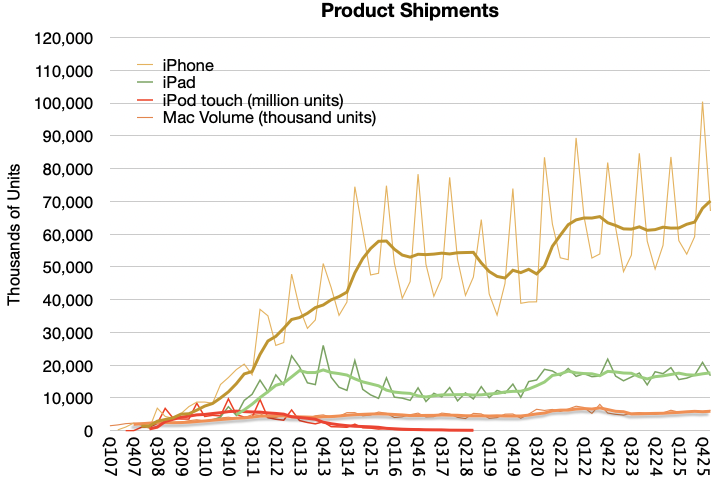
    My estimates for unit shipments for Products.

    Image


    Look at that R&D.

    Image

    Any tariff refunds will be re-invested in US production or operations (beyond existing commitments.) —Tim the Enchanter.

    India: low share is an opportunity; large middle class growing. I see no reason why it’s not an equal opportunity to that of China.

    That’ a wrap. See you during the Office Hours tomorrow.

    For a detailed review of Apple Earnings tune-in to Asymco Office Hours tomorrow, Friday, 1 May 2026 at 12pm ET / 9am PT.

  • Mark Gurman claims Apple dissolved the Vision Products Group in 2025, but that contradicts the fact that this group is still active and hiring new employees as of April 27 2026. Mark Gurman is pretty much the main source of all reports regarding the vision pro apart from supply source analysi…

    Source: Reddit r/apple via Reddit r/VisionPro

    NB: The Vision Products Group posted 14 new senior roles last week.

    The Vision Products Group is hiring for multiple senior-level software engineering positions across cutting-edge areas — Al, augmented and virtual reality, and more! These roles offer the chance to work on innovative products that will impact billions of users.

    (more…)
  • Why give all your cash to Nvidia? Why not make your own chips? Then why not sell them?

    Image

    Google said that it plans to sell its custom Tensor Processing Units (TPUs) to select customers who will install the chips in their own data centers.

    The move is a change from Google’s prior strategy, which saw it rent out TPU capacity to customers from its own data centers — and is yet another strike at AI chip king Nvidia.

    The announcement, during the company’s Q1 earnings call, comes a week after Alphabet announced two new TPUs: its TPU 8t for AI training and TPU 8i for inferencing.

    Alphabet didn’t disclose potential customers, but it signed a multiple-gigawatt agreement for next-generation TPUs with Anthropic earlier this month, with chips expected to begin coming online in 2027.

    And according to The Information, Alphabet has also entered into a multibillion-dollar chip deal with Meta (META).

    Source: Yahoo Finance

    NB: Alphabet Q1 sales grew 22% to $110 billion, with Cloud up 63% to $20 billion. Operating margins grew by 220 basis points, with services and cloud operating margins both increasing y/y.

    The search business continues to benefit from AI. AI overviews and AI mode are sustaining as search sales grew 19%.

    (more…)