Image

Bike Trainers As Video Game Controllers

While we’ve largely settled on analog sticks and digital buttons for controlling video games, there’s all sorts of projects to create truly esoteric controllers that allow playing games in unique ways. This one from [sukolupo] lets you use data from standard bike trainers to get your virtual character moving.

Called Deck de France, it maps the data coming from one of the supported bike trainers to a virtual controller which can then be “plugged in” to a Linux system, in this case a Steam Deck mounted to the trainer’s handlebars. Although a bike trainer doesn’t have the same number of inputs as a modern gaming controller, it does have enough to play games like Rocket League. As you might expect, it’s also perfect for biking titles such as the Tour de France series.

As far as unique controllers for video games go, this one is surely up in the rankings with a real trombone or a controller purpose-built for riding virtual horses. It’s also a great way for those who are getting a bit bored of riding their trainers to breathe some new life into their exercise routine. We’ve also seen some open-source alternatives for modern bike trainer software as well, which is another great way to get excited about exercise equipment too.
Image

Take The Reins Of This Unique Controller

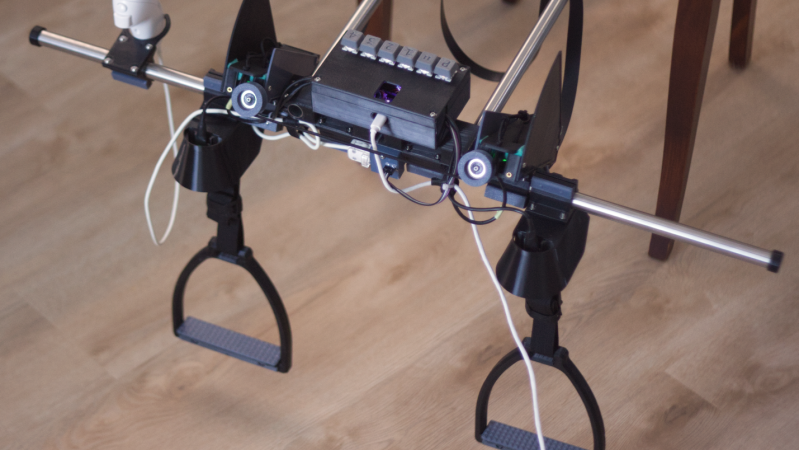
Many simulator-style games have their own dedicated controllers, from racing sims with pedals, steering wheels, and shifters to flight sims which have their own joysticks and sometimes entire cockpits. But for how prevalent riding horses is in a wide array of video games from Red Dead Redemption to Zelda to The Witcher we’re not sure we’ve ever seen a controller built specifically for riding virtual horses, at least not until [Squalius] built this horse riding controller.

[Squalius] has been working through a few prototypes of his OpenRidingController and has a fairly complete riding setup now, complete with reins and stirrups for controlling one’s in-game companions. The reins are attached to infrared distance sensors which can send analog signals to the game for controlling steering, and are attached to each other through an elastic band to provide a more realistic feeling when both are pulled to ask the horse to stop. The stirrups can be pulled to tell the horse to move at various speeds, and although a horse doesn’t need to be commanded to jump in real life, this controller provides a method for jumping an in-game horse as well.

Although we’ve mentioned a few games famous for using horses already, [Squalius] also added a handheld joystick to enable his controller to be used in less-conventional games like Minecraft where the player can use a mod to add a horse, and has also used his controller to play DOOM as well. As its name suggests it’s also open source and the code for it is all available on the project’s GitHub page. It’s a type of controller we didn’t realize we were missing until now, and perhaps we would have expected to see one before something like a controller meant for a virtual trombone.

Thanks to [Keith] for the tip!

Continue reading “Take The Reins Of This Unique Controller”

Image

Game Cube Hot Tub Animation Brought Into Real World

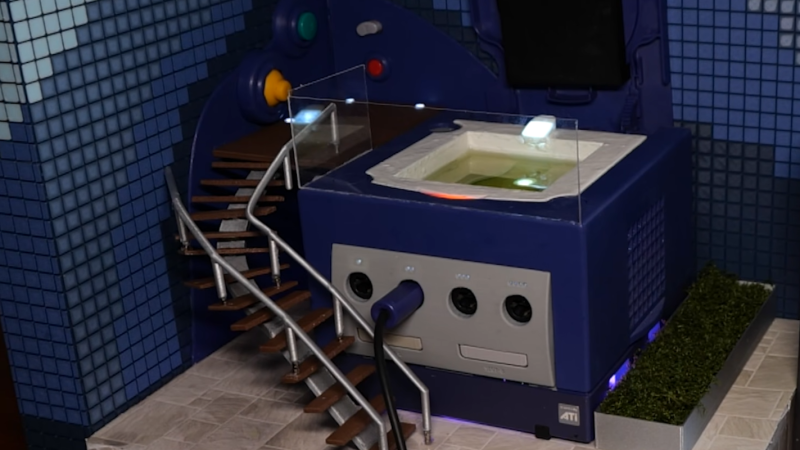
Unlike the current era where most consumer electronics are black rectangles, or the early 90s where most consumer electronics were black rectangles, we got a brief glimmer of color, light, and hope in the 2000s. Cell phones had all kinds of shapes and sizes, laptops came in bright colors, and even video game consoles got in on the fun. The Nintendo GameCube not only featured its namesake shape but came in several vibrant colors, most famously a bright purple. In fact, its design was such a hit that it continues to inspire artists and console modders alike. An animator named [kidd.gorgeous] recently envisioned a GameCube as a hot tub, and [BigRig Creates] set out to make this animation a reality.

Of course, this won’t be a life-sized hot tub capable of holding a human, but [BigRig Creates] did want it to be a usable, playable Game Cube with all of the features from the animation present in the final version. Since the lid won’t be operational with a hot tub model on the top lest all of the water spill out every time a game is changed, he’s modified it with some modern tools to hold his games inside the console itself. With the case open he’s also added the LED accent lighting featured in the animation as well as added the 3D-printed hot tub to the top. The hot tub is filled with mineral oil for electronics safety, and has a small pump built in to give the appearance of a working hot tub.

The buttons around the outside are functional as well, toggling the various lighting features and hot tub operation. And of course, the console diorama is fully playable, with the staircase railing able to easily detach in order to access the leftmost controller ports. It’s a faithful adaptation of the original animation, and [BigRig Creates] has a few games on queue that are properly themed for the new hot tub addition like Wave Race 64, Super Mario Sunshine, and Pool Paradise.

Continue reading “Game Cube Hot Tub Animation Brought Into Real World”

Image

Driving Sim Handbrake Based On Load Cell

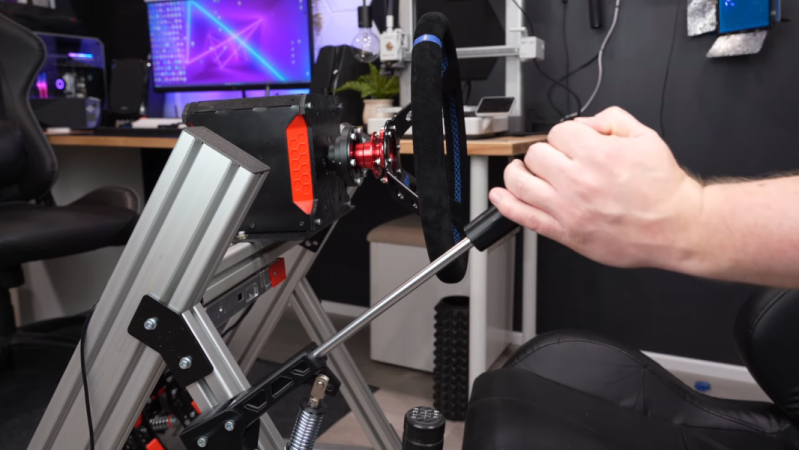
Simulator-style video games are designed to scale in complexity, allowing players to engage at anything from a casual level to highly detailed, realistic simulation. Microsoft Flight Simulator, for example, can be played with a keyboard and mouse, a controller, or a huge, expensive simulator designed to replicate a specific airplane in every detail. Driving simulators are similar, and [CNCDan] has been hard at work on his DIY immersive driving sim rig, with this hand brake as his latest addition.

For this build, [CNCDan] is going with a lever-style handbrake which is common in motorsports like drifting and rallying. He has already built a set of custom pedals, so this design borrows heavily from them. That means that the sensor is a load cell, which takes input force from a lever connected to it with a spring mechanism. The signal is sent to an Arduino for processing, which is set up to send data over USB like any joystick or controller. In this case, he’s using an Arduino that was already handling inputs from his custom shifter, so he only needed to use another input and add some code to get his handbrake added into his sim.

[CNCDan] built a version of this out of laser-cut metal parts, but also has a fully 3D printable one available as well. Plenty of his other videos about his driving rig are available as well, from the pedal assembly we mentioned earlier to the force-feedback steering wheel. It’s an impressive set of hardware with a feel that replicates racing about as faithfully as a simulator could. Interestingly, we’ve also seen this process in reverse as well where a real car was used instead as a video game controller.

Continue reading “Driving Sim Handbrake Based On Load Cell”

Image

Handheld Steering Wheel Controller Gets Force-Feedback

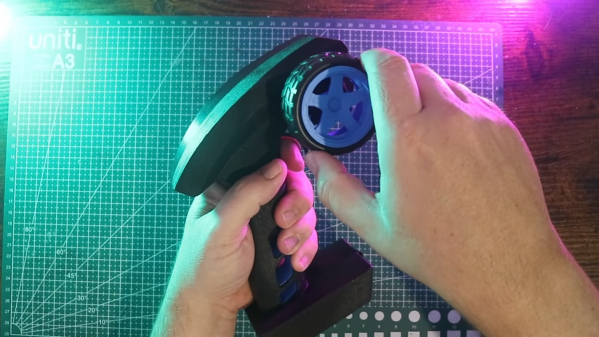
For a full-fledged, bells-and-whistles driving simulator a number of unique human interface devices are needed, from pedals and shifters to the steering wheel. These steering wheels often have force feedback, with a small motor inside that can provide resistance to a user’s input that feels the same way that a steering wheel on a real car would. Inexpensive or small joysticks often omit this feature, but [Jason] has figured out a way to bring this to even the smallest game controllers.

The mechanism at the center of his controller is a DC motor out of an inkjet printer. Inkjet printers have a lot of these motors paired with rotary encoders for precision control, which is exactly what is needed here. A rotary encoder can determine the precise position of the controller’s wheel, and the motor can provide an appropriate resistive force depending on what is going on in the game. The motors out of a printer aren’t plug-and-play, though. They also need an H-bridge so they can get driven in either direction, and the entire mechanism is connected to an Arduino in the base of the controller to easily communicate with a computer over USB.

In testing the controller does behave like its larger, more expensive cousins, providing feedback to the driver and showing that it’s ready for one’s racing game of choice. It’s an excellent project for those who are space-constrained or who like to game on the go, but if you have more space available you might also want to check out [Jason]’s larger version built from a power drill instead parts from an inkjet.

Continue reading “Handheld Steering Wheel Controller Gets Force-Feedback”

Image

Bringing Bluetooth To The Zune

The Zune might have joined the portable media player game too late to ever really be competition for the iPod, but that doesn’t mean it didn’t pick up some devoted fans along the way. Some of them are still breathing new life into the device, such as [The Director of Legal Evil Emeritus] at the Louisville Hackerspace, with this project that gives it Bluetooth capability.

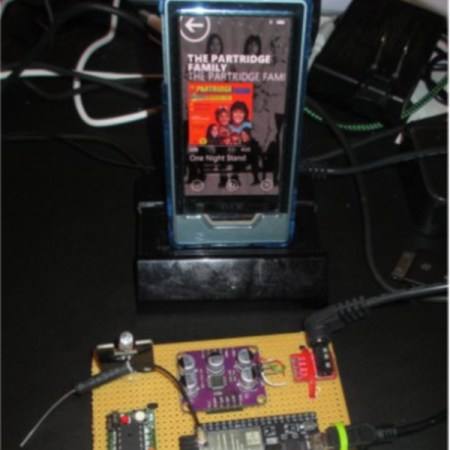
As far as media players go, there’s still some solid reasons to rock a Zune. Compared to other devices of the era, it offers a better DAC, an FM tuner, and no iTunes reliance. The goal of this project was to bring a bit of modern functionality without having to do any modification of the Zune itself. As the player supported docks with IR remotes, this build involves using an ESP32 to listen to the Bluetooth signal coming from the speakers, interpret any button presses, and forward them along to the Zune’s dock.

There is a dedicated scene for these old music players, but this build is unique for not needing to crack open the case and splice in a Bluetooth module. Even then, those typically don’t have the ability to interact with things like this speaker with its integrated control buttons.

We don’t often seen Zune hacks come our way — the last time Microsoft’s player graced these pages was in 2010, when the Open Zune Development Kit was released.

Thanks to [JAC_101] for the tip!

Image

An Open-Source Wii U Gamepad

Although Nintendo is mostly famous for making great games, they also have an infamous reputation for being highly litigious not only for reasonable qualms like outright piracy of their games, but additionally for more gray areas like homebrew development on their platforms or posting gameplay videos online. With that sort of reputation it’s not surprising that they don’t release open-source drivers for their platforms, especially those like the Wii U with unique controllers that are difficult to emulate. This Wii U gamepad emulator seeks to bridge that gap.

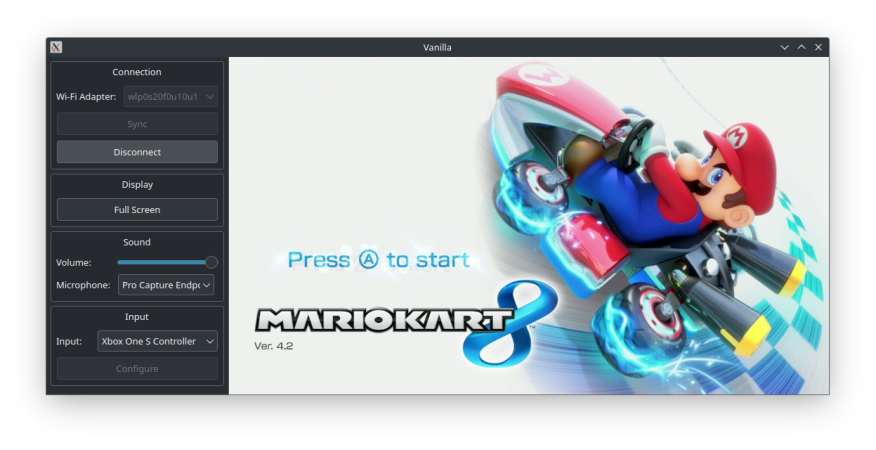
The major issue with the Wii U compared to other Nintendo platforms like the SNES or GameCube is that the controller looks like a standalone console and behaves similarly as well, with its own built-in screen. Buying replacement controllers for this unusual device isn’t straightforward either; outside of Japan Nintendo did not offer an easy path for consumers to buy controllers. This software suite, called Vanilla, aims to allow other non-Nintendo hardware to bridge this gap, bringing in support for things like the Steam Deck, the Nintendo Switch, various Linux devices, or Android smartphones which all have the touch screens required for Wii U controllers. The only other hardware requirement is that the device must support 802.11n 5 GHz Wi-Fi.

Although the Wii U was somewhat of a flop commercially, it seems to be experiencing a bit of a resurgence among collectors, retro gaming enthusiasts, and homebrew gaming developers as well. Many games were incredibly well made and are still experiencing continued life on the Switch, and plenty of gamers are looking for the original experience on the Wii U instead. If you’ve somehow found yourself in the opposite position of owning of a Wii U controller but not the console, though, you can still get all the Wii U functionality back with this console modification.

Thanks to [Kat] for the tip!