Image

Bladerunners And The Mother Of Invention

There are plenty of stories about inventors who see a problem and decide they can do better. But Van Phillips had a little more motivation than most. The problem was his own leg. In 1976, Phillips was a 21-year-old college student when a water-skiing accident cost him his left leg below the knee. If that wasn’t bad enough, the prosthetic leg he received afterward wasn’t exactly a technological marvel. Prosthetic limbs of the era were generally designed to look and act something like a biological leg and foot, but “act” might be giving them too much credit. They were passive structures that provided something to stand on and roll over while walking.

Phillips wanted to do more than walk. There was just one problem: he wasn’t an engineer. Before the accident, he had been studying business. So, if he was going to build a better leg, first he was going to have to learn how.

Back To School

Image
Traditional prosthetic feet (public domain)

Phillips became fascinated with prosthetics and eventually studied prosthetic design at Northwestern University’s Prosthetic-Orthotic Center. He also worked at the University of Utah’s prosthetics laboratory, where he had access to both the people and equipment he needed to experiment.

The conventional wisdom was that a prosthetic foot should imitate a human foot. That seems perfectly reasonable — evolution has had quite a long time to work on the design. But there’s a problem with simply copying the shape. A real foot isn’t just a foot-shaped object attached to the bottom of your leg. Muscles, tendons, and ligaments store and release energy as you walk or run. Your Achilles tendon, in particular, acts very much like a spring. A conventional prosthetic foot might look right, but it didn’t have anything corresponding to that spring.

Phillips eventually stopped worrying so much about making something that looked like a foot. Instead, he decided to make something that worked like one.

Continue reading “Bladerunners And The Mother Of Invention”

Image

Getting Back Into Resin Printing: First Results

When we last left off, I had just set up a new SLA resin printer and was on the verge of doing the initial round of printing to see just how resin printing in 2026 compares to way back in 2020. Surely SLA printing had to be easier and less fussy than it was in 2020?

During these weeks of printing, setting up printers and taking a gander at the various workflows that certain printers and their manufacturers try to push you into I have both produced a series of not too shabby prints and some delightful spaghetti. I also flipped a few proverbial tables and formed some strong opinions on 3D printing workflows, of which some can considered to be family-friendly.

Without further ado, let’s get into some updates, a bit of ranting, and even some printing results.

Continue reading “Getting Back Into Resin Printing: First Results”

Image

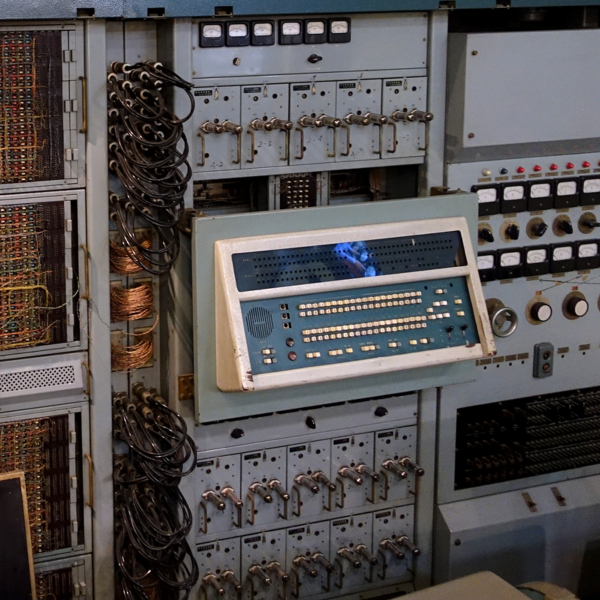
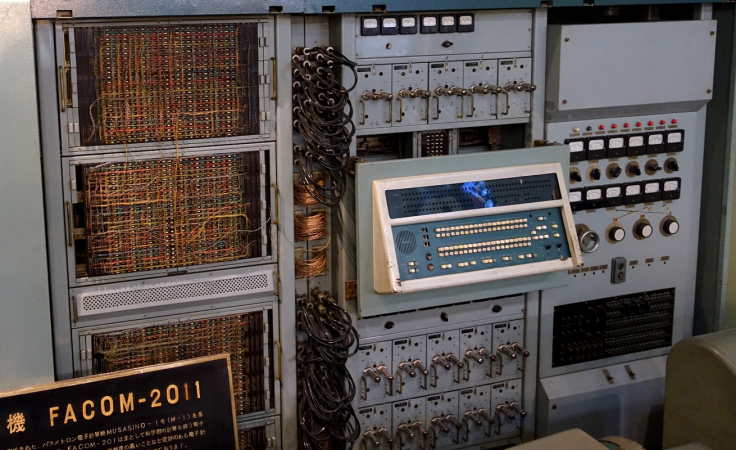
PC-1: The 1954 Computer With No Tubes, Relays, Or Transistors

However you make a digital computer, you need something to represent a binary digit. Usually this is some form of switch: a relay, a tube, or a transistor, although there have been other ways to represent state. In 1954, [Eiichi Goto] of Japan invented the parametron, a resonant circuit using a ferrite core and a capacitor that could be moved between two phases.

According to [Goto’s] 1959 paper, the device is effectively a parametric oscillator, similar to some used at UHF frequencies by hams. The idea is that a tuned circuit is set to some frequency and driven with twice that frequency.

A What?

A parametron is essentially a resonant circuit made with inductors or capacitors whose reactance is varied at twice its resonant frequency. That “pumping” causes the circuit to oscillate at half the pump frequency. The neat trick is that there are two equally stable oscillation states at half the pump frequency, separated from each other by 180° of phase. Those two phases become binary 0 and 1. Depending on the incoming signals, one phase will win over the others.

Continue reading “PC-1: The 1954 Computer With No Tubes, Relays, Or Transistors”

Image

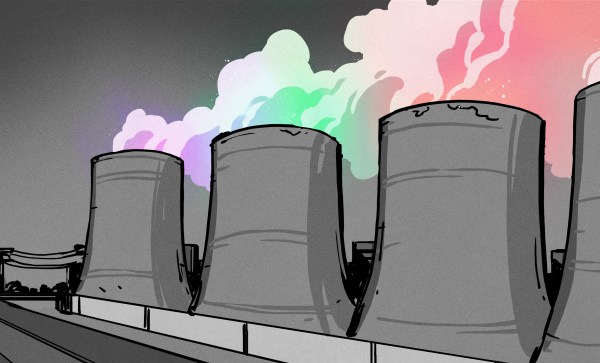
The Physics Of Keeping Thermal Power Stations Cool

Recently thermal power stations have been in the news quite a bit, mostly in the context of them being throttled back or shut down due to the river water used to cool them either getting too warm or said river having dropped to a level where it can no longer provide cooling water. Obviously this is a problem, but it helps to understand how we got to this point and what can be done to fix it.

Thermal power stations – also called power plants – come in a wide variety of shapes and sizes, ranging from old-school coal- and gas-fueled power stations to modern nuclear power plants. Something like a concentrated solar power (CSP) station is also a thermal power station, as all of them have a heat source that’s used to generate electricity from, whether that’s a boiler, nuclear reactor core or a big vat of sodium heated up by the Sun via massive mirrors or oil-filled tubes in parabolic throughs.

Except for open-cycle gas turbines (OCGTs) – which are basically jet engines connected to a generator – this thermal energy is then used to generate steam that drives a steam turbine. Once most energy in the steam has been depleted, it has to be condensed back into e.g. water, so that it can be led back to the steam generator. How this condensing step is performed is the question here, with a number of methods available.

Continue reading “The Physics Of Keeping Thermal Power Stations Cool”

Image

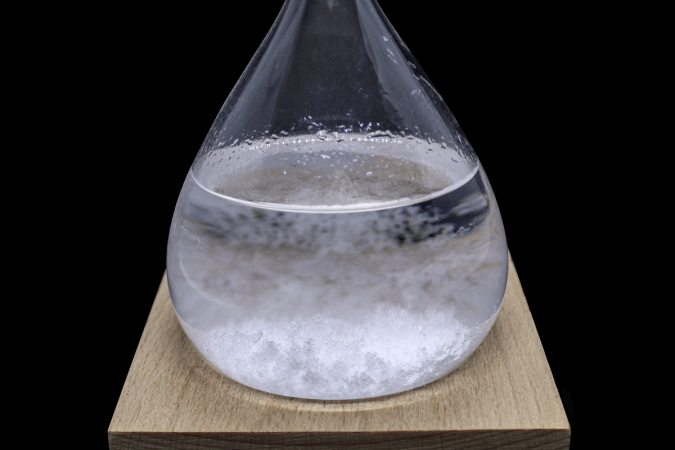
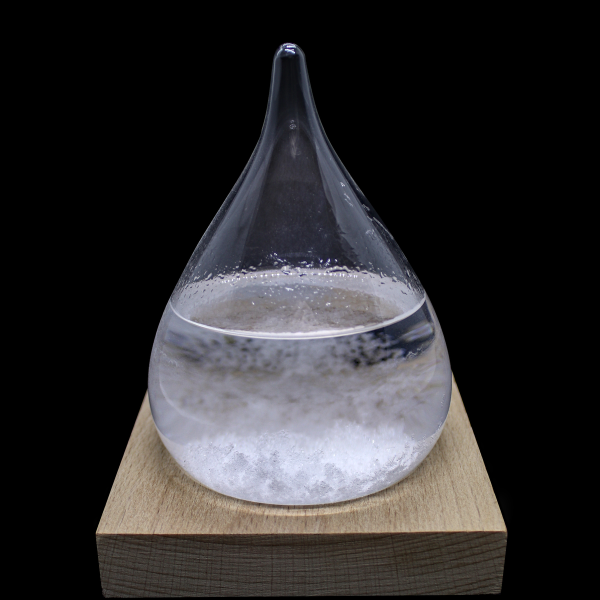
FitzRoy’s Glass: Victorian Weather Marvel Or Glorified Thermometer?

Everyone talks about the weather. This is doubly true for sailors, where bad weather could mean a very bad day. So it isn’t surprising that navies around the world have had a keen interest in weather forecasting. But how did you predict the weather before modern instruments, radar, and satellite images? Vice Admiral Robert FitzRoy had great faith in “storm glasses,” a glass chamber containing some chemicals that he didn’t invent, but did document and promote heavily during the 1860s.

Did it work? Apparently not, but the device is still interesting in its own right. FitzRoy was a pioneer of meteorology, replacing folklore with actual observations and attempts at scientific rigor. While he did arm observation stations with conventional things like thermometers and barometers, he was also a proponent of the weather glass. Continue reading “FitzRoy’s Glass: Victorian Weather Marvel Or Glorified Thermometer?”

Image

Cell Broadcast: The Modern Emergency Alert System

Once upon a time, telephones were primarily point-to-point communications systems. There were options for three-way and conference calls out there, but by and large the plain old telephone system was about connecting one handset to another for a direct conversation. For this reason, the telephone was seldom used for mass emergency communications, because it was simply not fit for broadcasting a message to a wide number of people.

However, technology has since changed. Our modern phones are all connected to a big digital over-the-air network, and large swathes of them can be addressed all at once if so needed. This has led to the development of emergency warning systems that use the cellular network, with Cell Broadcast being the most notable iteration.

Continue reading “Cell Broadcast: The Modern Emergency Alert System”

Image

Road Trains Roam The Backroads Of Australia

Trains and the railways they run on are a great way to move lots of stuff, or lots of people, a long way. Steel wheels on steel rail can shift great loads at good speeds and railways remain a backbone of logistics for this very reason. The only problem is that they require a great deal of initial investment to build and plenty of maintenance to keep them functional over time.

These concerns can make a railway a difficult proposition when it comes to getting large amounts of goods in and out of remote areas. It’s a problem that Australia faces, with settlements far off the beaten track that are nevertheless in need of high-throughput freight connections. And if you can’t go rail, you go road… in a big way.

Continue reading “Road Trains Roam The Backroads Of Australia”