Image

Removing Microplastics From Soil With Tumbling Magnetic Flakes

While in aquatic environments microplastics can be filtered out relatively easily, in soil it’s much harder to get to these microscopic particles. While you can certainly strip mine an entire area to process its soil, a less invasive method would involve something like the magnetic flakes proposed and demonstrated by [Jeonghyo Kim] et al. in a recent article in npg asia materials.

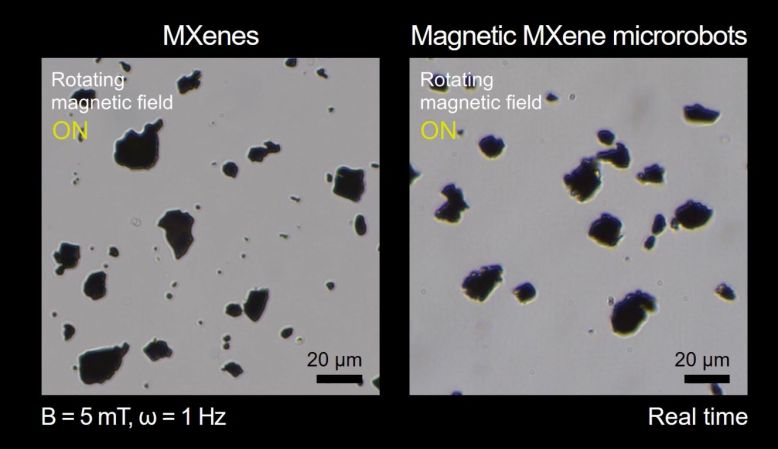
The Ti3C2Tx flakes, referred to as MXene microparticles, were designed to attract target microplastics. These were then combined with ferromagnetic nickel nanoparticles to make structures that can be propelled through soil using an external magnetic field.

During tests under laboratory conditions the researchers managed to remove about 81% of polystyrene and 72% of PET particles this way from soil, with a correspondingly higher percentage in water. After having the flakes rummage about for a while through the target material, they are removed with a strong magnetic field, which should recover most of them.

Naturally, the question with any such system is how it’ll perform once exposed to real world conditions and its myriad of soil types and conditions.

Image

Have Scientists Stuck The Landing On The Glueball Discovery?

Exciting discoveries in particle physics are one of those things that it can be easy to get blase about. Some people get caught up in the obvious excitement, while others yawn: “Oh, you found the Higgs Boson, just like Higgs predicted. Call me when you have something new.” Well, if you’re in category B, prepare to yawn while the rest of us break out champagne, because it looks like we’ve finally found the glueball. 

The glueball has got to be one of the oddest particles to fall out of the Standard Model. It’s not a fundamental particle, but its makeup contains no quarks– those itty bits that make up protons and neutrons– nor any leptons like electrons or muons. No, the glueball is a hadron made entirely of bosons: specifically, gluons, the force-carrying particles of the strong nuclear force. It’s also been called gluonium or a gluon-ball, but glueball is more fun.

Try and imagine a proton without any quarks. Remember that inside the proton there are three quarks, held together with force-carrying gluon particles. If you have zero quarks, but enough of those gluons tangled up in the right ways, and you get a tangible, if short lived particle. That’s the glueball, a neutral particle that will decay almost immediatly in to Pions. It works because gluons have ‘colour charge’– the strong nuclear force’s answer to electric charge.

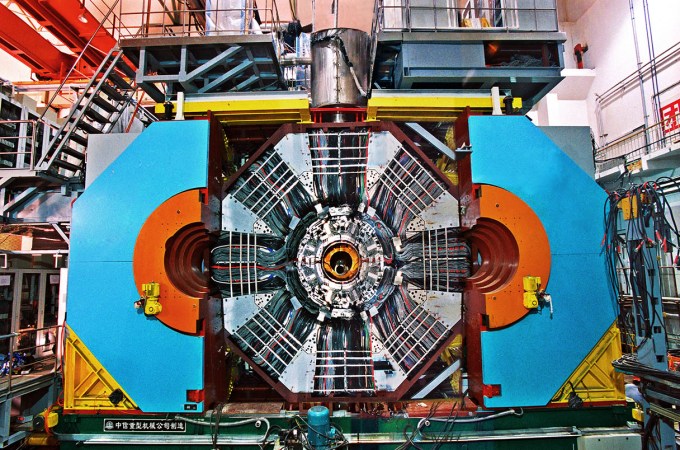
It’s also one of those things that will probably never be seen in nature: odds are, even in the hottest collisions, you’re going to get a quark or two mixed up with your gluon soup. That’s okay; the gluonic state is what we’ve been looking for. As long as the particle is mostly gluons, and behaves as the Standard Model predicts it should, physicists are inclined to call it good enough. The latest candidate to hit “good enough” is X(2370), which fell out of a collision in the Beijing Electron–Positron Collider II (BEPC II), as detected by the Beijing Spectrometer III (BES III). The paper hit ArXiv at the end of July. It’s taken the collaboration this long to make sure of what they were looking at, as they sorted through the terabytes of data an instrument like this generates.

Is this likely to affect you in any way? No. It confirms what we already thought we knew about the universe, and the particle itself is too short-lived to ever exist outside of some very extreme– mostly man-made– environments. On the other hand, it’s an excuse to celebrate scientific discovery, and we’ll take any of those we can, just like when the Muon Magnetic Moment measured in at the expected value, or neutrinos transmuted elements in exactly the way the models said they would. Besides, if we’re really lucky this result will turn out not to be a glueball, but something new and interesting. Then even the most jaded nerds will have reason to celebrate.

Header image: The Bejing III Spectrometer, BESII.

Image

The Physics Of Keeping Thermal Power Stations Cool

Recently thermal power stations have been in the news quite a bit, mostly in the context of them being throttled back or shut down due to the river water used to cool them either getting too warm or said river having dropped to a level where it can no longer provide cooling water. Obviously this is a problem, but it helps to understand how we got to this point and what can be done to fix it.

Thermal power stations – also called power plants – come in a wide variety of shapes and sizes, ranging from old-school coal- and gas-fueled power stations to modern nuclear power plants. Something like a concentrated solar power (CSP) station is also a thermal power station, as all of them have a heat source that’s used to generate electricity from, whether that’s a boiler, nuclear reactor core or a big vat of sodium heated up by the Sun via massive mirrors or oil-filled tubes in parabolic throughs.

Except for open-cycle gas turbines (OCGTs) – which are basically jet engines connected to a generator – this thermal energy is then used to generate steam that drives a steam turbine. Once most energy in the steam has been depleted, it has to be condensed back into e.g. water, so that it can be led back to the steam generator. How this condensing step is performed is the question here, with a number of methods available.

Continue reading “The Physics Of Keeping Thermal Power Stations Cool”

A lightning strike is shown striking the ground at close range (fewer than thirty feet away).

Triggering Lightning With A Rocket

Lightning, despite being a common and readily-detected phenomenon, is nevertheless difficult to study. One reason is the difficulty of predicting when and where lightning will strike; tall structures do attract more lightning strikes, but it’s hard to move them into a storm’s path. Instead, researchers often use small rockets carrying a fine wire to trigger strikes, an approach [Electron Impressions] recently replicated (more details).

The science of this is less than straightforward: even in calm weather, there’s a surprisingly strong atmospheric electric field, about 100 volts per meter off the ground. During a thunderstorm, though, this can build up to kilovolts per meter, and may reverse polarity. When an updraft carries supercooled water, ice crystals, and graupel (ice particles formed by supercooled water freezing on a snowflake) upwards, the heavier graupel falls relative to the other components. As it collides with ice crystals, it builds up a negative charge and the crystals accumulate a positive charge; across a storm, this leads to positive charge building up near the top of clouds and negative charge near the bottom. Lightning equalizes this imbalance. In the relatively few cloud-to-ground strikes, a dielectric breakdown begins from both sides of the stroke, with leaders rising from the ground and descending from the cloud. The wire trailed by a rocket creates an artificial leader, ideally triggering a controlled strike.

To consistently get a strike, the rocket needs to be launched under a strongly-negatively-charged region of the cloud. An electric field mill measures the local field strength; these are usually quite expensive, but [Electron Impressions] managed to build his own. The rocket itself was 3D printed and designed to fly well under stormy conditions. It carried a strand of thin copper wire wound onto a plastic spool meant to minimize friction and prevent broken wires. The rocket’s igniter was waterproofed for storm conditions and remotely triggered using a walkie-talkie for safety.

After many attempts, [Electron Impressions] finally managed to trigger a strike and video the results. The first stroke created a plasma channel, along which several more strokes followed. This indicated that the cloud had probably been negatively charged, which was in agreement with the field mill’s measurements. The wind blew the plasma channel slightly to the side, where it caused a second rocket to explode on the ground. Both ignition systems were destroyed, and the remains of the rocket were never found. Sadly, the strike doesn’t seem to have formed a fulgurite, but it did fracture the ground as water flash-boiled.

For a more reusable solution, some researchers have also experimented with using drones to trigger lightning. There’s good reason for more study; the theory of lightning formation still has some major open questions.

Image

Even On The Red Planet, Hexagons Are The Bestagons

Though their pure Platonic Forms may only exist in the world of ideas, certain regular shapes can’t help but keep falling out of natural processes– case in point, the six-sided solid we call a hexagon, which is indisputably the bestagon. Don’t take it up with us– start an argument with the God of War, because its his planet that’s showing off six sided features, dubbed “polygonal fractures” which NASA’s Curiosity rover is currently crushing under tread in Valle Grande. Now, you might look at the photos and say– well, that’s clearly a dried mudflat. Evidence of water! No brainier, let’s all get Nobel Prizes. Not so fast.

Nothing in nature is ever single-sourced or that simple; if you live somewhere you get dried mud, you may have seen such hexagonal features, but ask anyone from the land of the ice and snow and they’ll tell you that freeze-thaw or frost heave can bring a field of rigolith’s inner Catan board out as well. Sure, we usually call it “dirt” here on Earth, but it’s rigolith by any other name. So NASA isn’t jumping the gun, and their announcement conservatively says that they aren’t sure how the polygonal features formed. Which is both fair enough and very interesting, as figuring it out is going to give some clues into what was going on in this part of Mars in the geologically recent past, especially since this vast field of grid tiles stretches as far as the camera can see. The consensus is that Mars was once “warm and wet” but that’s a relative term– how warm, and how wet, are very much up for debate.

Speaking of crushing hexagons under Curiosity’s wheels– did anyone think said wheels would last this long? They were already tweaking the traction control to extend their life nine years ago. Between it’s plutonium power and ongoing software updates, its a fair bet that Curiosity will outlast the late, lamented Opportunity who currently holds the endurance record at 15 Earth-years.

Image

High-Density Parchment Paper Papertronics With Laser-Carved Hydrophilic Channels

ImagePaper as a substrate for electronic circuits is not very common, but promising for flexible circuits with low cost and easy recyclability. That said, paper is not an easy material to work with when printing traces, as the cellulose material is both absorbent and irregular, limiting the resolution and accuracy of so-called papertronics. Even when using higher-quality paper with wax-based masks this resulted in poor resolution issues, so [Zahra Rafiee] et al. opted to approach the problem from the other direction, by using hydrophobic parchment paper as the base combined with a laser.
The nice thing about the inks used with papertronics that they aren’t just traces, but can also be functional elements like resistors, which is also demonstrated in the paper. The channels for the inks are created using a 50 Watt CO2 laser, which etches away the silicone coating on the parchment paper. The achieved resolution in the article is around 250 µm for line widths and 300 µm line spacing, which is much better than that for wax-based alternatives.

Continue reading “High-Density Parchment Paper Papertronics With Laser-Carved Hydrophilic Channels”

Image

Rubidium Frequency Standard Explained

You’ve probably heard of rubidium frequency standards, which are used where you need an extremely accurate time or frequency reference. [IMSAI] guy has a good explainer video about what’s actually going on inside one of these standards. Much of the basic idea also applies to cesium standards.

The explainer starts with the periodic table. Rubidium and cesium are both alkali metals, with a single electron in their outermost electron shell. Rubidium has 37 electrons, with the outermost one relatively loosely bound. Naturally occurring rubidium consists mainly of two isotopes, rubidium-85 and rubidium-87, which have the same number of protons and electrons but different numbers of neutrons.

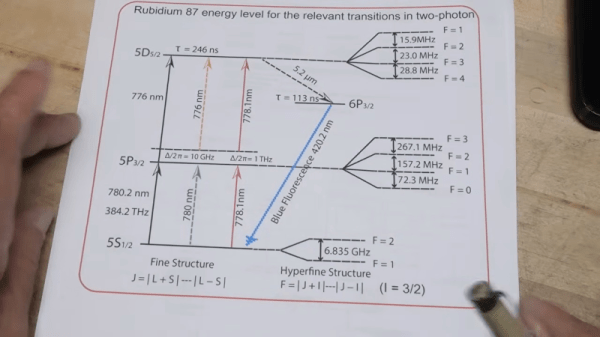
A rubidium standard typically has three gas cells that have a bit of rubidium in them. An RF-excited rubidium-87 discharge lamp produces light at very specific wavelengths. The RF energy excites rubidium atoms into higher electronic states, and when their electrons fall back to lower-energy states, the atoms emit photons.

That light passes through a filter cell containing rubidium-85. The filter preferentially absorbs part of the lamp’s spectrum, leaving light that optically pumps the rubidium-87 atoms in the second resonance cell into one of two closely spaced hyperfine states of the atom’s ground state.

Those two states differ because of the interaction between the magnetic moment of the outer electron and that of the rubidium-87 nucleus. Their energy separation corresponds to a microwave frequency of about 6.835 GHz.

The resonance cell is illuminated by the filtered light while also being exposed to microwave energy from a local oscillator. When the microwave frequency is exactly equal to the rubidium-87 hyperfine transition frequency, it transfers atoms between the two ground-state hyperfine levels. That changes how strongly the cell absorbs the optical pumping light, producing a detectable dip in the light reaching a photodetector.

Electronics then servo the microwave oscillator onto the center of that absorption dip, using a feedback technique somewhat analogous to a phase-locked loop. Once locked, the oscillator is effectively referenced to an atomic transition rather than to the dimensions or mechanical properties of a crystal, giving you an extremely stable frequency standard.

Continue reading “Rubidium Frequency Standard Explained”