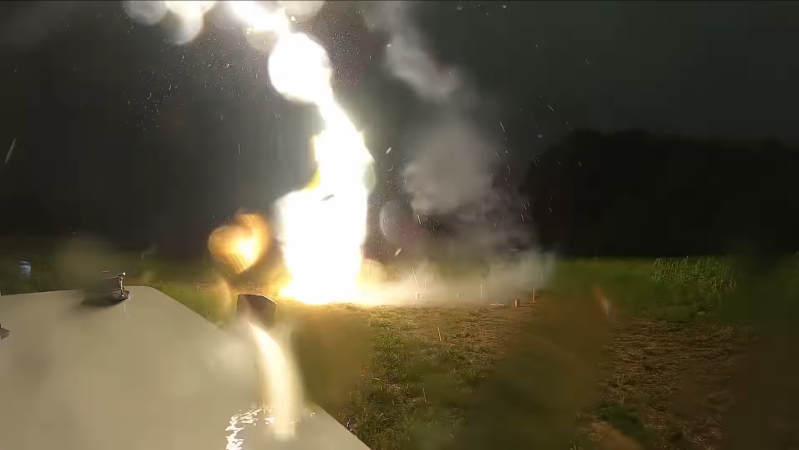
A lightning strike is shown striking the ground at close range (fewer than thirty feet away).

Triggering Lightning With A Rocket

Lightning, despite being a common and readily-detected phenomenon, is nevertheless difficult to study. One reason is the difficulty of predicting when and where lightning will strike; tall structures do attract more lightning strikes, but it’s hard to move them into a storm’s path. Instead, researchers often use small rockets carrying a fine wire to trigger strikes, an approach [Electron Impressions] recently replicated (more details).

The science of this is less than straightforward: even in calm weather, there’s a surprisingly strong atmospheric electric field, about 100 volts per meter off the ground. During a thunderstorm, though, this can build up to kilovolts per meter, and may reverse polarity. When an updraft carries supercooled water, ice crystals, and graupel (ice particles formed by supercooled water freezing on a snowflake) upwards, the heavier graupel falls relative to the other components. As it collides with ice crystals, it builds up a negative charge and the crystals accumulate a positive charge; across a storm, this leads to positive charge building up near the top of clouds and negative charge near the bottom. Lightning equalizes this imbalance. In the relatively few cloud-to-ground strikes, a dielectric breakdown begins from both sides of the stroke, with leaders rising from the ground and descending from the cloud. The wire trailed by a rocket creates an artificial leader, ideally triggering a controlled strike.

To consistently get a strike, the rocket needs to be launched under a strongly-negatively-charged region of the cloud. An electric field mill measures the local field strength; these are usually quite expensive, but [Electron Impressions] managed to build his own. The rocket itself was 3D printed and designed to fly well under stormy conditions. It carried a strand of thin copper wire wound onto a plastic spool meant to minimize friction and prevent broken wires. The rocket’s igniter was waterproofed for storm conditions and remotely triggered using a walkie-talkie for safety.

After many attempts, [Electron Impressions] finally managed to trigger a strike and video the results. The first stroke created a plasma channel, along which several more strokes followed. This indicated that the cloud had probably been negatively charged, which was in agreement with the field mill’s measurements. The wind blew the plasma channel slightly to the side, where it caused a second rocket to explode on the ground. Both ignition systems were destroyed, and the remains of the rocket were never found. Sadly, the strike doesn’t seem to have formed a fulgurite, but it did fracture the ground as water flash-boiled.

For a more reusable solution, some researchers have also experimented with using drones to trigger lightning. There’s good reason for more study; the theory of lightning formation still has some major open questions.
Image

Water-cooling A 3D Printed Rocket Isn’t Quite Practical

Consumer-grade 3D printers are useful for lots of things, but they kind of fall down when it comes to making stuff that survives high temperatures. [Mr. More Gooder] wasn’t deterred from a rocket build using FDM printed parts though, instead relying on water cooling to try and beat this practical limit.

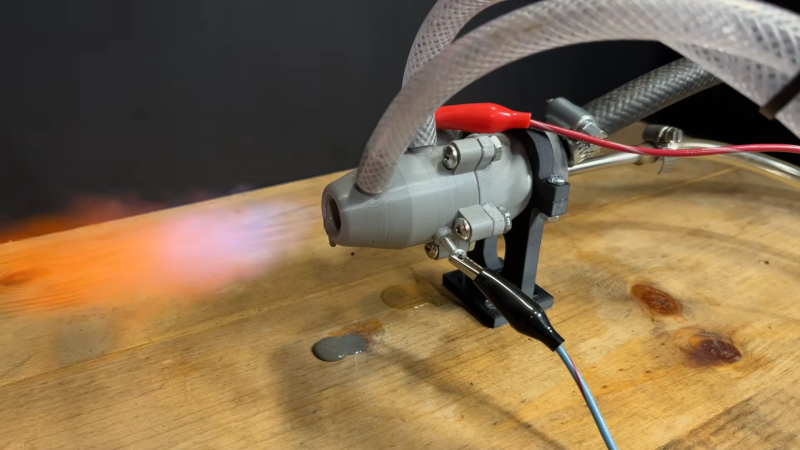
The concept is simple enough—[Mr. More Gooder] printed a propane-burning combustion chamber and nozzle out of plastic that you’d totally expect to melt when the flames started. Thus, the nozzle was given fittings to allow water to be continually pumped through to try and drag away enough heat to let the rocket survive more than a few seconds. Unfortunately, during testing the uncooled combustion chamber quickly melted. A redesign with water cooling throughout performed a little better, until the water jacket began to leak into the main chamber and extinguished the flames. Melted plastic could be seen dripping out of the nozzle shortly after ignition, too.

Even if the nozzle did hold up for a longer period of time, it’s worth noting this is probably not a viable route towards a flight-ready engine. Mostly because you would need a huge supply of water to keep the components cool which would add a great deal of weight to any such build. There’s a reason NASA doesn’t recycle old drink bottles to make rocket engines, after all.

In any case, we love to see all sorts of rocket experiments, even the unsuccessful ones.

Continue reading “Water-cooling A 3D Printed Rocket Isn’t Quite Practical”

Image

Photographing Rocket Chute Deployment At 10 Km

For those who haven’t been following along, [BPS.space] aka [Joe] is on a journey to launch a home-built rocket past the Kármán line where it will officially reach outer space. But one does not simply launch a rocket to outer space on the first try. The process is long and involves not only building a series of rockets, but designing and building propellant mixtures, solving aerodynamic problems, gaining several model rocket certifications along the way, and a whole host of other steps. He’s also documenting the entire process on video as well, which involves some custom camera work like this rocket selfie camera which will take an image of his rockets at apogee.

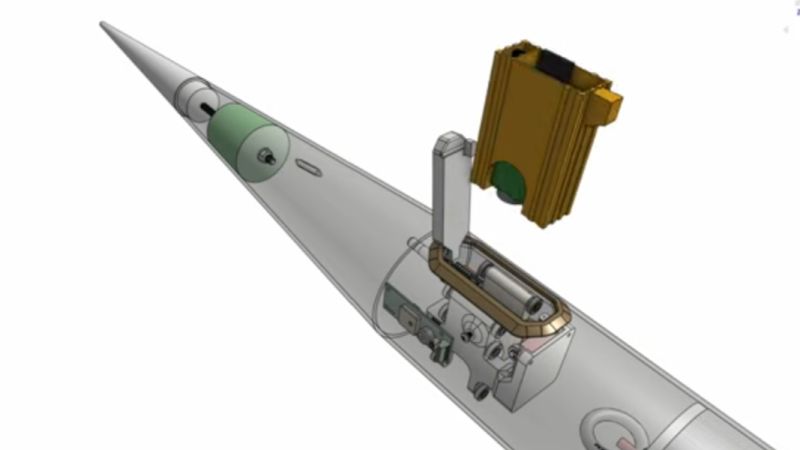
Like most problems in high-power rocketry, extremely tiny problems have a way of causing catastrophic failure, so every detail needs to be considered and planned for in the final design. For a camera that needs to jettison itself from the rocket at a precise moment after experiencing an incredible amount of forces, this is a complicated problem to solve. The initial design involves building a sled for a small deconstructed GoPro which uses springs and a servo to launch itself out of the rocket. The major problem with the design is that even the smallest torque on the sled will cause the camera to point in a random direction by the time it’s far enough from the rocket to take a picture. [Joe] tried a number of design iterations but could not get these torques to vanish.

One of the design limitations with this camera is that it won’t have any sort of parachute or tether itself to the rocket, so it will hit the ground at its terminal velocity. To keep that velocity down and improve survivability chances of the footage, the mass has to stay low. Eventually he settled on a semi-active control system by mounting a brass weight on a small motor, giving the camera module enough stability to stay pointed at the rocket long enough to take the video. Even though it hasn’t flown yet, admitting his first design wasn’t working at compromising on this solution which adds a bit of mass seems to be a good design change. We’ve been following along with his entire process so be sure to check out his actual rocket motor builds and teardowns as well.

Continue reading “Photographing Rocket Chute Deployment At 10 Km”

Image

Rocket Roll Control, The Old Fashioned Way

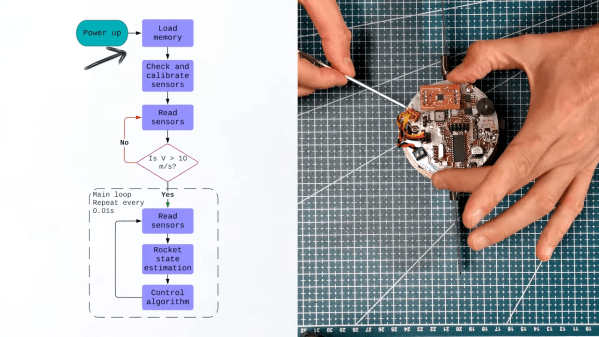
The vast majority of model rockets go vaguely up and float vaguely downwards without a lot of control. However, [newaysfactory] built a few rockets that were altogether more precise in their flight, thanks to his efforts to master active roll control.

[newaysfactory] started this work a long time ago, well before Arduinos, ESP32s, and other highly capable microcontroller platforms were on the market. In an era when you had to very much roll your own gear from the ground up, he whipped up a rocket control system based around a Microchip PIC18F2553. He paired it with a L3G4200D gyro, an MPXH6115A barometer, and an MMA2202KEG accelerometer, chosen for its ability to provide useful readings under high G acceleration. He then explains how these sensor outputs were knitted together to keep a rocket flying straight and true under active control.

[newaysfactory] didn’t just master roll control for small rockets; he ended up leveraging this work into a real career working on fully-fledged autopilot systems. Sometimes your personal projects can take your career in interesting directions.

Continue reading “Rocket Roll Control, The Old Fashioned Way”

Image

Australia’s Space Program Finally Gets Off The Pad, But Only Barely

Australia is known for great beaches, top-tier coffee, and a laidback approach to life that really doesn’t square with all the rules and regulations that exist Down Under. What it isn’t known for is being a spacefaring nation.

As it stands, a startup called Gilmour Space has been making great efforts to give Australia the orbital launch capability it’s never had. After numerous hurdles and delays, the company finally got their rocket off the launch pad. Unfortunately, it just didn’t get much farther than that.

Continue reading “Australia’s Space Program Finally Gets Off The Pad, But Only Barely”

Image

Generatively-Designed Aerospike Test Fired

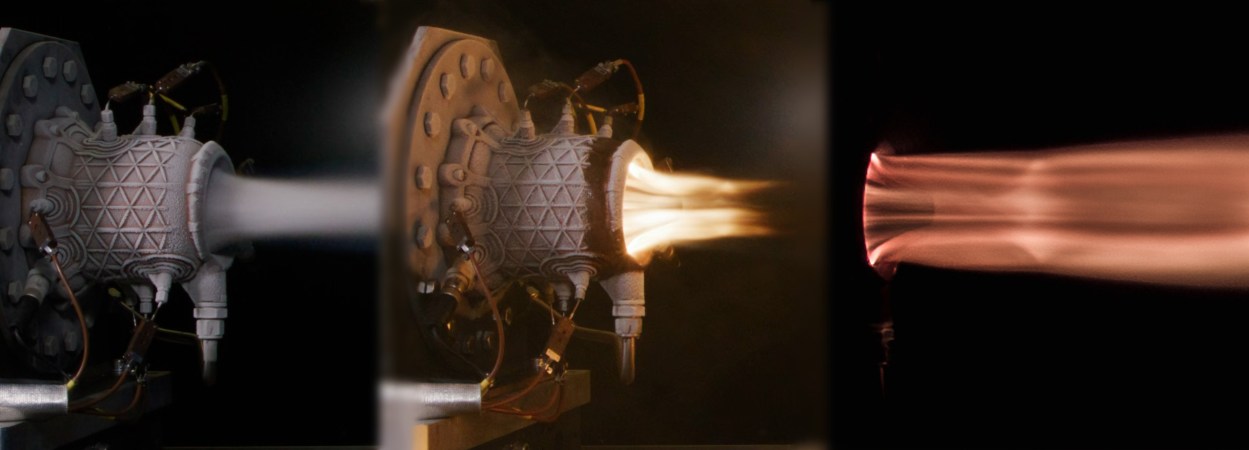
The aerospike engine holds great promise for spaceflight, but for various reasons, has remained slightly out of reach for decades. But thanks to Leap 71, the technology has moved one step closer to a spacecraft near you with the test fire of their generatively-designed, 3D printed aerospike.

We reported on the original design process of the engine, but at the time it hadn’t been given a chance to burn its liquid oxygen and kerosene fuel. The special sauce was the application of a computational physics model to tackle the complex issue of keeping the engine components cool enough to function while directing 3,500˚C exhaust around the eponymous spike.

Printed via a powder bed process out of CuCrZr, cleaned, heat treated, and then prepped by the University of Sheffield’s Race 2 Space Team, the rocket produced 5,000 Newtons (1,100 lbf) of thrust during its test fire. For comparison, VentureStar, the ill-fated aerospike single stage to orbit project from the 1990s, was projected to produce more than 1,917 kilonewtons (431,000 lbf) from each of its seven RS-2200 engines. Leap 71 obviously has some scaling up to do before this can propel any crewed spacecraft.

If you want to build your own aerospike or 3D printed rocket nozzles we encourage you to read, understand, and follow all relevant safety guidelines when handling your rockets. It is rocket science, after all!

Image

There’s A New Reusable Rocket, And It’s A Honda

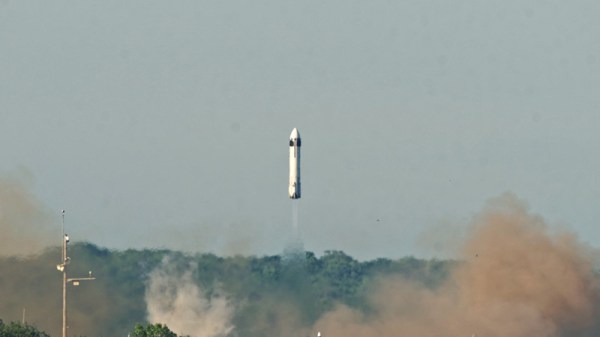
As we watched the latest SpaceX Starship rocket test end in a spectacular explosion, we might have missed the news from Japan of a different rocket passing a successful test. We all know Honda as a car company but it seems they are in the rocket business too, and they successfully tested a reusable rocket. It’s an experimental 900 kg model that flew to a height of 300 m before returning itself to the pad, but it serves as a valuable test platform for Honda’s take on the technology.

It’s a research project as it stands, but it’s being developed with an eye towards future low-cost satellite launches rather than as a crew launch platform.As a news story though it’s of interest beyond its technology, because it’s too easy to miss news from the other side of the world when all eyes are looking at Texas. It’s the latest in a long line of interesting research projects from the company, and we hope that this time they resist the temptation to kill their creation rather than bring it to market.