Image

The Physics Of Keeping Thermal Power Stations Cool

Recently thermal power stations have been in the news quite a bit, mostly in the context of them being throttled back or shut down due to the river water used to cool them either getting too warm or said river having dropped to a level where it can no longer provide cooling water. Obviously this is a problem, but it helps to understand how we got to this point and what can be done to fix it.

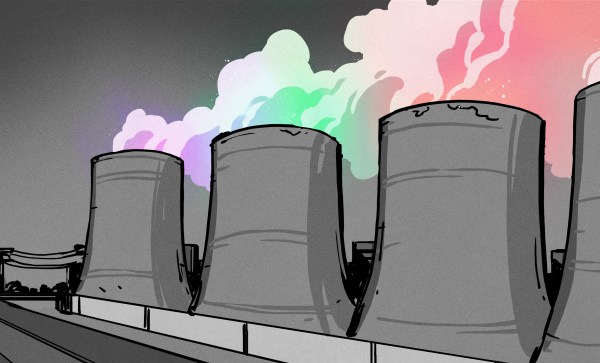
Thermal power stations – also called power plants – come in a wide variety of shapes and sizes, ranging from old-school coal- and gas-fueled power stations to modern nuclear power plants. Something like a concentrated solar power (CSP) station is also a thermal power station, as all of them have a heat source that’s used to generate electricity from, whether that’s a boiler, nuclear reactor core or a big vat of sodium heated up by the Sun via massive mirrors or oil-filled tubes in parabolic throughs.

Except for open-cycle gas turbines (OCGTs) – which are basically jet engines connected to a generator – this thermal energy is then used to generate steam that drives a steam turbine. Once most energy in the steam has been depleted, it has to be condensed back into e.g. water, so that it can be led back to the steam generator. How this condensing step is performed is the question here, with a number of methods available.

Continue reading “The Physics Of Keeping Thermal Power Stations Cool”
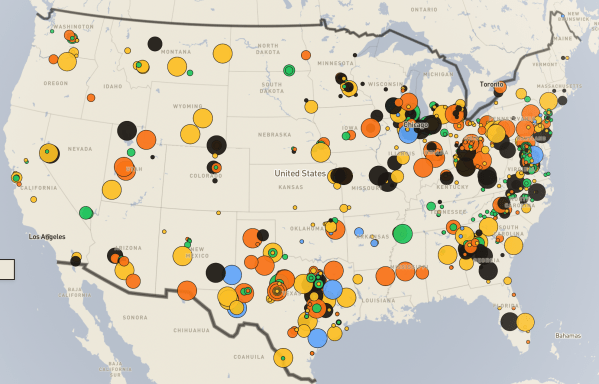
A map of the lower 48 US States with an overlay of various colorful bubbles indicating data center developments, whether proposed, contested, under construction, or operational. There are a lot of bubbles! Hawaii isn't pictured, but looks to have one project currently, but nothing in Alaska for now.

Who’s Building That Data Center?

One of the biggest “David versus Goliath” stories in tech right now is the towns beset by AI data center projects they may or may not have asked for. Powered By Who is tracking data center development in the US on this convenient map.

Currently, there are over 2,100 data centers being tracked by the project ranging from proposals to sites fully up-and-running. While you have to build bypasses data centers to keep the internet running (which we’re partial to here at Hackaday), there are certainly questions around the amount of power and water consumed by these sites, the emissions they’re sending into the surrounding community, and who exactly is reaping the benefits.

Whether you’re pro, against, or ambivalent about the proliferation of “AI” data centers, the map offers an engaging way to look at what projects are happening around the nation, especially when you start looking at clusters and how that interacts with the power generation and political makeup in a region. It’s particularly interesting how only three states account for roughly 70% of all the projects. Let us know if there’s a similar tracker in your area if you’re from one of the other parts of the globe!

Looking past the debate, there’s a lot of interesting engineering involved in keeping these data centers cool, although there are questions about where that heat ends up going. DC distribution inside the site, underwater data centers, and even putting them in space are some of the solutions for keeping the cooling loads tamed.

Image

The Coolest Hat At The Hacker Camp

People in hotter parts of the world may permit themselves a grin at this, but Europeans have recently been suffering under an unseasonal June heatwave. Most of us have been cowering inside with our air conditioners, but not [Making Stuff With Mike]. He’s adapting a safety helmet with a Noctua fan for only slightly uncool on-the-go cooling.

Continue reading “The Coolest Hat At The Hacker Camp”

Image

Building A Gifford-McMahon Cryocooler With 3D-Printed Parts

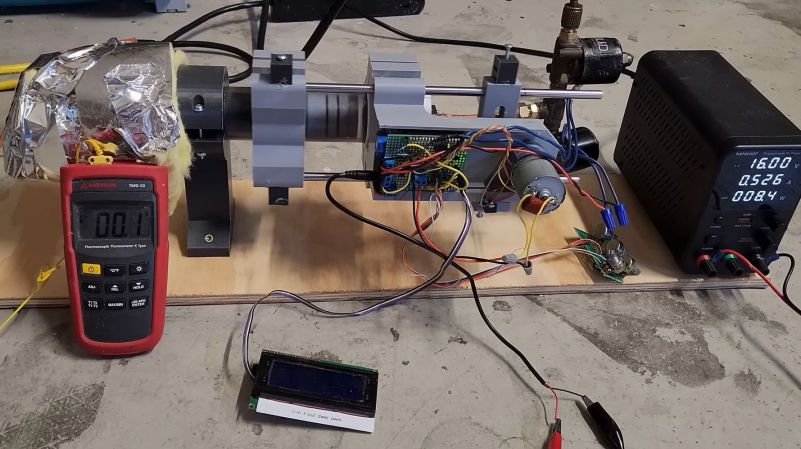
Although cryocoolers are capable of pretty impressive cooling, for many of them the underlying working principle is simple enough that you do not need any special skills or a big budget to make your own version. Take the Gifford-McMahon cryocooler for example, which works using nothing more than some kind of coolant gas and a piston in a cylinder that you can even 3D print, as demonstrated by [Hyperspace Pirate] in a recent video.

The lowest temperature reached across the two prototypes was only -84°C, but this was mostly due to some sub-optimal design choices, such as the use of regular air and a clear acrylic tube to get a good glimpse at the inner workings. The trickiest part of this type of cryocooler is probably that you need to move the piston containing the regenerator between both ends of the cylinder to get a cool and a hot side.

That particular problem was solved by using magnets to move the piston externally, which worked beautifully until the problem of using regular compressed air from the shop compressor caused massive ice formation that jammed up the piston. Obviously this was not an unexpected issue, and for the next step the coolant gas will be replaced by helium, as making that gas freeze up requires quite a bit more effort.

Continue reading “Building A Gifford-McMahon Cryocooler With 3D-Printed Parts”

Image

The Heat Island Effect Is Warming Up The AI Data Center Controversy

There’s been a lot of virtual ink spilled in environmental circles about the cooling water requirements of data centers, but less consideration of what happens with all the heat coming out of these buildings. Naturally, it’s going to warm the surrounding environment, but how much? Around 2 C (3.6 F) on average, and potentially much more than that, according to a recent study on the data heat island effect.

It’s common sense, of course: heat removed from the data center doesn’t go away. That heat might go into a body of water if one is available, but otherwise it’s out into the atmosphere to warm up everybody else’s day. In some places — like a Canadian winter — that might not be so bad. In others, where climate change and urban heat islands are cranking up the summertime temperatures, it very much could be. Especially if you’re in the worst-case scenario micro-climate described by the paper, which saw a predicted increase of 9.1 C (16 F).

Now, these results are theoretical and need to be ground-truthed, but anyone who has huddled next to the air-exchange unit of a large building for warmth knows there’s something to them. Unfortunately there don’t seem to be before-and-after measurements available for existing data-centers — AI or otherwise — to show exactly what their heat output is doing in the real world, but the urban heat island effect from all the dark asphalt in our cities is well known. Cooling paint and green roofs can help with that, but they won’t do much for the megawatts being pumped out to keep your cousin’s AI girlfriend online.

Some would argue that all this heat wouldn’t be a problem if we could launch the data centers outside the environment — just have a care the front doesn’t fall off.


Image of data center cooling by Анна from Pixabay

Image

How Water Vapor Makes Smartphones Faster

Once upon a time, home computers were low-powered enough that they barely needed any cooling at all. An Amiga 500 didn’t even have a heatsink on the CPU, while the early Macintosh got by with a single teeny little fan.

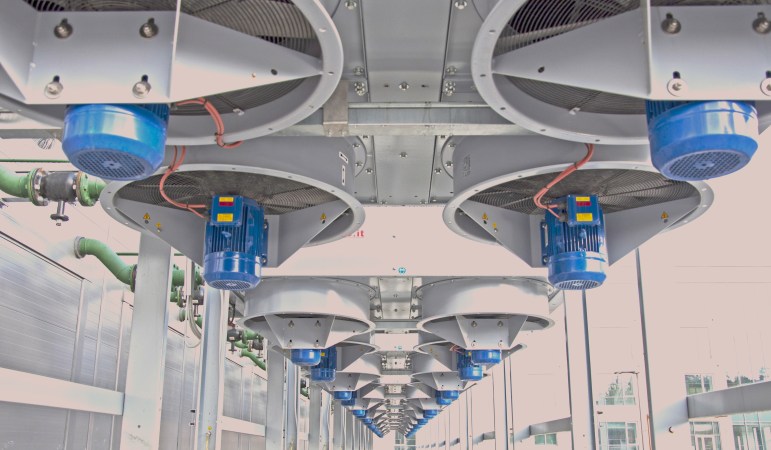
Modern smartphones are far more powerful than these ancient machines, packed with multi-core processors running at speeds of many gigahertz. Even still, they’ve generally been able to get by without any active cooling devices. However, as manufacturers continue to push the envelope of performance, they’ve had to scramble for ways to suck heat out of these handheld computers. Vapor chamber cooling has risen as a solution to this problem, using simple physics to keep your handset humming along at maximum speed for longer.

Continue reading “How Water Vapor Makes Smartphones Faster”

Hackaday Links Column Banner

Hackaday Links: August 17, 2025

We’ve studiously avoided any mention of our latest interstellar visitor, 3I/Atlas, on these pages, mainly because of all the hoopla in the popular press about how Avi Loeb thinks it’s aliens, because of course he does. And we’re not saying it’s aliens either, mainly because we’d never be lucky enough to be alive during an actual alien invasion — life just hasn’t historically been that kind to us. So chances are overwhelming that 3I/Atlas is just a comet, but man, it’s doing its level best to look like it’s not, which means it’s time to brave the slings and arrows and wade into this subject.

The number of oddities surrounding 3I/Atlas just keeps growing, from its weird Sun-directed particle stream to its extreme speed, not to mention a trajectory through the solar system that puts it just a fraction of an astronomical unit from two of the three planets within the “Goldilocks Zone” of our star — ignore the fact that at an estimated seven billion years old, 3I/Atlas likely would have started its interstellar journey well before our solar system had even started forming. Still, it’s the trajectory that intrigues us, especially the fact that it’s coming in at a very shallow along to the ecliptic, and seems like it will cross that imaginary plane almost exactly when it makes its closest approach to the Sun on October 29, which just coincidentally happens to be at the very moment Earth is exactly on the opposite side of our star. We’ll be as far as possible from the action on that date, with the comet conveniently lost in the glare of the Sun. Yes, there’s talk of re-tasking some of our spacecraft around Mars or in the Jovian system to take a peek when 3I/Atlas passes through their neighborhoods, but those are complicated affairs that show no sign of bearing fruit in the short time left before the comet heads back out into the Deep Dark. Too bad; we’d really love an up-close and personal look at this thing.

Continue reading “Hackaday Links: August 17, 2025”