Gears are usually the biggest contributors to backlash in a mechanical system, but they’re far from the only culprits. Ball bearings are a less obvious source of imprecision, since any gaps between the balls and the races can lead to axial wobble. Precision mechanisms can eliminate this by pairing two ball bearings, holding the outer races fixed, and applying a preload force to the inner traces. [Chronova Engineering], however, has a different solution, for which he split a ball bearing in half.
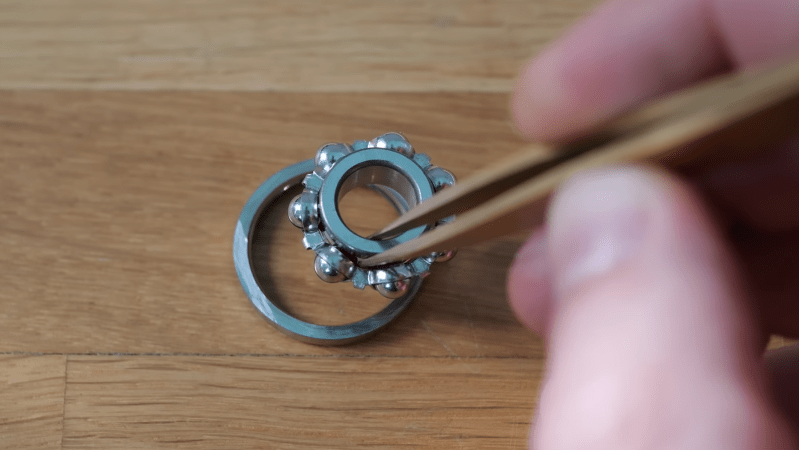
Besides taking up more room, thermal expansion also means that it’s difficult to apply a consistent preload force between two ball bearings. Instead, to make a self-contained preloaded bearing, [Chronova Engineering] first disassembled a single ball bearing. The most difficult part of this is taking apart the ball cage; the two parts of this are normally riveted together, but he managed to find a crimped cage and pry it apart. After taking the bearing completely apart, he cut the outer trace in half along the circumference, then reassembled the bearing. The split outer trace makes it possible to press the two halves together, preloading it and removing slop.
To see how well this worked, [Chronova Engineering] replaced the the ball bearing supporting one end of the feed screw for a milling machine with this new bearing. Before the replacement, it had a backlash of 0.1 to 0.2 millimeters; after the modification, it dropped to 30 to 40 microns. This kind of bearing is already known in the machining world – four-point-contact bearings use a very similar principle – but they don’t seem to be well known.
For more about these common yet remarkable rotary mechanisms, check out our article on bearings. If, on the other hard, precision isn’t a priority, you can always 3D print ball bearings.