Image

Stunning Volumetric 3D Display Goes For A Spin

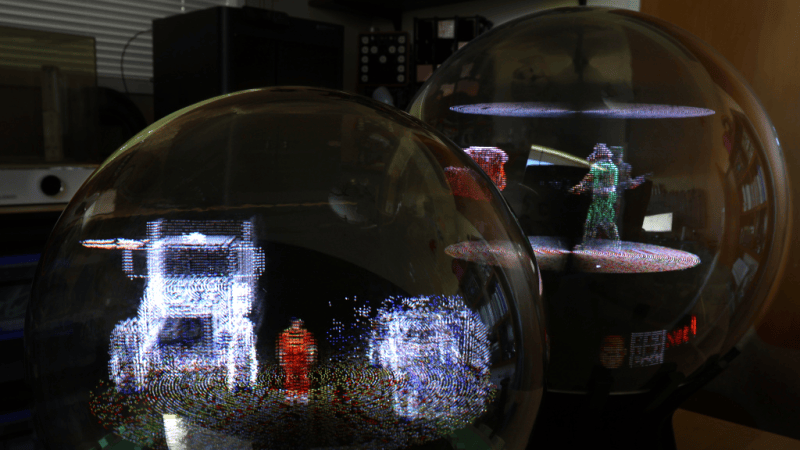
[AncientJames] gives us a detailed look at Vortex, one of his impressive volumetric displays made with two back-to-back LED panels that spin at high speed with a Raspberry Pi 4 driving it all. Vortex generates a true 3D image hanging in space that one can move around, and look at from different angles independent of anything else. The software for Vortex is up on GitHub which includes a simulator as well as CAD models for the 3D-printed parts.

Image
The images move, but can also be viewed from any angle.

Accomplishing what Vortex does requires precisely matching the images rendered on the panels to the physical rotation. If there’s a mismatch, the displayed 3D image will drift, or appear distorted. There’s also the physical matter of ensuring the spinning elements are balanced and stable while spinning at high speeds, a nontrivial undertaking that involved more than a little trial and error.

The amazing build quality and attention to detail really shines through, not just with the design but with smart use of off-the-shelf items like a large plastic globe for the display cover. [AncientJames] uses what looks like a plastic globe shade meant for a lighting fixture, and designs a clever fixture that attaches to a small rotary tool with a cutting wheel. With that, he can carefully and precisely cut away the unneeded section. Here’s a link to him doing so (at the 15:17 mark) in the video; sometimes it’s worth making a one-off gadget if it helps get a job done right.

[AncientJames] has made many volumetric displays in the past, and they’re each a little different. Check out one that spins a perforated drum around LED panels to create a lightfield display, instead of spinning the panels themselves.

Continue reading “Stunning Volumetric 3D Display Goes For A Spin” →
Image

Etching Press Aims To Impress

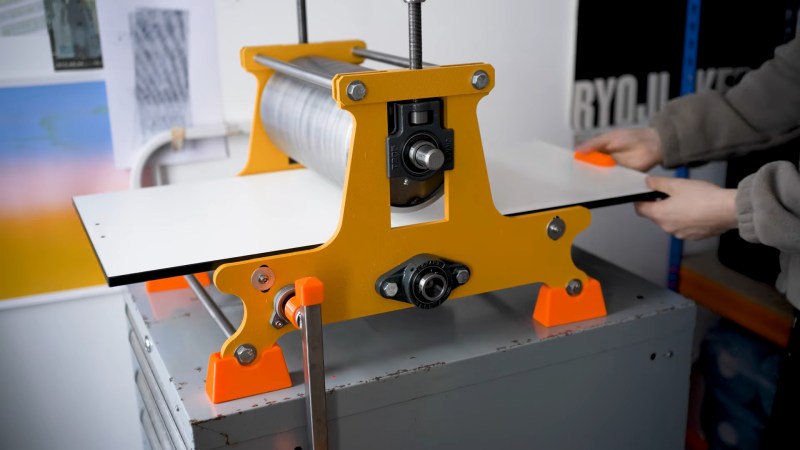
There’s an old joke about inviting somebody up to your dorm room to ‘look at your etchings’ — but if you’re going to do that, you’d best have some etchings, lest they call your bluff. Even better would be to have prints available, so you might share your hard work with adoring fans. Over on YouTube, [This Designed That] shows building the perfect little etching press  so you need never invite anyone to your room again: you can crank out enough prints on this bad boy to hand out your etchings on a street corner!

Crank is the right word, because it’s hand-cranked, with the rollers chain-driven off a separate driveshaft. It works like, well, a roller press: two steel rollers squeeze a platen holding your inked etching and a of paper together to put an image onto. His choice of an off-cut of steel pipe to use as the top roller is inspired, even if he did have to turn it down quite a bit to get an even radius and smooth surface finish. The whole thing is very well made, and all of it hand-machined except for off-the-shelf bearings and the yellow side plates, which were commercially CNC’d.

We also appreciate that [This Designed That] took the time to prove the merit of his machine by showing the press in work, and the resulting prints.  We’re not art critics, but we are willing to say this makes a good impression.

[This Designed That] is both printer and machinist, and we’ve seen his print projects before, like using resin prints for foil stamping or a DIY proofing press that seems to share some DNA with this larger project.

Continue reading “Etching Press Aims To Impress” →

Image

The Sounds Of The World, One Random Album At A Time

In the streaming era it’s easy to forget that there’s still a lot of stuff being broadcast over the radio for anyone who cares enough to dial in their receiver. Give me an antenna big enough and a tower on which to place it, and I shall listen to the world.

Of course, so you can’t actually listen to everything being blasted out all over the planet yourself. But if you’d like to at least have a little taste, check out Impermanence Series A — a project by [Sam Scorsby] that randomly combines bits and pieces of audio pulled down from shortwave and FM broadcasts with some web streams, live microphones, and even a bit of the Internet Archive each day into a one of a kind album. We’re not sure we’d call it music, exactly. But it’s certainly fascinating to listen to, a bit like randomly spinning the dial on a planet-wide radio receiver.

[Sam] has shared the Python scripts that pull together each day’s album, and he’s not shy about the fact that the project was created with the help of artificial intelligence tools. In fact, that’s sort of the point. [Sam] puts himself somewhere in the middle when it comes to the current debate over AI, and acknowledges that while computers are good at processing raw data, it still takes a human touch to put it all into context.

So each day [Sam] will listen to the latest computer-generated album and pick his favorite tracks, and once the project has run its course, he’ll put together a human-curated “Best Of” collection. Man and machine working together, each doing what they do best.

We know something of opinionated folks on the Internet, and our experience tells us that Impermanence Series A is unlikely to change anyone’s minds when it comes to AI. But we do appreciate the thoughtful approach [Sam] has taken with the project, and look forward to hearing what he comes up with in the end.

Image

Replicating The Color-Changing Effect Of The Lycurgus Cup

Although most archaeological finds from ancient civilizations aren’t quite as exciting as what you might expect from the movies, occasionally you come across something that’s truly special. The Lycurgus Cup is one of those, with the 3rd or 4th century CE glass cup and its incredible detail surviving likely because it ended up in church treasuries after the fall of the Western Roman Empire. Now its almost magical dichroic glass effect has been recreated in a modern take by researchers at the University of Sheffield.

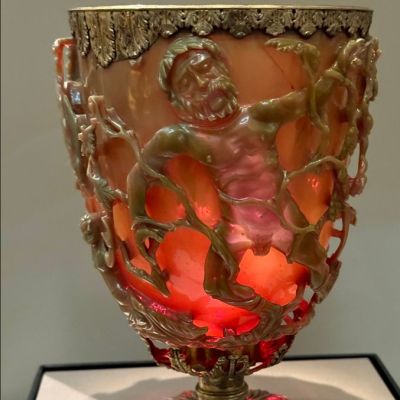
The Lycurgus cup with light shining through it. (Credit: Chappsnet, Wikimedia)

Dichroic glass takes on a different color depending on the lighting conditions, with the Lycurgus cup appearing to be green glass when lit from the front and red when light passes through it from behind. This serves to give the portrayed scene – of the demise of King Lycurgus from Greek mythology – an extra boost with the right lighting.

The cause of this dichroic effect in this ancient marvel of glass work was unknown for the longest time, but research on a fragment of the glass revealed that it contains nanoparticles of both gold and silver. Since then a number of researchers have recreated this dichroic glass, with [Lars Kool] et al. using FDM 3D printing to create objects embedded with the same nanoparticles that also display this effect.

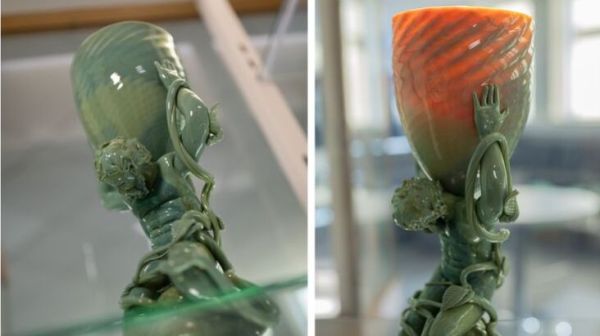
Where this work by the University of Sheffield differs is in that it creates the effect not only in glass, but also creating a piece of art in the form of a modified Atlas statue to use it. The resulting dichroic effect is rather similar, which isn’t too shocking since unlike over 1,600 years ago we can now literally see and measure nanoparticles in glass, while adding exact amounts of each to pure glass.

Here’s to raising a dichroic glass cup to bridging the millennia with recreated luxury glass recipes.

Image

Clotty The Custom Period Tracker Can, Of Course, Run DOOM

[kati]’s Clotty might run DOOM and game-ify the menstrual tracking process with a playful Tamagotchi-like aspect, but don’t let that distract you. It is, at its heart, a personal menstrual cycle tracking device that is defined as much by what it does do as what it doesn’t.

Image
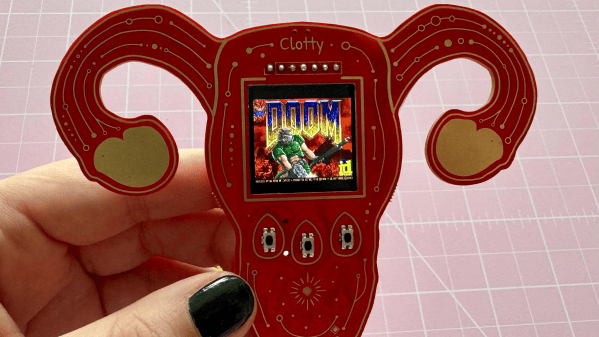
Clotty brings a Tamagotchi-like playfulness to the table.

What doesn’t it do? Well, it will never quietly upload one’s menstrual tracking data to a remote server. Nor will it harvest, mishandle, disclose, or sell that same data. Shamefully, that alone sets it far apart from the wide range of period tracking services and apps out there. Also setting it apart is its cheerful lack of discretion. As [kati] puts it, she wanted Clotty’s design to scream “HELLO I AM A PERIOD TRACKING DEVICE” and at this she absolutely succeeded.

Clotty uses an RP2040, color LCD display, and a small variety of sensors built into a palm-sized, uterus-shaped PCB complete with touchpad ovaries. Right now it’s still in its early stages, and basically at the point that everything works hardware-wise and the essentials are there for software, but it’s still in active development. Keep an eye on Clotty’s GitHub repository for updates as features get fleshed out.

Of course, as [kati] observes, the core validity of a device can be defined by whether it can run DOOM, which of course Clotty can. You can find [kati]’s fork of RP2040-DOOM here.

[kati] has a knack for designing effective hardware that gamifies functions and incorporates a playfulness to the design that’s a delight to see. Take a moment to check out her Slightly Sentient D20 which is another excellent example of the kind of work she does.

Image

The Hexa-Bouncer May Be The Most Overengineered Thing You See This Week

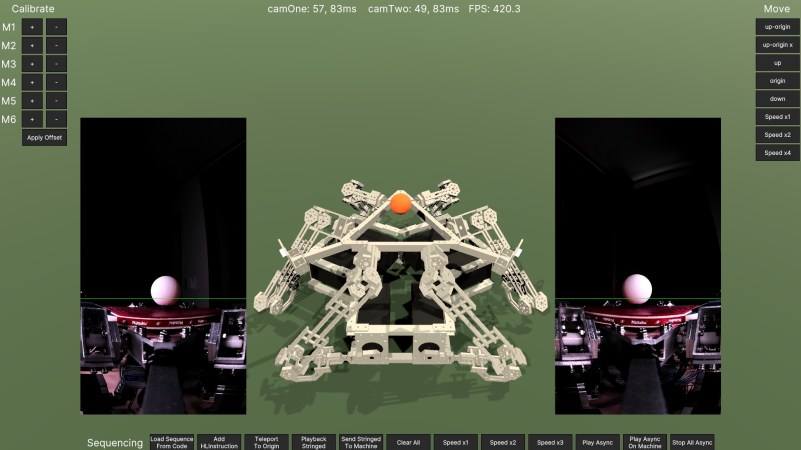
Sometimes, you want to build a simple project– the minimum viable product that solves your problem and nothing else. Other times you might be feeling a little extra, and want to use oodles of machined aluminum, six steppers, two cameras, a Teensy and a PC with a GPU just to bounce a ball. That’s the mood behind [T-Kuhn]’s hexa-bouncer, a Stewart Platform on steroids.  You can read all about it on his blog or witness it in action in the video below.  Trust us, really have to see it in action.

Continue reading “The Hexa-Bouncer May Be The Most Overengineered Thing You See This Week” →

Image

The Big Moon Plot

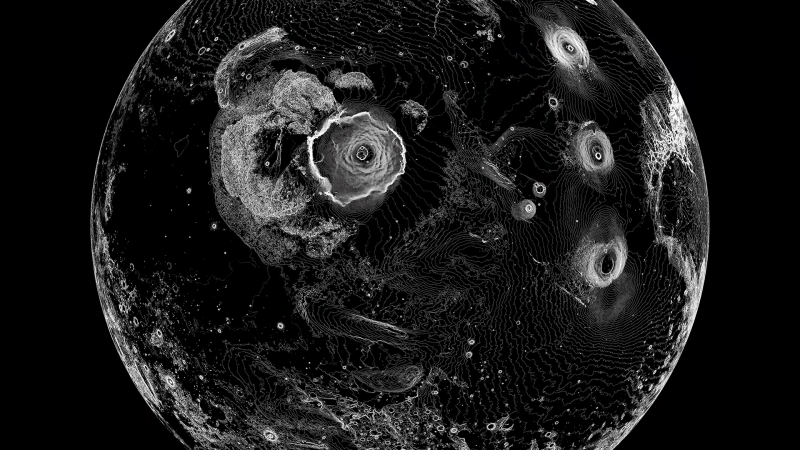
When you look into the night sky, you can’t help but wish to bring the outer worlds to your doorstep. One of the best ways to do that is to photograph the Moon’s surface to display in a frame. However, [Sebastian Lague] found a simple image too lackluster compared to something with a bit more style, such as a plotted image of the lunar terrain.

Why plotting? Well, the Moon is not defined in the same way with contrasting colors as Earth is. The Moon is peppered with craters and differing elevations that separate regions, so why not build an entire DIY plotter from scratch? [Sebastian Lague] did exactly this with a custom algorithm to take the elevation maps and create vector drawings which are plotted on his custom plotter.

Continue reading “The Big Moon Plot” →