Image

Static Radio For The Chumby One

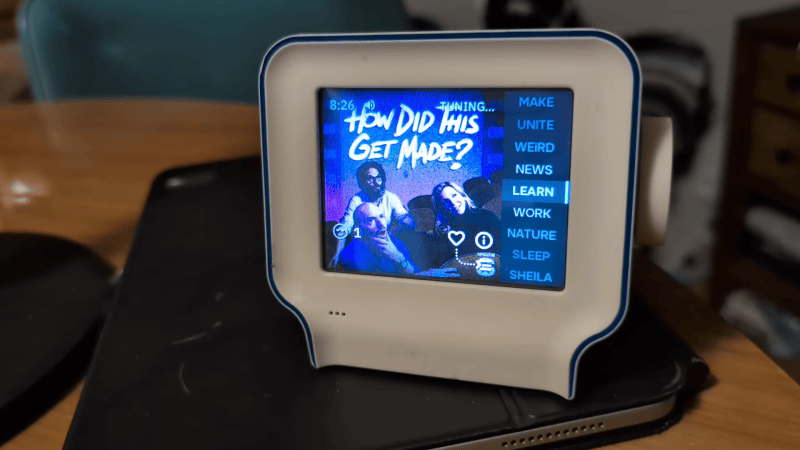
If you haven’t heard of Static Radio, it’s basically an online radio station made up of podcast content. [Brendan Fitzpatrick] decided to take an old 2009 Chumby One and turn it into an appliance for tuning in to Static.

This was achieved by creating a native C Static Radio client that could run on the Chumby’s 454 MHz ARM9 CPU. It’s got no FPU, only 60 MB of RAM, and runs Linux 2.6.28, so it’s not exactly the most up to date platform out there. But nevertheless, [Brendan] was able to make it work.

The client starts from a USB stick, without touching the original firmware on the Chumby itself. [Brendan] bundled in mbedTLS, since the stock Chumby OS shipped with OpenSSL 0.9.7 from 2004, which simply doesn’t cut it today. He also threw in a fixed-point Helix MP3 decoder along with HE-AAC and a polyphase resampler to handle sound, with the audio stream piped out to the kernel’s ALSA PCM device. The client is set up to buffer not only the current station, but the two neighbouring stations on the dial as well, so that turning the knob to switch stations comes with a clean crossfade transition.

If you’ve got a Chumby sitting around doing nothing, this could be the perfect way to put it back to work. We’ve examined other hacks for this venerable piece of hardware, too.
Continue reading “Static Radio For The Chumby One” →

Image

Building An ADS-B Receiver For Less Than You Think

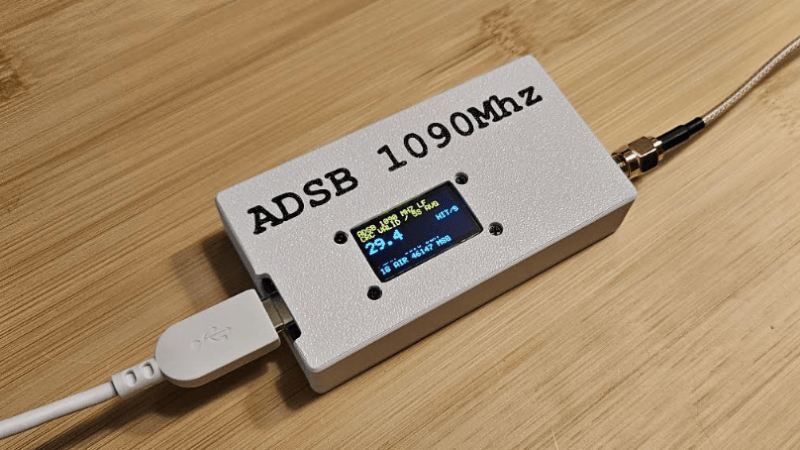
If you’ve ever wondered about the planes flying above your head, you could always listen in to ADS-B transmissions to learn more about them. [thefatmoop] has built a rig to do just that, and it comes in under $50 in parts.

The build is based around the Meshnology W12 board, which combines an ESP32-S3 microcontroller with an LR2021 LoRa Radio. The latter is able to be tuned into transmissions in the realm of 1090 MHz and it can capture ADS-B traffic that uses OOK and Manchester encoding. The data is passed to the ESP32-S3 which validates the CRCs of the captured data and serves up the aircraft tracks on a simple web interface. A GNSS receiver can also be added in so the board knows its own location as well as the location of the planes that it’s tuning in.

[thefatmoop] reports decent performance with the rig, pulling in aircraft tracks from up to 150 nautical miles away using a 915 MHz antenna. There are some mods required to achieve this performance, though—namely, you’ll want to modify the filter configuration on the board to avoid it attenuating the 1090 MHz signals of interest.

There are lots of other ways to listen to ADS-B signals, too—you can always grab yourself an SDR and get going. If you’re cooking up your own cheap radio hacks, don’t hesitate to let us know on the tipsline!

Thanks to [Moser] for the tip!

Image

Keeping Old Wi-Fi Radios Alive With Stream Conversion

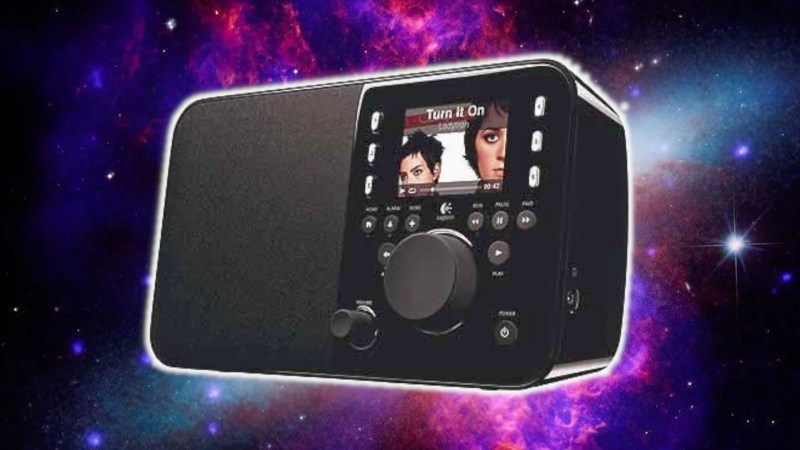
There are plenty of Wi-Fi radios out there that were built over the last two decades or so. However, many older models are now becoming less useful because many internet radio stations are switching to newer streaming formats that they don’t support. [Clifford Farrugia] has been working on a little project to save these appliances from the e-waste bin.

The HLS Radio Converter is the result of that work. It’s a small open-source tool that converts modern HTTP Live Streaming (HLS) protocol streams into regular old HTTP MP3 streams that older internet radio appliances are built to decode. You can run the tool on something as simple as an old Raspberry Pi. To make it work, you just give the tool the URL of the stream you’re looking to convert, and it then spits out a new URL to point your radio to which has the stream in the old-school format instead.

It’s a simple tool, but one that should prove very useful if you have a beloved old internet radio that can’t handle modern streams. We’ve featured lots of fun projects in this vein before, too, like this ultra-tiny internet radio build. If you’re working on your own projects in this space, be sure to let us know via the tipsline.

Image

Building A Simple Internet Radio

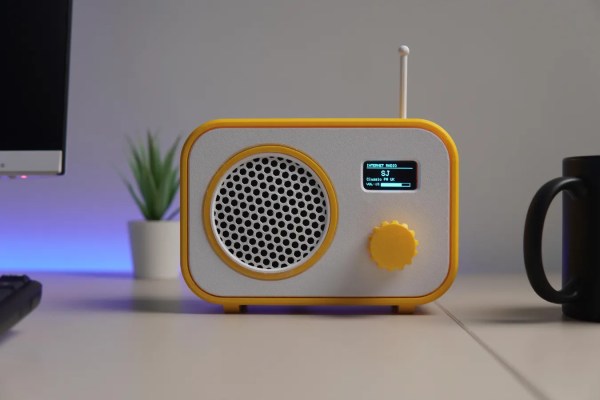
Broadcast radio isn’t as popular as it once was, its popularity suffering in turn due to technologies like MP3 players and music streaming services. If you don’t fancy either of those, you might like to listen to some internet radio stations, using a rig like the one [CodersCafeTech] built.

It’s a simple desktop radio set, but instead of tuning in to AM or FM broadcast bands, it has an antenna for 2.4 GHz instead. That’s because inside this radio is an ESP32-S3 development board, which is equipped with onboard WiFi hardware that lets it connect to the internet. It’s hooked up to a 1.3-inch OLED display over I2C, which acts as a user interface in concert with a rotary encoder. Sound is handled with a MAX98357 I2S audio amplifier, hooked up to a small 3 W speaker. Once programmed appropriately, all the unit needs is a WiFi SSID and password, and the URL for the internet radio station you’d like to listen to.

We’ve featured a few internet radio builds over the years, as well as a rather fun build that saw a Macintosh SE/30 hooked up to Spotify. If you’re tinkering with something along those lines, don’t hesitate to let us know on the tipsline!

Image

Going Whole-Hog On A First Satellite Ground Station

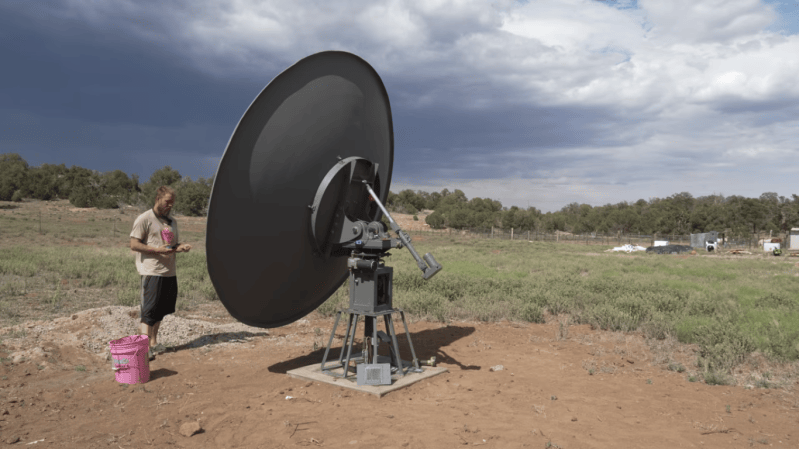
When most radio enthusiasts start trying to pick up signals from satellites, they might put together a quick-and-dirty Yagi antenna and try to catch a repeater as is passes overhead, or they might grab a small unused dish from a satellite TV service and point it up at a weather satellite by hand to try to decode some of the data coming down. But [Cranktown City] had a different approach. He found an eight-foot dish online and built a massive articulating base station out of it as his first exploration into the world of satellites.

The first problem that needs to be solved with a dish of this size is its mounting location. This installation uses a large post and concrete foundation with a custom-fabricated metal base at the bottom. The metal base houses all of the electronics not just for receiving signals from the dish, but also for orienting it properly. That includes a large metal gear driven by a wheelchair motor to control its azimuth and a linear actuator to take care of its elevation. Getting the large dish onto the frame was its own ordeal, complicated by the fact that it’s not uniform in its shape and has to be mounted in a specific orientation.

With everything assembled, the circularly-polarized antenna installed, and the computers up and running, the dish is able to track satellites across the sky and download data from things like GOES weather satellites. [Cranktown City] also built in a system that detects wind and points the dish vertically when it goes above a certain speed. This level of effort is impressive, and absolutely not required to listen in on plenty of sattelite activity out in the sky, but this installation will certainly give [Cranktown City] a lot of mileage and possibly even work for some radio astronomy.

Continue reading “Going Whole-Hog On A First Satellite Ground Station” →

Image

Discovering SDRs Everywhere

To quote commenter [douyarou], “It’s like our little version of a Precambrian explosion”. A bunch of hackers have discovered, independently and building on each other’s work, software-defined radio (SDR) capabilities in more places than you can shake a stick at.

It all started with [Espargos] and [h0m3us3r] apparently independently discovering that the ESP32 family of chips had a “secret” debug mode that allowed direct access to the radio that’s normally used for WiFi. While the 2.4 GHz radio signal is almost always immediately converted into data by the MAC hardware, here they found a way to listen in upstream, to the raw IQ data.

Seeing this, folks were immediately inspired to find out if they could transmit as well. [marble] not only got transmit functionality working, but integrated the part in with the standard osmosdr data flow, which meant that a whole bunch of existing tools were ready to go. We didn’t know about it at the time, but apparently [jochenhammes] and [z1000biker] concurrently had their TX-capable hacks up and running: here and here.

At this point, folks have already started to use the capabilities for broadcasting digital TV signals, voice signals, FM Hell, and other hijinks. This reminds us of the early days of the RTL-SDR project, when a competent, if receive-only, SDR functionality was found in a bunch of USB TV-tuner dongles. Once the hardware capabilities were sussed out, people started writing all sorts of useful software, and it gave rise to all manner of radio projects, from simply poking at domestic wireless devices to tracking all the airplanes in the world as they fly by.

[Tom] and I were discussing this on the podcast, and he remarked that of course there are SDRs hidden everywhere there is a radio unit these days, and the question is just whether or not we could hack them into usability. And before the podcast was even finally edited, [Samson1te] told us about his find in the LR2021 LoRa chip. This is a radio that’s designed to be a radio, with 16-bit resolution, and covering lower frequencies from 150 MHz to 960 MHz.

Compared to the RTL-SDR revolution, this is all happening at incredible speed. Each of these hacks will enable us to use different slices of radio spectrum with different degrees of ease, but it’s clear that the cost of entry into playing around with digital radio has just dropped precipitously. We will see hundreds of new signals hacks in the next few months – the floodgates have been opened.

Image

Another Wireless Chip Has A Hidden SDR Revealed

The news of the past couple of weeks has seen the ESP32 turned into an software-defined radio (SDR) thanks to a hidden baseband mode, an exciting development by anyone’s standards. It seems unexpected SDRs are like busses in that you wait for ages and two turn up at once, because hot on the heels of the ESP32 story is [Samson1te], revealing the SDR functionality hidden within the LR2021 LoRa chip. This one is especially interesting because as well as a 2.4 GHz radio, the chip sports a radio that works from 150 to 960 MHz.

We’re indebted to them for posting this in a comment on our receive converter post, as a complimentary project to the ESP32 one. It gives a 16-bit SDR with receive and transmit, however as with the ESP32 it’s early days and we hope great things lie ahead. There are comprehensive docs available, should you wish to enter the fray. Currently the main demo is P25 digital voice.

If you’re interested, you can follow our coverage of the ESP32 SDR.