Image

Japan Launches Mission To Study Martian Moon

Humanity has been sending robotic explorers to Mars since the 1970s, and for our efforts we’ve been rewarded with not only incredible imagery of the Red Planet’s magnificent desolation, but a wealth of information about the alien world and how it’s changed over the last several billion years. But comparatively, we know almost nothing about the planet’s two moons, Phobos and Deimos. In fact, as recently as the 1960s, there were some scientists that believed the unusual shape, mass, and orbit of Phobos hinted at the possibility that it was no moon at all, and was in actuality a derelict spacecraft of some type.

Image
Martian Moons eXploration Spacecraft

Once the first Viking probes arrived at Mars, we had the photographic evidence and up-close measurements to prove that Phobos wasn’t artificial. But even today, we still don’t know exactly what it is. The data suggests that it’s not solid rock, and that large voids may be hiding under its surface. While we can be fairly sure there won’t be any mummified remains of Martian astronauts to be found within Phobos, vast deposits of ice are a tantalizing possibility.

With the launch of the Martian Moons eXploration (MMX) mission earlier this week, the Japan Aerospace Exploration Agency (JAXA) hopes to bring us one step closer to understanding the formation and structure of Phobos. Should everything go to plan, MMX will deploy a small rover to its tenuous surface in 2029, and by 2031, a sample return capsule will bring pieces of the mysterious moon back to Earth for further study.

Continue reading “Japan Launches Mission To Study Martian Moon” →

Hackaday Links Column Banner

Hackaday Links: October 17, 2026

While Hackaday doesn’t maintain a crime blotter, we couldn’t help but start this week’s post off with a bit of civil disobedience — a retired professor from the University of Pennsylvania was arrested earlier this week for standing in front of a delivery robot.

Granted, she was standing there for long enough that the police were eventually called, but still. Previous reporting indicates that Carolyn Marvin has a history of blocking delivery robots as a form of protest, but this is the first time law enforcement got involved. We’re not lawyers here at Hackaday, so we can’t say for sure whether or not blocking the progress of a robot engaged in commercial operation actually violates any laws. But we do know that refusing a lawful request from a police officer will get you in trouble, and that seems to be what Marvin was actually charged with when she refused to move.

Continue reading “Hackaday Links: October 17, 2026” →

Image

Hackaday Podcast Episode 391: Tuned In To ESP32 SDR, New Old Pagers, And Bugs On Mars

Hackaday Editors Elliot Williams and Tom Nardi start this episode off with a discussion about Philadelphia’s budding hacker conference and the imminent retirement of the EZ80. After considering the parallels between the wide world of aviation headsets and our personal projects, talk moves on to the exciting developments in the world of software-defined radio on the ESP32, a Meshtastic pager from a bygone era, and how all the wild flying machines entered into DARPA’s Lift Challenge ended up losing to a simple helicopter.

You’ll also hear about turning plastic bottles into printer filament, pushing e-ink screens to their limits, and browsing the web on the PSP in 2026. To wrap things up they’ll marvel at all the modern abstraction sitting between software and the memory it’s running on, and revisit some RF concepts that might be particularly useful now that everyone is playing with a new SDR device.

Check out the links if you want to follow along, and as always, tell us what you think about this episode in the comments!

Download in DRM-free MP3.

Continue reading “Hackaday Podcast Episode 391: Tuned In To ESP32 SDR, New Old Pagers, And Bugs On Mars” →

Image

Braino! Takes The Cheap Yellow Display To School

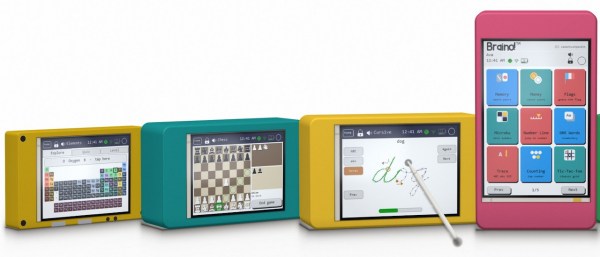
These days, it’s common to give even very young children a mobile device loaded up with educational software that aims to improve everything from basic motor skills to reading and arithmetic. But even the cheapest phone or tablet isn’t the kind of thing most parents would like to see get destroyed, and there’s always a concern about giving children a device that’s capable of connecting to the Internet.

Which is where Braino! from [Ankush Pandit] comes in. This suite of applications can be easily flashed to a common Cheap Yellow Display to turn it into a legitimate educational tool. Combined with a 3D printed case, the total cost of the build is low enough that you don’t have to feel bad about handing it off to even the roughest of youngsters.

Image[Ankush] makes it clear that this project isn’t trying to sell you anything. You’re responsible for picking up a compatible CYD and installing Braino via the web flashing application. The software is released under the GPLv3 license, and it contains no ads, user accounts, or cloud connectivity. We know not everyone is thrilled with how much time young kids spend staring at screens these days, but opinions on modern parenting aside, it’s hard to find fault with the way things have been implemented here.

When the parent sets up Braino they can pick which of the 40 games can be accessed, allowing the experience to be tailored to the individual child’s age and ability. Should you decide to enable Bluetooth, some of the games even support wireless multiplayer between devices.

The commonality of the Cheap Yellow Display is one of its best features, and Braino does an excellent job of showing why that’s so important. Trying to develop a project like this without a standardized platform of some type would be a non-starter, but when anyone can get a CYD sent to their house from Amazon and flash it right from the browser, it’s makes the whole thing far more accessible.

Continue reading “Braino! Takes The Cheap Yellow Display To School” →

Image

Running DOOM (Sort Of) On A Sonoff Smart Switch

It’s often said in this community that DOOM can be made to run on anything, and as time goes on, that’s becoming more and more accurate. We’re at the point now that every “normal” device seems to have some version of the iconic 1993 shooter, so now there’s nothing left but to start working on the more oddball targets.

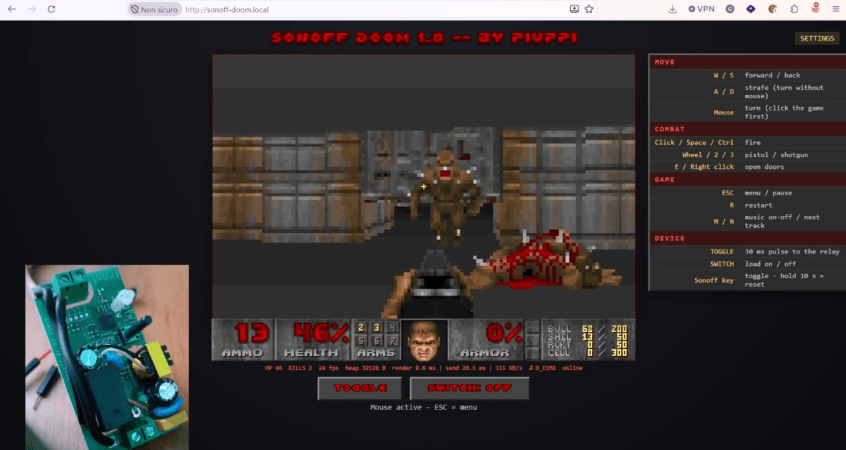
As a perfect example, [piuppi] recently wrote in to share their efforts to get DOOM — or at least something that looks like it — running on the Sonoff Basic R2 smart switch. We say something that looks like it because the game you’re seeing in the video below isn’t actually DOOM. In fact, it’s not even really a full game. It’s essentially a tech demo that’s capable of rendering graphical data pulled from the game, but only within the confines of simplistic map. Still, not bad for something designed to turn lamps on and off.

The GitHub repo includes excellent documentation should you want to rip and tear on your own Sonoff device. As you might expect the process is a bit involved, and does require you to provide your own copy of DOOM for the script to extract the necessary data from. After it’s setup, you can hit the switch from any browser on the local network and take out your frustrations on the state of modern home automation on some imps. The best part is, even after the game is installed and running on the switch, the device still actually works as a switch.

But don’t worry. Even in the unlikely event that we run out of devices that can be hacked to run DOOM, there’s still a whole world of gadgets out there that need their own port of Duke Nukem 3D.

Continue reading “Running DOOM (Sort Of) On A Sonoff Smart Switch” →

Image

JawnCon 0x3 Kicks Off In Philadelphia This Friday

Philadelphia’s homegrown hacker con returns this weekend, and this time it’s starting a day early to pack in even more talks, demos, and activities. Tickets are still available for anyone who can get themselves to Arcadia University by the end of the week, and as always, students with a valid .edu email address get in for free. The talks will also be recorded for hackers that can’t make it out in person, but of course there’s no substitute for a weekend spent hanging out with like-minded folks.

Image

Now in its fourth year, JawnCon continues to steadily grow and evolve. In 2026, it’s not only getting an extra day, but also a second stage for talks, delivering nearly 30 presentations on everything from board games to modern pager networks. For style points, the schedule is available via HyperCard running on an emulated Macintosh Plus, but you can also just read it off the web page if you insist.

In addition to the talks, there will be exhibits from local groups such as Philly Mesh, PhilTel, and the Open Organisation Of Lockpickers, as well as a dedicated classroom for those looking to study ahead of their amateur radio exams. Attendees can even use a pair of Zebra ID printers to produce custom badges, and we’re sure nothing untoward will happen with them.

Continue reading “JawnCon 0x3 Kicks Off In Philadelphia This Friday” →

Image

Open Firmware Fixes Dead Onkyo AV Receivers

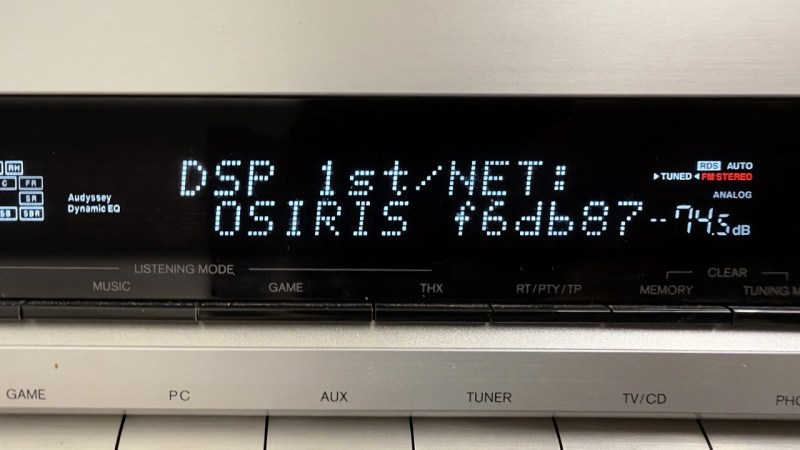
If you’ve been reading Hackaday for any length of time, you’ll know we love seeing hackers replacing the stock firmware on their devices with open source alternatives. Usually this is done because the open firmware offers more features, or lifts some arbitrary limitation. But if you find yourself installing OSIRIS on an Onkyo AV receiver such as the TX-NR717, it’s probably because you’re trying to bring the thing back to life.

As developer [Jokūbas] explains, certain Onkyo receivers that use the Texas Instruments D830 are known to suffer from a very specific failure — the device will power on and appear functional, but no audio will come through. When this happens, it’s either because the D830 itself has failed or the 64 MiB NAND flash chip that holds the firmware it runs is cooked. Unfortunately, replacing either component is a bit more difficult than you might expect.

Image
Everything passes through the Texas Instruments D830. If it goes, you’ve got a problem.

If you swap the D830 with a pin-compatible chip that’s easier to find and less prone to failure, the stock firmware won’t boot. If you try to replace the NAND, you’ll find that the original software is only capable of addressing 512-byte pages, while the flash you’ll find on the market today uses 2 KiB or 4 KiB pages. In both cases, it’s OSIRIS to the rescue.

The open firmware not only supports D830 compatible chips such as the OMAP-L137, but it’s able to address modern NAND flash, making the replacement of either or both component far more practical. With fresh hardware and the new firmware installed, your Onkyo receiver should spring back to life. That said, OSIRIS isn’t feature complete yet, and truthfully the items listed as untested or not implemented on the feature list currently outnumber the entries for what actually does work. But at least it’s a start.

Of course, not all the burned out parts on your Onkyo receiver require a firmware flash to replace. Sometimes a misbehaving unit just needs to have a few of its passive components replaced.