Image

Meshtastic Sniffer For DragonOS

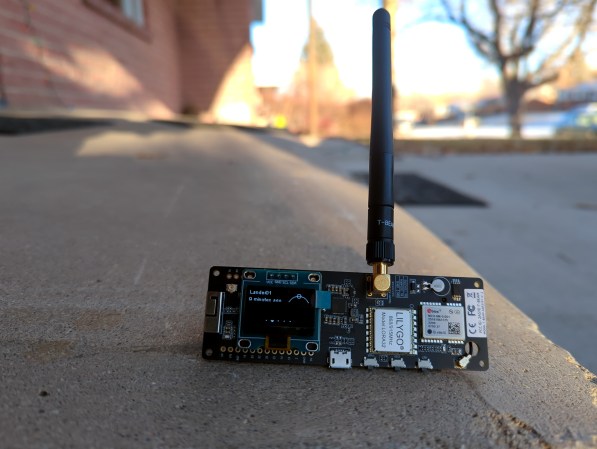
Meshtastic has gained a lot of popularity over the last few years thanks to its low barrier of entry. No licenses are needed and the hardware is dirt cheap, at least when compared to a lot of ham radio gear. But while that physical barrier is low, there is a bit of a learning curve. Part of that comes from the fact that there are a lot of channels and modes that people could be communicating on, and unless the user knows that information up front it can be hard to find where the conversations are happening. [cemaxecuter] noticed this problem and built a Meshtastic sniffer into his radio-forward Linux distribution, DragonOS.

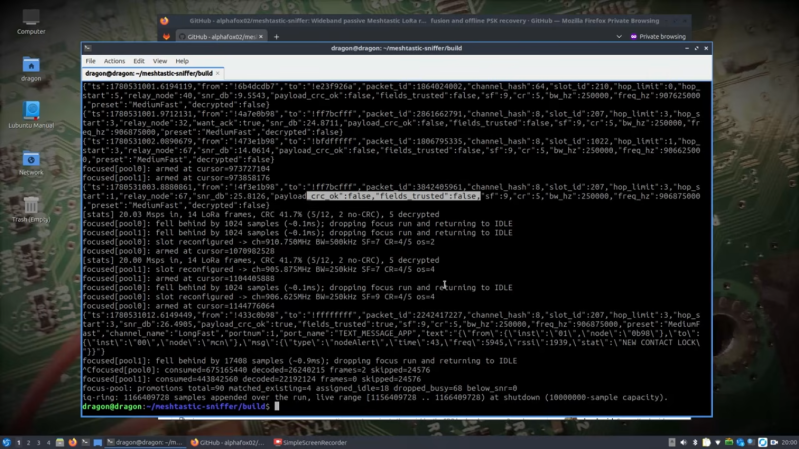
The sniffing software is built in C and comes as a complete standalone binary and does not rely on GNU Radio. With DragonOS up and running and the software loaded, it can look at the entire bandwidth that Meshtastic operates on and detect any traffic and decode it (as long as the key is known). [cemaxecuter] is using a HackRF as a software-defined radio for this project, which he notes doesn’t quite have enough bandwidth to cover every Meshtastic operating frequency, but it can get most of them. After firing up his own node, the software quickly detects it and shows its details in the terminal.

Software like this opens up a lot of opportunities for things that would be tedious, difficult, or impossible to do with with a standard Meshtastic node. Besides finding places where conversations are happening more easily, [cemaxecuter] also suggests that it could be used for wardriving and for locating or finding other networks much more easily. For those who still haven’t tried it out, take a look at this 2023 treatise on the protocol and hardware and then dive right in.
Continue reading “Meshtastic Sniffer For DragonOS” →

Image

Pager Converted To Meshtastic Node

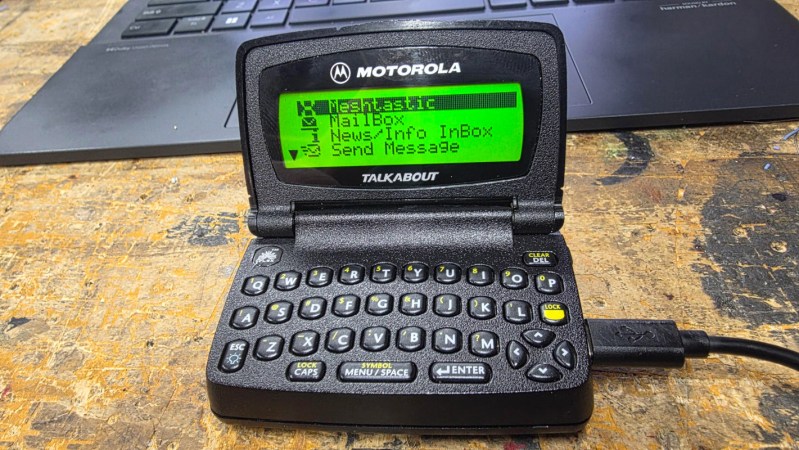
Text messaging has been around on cellular networks en masse for around three decades now. It’s so common that it’s difficult to remember a time without it. Its two-way quick messaging is incredibly useful, but for even simpler communications there’s a one-way system that predates it. Pagers are able to receive simple messages, but outside of hospitals are rarely used nowadays. Eventually some added in two-way communications like this Motorola T900, but they’re still mostly obsolete. That’s why [zindustries87] converted it to operate on the Meshtastic network instead.

To get this pager working, a lot of reverse engineering was needed. There is essentially no documentation on the chips in these devices, so the screen and keyboard both were reverse-engineered to work with other hardware. In this case, [zindustries87] found space for a Heltec V4 with an ESP32-S3, a popular Meshtastic node with a small form factor. Some programming was needed to get everything communicating together, but from the looks of things it seems to have basic functionality.

[zindustries87] points out that this is a prototype, and didn’t know going in if the keyboard and screen could be brought back to life, or if the other hardware would fit in the case. But with it working on this level, they plan to add a number of other features in and possibly build a drop-in PCB replacement for these devices. They were once fairly popular so there are plenty around, and they’re a good form factor for a dedicated Meshtastic device that doesn’t need a smartphone to work. The only other ways of bringing pagers back to life involve bootstrapping an entire pager network, and Meshtastic is a bit more useful than that now.

Image

FCC ISM Rules May Shatter Lora Mesh Communities

Although everyone has their own reasons for exploring a new hobby, one of the driving factors behind the popularity of Meshtastic and MeshCore has been the incredible accessibility offered by off-grid LoRa mesh networks. You don’t need any expensive hardware or a license to get on the air — armed with a $20 microcontroller dev board and open source software, you could be on the mesh in minutes. Then came the really exciting part, seeing who else was out there. The low barrier of entry and ad-hoc nature of these projects meant there was a good chance you’d soon find yourself exchanging messages with other like-minded folks in the area.

Or at least, that’s how it used to be. With the recent revelation that their default radio configurations have potentially been in violation of the Federal Communications Commission’s (FCC) regulations governing amateur usage of the 900 MHz industrial, scientific and medical (ISM) band, the users and developers of both Meshtastic and MeshCore have been sent scrambling. Getting in compliance isn’t necessarily a technical challenge. In fact, Meshtastic has already introduced changes aimed to address the issue and anyone running the latest alpha release can be sure that their initial radio configuration will meet FCC standards.

But unfortunately, this introduces a new problem. While it’s easy enough to get new installations of Meshtastic and MeshCore operating in a mode that keeps the FCC happy, doing so breaks compatibility with everything that’s already been deployed. The community will be fractured into distinct strata depending on when they first configured their hardware, with an added dash of confusion from the more rebellious users who will undoubtedly refuse to migrate over to the new settings.

What was once easy and accessible has just gotten a whole lot more complicated.

Continue reading “FCC ISM Rules May Shatter Lora Mesh Communities” →

Image

The Hackaday Communicator Badge, Re-Imagined With New Firmware

Our recently concluded event in Europe saw the return of the Hackaday Communicator badge — a stylish handheld gadget with a QWERTY keyboard, a LoRa radio, and an ESP32. It came complete with a simple messaging app built into its MicroPython firmware, and by all accounts it was a great success.

But there was certainly room for improvement, which is where [Giovi321]’s new firmware for the badge comes in. It brings support for Meshtastic proper, as well as longer battery life support for GPS module. To install this firmware you will need to have the ESP-IDF but fortunately there are very comprehensive instructions provided to help you. Under the hood it’s running FreeRTOS.

It’s something which is so often missing with an event badge, any sense of how it might have a life after the event rather than becoming a piece of e-waste. The Communicator badge is such a nice physical design that it obviously has potential, so this firmware unlocks it and gives the badge a use out in the real world. We really like it for this, and we’ll be flashing a few of our badges over to give it a shot shorlty.

If you’re looking to upgrade the hardware on your Communicator, check out the custom RGB keyboard we covered last week.

Image

Meshtastic Does More Than Simple Communication

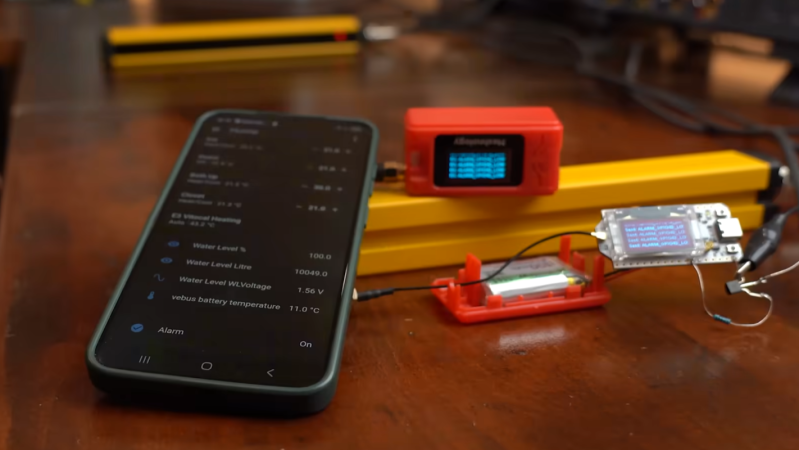
Meshtastic has been experiencing a bit of a renaissance lately, as the off-grid, long-range radio text messaging protocol gains a ton of new users. It’s been used to create mesh networks in cities, during disasters and protests, in small groups while hiking or camping, and for search and rescue operations. Although it’s connected plenty of people together in all of these ways, [GreatScott!] wanted to put it to work connecting some computing resources instead. He has a garden shed that’s too far for WiFi, so Meshtastic was used to connect it instead.

This isn’t a project to bring broadband Internet out to the shed, though; Meshtastic is much too slow for that. All he really wanted to do here was to implement a basic alarm system that would let him know if someone had broken in. The actual alarm triggering mechanism is an LED emitter-detector pair installed in two bars, one of which sends a 12V signal out if the infrared beam from the other is broken. They’re connected to a Heltec ESP32 LoRa module which is set up to publish messages out on the Meshtastic communications channel. A second module is connected to the WiFi at the house which is communicates with his Home Assistant server.

Integrating Meshtastic devices into Home Assistant can be pretty straightforward thanks to the various integrations already available, but there is some configuration to get these specific modules working as an alarm. One of the pins on the remote module had to be set up to watch the light bar, and although sending the alarm message out when this triggered worked well, the received signal never passed through to Home Assistant until [GreatScott!] switched to using the RadioLib library an an MQTT integration instead. But with perhaps more configuration than he planned for out of the way, [GreatScott!]’s alarm is up and running. Meshtastic projects often balloon into more than we had originally planned though, in more ways than one. You can follow along as our own [Tom Nardi] attempts to connect all of New Jersey with this new protocol.

Continue reading “Meshtastic Does More Than Simple Communication” →

Image

2025: As The Hardware World Turns

If you’re reading this, that means you’ve successfully made it through 2025! Allow us to be the first to congratulate you — that’s another twelve months of skills learned, projects started, and hacks….hacked. The average Hackaday reader has a thirst for knowledge and an insatiable appetite for new challenges, so we know you’re already eager to take on everything 2026 has to offer.

But before we step too far into the unknown, we’ve found that it helps to take a moment and reflect on where we’ve been. You know how the saying goes: those that don’t learn from history are doomed to repeat it. That whole impending doom bit obviously has a negative connotation, but we like to think the axiom applies for both the lows and highs in life. Sure you should avoid making the same mistake twice, but why not have another go at the stuff that worked? In fact, why not try to make it even better this time?

As such, it’s become a Hackaday tradition to rewind the clock and take a look at some of the most noteworthy stories and trends of the previous year, as seen from our rather unique viewpoint in the maker and hacker world. With a little luck, reviewing the lessons of 2025 can help us prosper in 2026 and beyond.

Continue reading “2025: As The Hardware World Turns” →

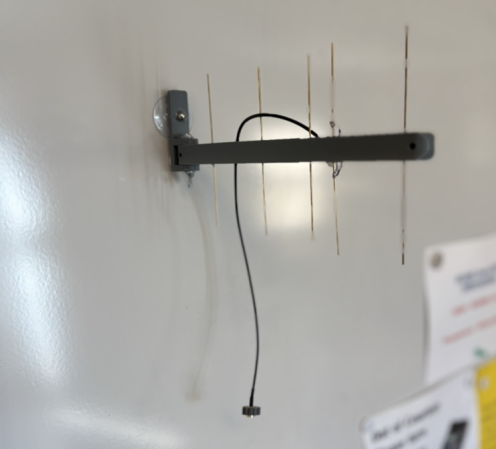
The yagi, suction-cup mounted to a wall

Bringing A Yagi Antenna To 915MHz LoRa

If you’re a regular reader of Hackaday, you may have noticed a certain fondness for Meshtastic devices, and the LoRa protocol more generally. LoRa is a great, low-power radio communications standards, but sometimes the antennas you get with the modules can leave you wanting more. That’s why [Chris Prioli] at the Gloucester County Amateur Radio Club in the great state of New Jersey have got a Yagi antenna for North America’s 915 MHz LoRa band.

Right out the gate, their article links to one of ours, where [tastes_the_code] builds a Yagi antenna for the European 868 MHz LoRa. Like [tastes_the_code], the radio club found [Chris]’s antenna gives much better reception than what came with the LoRa module. Looking out their window, instead of two Metastatic nodes with a stock antenna, one club member is now connecting to two hundred.

Image
A simulation of the radiation pattern. Looks like a Yagi, alright.

Now, the Yagi is directional, so you only get that boost pointed down the axis of the antenna, but at least in simulation they estimate a 7.7 dB front-to-back gain vs under 3 dB for an omnidirectional antenna. Not bad, for a simple 3D print and some stiff wire!

If you don’t want to re-invent the wheel again, check out the GCARC’s GitHub for files if you’re in North America. If you’re in Europe, check out [taste_the_code]’s build from last year. Of course whatever band you’re operating in, Yagi isn’t your only roll-your-own option for a LoRa antenna.

Thanks to [Jon Pearce WB2MNF] for the tip!