Image

Off-Grid Refrigeration Using Fire And Salt

Refrigeration has been a challenge for humanity since the start. Ancient civilizations in dry climates like Persia and Egypt could use evaporative cooling on a large scale with specialized architecture, and with easy access to electricity modern civilization can cool down almost anything it wants. But whether in a refrigerator or heat pump, the electricity demands can get out of hand quickly, and heat-driven systems often require dangerous or hard-to-get chemicals. But [Greenhill Forge] has crafted a system that creates effective refrigeration with only fire and salt… and a bit of electricity.

Heat-driven systems are called absorption coolers. In this design, water is used as a refrigerant and forced to a very low pressure so that it can boil at a low temperature. When it boils it absorbs heat from the surrounding environment, and then that water vapor can be moved and condensed where it gives off that heat. The build has a few distinct loops to make all of this happen. The generator loop holds the heat source and a tank of water mixed with road salt. Boiled water travels up a tube to a condenser. A valve here is opened slightly to allow the water to drip into the absorber section, where it is under low pressure and boils rapidly. The vapor is carried away by the third system, which uses a shower of the salt solution to quickly suck up the vapor and move it away from the cooled area.

There is a small amount of electricity needed to run pumps and fans, but to keep this off-grid this requirement is easily met by a small solar panel or battery. The bulk of the energy is from the fire which boils the saltwater solution. [Greenhill Forge] added a number of temperature and pressure sensors to monitor and control the system as well, and in his firsts tests the refrigeration system was able to get to about 5° C with an ambient temperature around 16° C. That’s not quite the temperature needed for a refrigerator, but not bad for only salt and fire. [Greenhill Forge] has a number of other ingenious off-grid builds like this sawdust stove and a magnetic induction water heater.

Continue reading “Off-Grid Refrigeration Using Fire And Salt” →
Image

Defeating Bacteria In Hot Water Systems With A Heat Exchanger

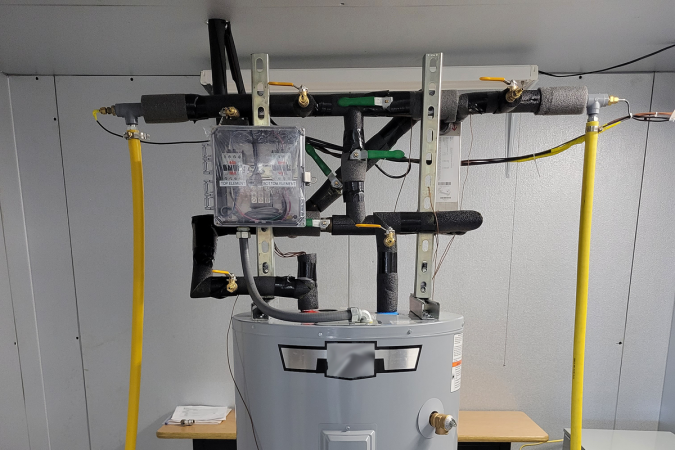
The average hot water is a relatively simple appliance to understand. It uses gas or electricity to dump energy into water in the form of heat, keeping it at a pleasant temperature for uses like bathing and cleaning. Basic mechanisms are in place to ensure the water stays at a relatively constant temperature, neither too hot where it could cause burns, nor too cold such that it wouldn’t be fit for purpose.

One of the problems, though, is that sometimes storing water at the desired temperature can create the perfect breeding ground for bacteria. However, a neat little trick developed by NIST could solve that problem rather elegantly.

Continue reading “Defeating Bacteria In Hot Water Systems With A Heat Exchanger” →

Image

An Automated Water Tank Controller

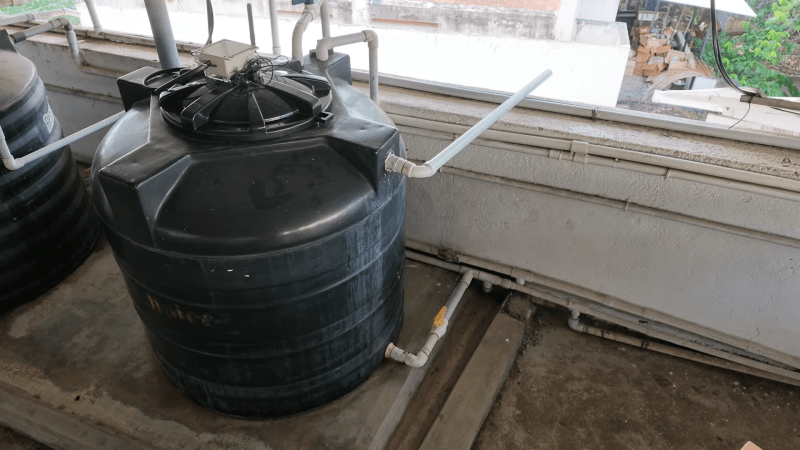
[Jumpor] lives in a part of India where the water infrastructure is a little frustrating to use. Water gets delivered to underground tanks outside of homes, and must then be regularly pumped into rooftop tanks prior to use inside the building. Typically, this pumping is handled manually—by switching on a pump and running it until water comes out of an overflow pipe to indicate the rooftop tank is full. [Jumpor] decided to improve this wasteful and time consuming process with a little automation project.

The build is based around an ESP32 microcontroller. It’s hooked up to an ultrasonic sensor which can measure the water level inside the rooftop water tank. When the sensor detects the level descending below a set point, the microcontroller fires a relay to trigger the lift pump to fill up the tank. Once the sensor detects the tank is full, the pump is shut off, saving liters of water compared to waiting for water to pour out of the overflow as an indicator of the same.

It’s a simple enough project, but [Jumpor] was sure to include the important practical considerations. Since the rig was being installed in a rental, it was desirable to not make any permanent modifications to the water system. Thus, a fresh cap for the water tank was modified to host the electronics and level sensor, such that the original could be replaced at a later date. Due consideration was also paid to things like avoiding crossing the minimum detection threshold of the sensor, which could lead to accidental overflows if not managed correctly.

The aim of this project was to ease the day to day burden of maintaining a basic utility. That’s the sort of project we love to see around these parts.

Continue reading “An Automated Water Tank Controller” →

Image

High-Tech Trailer Brings Water Home

Living without standard utility hookups like electricity, Internet, water, and sewer comes with a whole host of challenges, all of which are most commonly solved by spending lots of money. For electricity, a solar array or a generator is fairly common. The Internet can similarly be accessed via a satellite link if wires aren’t available. For water, most people will drill a well, but that gets similarly expensive. [Cranktown City] recently bought an off-grid home and needed a way to get water to it on a budget, so he built this water trailer instead.

Continue reading “High-Tech Trailer Brings Water Home” →

Image

3D-Printing A Full-Sized Kayak In Under A Day

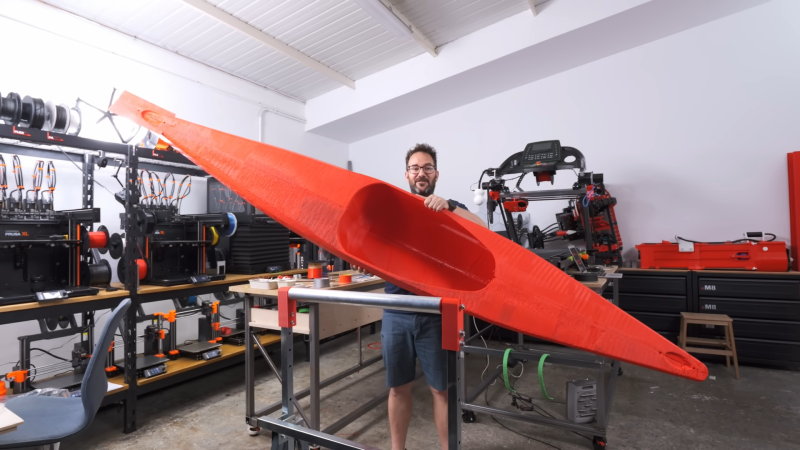
If you want to get active out on the water, you could buy a new kayak, or hunt one down on Craigslist, Or, you could follow [Ivan Miranda]’s example, and print one out instead.

[Ivan] is uniquely well positioned to pursue a build like this. That’s because he has a massive 3D printer which uses a treadmill as a bed. It’s perfect for building long, thin things, and a kayak fits the bill perfectly. [Ivan] has actually printed a kayak before, but it took an excruciating 7 days to finish. This time, he wanted to go faster. He made some extruder tweaks that would allow his treadmill printer to go much faster, and improved the design to use as much of the belt width as possible. With the new setup capable of extruding over 800 grams of plastic per hour, [Ivan] then found a whole bunch of new issues thanks to the amount of heat involved. He steps through the issues one at a time until he has a setup capable of extruding an entire kayak in less than 24 hours.

This isn’t just a dive into 3D printer tech, though. It’s also about watercraft! [Ivan] finishes the print with a sander and a 3D pen to clean up some imperfections. The body is also filled with foam in key areas, and coated with epoxy to make it watertight. It’s not the easiest craft to handle, and probably isn’t what you’d choose for ocean use. It’s too narrow, and wounds [Ivan] when he tries to get in. It might be a floating and functional kayak, just barely, for a smaller individual, but [Ivan] suggests he’ll need to make changes if he were to actually use this thing properly.

Overall, it’s a project that shows you can 3D print big things quite quickly with the right printer, and that maritime engineering principles are key for producing viable watercraft. Video after the break.

Continue reading “3D-Printing A Full-Sized Kayak In Under A Day” →

Image

2025 One Hertz Challenge: Drop The Beat (But Only At 60 BPM)

Mankind has been using water to mark the passage of time for thousands of years. From dripping stone pots in Ancient Egypt to the more mechanically-complicated Greco-Roman Clepsydrae, the history of timekeeping is a wet one — and it makes sense. As an incompressible fluid, water flows in very predictable patterns. If you fill a leaky pot with water and it takes an hour to drain, it will also take an hour the next time you try. One Hertz Challenge entrant [johnowhitaker] took this idea in a different direction, however, with an electromechanical clock that uses dripping water as an indicator.

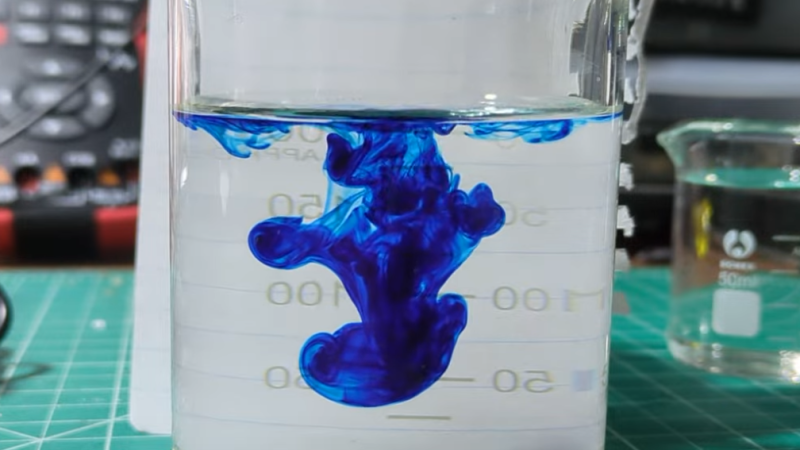
This clock uses a solenoid to briefly pop the plunger out of a water-filled syringe. This allows a drop to fall from the tip, into a waiting beaker. In addition to the satisfying audio indication this produces, [johnowhitaker] added a bit of food coloring to the dripping water for visual flair. The entire thing is controlled by a Raspberry Pi Pico and a motor driver board, so if you’ve got some spare parts lying about and would like to build your own be sure to head over to the project page and grab the source code.

While this clock isn’t exactly here for a long time (either the syringe will eventually empty or the beaker will overflow), it’s certainly here for a good time. [John] and commenters on his project even have ideas for the next steps: a 1/60 Hz beaker changer, and a 1/600 Hz spill cleaner. Even so, the first couple of drops hitting the beaker produce a lovely lava lamp-esque cloud that is a joy to watch and has us thinking about other microfluidics projects we’ve seen.

And remember — it’s not too late to enter the 2025 One Hertz Challenge!

Image

Big Chemistry: Seawater Desalination

For a world covered in oceans, getting a drink of water on Planet Earth can be surprisingly tricky. Fresh water is hard to come by even on our water world, so much so that most sources are better measured in parts per million than percentages; add together every freshwater lake, river, and stream in the world, and you’d be looking at a mere 0.0066% of all the water on Earth.

Of course, what that really says is that our endowment of saltwater is truly staggering. We have over 1.3 billion cubic kilometers of the stuff, most of it easily accessible to the billion or so people who live within 10 kilometers of a coastline. Untreated, though, saltwater isn’t of much direct use to humans, since we, our domestic animals, and pretty much all our crops thirst only for water a hundred times less saline than seawater.

While nature solved the problem of desalination a long time ago, the natural water cycle turns seawater into freshwater at too slow a pace or in the wrong locations for our needs. While there are simple methods for getting the salt out of seawater, such as distillation, processing seawater on a scale that can provide even a medium-sized city with a steady source of potable water is definitely a job for Big Chemistry.

Continue reading “Big Chemistry: Seawater Desalination” →