Showing posts with label Poetry. Show all posts

Thursday, 15 October 2026

New Books from Materials: Laâbi, Blavi, el-Wardany

Very pleased to announce three new titles from Materials, now available for pre-order from http://material-s.blogspot.com/.

They are:

—The Eye and the Night, by Abdellatif Laâbi, translated and with a foreword by Howard Slater, with an introduction by scholar Khalid Lyamlahy, a glossary, and Abdellatif Laâbi’s original afterword to the 1982 edition. (We’ve been working on this book, Abdellatif Laâbi’s “literary birth certificate”, for the past three years, so I’m especially pleased to announce it.)

—Acacia by Camila Blavi, translated and with an afterword by Will Rowe.

—Notes from the Marshes, by Haytham el-Wardany, translated by Wiam El-Tamimi and Yasmin Zohdi.

All titles involve translation into English, from French, Spanish, and Arabic.

============================================
ABDELLATIF LAÂBI—THE EYE AND THE NIGHT
Translated by Howard Slater
Published October 2026
============================================

Image

Available for the first time in English translation, The Eye and the Night was Abdellatif Laâbi’s explosive debut book. Written in Rabat between the popular uprisings of 1965 and the Six Day War of 1967, and first published in 1969 during Laâbi’s involvement with the radical anti-colonial journal Souffles-Anfas, Laâbi’s itinéraire”, a poetic novel or poem in prose, combines Surrealism’s spirit of revolt with the influence of Arabic literary, oral and musical traditions, the innovations of the Nouvelle Vague and Third Cinema with the soaring songs of Umm Kulthum, their tales of enormous feeling and impossible love.

From Casablanca to Hiroshima to Franco’s Spain, The Eye and the Night takes places in the squares of public defiance and the shadows of clandestine revolutionary gathering. At once novel, poem, pilgrimage and escape route, it is a classic of Francophone decolonial literature comparable to Aimé Césaire’s Cahier d’un Retour au Pays Natal and Etel Adnan’s L’Apocalypse Arabe. And it is living proof that, as Laâbi writes in his most recent collection, “poetry is invincible”. Published with new introductions by scholar Khalid Lyamlahy and translator Howard Slater, a glossary, and a 1982 preface by Abdellatif Laâbi.

Jamil Buthayna, Majnoun Laïla, necklaces of migratory doves.
Al Hallaj suffering the Truth and his millionth pyre [...]
Pass. This night is ours. Our final test.

ABDELLATIF LAÂBI (عبد اللطيف اللعبي) is one of the most important authors to have emerged from the Arab world in the twentieth-century. A founder member of the Moroccan journal Souffles-Anfas (1966-1972), a radical journal which played a key role in a renaissance of left-wing, anti-colonialist, and internationalist Maghrebi culture, he was imprisoned and tortured for “crimes of opinion” when the journal was banned in 1972. Released in 1980, he went into exile in France in 1985, where he has published numerous books of poetry alongside plays, novels, essays, children’s books and translations, and been awarded numerous honours, including Commander of the Order des Arts et des Lettres, the Alain Bosquet Prize, the Prix Goncourt de la Poésie, the Académie française’s Grand Prix de la Francophonie, and the Mahmoud Darwish Award for Culture and Creativity.

HOWARD SLATER is a writer and translator and former mental health support worker whose work has appeared in small press magazines, independent publishing initiatives and websites since the early 1980s. The author of Anomie/Bonhomie & Other Writings (Mute, 2012) and Anti-Wall (Kudaorg, 2017), he was the editor of Break/Flow and a founder member of the radical history archive May Day Rooms, London.

A5, perfect-bound, colour covers, illustrated, 168 pages.

============================================
HAYTHAM EL-WARDANY—NOTES FROM THE MARSHES
Translated by Wiam el-Tamimi and Yasmin Zohdi
Published October 2026
============================================

Image

“After the genocide, language must become a means for striking fascism and overcoming property relations.”

Haytham el-Wardany is one of the most compelling writers of our moment. Following The Book of Sleep (2021) and the recent pamphlets Gaza 2035 (2025) and The Difficulties (2025), Notes from the Marshes contains two prose texts and a sequence of poems. In the title sequence, written in English, verses from Refaat Alareer are read amidst military bases in Cyprus, turtles lay their eggs in an alley, a sister asks: “What is fascism?” Alongside these stanzas are two prose texts, translated from Arabic. ‘What if the word we’ ask questions about the possibility of collective voicing, when “the grammar of revolution” is “cut by the syntax of the state”. In ‘Needle in the Eye’, the author walks with a severed hand in their pocket down a Kreuzberg street, seeking for the language beneath the rubble of Gaza, for the wounded vowels and wounded words among the bodies; for a way to keep communion with the dead intact. Notes from the Marshes asks: Where now?

A5, perfect-bound, colour covers, 64 pages.

HAYTHAM EL-WARDANY is an Egyptian writer and translator. He lives and works in Berlin, and writes short stories and experimental prose. His praxis focuses on fiction, especially short stories, and nonfiction formats, like essays, and fragmental prose.

WIAM EL-TAMIMI is an Egyptian writer, literary translator, and editor whose work has been featured in publications such as The Paris Review, Granta, AGNI, Ploughshares, Freeman’s, Literary Hub, ArabLit, and The Common. She is an editor-at-large at The Avery Review, and is currently writing a nonfiction book.

YASMIN ZOHDI is a writer, translator and film critic based in Cairo, Egypt. She holds an MFA in Fiction Writing from Sarah Lawrence College, New York. A former culture editor at the independent news website Mada Masr and an alumna of Berlinale Talent Press, Zohdi is interested in the intersections between literary and cinematic forms, and how they continue to inform one another.

“Haytham’s exceptional prose and remarkable originality make him one of literature’s most distinctive voices today. Across fiction, creative nonfiction, and experimental writing, he unsettles genre boundaries and reinvents storytelling with each new work.”
—Iman Mersal, author of The Threshold and Traces of Enayat

“I think the greatest writer I have met, quite frankly, is the Egyptian modern writer Haytham el-Wardany.”
—Siddhartha Lokanandi, Wasafiri

========================
CAMILA BLAVI—ACACIA
Translated by William Rowe
Published October 2026
=======================

Image

Acacia: genus. Acacia: flower. Acacia: a thousand species. Acacia: oryx and mother; Acacia: plant, person, poem. This book-length poem has from the start abandoned the form it was given and must proceed: through the burning of roots and the swelling of buds, the flow of flesh and the flaming inside; hunger and plunging, tendrils and shoots, the sea and the shore, the house and the flood, actions echoing across a landscape in constant metamorphosis and constant collapse. In Acacia, Camila Blavi asks what allows a person to say “I”, what it means to give birth and to be born. Acacia: spider crab, wren, seagull. Acacia: oryx, tern, plover, branch. Acacia: to find that “love is not what they said”, in bitterness, anxiety and howling, in drowning and living, observing what it is that organises us in the world. Acacia: everything you can see.

CAMILA BLAVI (Santiago, Chile, 1988) is the author of Contaminaciones (Komorebi Ediciones, 2022), Puna (Bokeh Press, 2025; Provincianos Editores, 2026) and Acacia (Provincianos Editores, 2025). She studied at the University of Santiago de Chile and Pompeu Fabra University, Barcelona. She has twice received a grant from the Chilean Ministry of Culture.

WILLIAM ROWE’S Collected Poems were published in 2016 by Crater Press. He has translated a number of Latin American poets, including Raúl Zurita, Néstor Perlongher, Magdalena Chocano, and César Vallejo. He is Professor Emeritus at Birkbeck College, University of London, and a co-founder of Veer Books.

“Acacia is poetry returned to its original, genuine, stripped-down form, crafted from precious words awakened by a reborn alchemy.”— Edgardo Dobry

A5, perfect-bound, colour covers, 112 pages.

Wednesday, 19 August 2026

The Changing Same (Part 2) (Preview)

As ever with this kind of writing, there’s a whole range of other work I drew on during the research, which this writing is in concert with. More on the critical field available to subscribers at Substack by following this link.

Wednesday, 5 August 2026

Stolen Moments, Broken Epics (Preview)

Preview of a subscriber post on Substack on Nellie Wong and Harmony Holiday.

In the past month, two articles of mine on two quite different poets appeared in The Poetry Foundation and the newly founded Hythe Review. This post goes into a bit more detail on the background to those pieces and serves as an additional tribute to the late Nellie Wong, who passed away earlier this year.

It’ll be followed in the next while by material relating relating to two further recent publications, on jazz poetics and on the relation between jazz and hip hop. More on those in due course.

Nellie Wong: Typing Back

Image

Based in San Francisco for many years, Nellie Wong features in a chapter of my 2024 book on Boston and Bay Area queer poetry, Never By Itself Alone, focused on her comradeship with fellow poets and activists Merle Woo and Karen Brodine. Wong wrote of labour, of class struggle, of family history. Her first book appeared in the late 1970s, when Kelsey Street Press published Dreams in Harrison Railroad Park; her final book will appear posthumously in this new century, now moving beyond its first quarter.

Employed as a secretary, typing others’ words, Wong used her own poetry and prose to write back, to write over the words of bosses. To write, Wong reminds is, is also to be involved in labour—physical labour, or labour that removes traditional, hierarchical distinctions between intellectual and manual labour, that attempts to deny the workings of the mind within the workings of the body and of the body within the mind. Poetry, activism, and education were a way out of those frames and into herself, into the fullness of her own life, but using precisely the means of that gendered labour—the typewriter, reproducing the words of others as a way of reproducing oneself for a wage, become now a weapon, a way into words and language and struggle.

To type back, Wong discovered, is to fight back, to discover and invent, to transmit. There is a friction here, and it is this friction that poetry operates like a lever. To type back is not the current invisibilising process of automation, of Large Language Models which anticipate and erase waged labour without any alternative recompense. Rather than the erasure of bodies, such writing attests to their presence within the system, insisting on their agency, their potential for sabotage, and their own inherent worth.

Image
An early draft of Nellie Wong’s ‘Stolen Moments’, published in the Freedom Socialist newspaper in Spring 1980. A revised version forms the title poem to Wong’s 1997 pamphlet.

Last year I was privileged to attend an online discussion with the socialist feminist organisation Radical Women. Wong was involved with both RW and the affiliated Freedom Socialist Party until her passing, and was there herself on the Zoom call. I was deeply honoured by her presence, and struck by her modesty. Here’s the conclusion to the Poetry Foundation piece:

An individual writer’s work makes a contribution toward something whose contours will exceed those of their own life. “You will not survive the work that still needs to be done,” Wong wrote back in 1981. “You will be gone when the questions of the future arise like wildflowers on the plains of this earth.” To write is to live, but also to accept death. Wong’s late poems reconcile themselves to transience in the belief that human struggle might build a better world. As she wrote in “Under Our Own Wings” in 1979:

If you begin I begin
If you sing I sing . . .
In death our bodies regress to the innocence of bones.
In love we work to live in America under our own wings.


Image
Nellie Wong reading at the Generations of Power festival in 2022. Photograph © Mark Shigenaga, via The Oaklandside.

Beyond the introductory work of that article, readers should head straight to the source. There are multiple rare recordings of Wong available at the invaluable Archive.org, among them:

—a 1978 reading with Susan Griffin (including the unpublished dialogue ‘The Interrogation of Ms. Security-Runs-A-Risk’);

—speaking on Asian American writing for KPFA radio the following month;

—Allie Light’s 1981 film Mitsuye and Nellie: American Poets, featuring Wong and Mistuye Yamada, who is at the time of writing an astonishing 103 years old;

—reading her comrade Karen Brodine’s poems in Washington for Radical Women in 1991, as well as delivering a lecture on ‘Racism, Sexism, and War’;

—interviewed on the KMVT15 Community Media TV channel, in a programme entitled ‘A Banquet of Poems’;

—and speaking on family and creativity with her siblings Flo and William at the Headlands Center for the Arts in 1996.

Wong’s illuminating 2017 reading and conversation with Genny Lim at the San Francisco Poetry Center can also be accessed via the Poetry Center website. In July 20025, she read with the Laborfest Writers Group at Bird and Beckett Books: the full reading can be viewed on Youtube, as can the memorial reading held in January 2026. A lovingly-maintained website can also be found here. And the organisations with which Wong was involved—a part of her life just as important to her as her writing, and inseparable from it—can be found at their respective websites: Radical Women here and the Freedom Socialist Party here.

In these traces, in her work, in her impact on many lives, Nellie Wong lives on.


Harmony Holiday’s broken epic

Image

Also just published, a review of the expanded UK edition of Harmony Holiday’s epic poem Maafa, on The 87 Press’s new open-access journal The Hythe Review. For those who don’t know, Holiday’s Substack, Black Music and Black Muses has been running for several years and documents her ongoing writing on music. But music suffuses almost everything Holiday writes: her essays, her ongoing biography of Abbey Lincoln, her collections of poetry.

Maafa’s soundtrack would be Prince; it would be Pharoah Sanders; it would be the music of Holiday’s father, Jimmy Holiday, of Billie Holiday, to name some of Holiday’s touchstones, those named within its pages and the pages of her other books. 

The rest of the post can be read by subscribers on Substack here.

Tuesday, 12 May 2026

Poetry + Music this Saturday

Image

A relatively spontaneous announcement of a relatively spontaneous gig: this for a new quartet combining poetry and music, with myself (poetry), Andrea Burelli (voice, poetry, perhaps violin), Lucio Capece (bass clarinet), and Stellan Veloce (cello). It will happen at the Casino for Social Medicine at Sonnenallee 100, Berlin, on this coming Saturday, 16th May, at 19h.

As a trio, Stellan, Lucio and I worked together twice last year, and that was beautiful. (Their duo at a performance a few months before the first of those occasions, after which I approached them to work together, was even more beautiful). As a quartet with Andrea, we’ve done one rehearsal so far, and I think it’s entering a whole new dimension, which I’m very excited about.

Also reading will be Tracy Fuad. And I’m excited about that, too.

Do come if you can.

More performances to be confirmed in due course!

Sunday, 10 May 2026

J.H. Prynne (1936-2026)

Reposting here a piece which just appeared on the excellent online journal Little Mirror alongside Luke Roberts’ collection of Prynne memories. Many thanks to the editors. A longer and more detailed piece on J.H. Prynne will follow elsewhere in due course.

Image

The poet J.H. Prynne died last Wednesday morning.

Jeremy was important to a whole host of us down the generations, for a whole host of reasons: politically, personally, and above all, poetically. For his avant-gardism; for his careful, critical, ethical attention to the specifities of poetic language; for his unorthodox Maoism, however that was understood; for his personal kindness and encouragement; for the kinds of permission his work opened up. Of the poems written during the period I knew him, the most important to me remains the life-work summary of Kazoo Dreamboats, written during the era of the financial crisis through the lens of Piers Plowman’s societal vision, via modern scientific textbooks, ancient funeral rites, and Maoist dialectics. A particularly treasured memory is Jeremy’s reading of a substantial portion of this poem to the student occupation of Lady Mitchell Hall, Cambridge in November 2011, alongside the veteran feminist campaigner and author Selma James. Insisting on making this a poem which could speak to the occasion and the political struggle, without compromising the fierce difficulty of the work itself, the reading was forceful and moving. When he read out the line “Rule One: people with top pay are rubbish”, the room was electrically charged, a charge that seemed to come both from the poem and to enter into the poem from outside. What I learned from this moment was that the poem itself does not change its context, nor does the context change the poem: but that their dialectical relation adds something to both.

Image
Poster for the event hosted by Cambridge Defend Education at which J.H. Prynne read from Kazoo Dreamboats, 27 November 2011

Other works from these years that I treasure: the “bruised compassionate dismay” of Of . the . Abyss, a pamphlet I had the honour of publishing, which overlays Victorian child cruelty and the present migrant crisis; and the enquiry into the entanglement of British imperialism with poetic song in Parkland: a complex, insistent and direct enquiry into how the poet can sing when empire starves those other “fair field full of folk” elsewhere; a poem which movingly and deeply wants to believe in the possibility of poetry as lyric joy, but is totally lacking illusion about poetry as salvation; a poem that ask how the poet can go on singing their song when that song gets conscripted as the national anthem; that treats poetry with a near-devotional cast, yet radically questions whether poetry is morally complicit with corrupt orderings, if not actively harmful, then at least insufficiently attentive to or able to frame harm; a poem concerned with a national verse tradition, that ruthlessly interrogates the bases behind that tradition in the interests of a fervent, anti-imperialist internationalism; a poem rigorously dialectical, as dialectic is a practice of dialogue and question in origin, but as it is also the ruthless criticism of all that exists, and the very conditions for that questioning.

Image
Cover to J.H. Prynne, Parkland (Critical Documents, March 2020)

Language is no innocent playground, yet the ludic is important to Jeremy’s late work (much of it published by Ian Heames’s Face Press), with its insistence that contemplation, play, and purposive activity be not separated. I love, too, the playful and unsettling rhyming poems of Snooty Tipoffs, the dense compaction of Al Dente, the fables and orchards and tales and streams of language that are the river all those late books swim. But maybe most of all I love the text ‘No Universal Plan for a Good Life’, a didactic summary in clear prose of the ethical position Jeremy believes poetry to hold, written for the context of people’s struggle in Nepal. I treasure both the text itself and the act of imaginative extension and solidarity it performs. And this is what I want to hold onto, about J as a person and about his work, this act of imaginative solidarity, this absolute belief in the power of poetry, this ethical rigour, this thinking through of the question of spirit and matter, this permission and this belief that poetry matters. I think I’ll carry that with me throughout my life. I hope I do so.

At play and at work there in language, into which he has now gone—at play and at work and now and then at rest—a life.

Wednesday 22 April 2026

Sunday, 15 March 2026

Abstractive

Very pleased to announce the publication of Abstractive, a new collaboration between myself and Candace Hill Montgomery, begun in Sag Harbor in 2024 and just published by Further Other Book Works. It’s been an honour to collaborate and many thanks are due also to publishers CJ Martin and Julia Drescher. Please see the publisher’s announcement below for more details.

Image


Candace Hill Montgomery & David Grundy
Abstractive

ISBN: 9780998460703
142 pages
Full Color Paperback
$34.95
April 2026

Buy Now

Praise for Abstractive:

“For Russell Atkins, the ‘psychovisualist’ composes structured relationships that can be viscerally felt by the mind’s eye. In Abstractive, readers learn to lean on the way those structures snare hidden connections: between visual and language arts, music and emotion, and everyone out there searching for the ancient heavenly connection. We are on the cusp.”—Craig Dworkin, author of Radium of the Word: A Poetics of Materiality

“Here is vivacious visual and textual collaboration where melodic lines act as a counterpoint of philosophic riffing so that signification is expansively flung open delivering vantage points galore, tantalizing consciousness. ‘Form sets off everywhere’. We are treated to a cacophony in words accompanied by intense, colorful images. Candace Hill Montgomery and David Grundy conjure the living legacy of Russell Atkins and the results are exquisite!”—Brenda Iijima, author of Presence

“Candace Hill Montgomery and David Grundy set off a collaborative sensory sweep via these polyphonic and polyrhythmic poems, ‘ensorcellating’ an expansive tonality playing within and around image and word. These poems seek a mental music that ‘avoids fitting into the chord,’ ‘innuendoewing’ around the breakage of each eroding word. We are borne through the revelation of a doubled ‘mind in flight’: poetry as ongoing, unceasing dialogic process. Following Candance Hill Montgomery’s incredible long poem, Short Leash Kept On (Materials 2022), this is a thrilling and essential work.”—Geoffrey Olsen, author of Nerves Between Song

Image

About the Authors:

The work of Candace Hill Montgomery spans painting, photography, installation, assemblage, textiles and writing. Making and exhibiting since the 1970s, Hill Montgomery was born in 1945 in Queens, New York, and now lives and works in Bridgehampton, New York. In 2024, she presented a solo exhibition, Pretty Birds Peer Speak Sow Peculiar, at Blank Forms, New York. Recent group exhibitions include From the Studio: Fifty-Eight Years of Artists in Residence, Studio Museum in Harlem (New York, 2025); Here Is a Gale Warning: Art, Crisis & Survival, Kettle’s Yard (Cambridge, 2025) and Reluctant Gravities, Hollybush Gardens (London, 2024). Her latest publications include the collection Muss Sill (Distance No Object, 2020) and Short Leash Kept On (Materials, 2022), a long poem inspired by detective fiction and the writing of Lloyd Addison and Russell Atkins. In 2023, a major essay on her work, “Candace Hill-Montgomery, Against Containment” by Amy Tobin, was published in Art History, Volume 46. She is represented by Hollybush Gardens in London and will present her first solo exhibition with the gallery in June 2026.

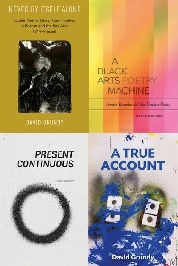
David Grundy is a poet and scholar. He is the author of the critical books A Black Arts Poetry Machine: Amiri Baraka and the Umbra Poets (Bloomsbury, 2019) and Never by Itself Alone: Queer Poetry in Boston and San Francisco, 1944–Present (Oxford University Press, 2024); A True Account (The 87 Press, 2023), a book of poetry; and Present Continuous (Pamenar Press, 2022), a book of lyric essays; and co-editor, with Lauri Scheyer, of Selected Poems of Calvin C. Hernton (Wesleyan University Press, 2023). He runs the small press Materials.

Monday, 13 October 2025

Triumph of the outcasts, coming! (Preview)

Image


As a subscriber post on Substack, this piece on a track from Adegoke Steve Colson’s and Iqua Colson’s album Triumph!, along with thoughts on survival, the outcast and, once more, the work of John Wieners.

Often, the poems that give consolation to others don’t always give consolation to the poet themselves, or the time of release is different. The renewal they offer wavers in its power. It saves some and not others, and sometimes it seems like it can save no one or do precisely nothing, but what matters is that it’s still there, if nothing else as testimony and record, as the poems of the martyrs in Gaza, as the poems of the shining martyrs Wieners saw in the queer poets of Boston, as in all the poems being written now, all the poems that have been written and that will be written, triumph of the outcasts, coming!

Tuesday, 7 October 2025

First Nettles, Earliest Persons (Preview)

Image

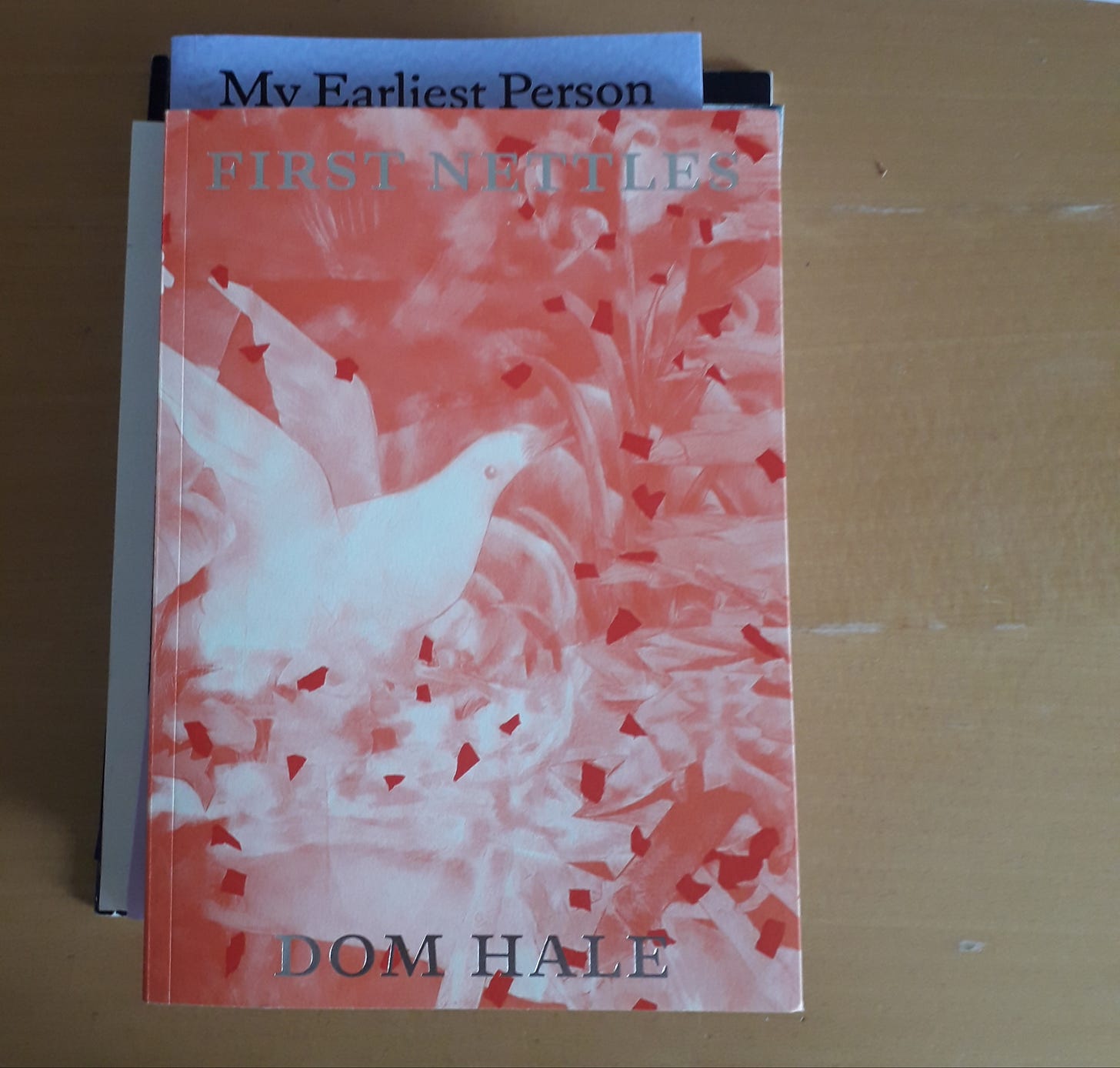
On the Substack version of this site, a review of Dom Hale’s First Nettles and Jennifer Soong’s My Earliest Person, both published by the Last Books. As it’s a long post (6,000 words or so) it’s only available in full behind the Substack paywall. But some excerpts below:

“How did the earlier poets hold it together[?]” asks Hale in the wracked ode ‘Castor and Pollux’, which I first read in a draft from 2021, just this side of the pandemic. “what defence does a poet have?” Not so much a defence of poetry or poetry as defence, but poetry as defencelessness. (“a poets lot is morbid frailty”...) The poem’s epigraph is from Stephen Jonas’s own resplendent ode ‘Love, The Poem, The Sea’—“I shall / with doubt / bloom in my season”. Jonas himself died young, that doubt overwhelming him—the earlier poets, too often, unable to hold it together—but Hale takes the message of loving survival in Jonas’ poem seriously. For, for all their faults, what are we writing poetry for if we can’t learn something from the poems that have gone before us? 

 “I found a pied wagtail and it spokes to me”, writes Hale in a parenthetical aside shot through with a deep Romanticism, as Romanticism emerged during the privatisation of the commons and the beginning of the Capitalocene. A poem takes or borrows its material from the world, but the way it does this is the opposite of the extractivist logic that governs that world system. A refusal to extract, is what a poem is, or could be.

And:

In Soong’s poems, violence, forgiveness, love, exist beyond the theological register that still haunts the way we speak of them: “I say: what to do / with such forgiveness / of the unforeseeable?” Language betrays us: or we exceed it, it exceeds us. “we / leave behind what / we say we can’t”. “what is equal to more / than can be said”. To be equal to, to balance up, to come up with an equation that would solve things, would be one way: the well-made poem, rhyme as resolution, metre as an ordering of the normal disorder of speech. But poetry is not that. It overflows it, unbalances it: seeks instead, dialectically, to acknowledge imbalance and transformation. The poems move in the instability of that line break, that cut, as much as they move in the smoothing, soothing shell of enjambment, sound-pattern, echo. When our speech is choked off, we speak with stumbling fluency through that prohibition: it births our speech. We perform and refuse to move on and our desire is shared with others and others are internalised into us, this ensemble that is the poem. For

we get to where
we can't, having been
taught by the things in
each other.

Poems like Dom Hale’s and Jenn Soong’s sift through the grift, let it stick: not the fine details, but the jagged edges of feeling, which are a thousand small ridges, cuts, wounds, incisions on the break of a line, the placement of a comma, the absence of an apostrophe. Care in the scattering. [...] In our poems, our posts, our criticism: trying to find a form for these things we perhaps cannot even properly say to each other in conversation when we speak, these things we try to put our finger on, while the map moves beneath our pointing digits.

Sunday, 21 September 2025

Recent writing elsewhere

Some recent writing elsewhere...

Image


Pleased to have poems alongside good company in Michael Klausman's and Patrick Tillery's magazine Luigi Ten Co: a sequence called 'Axis and Orbit' and a prose poem from something in-progress...

Image


Thanks to Florence Uniacke for producing this beautiful pamphlet, Two for Notley, for the Cafe Oto summer fair, with proceeds going to the new trans health centre at House of Annetta.

Image


One of the two texts in the pamphlet is an extended version of a text that first appeared on this blog. And a different version of that text is also up at Little Mirror--thanks to Hunter, Jen and Allie.

Image


Also out, a piece on Steven Belletto's extremely well-researched new biography of the great Ted Joans, Black Surrealist, over at The Poetry Foundation: "Nothing to Fear From the Poet but the Truth".

Image


Finally, I've introduced a paid option for my Substack, same name as this blog, over at this link. A paid subscription gets you access to any posts over 1,000 words, which go behind a paywall. The Substack-ification of writing (and the way it negotiates the sphere of paid writing, traditional media, precaritisation of readers and writers alike) is perhaps something to be ambivalent about, but it is, at least, a platform...

What is a reading? John Wieners at Brooklyn College

Image

Just up on Penn Sound—part of a bumper crop of recently-digitized recordings from the Eric Mottram archives—a 1988 reading by John Wieners, hosted by Allen Ginsberg at Brooklyn College, and split into two parts here and here. “Reading” here is not so much noun—a discrete recitation of a set of poems—as verb, Wieners reading aloud from a book, extemporising, elongating, truncating, extending. The book in question appears to be the author’s copy of the then-recently published Black Sparrow Selected Poems, into which he’d collage various images and text fragments. Within the first few sentences, we’ve had text from bodybuilder Charles Atlas about “what it means to be a man”, a mention of the nowadays obscure poet Jean Garigue, displacing the Beat lore Ginsberg tries to extract from Wieners when he mentions their first meeting in New York; a discourse where a character from a film—a bit of digging reveals it to be the war film Candlelight in Algeria—is juxtaposed with a novelist, a poet, and so on: a giant, collaged ensemble.

It’s of a piece with the turn Wieners’ work takes in the ’70s, exemplified in his magnum opus of that period, Behind the State Capitol: disavowing the self through collaging devices, reading-through his own and others’ work without indication, a surface in language jagged and dazzling, scattering clues and then retreating. In this there are echoes of his poetic comrade Bob Kaufman—like Wieners, championed by the inexhaustible Raymond Foye, who helped shepherd work resistant to book publication into texts that could be read by others.1 Kaufman would suddenly speak poetry in the middle of a conversation, improvising off the many poems of his own and others he’d retained in his head. Yet, while Wieners’ Brooklyn College reading often obscures whose words are being spoken and what is being read, he also deploys a-near excessive identification of source. Flicking at will across the book, sometimes reading only a line or two at a time, he identifies each page number, though by the time whoever reading along has turned to the relevant place, he’s off somewhere else, frustrating his host Ginsberg’s bid to keep up and keep track of all the references. In some cases, he even reads out the punctuation, as in these lines from the 1970 poem ‘Consolation’: “It’s best not to think too much. What awaits but death, question mark. A long life of misery, comma.”

In Delirious Verse, a talk on versification recently published by The Last Books, Amelia Rosselli claims that “sound was once so close to the written sign that people wrote without spaces between words”. Wieners treats the normally invisible notational frame of punctuation as part of the spoken text itself, establishing distance in the middle of immediacy. Likewise, when he reads flashes of his more famed, emotionally wrenching lyrics, his voice speeds up and his tone becomes hard to place—sarcastic, or a kind of sigh, as if he can’t wait to get to the ends of the words, which he has to read them, but wants to render incomprehensible. As such, it’s an anti-lyrical gesture. Yet at other points, Wieners whispers, barely audible. And isn’t one of the classic definitions of lyric poetry talking to oneself in public? Wieners is still reading, but not to us, perhaps not even to himself. Selving and un-selving. (“For the voices”, as the dedication to the 1964 collection Ace of Pentacles goes.)

But this is a reading at a college: the event is supposed to have a pedagogical function, something of which Ginsberg, with his history at Naropa, is keenly aware, interjecting to ask for clarification—what exactly is Wieners reading now?—entreaties Wieners gently brushes off, at one point waspishly remarking, “you should call the embassy and tell them you’re Allen Ginsberg and they’ll translate it for you”. But Wieners doesn’t refuse interpretation, though “it’s best not to think too much”. Misreading a phrase as “heartbreak libertarian”, Wieners wonders “who would that be? Jack Spicer?” (His devastating 1965 elegy for Spicer, ‘Hotel Blues’, opens: “Pass by this room, stranger / Heartbreak hides within it.”) This additive approach nonetheless continually calls back to memories of the past, of poets and lovers who are gone yet live on in the poems’ haunted shell: a constellation of references subject to melancholic improvisation. This may be an inability to move on, yet it, too, is a kind of transformation of loss, perhaps at times even a triumphant one, keeping the dead alive.

This is not an easy listen. It refuses the pathos and heartbreak of Wieners’ earlier work. Like Kevin Killian, interviewing Wieners in San Francisco a couple of years later, Ginsberg tries to keep up and give the audience some way in, while Wieners speaks on associatively in a barrage of names, always at an oblique angle to the question (there is a relation, but it might take a few minutes of puzzling to work out exactly what it is.)2 There’s no literary-critical guidebook for how we experience this—and how it’s inflected by our knowledge of Wieners’ biography, of the toll of drugs, heartbreak, psychiatric incarceration. At one point, Wieners refers to the Selected Poems as a “cookbook”. We may not know what the ingredients are, but it’s up to each reader to implement the recipe. As readers, we too, have to improvise. Along the way, some our fundamental assumptions about a reading, what is, what it’s for, poetry, what it is, what it’s for, are at stake.

The imminent reissue of Behind the State Capitol from The Song Cave is eagerly awaited!

1

See Foye’s work on Kaufman’s The Ancient Rain and the 2020 Kaufman Collected Poems, and on Wieners’ Black Sparrow Books, Selected Poems and Cultural Affairs from Boston.

2

The Penn Sound website doesn’t allow external embedding, but scroll down to the March 1990 Cloud House Poetry Archive video embedded here. The image at the top of the post is taken from this video.