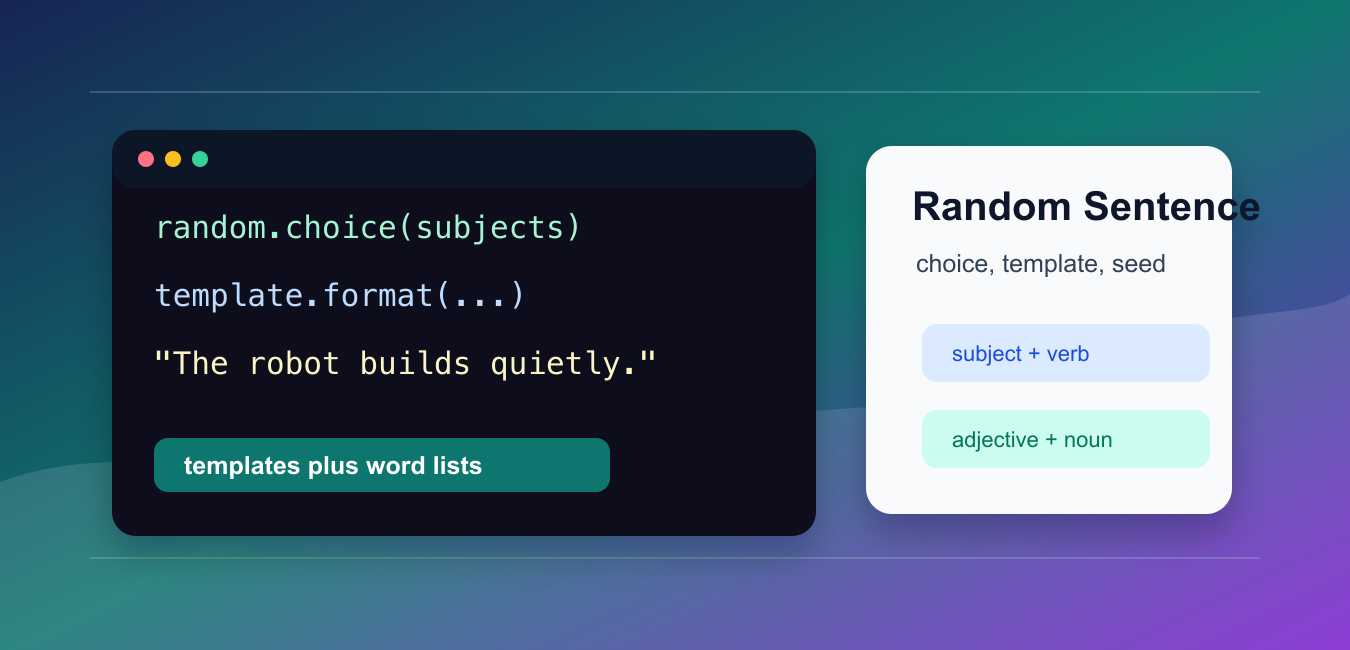
Quick answer: Generate a random sentence by choosing words from structured lists and assembling them with a template or grammar rule. Use random for ordinary variation, secrets for security-sensitive choices, and an injectable seeded generator for reproducible tests.
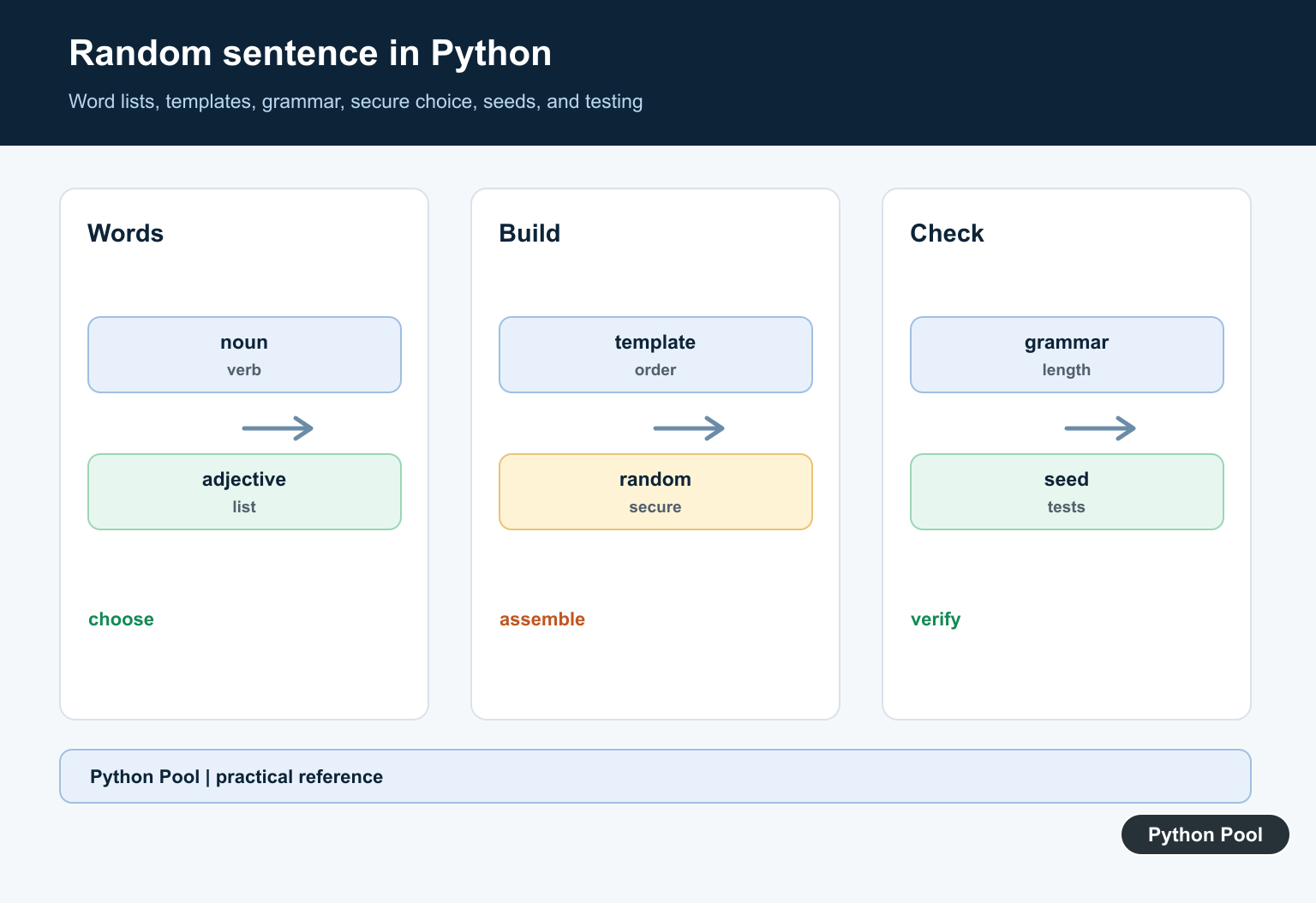
Generating a random sentence in Python usually means choosing words from several lists and placing them into a template. The standard random module is enough for games, examples, test data, and simple text generation.
The main references are Python’s random.choice() documentation, random.choices() documentation, and the secrets module documentation.
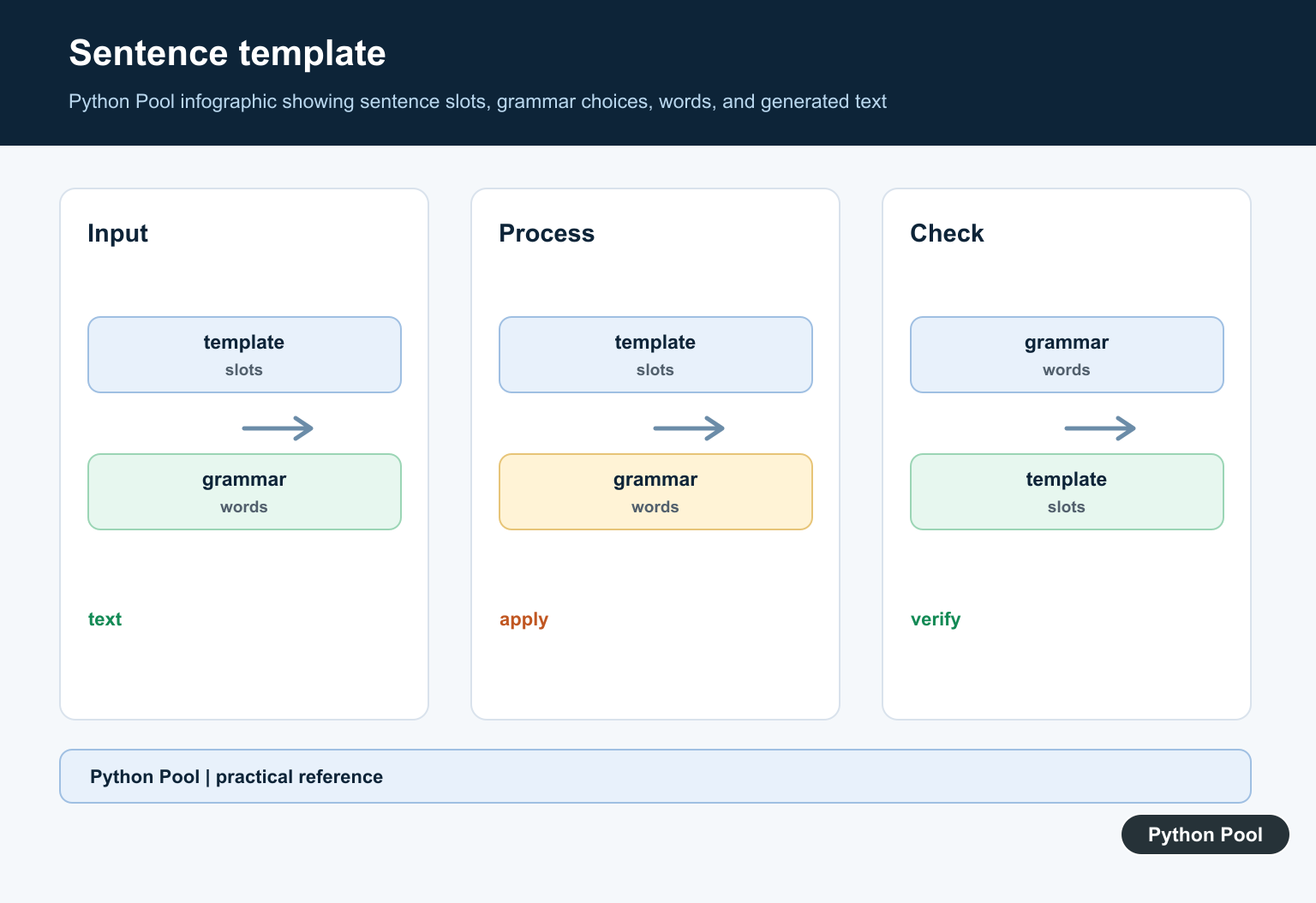
The best approach is template based. Choose a subject, verb, object, and optional modifier, then format them into a sentence. That gives you control over grammar while still producing variety.
Use random for normal pseudo-random output. Use secrets only when the selection affects security, such as a password phrase or token-like text.
A good sentence generator has three parts: word banks, sentence shapes, and a selection method. Word banks hold nouns, verbs, adjectives, or phrases. Sentence shapes decide where each choice appears. The selection method decides whether each option is equally likely, weighted, repeatable, or suitable for security-sensitive text.
This keeps the code predictable. Instead of joining random words in any order, you define a small grammar and let Python fill the slots. That is enough for classroom examples, placeholder text, small games, chatbot demos, test fixtures, and log-style sample messages.
Choose Words From Lists
random.choice() selects one item from a non-empty sequence.
import random

subjects = ["The robot", "A student", "The artist"]
verbs = ["builds", "studies", "sketches"]
objects = ["a model", "the lesson", "a portrait"]

sentence = f"{random.choice(subjects)} {random.choice(verbs)} {random.choice(objects)}."

print(sentence)
This is the simplest useful pattern: each part of the sentence comes from its own list.
Keep each list grammatically compatible with the template. That avoids awkward output such as plural subjects with singular verbs.
If the output sounds unnatural, improve the word lists before adding more code. For example, keep past-tense verbs in a separate list from present-tense verbs, and keep singular nouns separate from plural nouns. Small, clean lists usually produce better examples than a large mixed list.
Use A Template Function
A function keeps the word lists and sentence format reusable.
import random

def make_sentence():
    subjects = ["The cat", "A developer", "The teacher"]
    verbs = ["finds", "writes", "explains"]
    endings = ["a clue", "clean code", "the answer"]
    return f"{random.choice(subjects)} {random.choice(verbs)} {random.choice(endings)}."

print(make_sentence())
This function returns one sentence per call.
For larger projects, keep word lists outside the function or load them from a file so they are easier to edit.
A function is also easier to test. You can call it many times, check that it always returns a string, and confirm that the result ends with punctuation. If your project later needs different sentence types, add more template functions instead of making one function handle every possible shape.
Generate Several Sentences
Use a loop or comprehension when you need more than one sentence.
import random

subjects = ["The app", "A script", "The service"]
verbs = ["logs", "checks", "updates"]
objects = ["events", "files", "records"]

sentences = [
    f"{random.choice(subjects)} {random.choice(verbs)} {random.choice(objects)}."
    for _ in range(5)
]

print("\n".join(sentences))
This produces a small block of generated text.
Repeated sentences are possible because each part is chosen independently. Use more words or more templates to improve variety.
For display text, join sentences with spaces. For console output, one sentence per line is often easier to read. When you need a fixed number of sentences, build a list first and then join it, because that makes it simple to inspect, filter, or reuse the generated text before printing.
Use A Seed For Repeatable Output
A dedicated random.Random instance gives repeatable output without changing the module-level generator.
import random

rng = random.Random(42)

words = ["quiet", "bright", "fast", "curious"]

print(rng.choice(words))
print(rng.choice(words))
Using the same seed produces the same sequence, which is useful for tests, demos, and documentation examples.
Do not use a fixed seed when you want fresh output for end users.
A local generator object is better than calling random.seed() at the top level of a program. It keeps the repeatable behavior close to the code that needs it and avoids surprising other code that also uses the random module.
Add Weighted Choices
random.choices() can make some words appear more often.
import random

moods = ["calm", "focused", "excited"]
weights = [5, 3, 1]

mood = random.choices(moods, weights=weights, k=1)[0]
sentence = f"The team feels {mood} today."

print(sentence)
Weights are relative. A weight of 5 is five times as strong as a weight of 1.
Use weighting when some options should be common and others should be rare.
Weighted choices are useful when a sentence should feel balanced. You might want common moods, simple verbs, or ordinary endings to appear often, while unusual words appear only occasionally. Keep the weights easy to understand so future edits do not change the tone of the output by accident.
Use secrets For Security Text
For password-style phrases, use secrets.choice() instead of random.choice().
import secrets

words = ["river", "stone", "cloud", "ember", "field"]

phrase = "-".join(secrets.choice(words) for _ in range(4))

print(phrase)
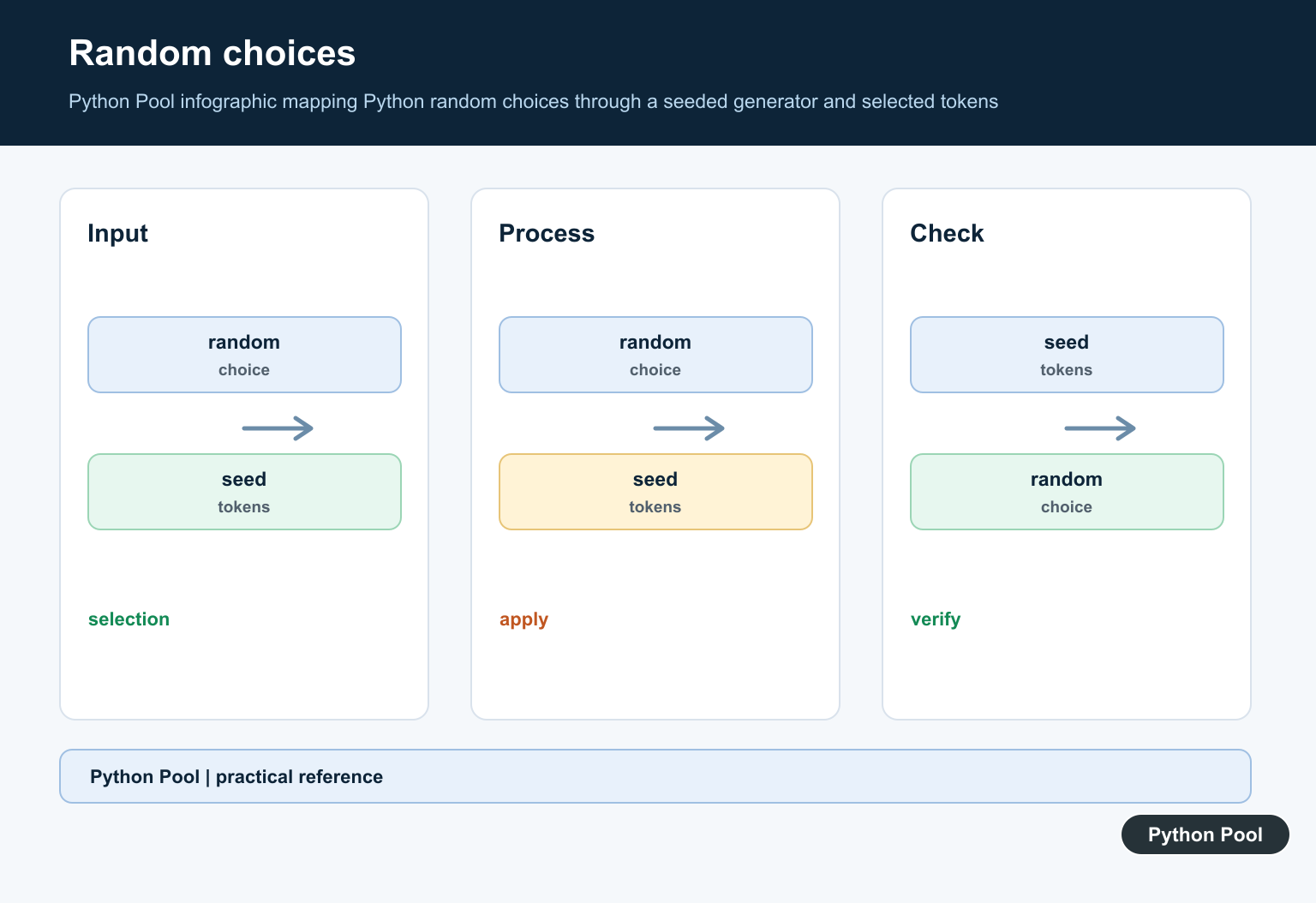
The random module is deterministic and not suitable for security-sensitive choices. The secrets module is designed for that use case.
For ordinary random sentences, secrets is usually unnecessary and slower than the regular pseudo-random tools. Reserve it for cases where guessing the output would matter, such as recovery phrases, invite codes, or password-style examples.
The practical rule is: use templates for grammar, random.choice() for simple sentence parts, a seeded generator for repeatable examples, random.choices() for weighting, and secrets for security-sensitive phrases.
Use Word Roles
Separate nouns, verbs, adjectives, and other roles instead of choosing every token from one flat list. The resulting sentence can then follow a predictable grammatical shape.
Assemble A Template
A template such as adjective noun verb adverb is simple to explain and test. Keep punctuation and spacing in the template so generated output does not depend on ad hoc string cleanup.
Choose The Random Source
The random module is appropriate for creative output and simulations, while secrets is designed for tokens and security-sensitive selection. Never use a predictable random seed for authentication material.
Support Reproducible Tests
Accept a random generator or choice function as a dependency. A test can then use a seeded instance and assert exact output while production uses a normal generator.
Add Grammar Constraints
For richer output, define templates with optional clauses, agreement rules, and a controlled vocabulary. More flexibility increases the need for validation and a clear output contract.
Test Output Properties
Test allowed words, punctuation, length, empty lists, repeated choices, seeded repeatability, Unicode, and security boundaries. Assert structure rather than relying only on visual inspection.
The official secrets documentation distinguishes secure selection from ordinary pseudo-random generation. Related Python Pool references include strings and tests.
For related generation workflows, compare string assembly, seeded tests, and word lists before building random sentences.
Frequently Asked Questions
How do I generate a random sentence in Python?
Choose words from sequences and assemble them with a template or grammar rule that matches the sentence structure you want.
Should I use random or secrets?
Use random for simulations and ordinary creative variation, but use secrets for passwords, tokens, or choices that need cryptographic unpredictability.
How can I make generated sentences grammatical?
Use templates, part-of-speech lists, or a grammar model instead of selecting every word from one unrestricted list.
How do I test random sentence generation?
Inject a seeded generator or selection function for tests and assert structure, allowed words, length, and reproducible output.

A noun is used to identify people place or thing. Your array of nouns also contain verbs. Sentence construction is a little more complex than this. https://en.wikipedia.org/wiki/Syntactic_Structures
Yes, Generating a completely random sentence does not make sense if it’s generated by the computer. I believe there are many ML techniques to develop random sentences syntactic way.