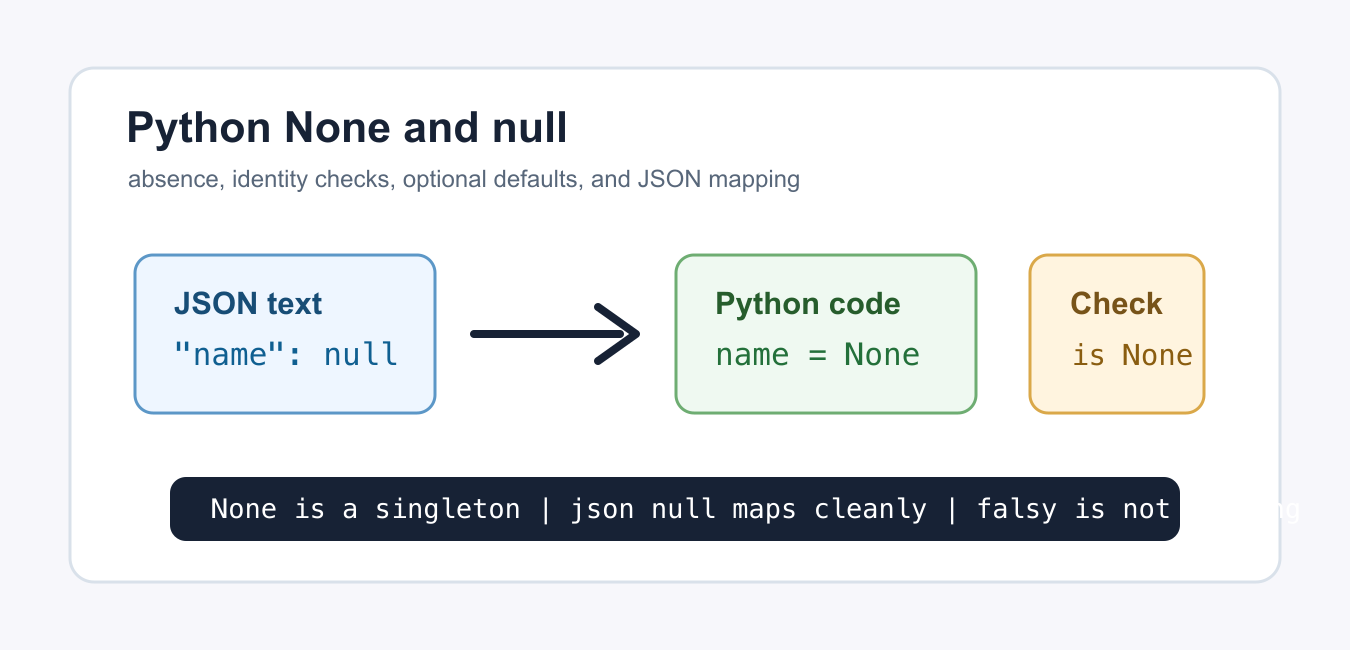
Quick answer: Python represents the absence of a value with None, not a null keyword. Test it with is None or is not None, and keep it distinct from 0, False, empty strings, and empty containers when those states mean different things.
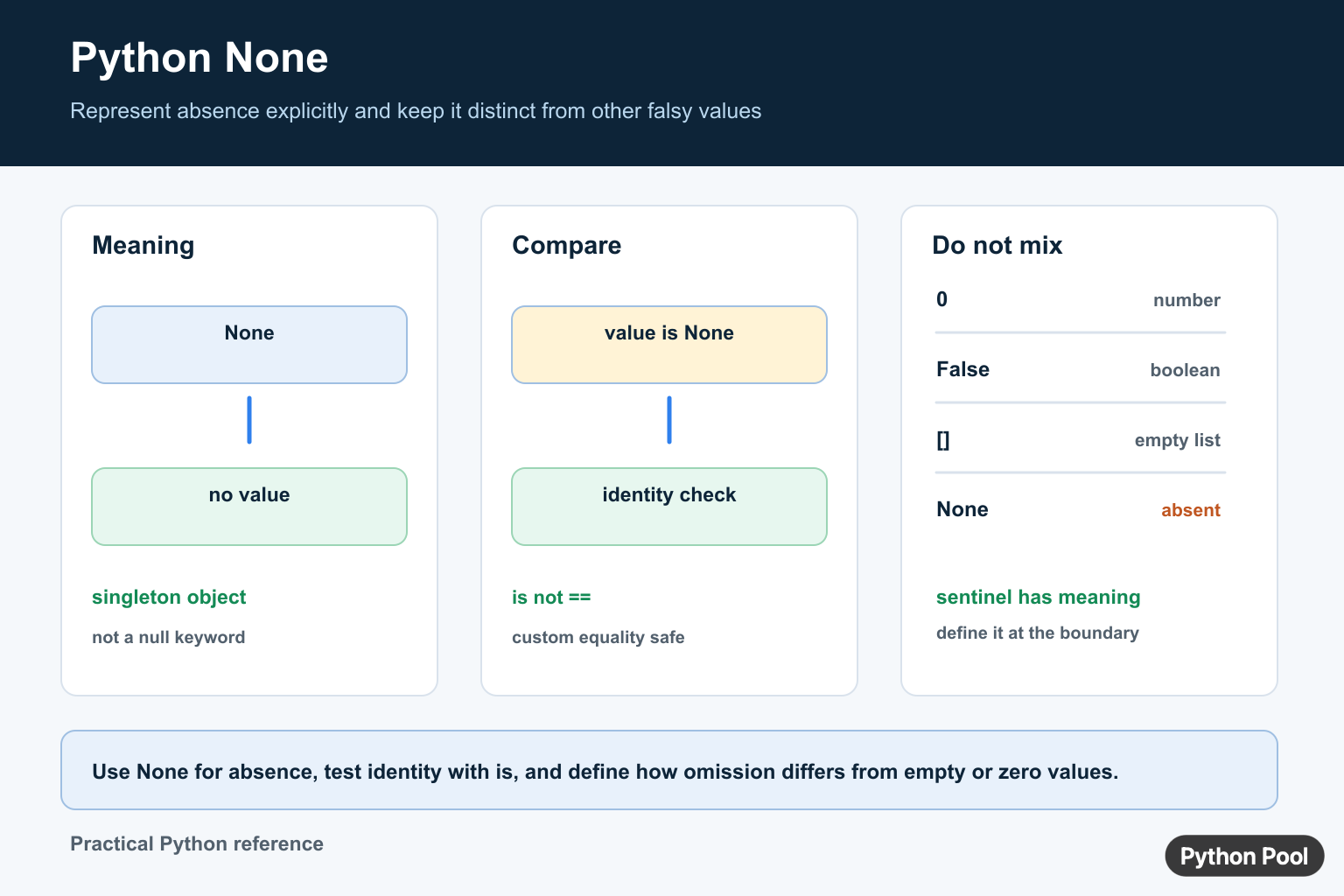
Python does not have a null keyword. The Python name for the absence of a value is None. If you come from JavaScript, Java, SQL, or JSON, this is the main translation to remember: Python code writes None, while JSON text writes null.
The official Python documentation defines None as a built-in constant. The language reference explains identity comparisons, and the json module documentation shows how JSON null maps to Python None.
Use None when a result is intentionally absent, not yet known, or not supplied by the caller. It is common for missing dictionary lookups, optional function arguments, parser results, search results, and placeholder return values.
Do not use None as a replacement for every empty value. An empty string, an empty list, zero, and False all carry different meaning. Mixing them with None can make later checks confusing, especially when a real value is allowed to be empty.
The safest habit is to choose one meaning for None in each API. If it means “not found”, keep that meaning clear. If an empty result is valid, return the empty result instead of None. That makes calling code easier to test.
Create And Check None
None is a singleton object. There is only one None object in a Python process, so identity checks are the standard way to test for it.
missing = None

print(missing is None)
print(missing is not None)
print(bool(missing))
The first line prints True because missing refers to None. The final line prints False because None is falsy in truth-value testing.
That falsy behavior is useful, but it can also hide important distinctions. If an empty string or zero is valid in your program, do not use a broad truth check to detect missing data.
Use is None Instead Of Equality
For None, prefer is None and is not None. Equality can be customized by objects, while identity asks whether the object really is None.
class LooksEqual:
    def __eq__(self, other):
        return other is None

item = LooksEqual()

print(item == None)
print(item is None)
The first check can be influenced by __eq__(). The identity check cannot be fooled by custom equality behavior.
This is why style guides and experienced Python programmers write if value is None: instead of if value == None:. It is clearer and more exact.
Notice Implicit None Returns
A function returns None when it reaches the end without a return statement. Many functions that mutate an object in place follow this style.
def add_tag(tags, tag):
    tags.append(tag)

tags = []
result = add_tag(tags, "python")

print(tags)
print(result is None)
The list changed, but the function result is None. This pattern is common with mutating methods such as list.append() and dict.update().
If a helper changes an object in place, returning None can signal that callers should inspect the object, not the result. If the helper creates a new object, returning the new object is usually more convenient.
Use None For Optional Arguments
None is a good default when a function needs to create a fresh list, dictionary, or set for each call. The function can detect the missing argument and allocate inside the body.
def collect(value, items=None):
    if items is None:
        items = []
    items.append(value)
    return items

print(collect("alpha"))
print(collect("beta"))
Each call receives a fresh list when the caller does not provide one. This avoids shared state between calls.
Use this pattern for optional containers. It keeps the public function easy to call while avoiding accidental reuse of the same object across separate calls.
Convert JSON null To None
JSON uses null, but Python code uses None. The standard json module handles the conversion in both directions.
import json

payload = json.loads('{"name": "Ada", "nickname": null}')

print(payload["nickname"] is None)
print(json.dumps({"nickname": None}, sort_keys=True))
After loading JSON, test the parsed value with is None. When dumping Python data back to JSON, None becomes null in the output text.
This conversion is one reason the words are often confused. Keep the spelling tied to the format you are writing: None in Python source, null in JSON text.
Separate Missing From Falsy
Sometimes a real value can be falsy. A timeout of 0, an empty label, or False can all be valid. In those cases, use a unique sentinel object so missing data is not confused with present data.
not_found = object()
settings = {"timeout": 0, "label": ""}

for key in ["timeout", "label", "retries"]:
    value = settings.get(key, not_found)
    if value is not_found:
        print(key, "missing")
    else:
        print(key, repr(value))
The sentinel is different from every real setting, including falsy settings. That lets the code keep zero and empty text while still detecting the absent key.
Reach for this pattern when None itself can be a valid stored value, or when several falsy values need to stay distinct. It is more explicit than if not value, and it gives future readers a clear missing-data branch.
The practical rule is short: write None in Python, use is None for checks, let json translate null, and decide whether missing, empty, zero, and false each need separate handling.
Use None As A Sentinel
None is a singleton object used to represent no value or an absent result. A function may return it when a lookup has no match, an optional argument was omitted, or a value has not been computed yet. That meaning is different from a legitimate numeric zero or an empty collection.
def find_user(users, wanted_id):
    for user in users:
        if user["id"] == wanted_id:
            return user
    return None

user = find_user([], 10)
if user is None:
    print("No user found")
Compare With is None
Use identity comparisons, value is None and value is not None, when checking the singleton. Avoid value == None because custom equality methods can implement surprising behavior. Do not use if not value when zero, False, an empty string, or an empty list is a valid value.
At an API boundary, decide whether None means omitted, unknown, not found, or explicitly cleared. That decision affects serialization, database writes, default arguments, and validation rules.
For missing-value and optional-code decisions, compare Python data types with conditional imports. Read python data types and python conditional import for the related workflow.
Frequently Asked Questions
What is the Python equivalent of null?
Python uses the singleton object None to represent no value, an absent result, or an omitted optional value.
How do I check for None in Python?
Use value is None or value is not None rather than equality comparison when checking the None singleton.
Is None the same as False or 0?
No. None, False, 0, an empty string, and an empty container can all be false in a Boolean context but represent different states.
Why should I use is None instead of == None?
Identity checking expresses the singleton contract and avoids surprising custom equality behavior from user-defined objects.

It’s useful to me
I’m glad it helped you 🙂
Regards,
Pratik