1. X
  2. ESA ESDC
Log inSign up
ESA ESDC
European Space Agency
3,855 posts
Image
user avatar
ESA ESDC
European Space Agency
@ESAesdc
ESAC Science Data Centre, holding, curating and distributing science data from @ESA's science missions to all scientists. The digital library of the Universe!
ESAC, Madrid, Spain
cosmos.esa.int/esdc
Joined October 2015
860
Following
2,184
Followers
RepliesRepliesMediaMedia

New to X?

Sign up now to get your own personalized timeline!

Create account

By signing up, you agree to the Terms of Service and Privacy Policy, including Cookie Use.

Terms·Privacy·Cookies·Accessibility·Ads Info·© 2026 X Corp.
Don't miss what's happening
People on X are the first to know.
Log inSign up
  • ESA ESDC reposted
    user avatar
    ESA Gaia
    European Space Agency
    @ESAGaia
    Dec 18, 2025
    Replying to @ESAGaia and @esa
    Wouldn't it be wonderful if also photometric information from Gaia could help find these baby star systems? Meet a new #GaiaDR4 data product: the residual image. Obtained from stacking many individual images and removing the point spread function of the central source:
    Image
    9940994
  • ESA ESDC reposted
    user avatar
    ESA Gaia
    European Space Agency
    @ESAGaia
    Dec 18, 2025
    Replying to @ESAGaia and @esa
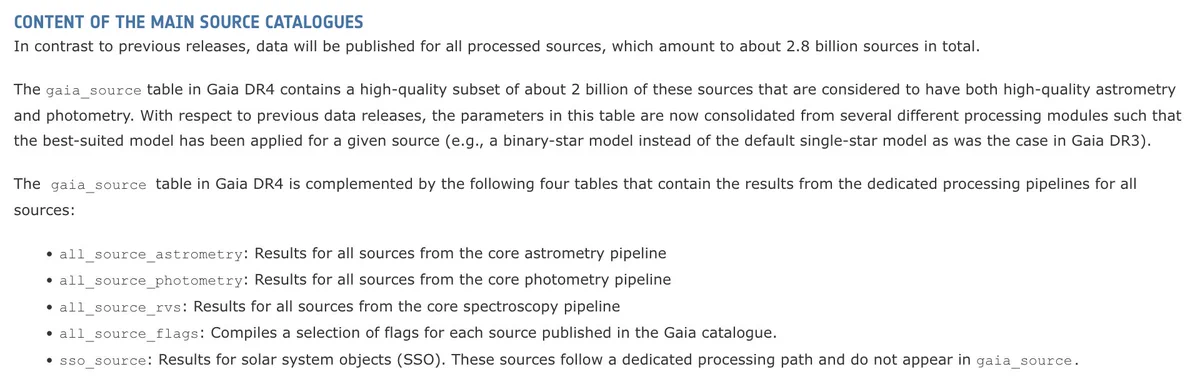
    Gaia Data Release 4 is expected December '26 and #GaiaDPAC is hard at work processing, validating & documenting the data sets. While #GaiaDR3 brought ~60 different data products, #GaiaDR4 will bring ~130 of them. Lots of new data products! Updated page 👉cosmos.esa.int/web/gaia/dr4
    Screenshot extract of the webpage: https://www.cosmos.esa.int/web/gaia/dr4 showing the content of the main source catalogues.
    6750675
  • ESA ESDC reposted
    user avatar
    ESA Gaia
    European Space Agency
    @ESAGaia
    Sep 29, 2025
    Gaia dances the night away! 💃A farewell to a fading Gaia... But no worries, you can still follow Gaia's location in the sky using some ephemeris services! GIF credits: Liverpool telescope / J. Marchant. Full story on Gaia Cosmos: cosmos.esa.int/web/gaia/iow_2…
    Image
    GIF
    19K019K
  • ESA ESDC reposted
    user avatar
    ESA Gaia
    European Space Agency
    @ESAGaia
    Sep 30, 2025
    Replying to @ESAGaia
    Wondering what Gaia's retirement orbit is and where to find it with respect to Earth and the Sun? Check out this video👇🏽 as published here: esa.int/ESA_Multimedia… youtu.be/8RznHsG12t0
    Image
    ESA’s Gaia spacecraft leaves for retirement orbit
    From esa.int
    2.6K02.6K
  • ESA ESDC reposted
    user avatar
    ESA Gaia
    European Space Agency
    @ESAGaia
    Sep 30, 2025
    Gaia was passivated in March after its cold gas ran out. It was seen dancing in the sky! But where is Gaia now? You can find the details from our story here: cosmos.esa.int/web/gaia/iow_2…! Meanwhile, #GaiaDPAC works hard preparing #GaiaDR4: cosmos.esa.int/web/gaia/data-…
    Orbit of the Gaia spacecraft relative to Earth at various dates.
    2.5K02.5K
  • ESA ESDC reposted
    user avatar
    ESA Gaia
    European Space Agency
    @ESAGaia
    Sep 30, 2025
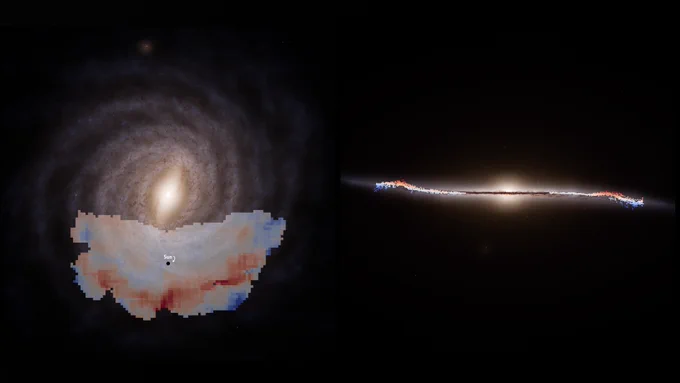
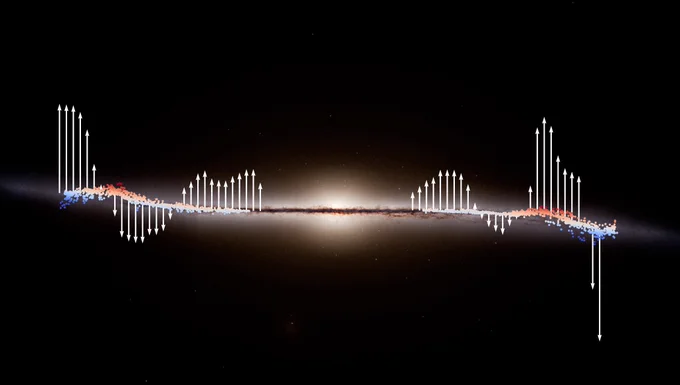
    Gaia finds waves galore! Stars are surfing a giant wave in our Milky Way... Find the full story here: esa.int/Science_Explor…
    user avatar
    ESA Science
    European Space Agency
    @esascience
    Sep 30, 2025
    Stars in our galaxy make a stadium wave, Gaia finds 🙌 Our Milky Way galaxy never sits still: it rotates and wobbles 🌀 But @ESAGaia has just revealed that our galaxy also has a giant wave rippling outwards from its centre 👉 esa.int/Science_Explor…
    This image consists of two sides. Left side: A top-down view of a spiral galaxy is shown. It has a bright central bulge with several spiral arms radiating outward. Overlaid on the lower part of the galaxy is a data visualisation, with colours ranging from blue to red. A label reading ‘Sun’ marks a specific location within this overlay. Right side: An edge-on view of the same spiral galaxy is presented. It reveals the galaxy's thin disc and central bulge from the side. Coloured points are scattered along the disc, representing the same data as the overlay on the left side.
    The image features a dark background with a thin, bright horizontal line running across the centre. This is our galaxy’s disc. Above and below this line, numerous white arrows point upward and downward. These arrows vary in length and are spread evenly along the line. Scattered among the arrows are small red and blue dots. The visual resembles an astronomical data visualisation, illustrating positions and motions of stars in our galaxy.
    1.9K01.9K
  • ESA ESDC reposted
    user avatar
    ESA's Euclid mission
    European Space Agency
    @ESA_Euclid
    Mar 19, 2025
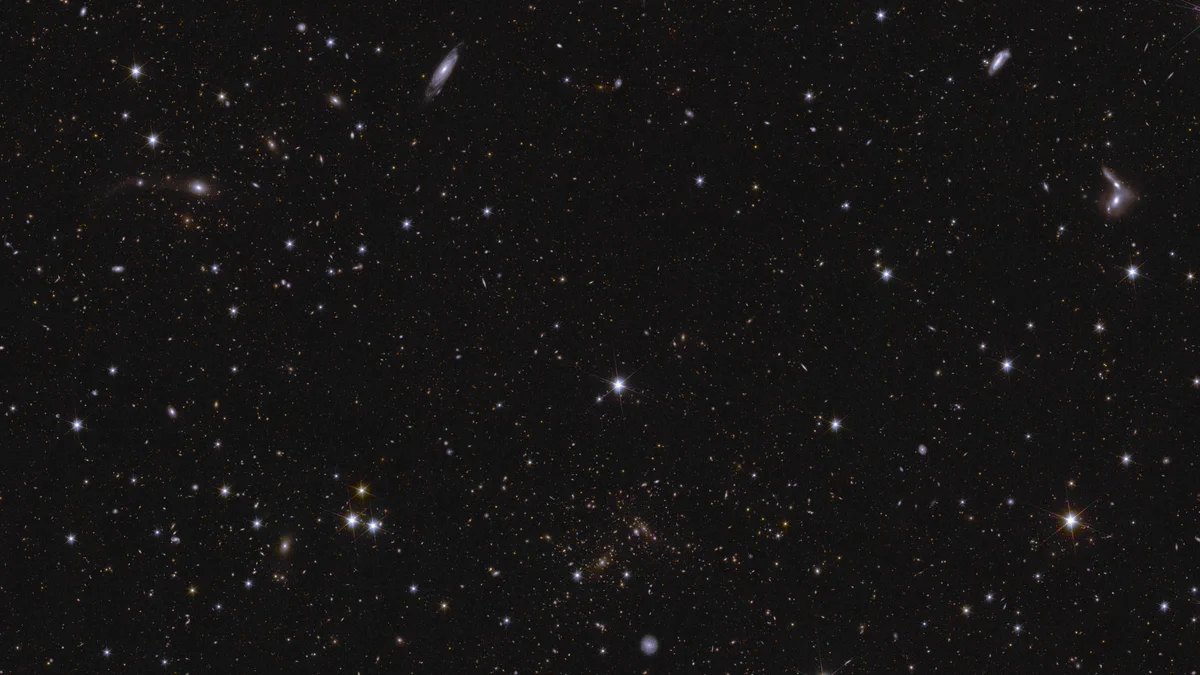
    📣 Euclid releases first batch of survey data, including a preview of its very own deep fields! With just one scan, #ESAEuclid has already spotted 26 million galaxies 👉 esa.int/Science_Explor… Let's explore the treasure trove that our #DarkUniverse detective has uncovered 🧵
    A sea of stars and galaxies sparkle against a black background. Several galaxies can be identified by their elongated shape and/or spiral arms. Some galaxies are seen edge-on while one prominent spiral galaxy at the bottom centre is seen face-on. At the far right, between the middle and top of the image, are some interacting galaxies. Galaxy clusters are also seen, in particular near bottom centre, where features smeared into arcs represent gravitational lensing. The brightest stars in the image have diffraction spikes.
    56K056K
  • ESA ESDC reposted
    user avatar
    ESA Gaia
    European Space Agency
    @ESAGaia
    Jan 20, 2025
    Gaia was a faint object in the sky during its science observation phase but could potentially reach a 14 magnitude in the coming days. More details: cosmos.esa.int/web/gaia/obser… Amateur astronomers & ground observatories are invited to observe Gaia's final moments before passivation.
    Image
    GIF
    6.7K06.7K
  • ESA ESDC reposted
    user avatar
    ESA Gaia
    European Space Agency
    @ESAGaia
    Jan 20, 2025
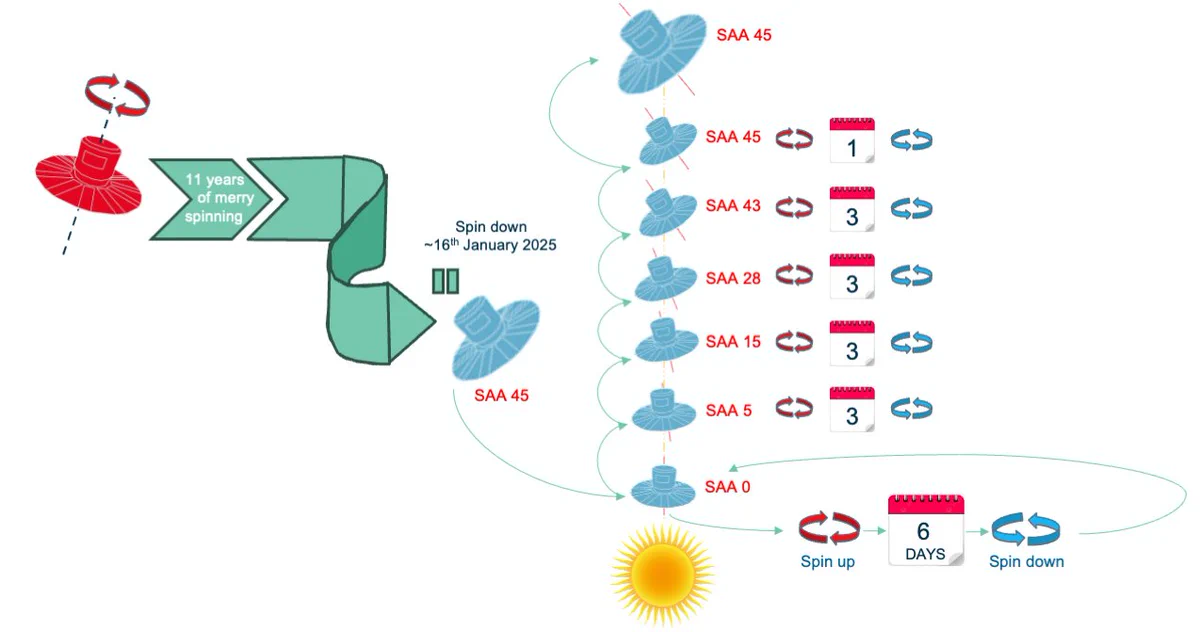
    While Gaia stopped taking science observations, it is hard at work to perform a set of technology tests: cosmos.esa.int/web/gaia/techn…. As part of these tests, Gaia's angle with respect to the Sun will change, and the Gaia spacecraft's brightness is gradually increasing at the moment.
    Image
    3.6K03.6K
  • user avatar
    ESA ESDC
    European Space Agency
    @ESAesdc
    Jan 15, 2025
    Congratulations to the six researchers just awarded with @ESA's Archival Research Visitor Programme funding! Next deadline to apply for funding is on the 25th of April of 2025. Check cosmos.esa.int/web/esdc/visit… Cc @esascience @ESA_Webb @ESA_CHEOPS
    Image
    4.1K04.1K
  • ESA ESDC reposted
    user avatar
    Pablo Turrión
    @Pablots25
    Dec 4, 2024
    Replying to @Pablots25
    As always, the full set of images can be found at the @esa Planetary Science Archive @esapsanews @ESAesdc 🪐 👉🏻 psa.esa.int/psa/
    2250225
  • ESA ESDC reposted
    user avatar
    ESA Gaia
    European Space Agency
    @ESAGaia
    Dec 3, 2024
    ✨Attention #GaiaData Users. The @ESAesdc Gaia Archive takes a first step towards Gaia DR4 soon on 10 December! To prepare for bigger volumes and the larger product diversity, some breaking changes to the way things work will be needed. ✨More details: cosmos.esa.int/web/gaia/iow_2…
    Image
    3.3K03.3K
  • user avatar
    ESA ESDC
    European Space Agency
    @ESAesdc
    Sep 27, 2024
    Join the @esa Science Directorate ! 🌌 We're hiring an Archive Scientist at the European Space Astronomy Centre (ESAC) near Madrid, Spain on a 3-year contract to work with the @ESASolarOrbiter, @ESA_Cluster and other Heliophysics data archives. 🔍 If you have a passion for
    Image
    00:00
    6.8K06.8K
  • ESA ESDC reposted
    user avatar
    HUBBLE
    European Space Agency
    @HUBBLE_space
    Sep 26, 2024
    🆕 Astronomers using Hubble have discovered that a blowtorch-like jet from a supermassive black hole seems to cause stellar eruptions 🧵👇
    An artist’s concept looks down into the core of the galaxy M87, which is just left of centre and appears as a large blue dot. A bright blue-white, narrow and linear jet of plasma transects the illustration from centre left to upper right. It begins at the source of the jet, the galaxy’s black hole, which is surrounded by a blue spiral of material. At lower right is a red giant star that is far from the black hole and close to the viewer. A bridge of glowing gas links the star to a smaller white dwarf star companion immediately to its left. Engorged with infalling hydrogen from the red giant star, the smaller star exploded in a blue-white flash, which looks like numerous diffraction spikes emitted in all directions. Thousands of stars are in the background.
    29K029K
Advertisement
Advertisement