1. X
  2. NASA Universe
Log inSign up
NASA Universe
NASA
12.3K posts
Image
user avatar
NASA Universe
NASA
@NASAUniverse
Your backstage pass to the universe and how NASA studies it. Exoplanets, black holes, dark energy, and more!
Greenbelt, MD
universe.nasa.gov
Joined March 2009
80
Following
1.1M
Followers
RepliesRepliesMediaMedia

New to X?

Sign up now to get your own personalized timeline!

Create account

By signing up, you agree to the Terms of Service and Privacy Policy, including Cookie Use.

Terms·Privacy·Cookies·Accessibility·Ads Info·© 2026 X Corp.
Don't miss what's happening
People on X are the first to know.
Log inSign up
  • Pinned
    user avatar
    NASA Universe
    NASA
    @NASAUniverse
    Jul 16
    Commissioning continues for Katalyst Space’s LINK as they turn on and test the robotic spacecraft’s systems to prepare for its boost of our Swift observatory. LINK captured these images of its solar panels and one of its thrusters firing last week. More: go.nasa.gov/4ppL7Hr
    A long purple and gold solar panel extends from the side of Katalyst Space’s orbiting LINK robotic servicing spacecraft in this image captured by one of LINK’s cameras on July 9, 2026. One side of LINK is visible in the left third of the image. Earth takes up half the background, and the rest is filled by the blackness of space. Our planet’s cloudy atmosphere appears a little over exposed. The image is watermarked “Credit: Katalyst Space.”
    LINK fires one of its xenon-fueled thrusters in this image captured by the spacecraft on July 8, 2026. LINK takes up the right third of the image, and various wires and cables are visible. A teardrop-shaped white flame with a green halo extends from the curved bottom edge of the spacecraft. The background of the rest of the image is black, although the flame extends to about the center. The image is watermarked “Credit: Katalyst Space.”
    19K019K
  • user avatar
    NASA Universe
    NASA
    @NASAUniverse
    16h
    Splashing around in the pool to keep cool? Sloshing might keep the superheated gas in the centers of galaxy clusters hot! An X-ray study showed that motions in the gas in the Centaurus cluster likely prevents the gas from cooling. #MondayMotivation
    This illustration depicts the center of the Centaurus cluster based on data from XRISM and other observatories. The black backdrop features dozens of round and oval spots in shades of yellow, red, and blue, representing the galaxies in the cluster. Just to the left of center is a large bright oval surrounded by tendrils of tan and dark brown like a small firework. A cloud of patchy electric blue representing the hot gas encircles the bright oval and swings up to the right, like a scarf flung around someone’s neck. The image is watermarked “Artist’s concept” and “Credit: JAXA.”
    15K015K
  • NASA Universe reposted
    user avatar
    NASA Goddard
    NASA
    @NASAGoddard
    18h
    Whether it's your birthday, an anniversary, or you're just hoping to jazz up a Monday, celebrate like a space telescope! 🎉 See what @NASAHubble saw on your big day, and share with us. ⬇️
    Image
    What Did Hubble See on Your Birthday? - NASA Science
    From science.nasa.gov
    22K022K
  • NASA Universe reposted
    user avatar
    NASA History Office
    NASA
    @NASAhistory
    21h
    One giant leap for mankind History was made on July 20, 1969, when Apollo 11's Neil Armstrong and Buzz Aldrin became the first to set foot on the Moon. For more than 5 decades, the total number of moonwalkers has remained at 12. NASA will change that with Artemis IV.
    Photo of Buzz Aldrin on the surface of the Moon taken by Neil Armstrong on July 20, 1969.
    1.9M01.9M
  • user avatar
    NASA Universe
    NASA
    @NASAUniverse
    Jul 17
    RT @NASAKennedy: Media accreditation is now open for two Kennedy launches, NASA's Nancy Grace Roman Space Telescope and the agency’s SpaceX…
    1.5K01.5K
  • NASA Universe reposted
    user avatar
    Nancy Grace Roman Space Telescope
    NASA
    @NASARoman
    Jul 17
    The hills are alive, with the sound of science! We are at the Rocky Mountain National Park "Weekend of Stargazing" for our next stop on "Roman" Across America.  If you’re enjoying our tour of the country, you can host your own Roman event to celebrate the launch! Check out
    Football sized and shaped one-fortieth scale model of the Nancy Grace Roman Space Telescope sitting on a table outside. In the background are very tall trees and a sunny blue sky with puffy white clouds.
    A blue Roman sticker featuring the telescope’s distinctive 18-square detectors is held up outside in front of a wooden sign that says “Elevation 12,005 feet above sea level.” In the background is a field covered in patchy grass and distant shadowed mountains.
    12K012K
  • user avatar
    NASA Universe
    NASA
    @NASAUniverse
    Jul 17
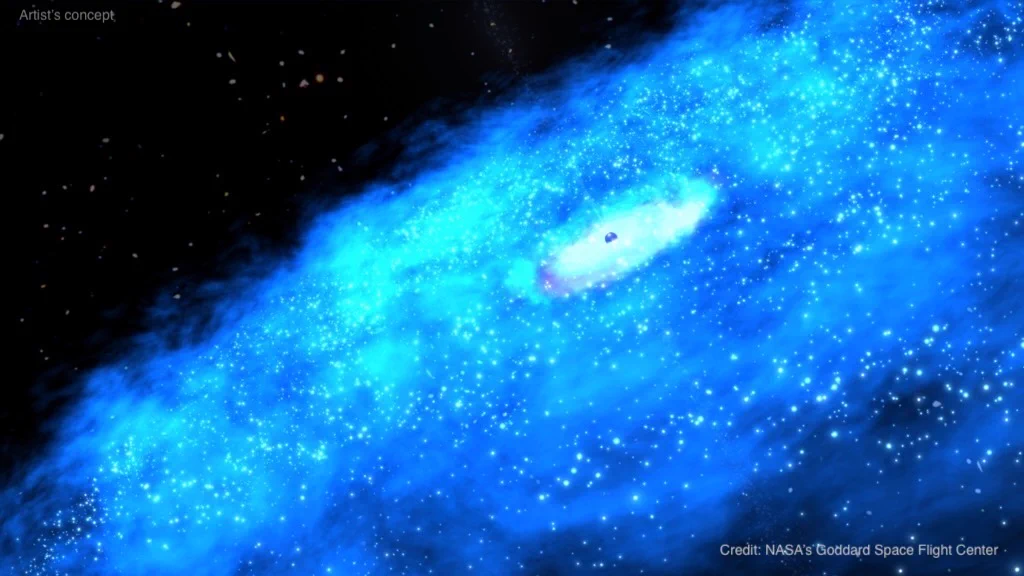
    Our friends at @Fermilab are celebrating the 70th anniversary of the first neutrino detection. These zippy particles hurtle through the universe, and @NASA telescopes have been able to help pinpoint and study the cosmic origins of a few of them. #Neutrino70 🧵
    Most of the image is taken up by a hazy disk of electric blue material that represents the galactic disk of a blazar. Dotted around that hazy disk are lots of individual stars. At the middle the disk glows white with a small black bubble embedded in the very center. The image is watermarked “Artist’s concept” and “Credit: NASA’s Goddard Space Flight Center.”
    17K017K
    user avatar
    NASA Universe
    NASA
    @NASAUniverse
    Jul 17
    Replying to @NASAUniverse @Fermilab and @NASA
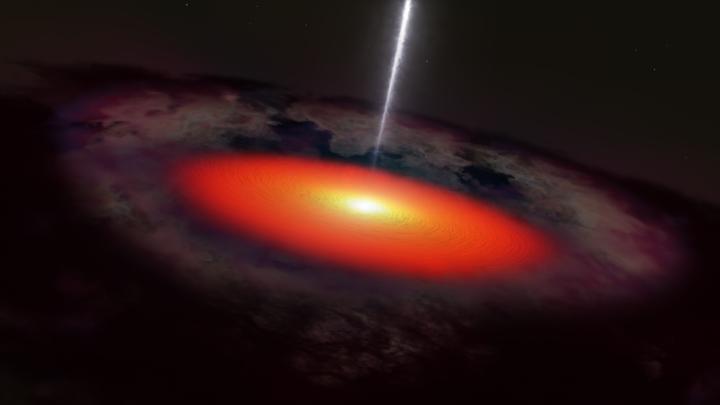
    In 2017, @NSF’s IceCube Neutrino Observatory in Antarctica detected a neutrino that had traveled 3.7 billion years. Our Fermi Gamma-ray Space Telescope helped trace its source to a flaring blazar — a type of galaxy powered by a supermassive black hole. go.nasa.gov/3THg2mM
    Image
    00:00
    3.4K03.4K
    user avatar
    NASA Universe
    NASA
    @NASAUniverse
    Jul 17
    Then, a couple years later, astronomers linked another neutrino to a source outside our galaxy, this time from a black hole tearing apart a star. They think the neutrino originated in the disk that formed as the star’s remains fell toward the black hole. go.nasa.gov/4pqTtid
    Image
    00:00
    3.2K03.2K
  • NASA Universe reposted
    user avatar
    Learn With NASA
    NASA
    @LearnWithNASA
    Jul 17
    Hey stargazer! Interested in astronomy?🤩🔭 The NASA Night Sky Network has events across the country to help you spot a star, peek at a planet & gaze at a galaxy.🪐🌌 Visit their website to find astronomy club events in your area! science.nasa.gov/skywatching/ni…
    A collage of images featuring young children looking through a telescope, a group of people gazing at a night sky, and a large depiction of Earth's Moon
    6.4K06.4K
  • user avatar
    NASA Universe
    NASA
    @NASAUniverse
    Jul 17
    Our Neil Gehrels Swift Observatory has a whopping wingspan of 17.8 feet (5.4 meters), substantially wider than its namesake bird. You’d need about 11 common swift birds to match Swift’s width. Even the living bird with the widest wingspan, the snowy albatross, falls short!
    Image
    00:00
    26K026K
  • NASA Universe reposted
    user avatar
    NASA's Kennedy Space Center
    NASA
    @NASAKennedy
    Jul 16
    🔭 Milestone complete! Solar panels that will power NASA’s Nancy Grace Roman Space Telescope finished prelaunch cleaning and checkouts at Kennedy’s Payload Hazardous Servicing Facility. These six panels form Roman’s Solar Array Sun Shield – about 7×10 feet each and built at
    Image
    Telescope Milestone: Teams Check Out NASA Roman Solar Panels
    From science.nasa.gov
    32K032K
  • NASA Universe reposted
    user avatar
    Hubble
    NASA
    @NASAHubble
    Jul 16
    What do all these cosmic views have in common? Hubble captured them on previous July 16s! ICYMI, you can find multiple beautiful views taken on any date using the new expanded edition of "What Did Hubble See on Your Birthday?": go.nasa.gov/3Rn86Gy Let us know what you get!
    NGC 6397. A cluster of orange, blue, and white stars shines against black space, more closely concentrated at center.
    ESO 239-2. Merging galaxies form a bright blob near image-center, with wispy trails of gas and stars seen surrounding it. More distant galaxies dot the black background of space. A foreground star shines near upper-left center.
    M87. A galaxy resembles a translucent, fuzzy white cotton ball. The brightness decreases gradually out in all directions from a bright white point of light at the center. A wavy blue-white jet of material extends from the point-like core outward to the upper right, about halfway across the galaxy. Stars speckle the background.
    NGC 6791. Bright stars with diffraction spikes shine against black space. A few galaxies are seen in the distance near the left.
    78K078K
  • NASA Universe reposted
    user avatar
    Nancy Grace Roman Space Telescope
    NASA
    @NASARoman
    Jul 16
    Some of our capabilities really pull you in! ⚫ Scientists will use Roman to detect and study supermassive black holes at great distances that existed up to 11 billion years ago! go.nasa.gov/456uQOi
    Artist concept of a tidal distruption event. A large, black circle representing a black hole occupies the upper right in this illustration. Thick, clumpy orange streaks arc around to the right and below it, essentially surrounding it on the right side. The star the black hole is shredding streaks across the image from the lower left to the black hole in the upper right. The words “Artist's Concept” appear in the bottom left corner.
    12K012K
  • user avatar
    NASA Universe
    NASA
    @NASAUniverse
    Jul 16
    #TBT to summer 2016 when @esa’s LISA Pathfinder turned on its @NASA-provided payload to test key technology that future space missions could use to measure ripples in the fabric of space-time called gravitational waves.
    This illustration depicts the European Space Agency’s LISA Pathfinder spacecraft on its way to the first Earth-Sun Lagrangian point. LISA Pathfinder has a boxy base wrapped in crinkly golden material with various hardware protruding from its sides. A shiny octagonal array of solar panels faces the Sun, which is not visible but shines yellow rays into the top left corner. The dark background is speckled with tiny stars. In the lower right is Earth with the African continent visible under an atmosphere mottled with clouds. The image is watermarked “Artist’s concept” and “Credit: ESA/C. Carreau.”
    11K011K
    user avatar
    NASA Universe
    NASA
    @NASAUniverse
    Jul 16
    Now, @esa and @NASA are partnering on LISA, a trio of satellites that will “listen” for gravitational waves from across the universe. Members of the LISA community recently gathered for a mission symposium and snapped this group pic. Keep up with LISA: go.nasa.gov/4w8mpxS
    Hundreds of people pose for a group picture at the LISA Symposium in June 2026 in College Park, Maryland. They are making the shape of a triangle with their arms over their heads, representing the shape that will be made by the three LISA spacecraft after launch. The group is standing on a sidewalk in front of large brick buildings and leafy trees on a sunny day with a cloudless blue sky. A tall clock on a pole is to their left. The image is watermarked “Credit: Dennis Henry/NASA.”
    3.8K03.8K
  • user avatar
    NASA Universe
    NASA
    @NASAUniverse
    Jul 15
    Hot DOGs were on the menu in the early universe! Our retired WISE satellite spied hot dust-obscured galaxies (DOGs) located about 10 billion light-years away. While they are superbright, most of their light is absorbed by thick shrouds of dust. go.nasa.gov/4fjul8i
    The main panel of this image is a portion of an all-sky survey captured by NASA’s WISE telescope. Multicolored speckles fill the image, predominantly in blue, representing a variety of cosmic objects that shine bright in infrared light. Over a dozen of these dots are circled in yellow, showing the locations of active supermassive black holes commonly found by WISE. At the center is a glowing red-yellow dot, circled in magenta, representing the first “hot DOG” found by the mission, a type of black-hole-powered galaxy obscured by hot dust. On the right side of the image are four smaller square images, each assigned a unique color (indigo, blue, green, and red), which zoom in on this circled central object in wavelengths from 5 (top) to 30 (bottom) time redder than what our eyes can see.. The pattern in each square is slightly different. Dust, which blocks shorter wavelengths, obscures the hot DOGin the upper two images. This image is watermarked: “Credit: NASA/JPL-Caltech/UCLA.”
    16K016K
Advertisement
Advertisement