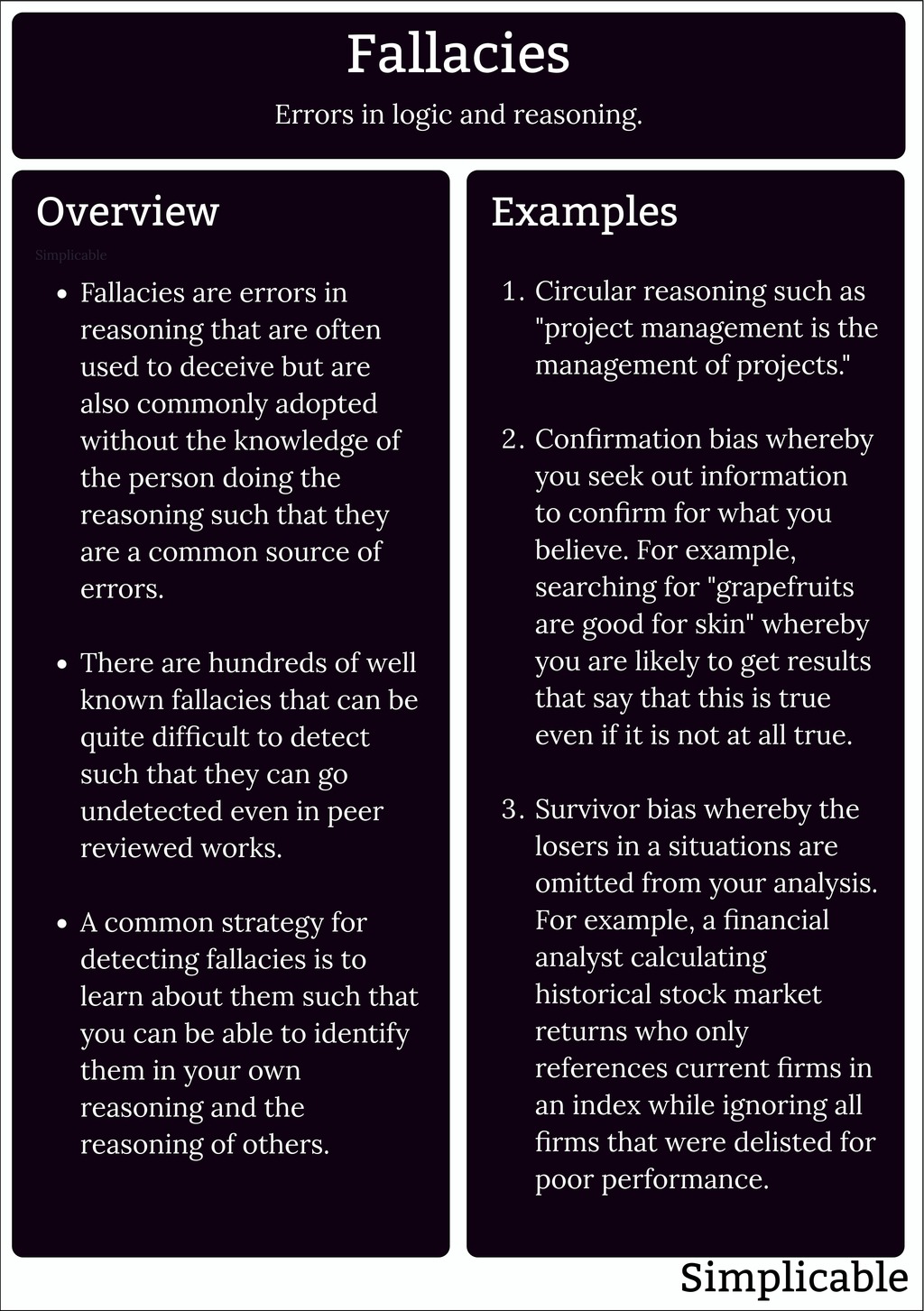
A fallacy is an argument that can be shown to have errors. These are an important component of logic as it's often easier to find an error in an argument than to prove that it's logically correct. In other words, if you can't find a fallacy in an argument, it might be correct even if you can't prove it. The following are common fallacies:
Affirming The Consequent
Assuming that the converse of a true statement is also true.
Anecdotal Fallacy
An argument based on a statistically insignificant example in the form of a story or personal experience.
Appeal To Accomplishment
Using the opinion of an accomplished individual as proof or inferring that someone has no right to talk about a topic due to a lack of accomplishment. For example, "if you know so much about acting, why aren't you a famous movie star?"
Appeal To Authority
Implying that those with power must know best. For example, "Who are you to question the Prime Minister, you work at a coffee shop."
Appeal To Consequences
Suggesting that consequences are impossible when they are not. For example, "If robots could really think then they might take over the planet someday. Clearly this is impossible."
Appeal To Emotion
Arguments that prey on emotions such as fear, hope and anger.
Appeal To Novelty
Overstating the benefits of new or innovative things out of a sense of excitement.
Appeal To Possibility
Suggesting that because something is possible, that it will necessarily happen.
Appeal To Ridicule
Acting as if someone's argument is obviously ridiculous when it isn't.
Appeal To Tradition
Claiming that something is right because it has been that way for some time.
Argument From Ignorance
Asserting that something is true because it hasn't been proven false or vice versa.
Suggesting that the middle between two extremes is necessarily correct.
Argumentum Ad Hominem
Attacking the person instead of their argument.
Argumentum Ad Nauseam
Literally "arguing to the point of nausea", meaning a long, repetitive argument that causes an opponent to concede out of boredom and despair.
Association Fallacy
Arguing that things are the same merely because they are associated. Also known as Guilt By Association or Honor By Association.
Bandwagon Argument
An argument that something is true because many people believe it.
Base Rate Fallacy
A tendency to focus on specific information over general probabilities. Often results in dramatic errors of math.
Begging The Question
A type of circular reasoning that assumes the conclusion of an argument. Often takes the form of proving something using a word that's a synonym. For example, America is rich because it has great wealth.
Broken Window Fallacy
An argument that ignores opportunity costs. Associated with economics and the false idea that damage such as wars and natural disasters are good for the economy.
Cherry Picking
Choosing evidence that supports a theory and ignoring evidence that contradicts it.
A rule of thumb that is mostly true with the exception of minor or obscure special cases. Such arguments may have value as a rule of thumb despite being a fallacy.
Falsely assuming that two things aren't identical because they don't share a property. The term is an analogy to the assumption that someone is a different person because they are wearing a mask.
Misleading Vividness
The tendency for an extremely detailed example to be convincing despite being statistically insignificant.
Moralistic Fallacy
The argument that something can't be true because its result is morally objectionable. For example, "war can't be in human nature, because then we're all doomed."
Nirvana Fallacy
Asserting that a practical approach is invalid because it contains minor flaws or isn't ideal. In many cases, the ideal approach is unfeasible or impossible to achieve.
Overwhelming Exception
An large exception that makes a statement meaningless. For example, "we are always fair except when it's not in our best interests."
Viewing past events if they were predestined when in fact they could have worked out differently. For example, "once the industrial revolution started pollution was bound to damage the Great Barrier Reef." The statement presupposes that no other options were available.
Slippery Slope
A dramatic argument that one small action leads to greater actions in the same direction until some tragedy ensures.
Straw Man Fallacy
Refuting an argument that your opponent didn't make.
Survivorship Bias
Only considering the survivors or winners in a particular situation, typically resulting in an overly optimistic analysis or argument.
Texas Sharpshooter Fallacy
Changing your target as you go. Often results in a clustering illusion whereby you find patterns that are random.
Thought-Terminating Cliche
Use of a catch-phase or slogan in place of rational thought.
Traitorous Critic Fallacy
Attacking a person's group membership as opposed to their argument. For example, "you're only saying that because you're a conservative."
Wrong Direction
Confusing cause and effect.
Summary
Fallacies are flaws in rational thought or logic that can be explained with a pattern or rule.
Discussion
While fallacies are famously used to influence, persuade and deceive it is also possible for people to have errors in their logic that are completely unintended. In fact, this is extraordinarily pervasive and can be difficult to detect. It is arguably common for fallacies of logic to be unintentionally present in strategies, analysis, research and expert opinions such that they represent a large source of human error.Next: Cognitive Biases
Cookies help us deliver our services. You have choices regarding these cookies. Please visit our privacy policy, cookie policy and consent tool to learn more.
Copyright 2002-2026 Simplicable. All rights reserved. This material may not be published, broadcast, rewritten, redistributed or translated. Report violations here.