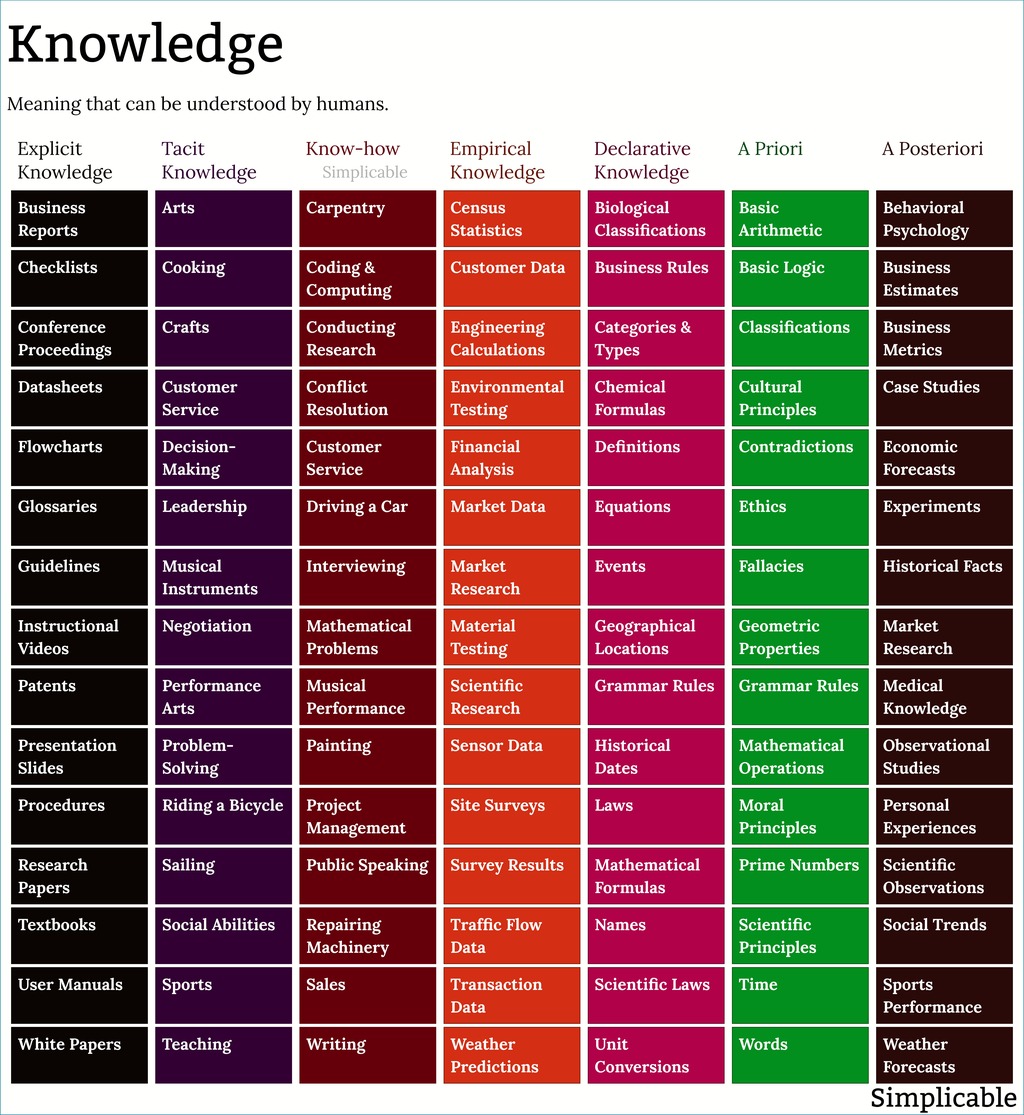
Knowledge is meaning that can be understood by humans. This includes your talents, experiences and thoughts. Knowledge also includes any information sources that you can use to find meaning. This need not pertain to cold factual information and includes elements of the human experience such as imagination, emotion and stories. The following are things that can be considered knowledge.
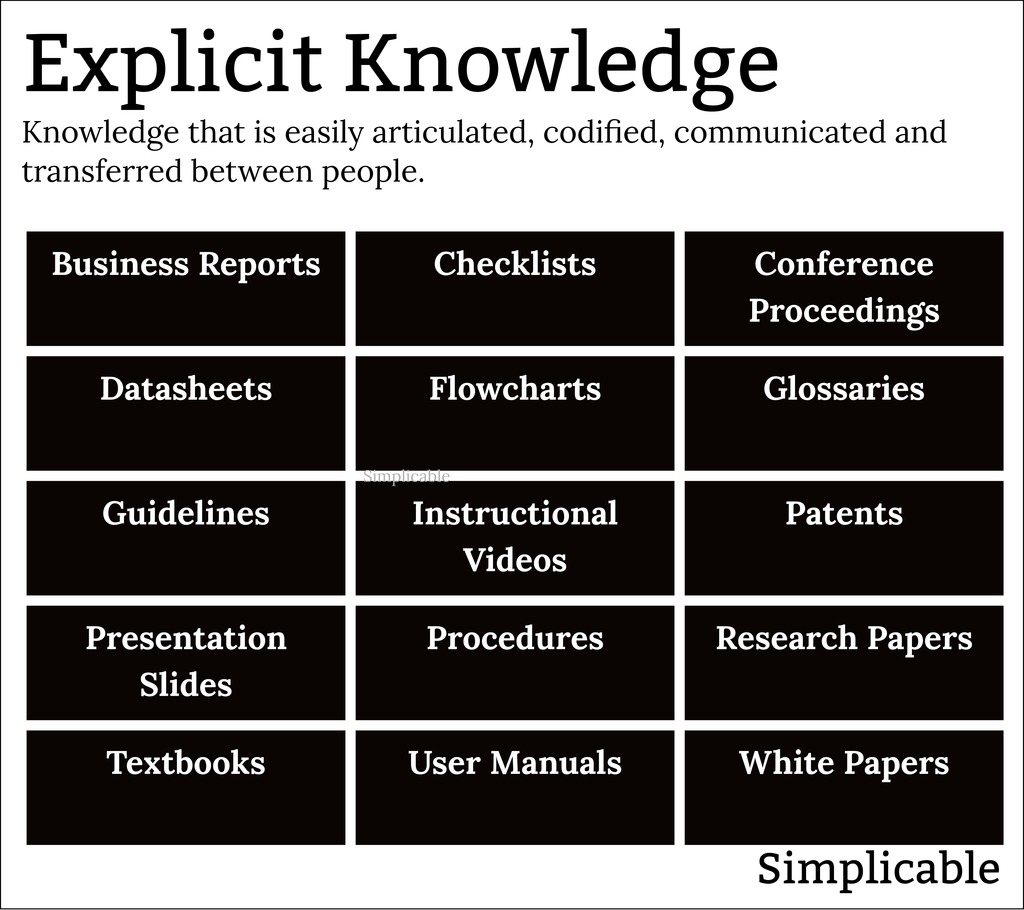
Explicit Knowledge
The type of knowledge that can be precisely documented and communicated such that it can be learned from a book. This is not domain specific as every knowledge area typically involves both tacit and explicit knowledge. For example, knowing how to sail is tacit knowledge that is difficult to transfer but knowledge of sailing regulations can be learned from a book.
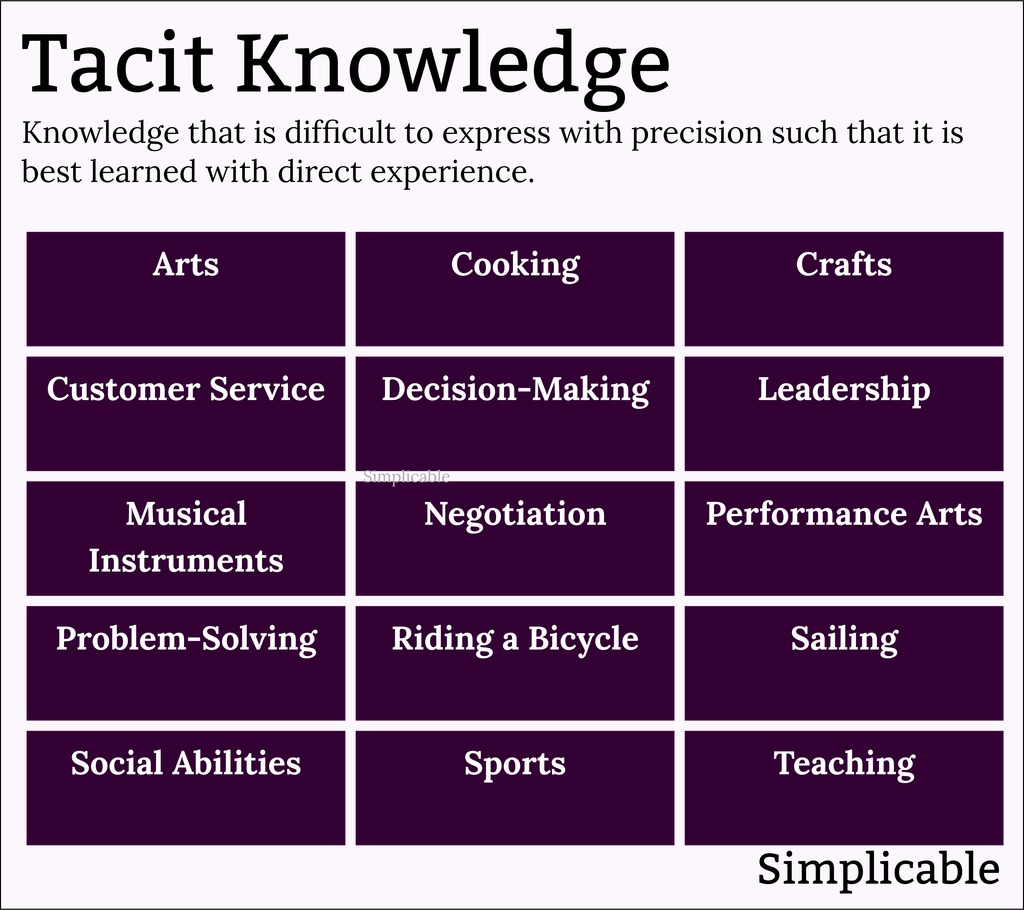
Tacit Knowledge
Knowledge that is difficult to codify or communicate with precision such that it is best learned with direct experience. This is a broad area of knowledge that includes many things described as talents and abilities. For example, social abilities such as conversational skills are certainly tacit knowledge.
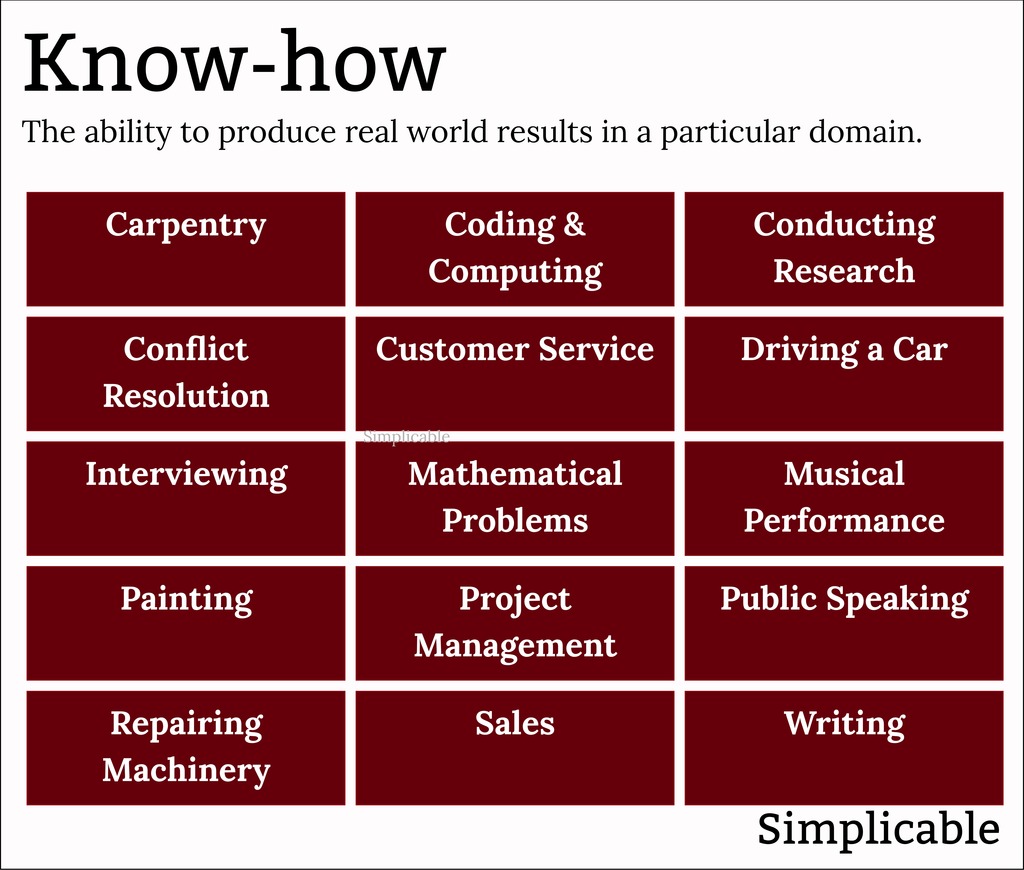
Know-how, also known as procedural knowledge, is the ability to complete real world tasks. This often combines explicit knowledge and tacit knowledge. For example, a carpenter with knowledge of local building codes and other knowledge that can be learned from a book who also has the experience required to produce fine carpentry with their hands.
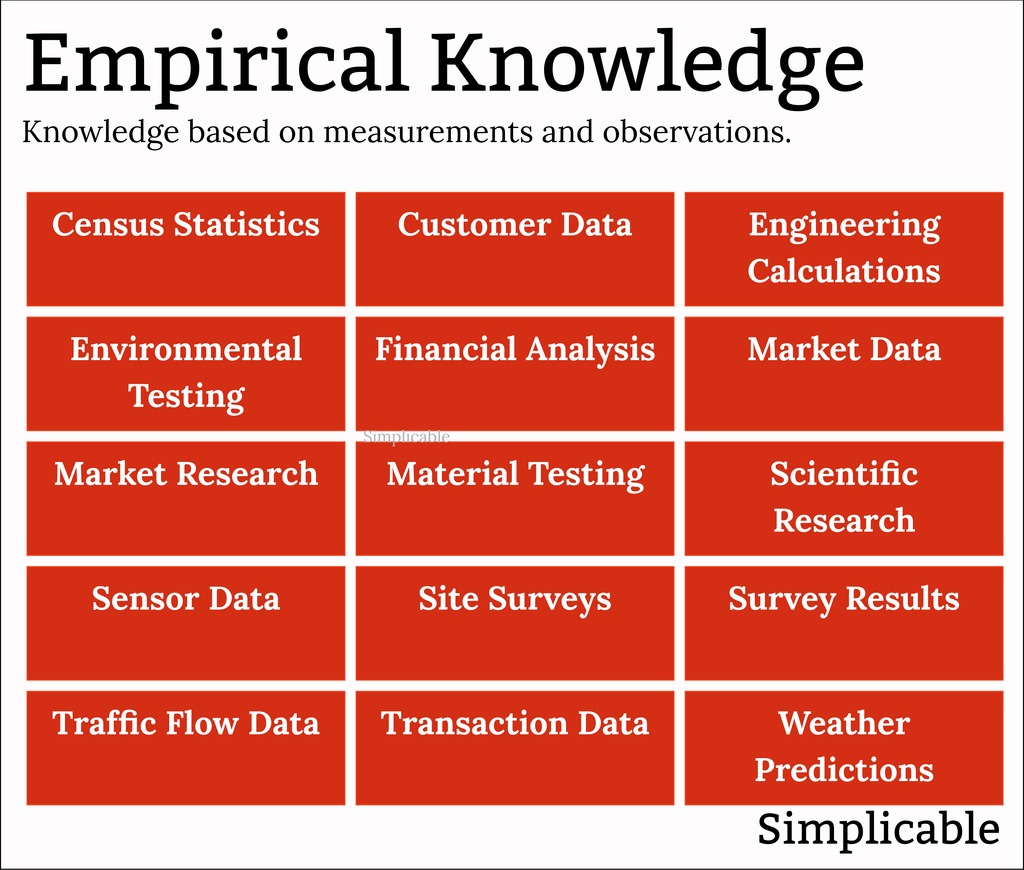
Knowledge based on measurements and observations. This doesn't mean that this knowledge is certain. For example, a weather forecast that is based on a massive number of data readings from sensors that is nonetheless probabilistic such that its predictions can be wrong.
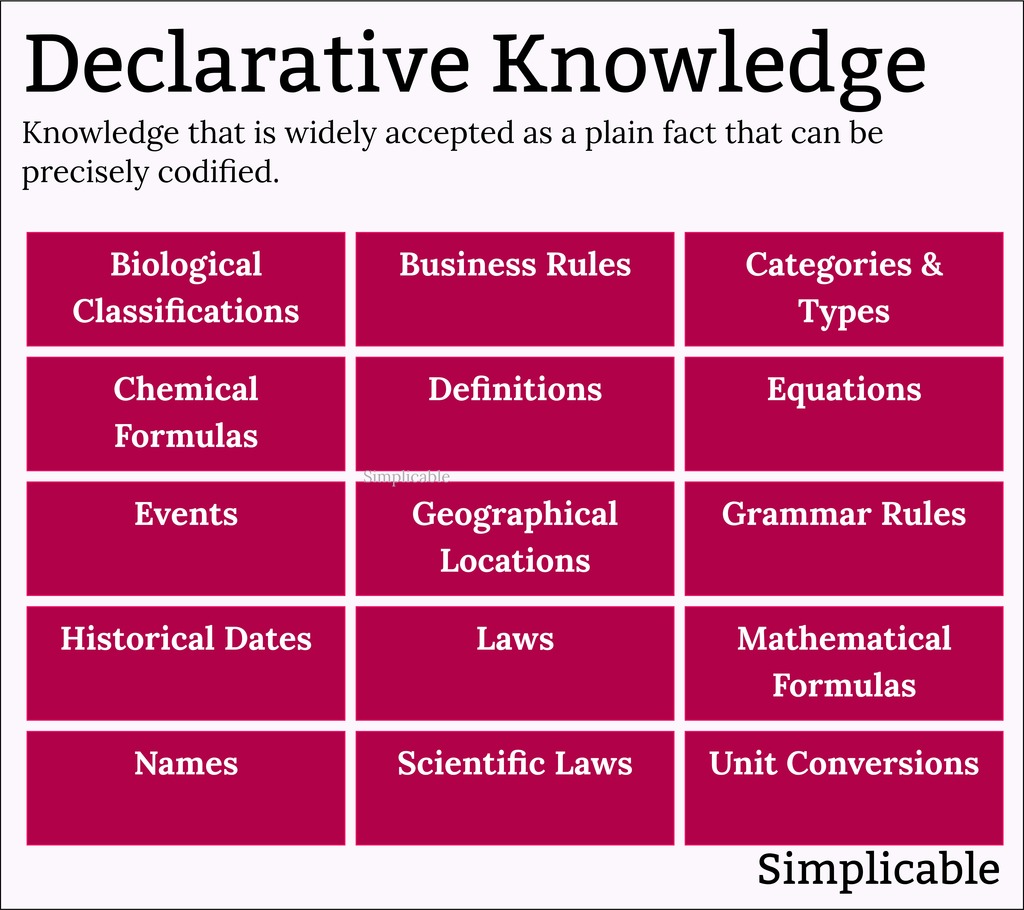
Knowledge that is widely accepted such that it is viewed as a plain fact that can be accurately and precisely defined. For example, it is accepted as a fact that a dog is an animal.
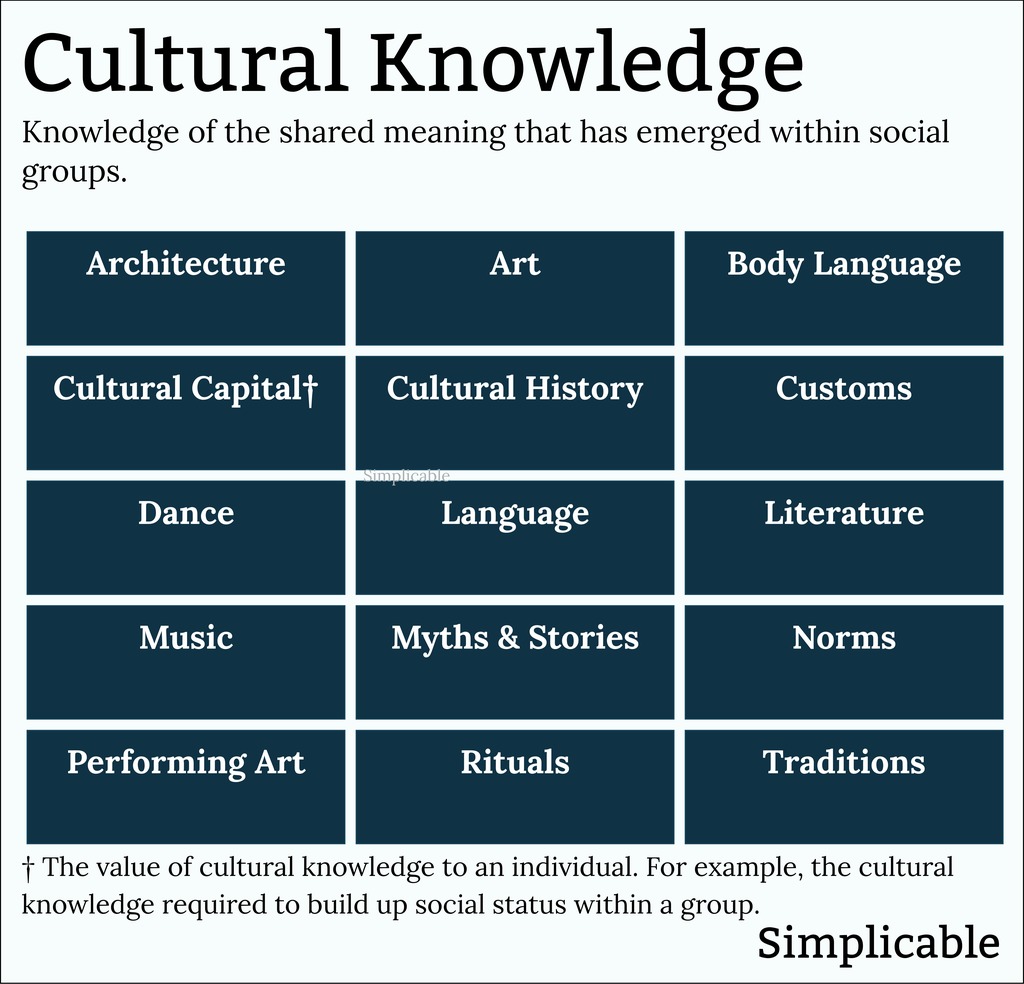
Knowledge of the shared meaning that emerges within a social group. This includes knowledge of traditional culture, pop culture and subculture such as youth culture. This includes cultural capital that is cultural knowledge or status that has future value.
Local Knowledge
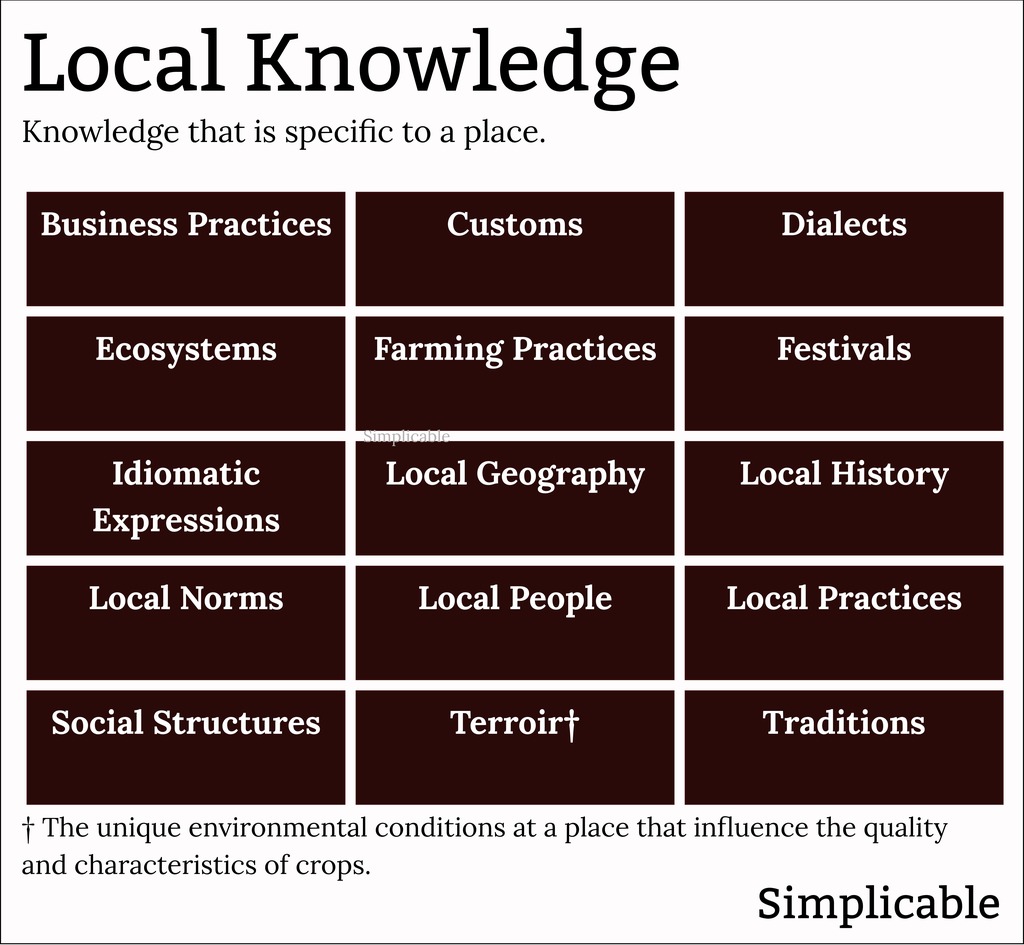
Knowledge of a local area such as a city, town or neighborhood. This can include current knowledge such as knowing the people who live in an area and historical knowledge such as knowledge of local traditions and celebrations.
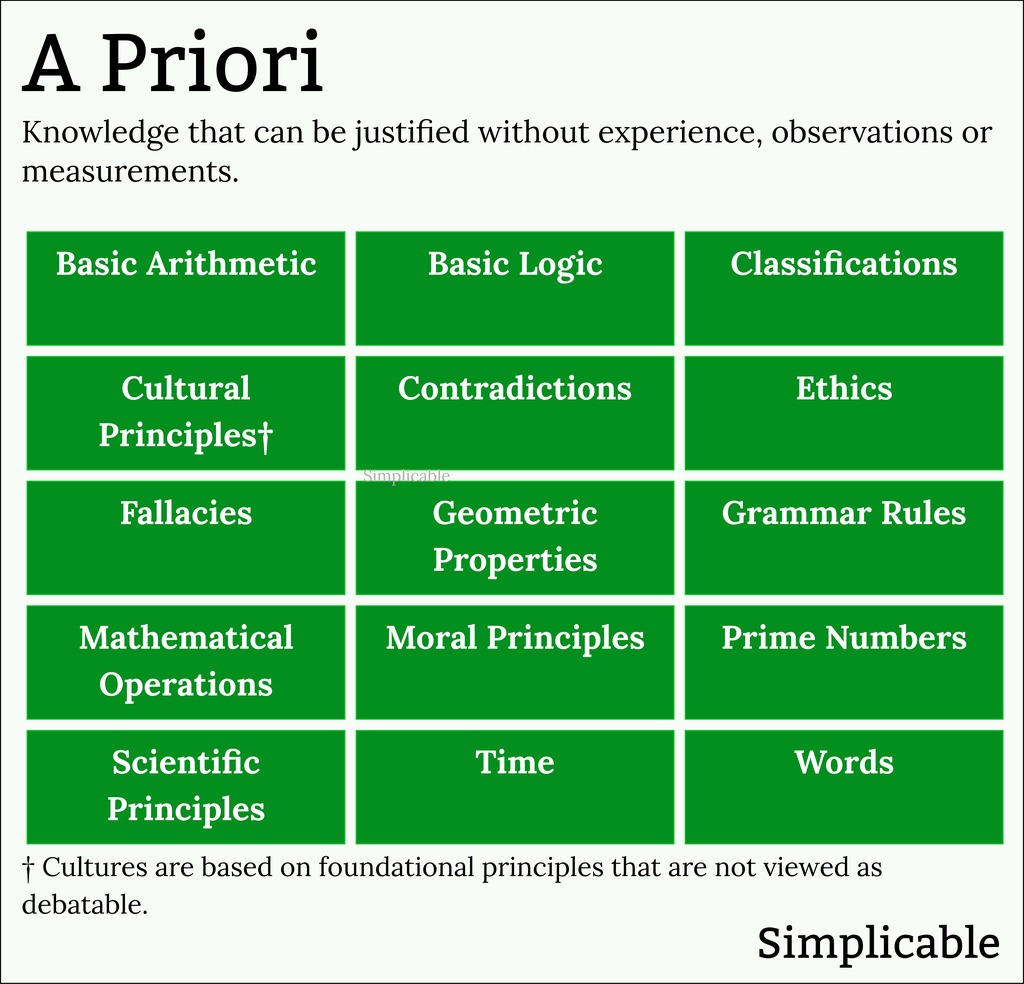
A Priori
We hold these truths to be self-evident, that all men are created equal, that they are endowed by their Creator with certain unalienable Rights, that among these are Life, Liberty and the pursuit of Happiness. ~ Declaration of Independence, In Congress, July 4, 1776
The philosophical argument that some knowledge can be determined with pure logic without being based on experience, observation and measurement. Mathematics is based upon a priori knowledge such as the properties of numbers. Societies are also based on principles that are held to be self-evident as in the statement from the Declaration of Independence above.
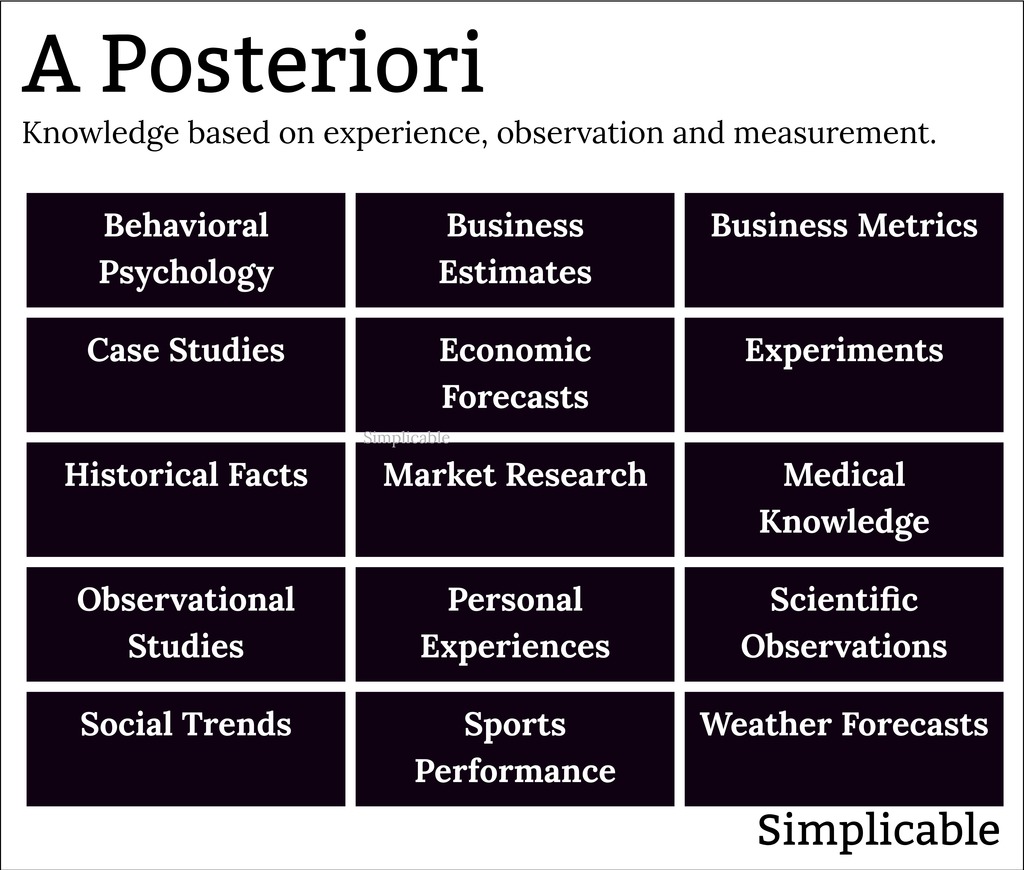
Knowledge that is based on experience such as measurement and observation. Most knowledge is like this including knowledge of history and future facing predictions and estimates.
Knowledge is meaningful information that is understood and used by humans. The universe abounds with both information and unknowns and it is a human characteristic to try to capture information and reduce unknowns. This is an endless pursuit whereby the more we know the more we realize there are things we don't know.
Cookies help us deliver our services. You have choices regarding these cookies. Please visit our privacy policy, cookie policy and consent tool to learn more.
Copyright 2002-2026 Simplicable. All rights reserved. This material may not be published, broadcast, rewritten, redistributed or translated. Report violations here.