












Absenteeism | Avoids Accountability & Responsibility |
Avoids Action Items | Avoids Work |
Broke the Law | Bypassing Processes or Procedures |
Claims Invalid Expenses | Client Dissatisfaction |
Conflict | Damages Reputation of Firm (e.g. inappropriate rants in social media) |
Deception & Dishonesty | Defeatism & Sabotage |
Destroys Value to Win Political Battles | Discriminates Against Others |
Doesn't Contribute in Meetings | Endangers Health & Safety |
Failure to Consult Stakeholders | Financial Mismanagement |
Frequent Mistakes | Frequently Late |
Frequently Wrong / Inaccurate | Goes Over Budget |
Harassment | High Turnaround Time (slow) |
Hostile to Customers | Hostile to Management |
Hostile to Projects / Strategy | Hostile to Stakeholders |
Hostile to Team | Ideological / Political at Work |
Ignoring Policy | Inappropriate Behavior (e.g. discussing personal life in front of customers) |
Ineffective in Role | Insubordination |
Intimidating Behavior | Intolerance |
Lacks Required Skills & Abilities | Low Resilience (e.g. loses composure when stressed) |
Low Work Quality | Low Work Throughput |
Makes Decisions Beyond Authority | Mismanagement |
Misses Deadlines | Misuse of Technology |
Misuse of Time (e.g. media consumption and shopping at work) | Neglect of Duty |
Plays Political Games | Poor Attention to Detail |
Poor Customer Service | Poor Response to Criticism |
Refuses Required Training | Resistance to Change |
Stakeholder Dissatisfaction | Unavailable During Work Hours |
Uncooperative | Unprofessional |
Unreasonable Waste of Resources | Workplace Bullying |
What Qualifies as Poor Performance?
Poor performance is a failure to meet expectations. This can include a sustained failure to meet commitments, deliver quality work and achieve goals. Poor standards of professionalism such as unreasonable conflict behaviors is also poor performance. The process of managing poor performance generally requires direct evidence, an investigation into causes and giving the employee feedback and a chance to improve.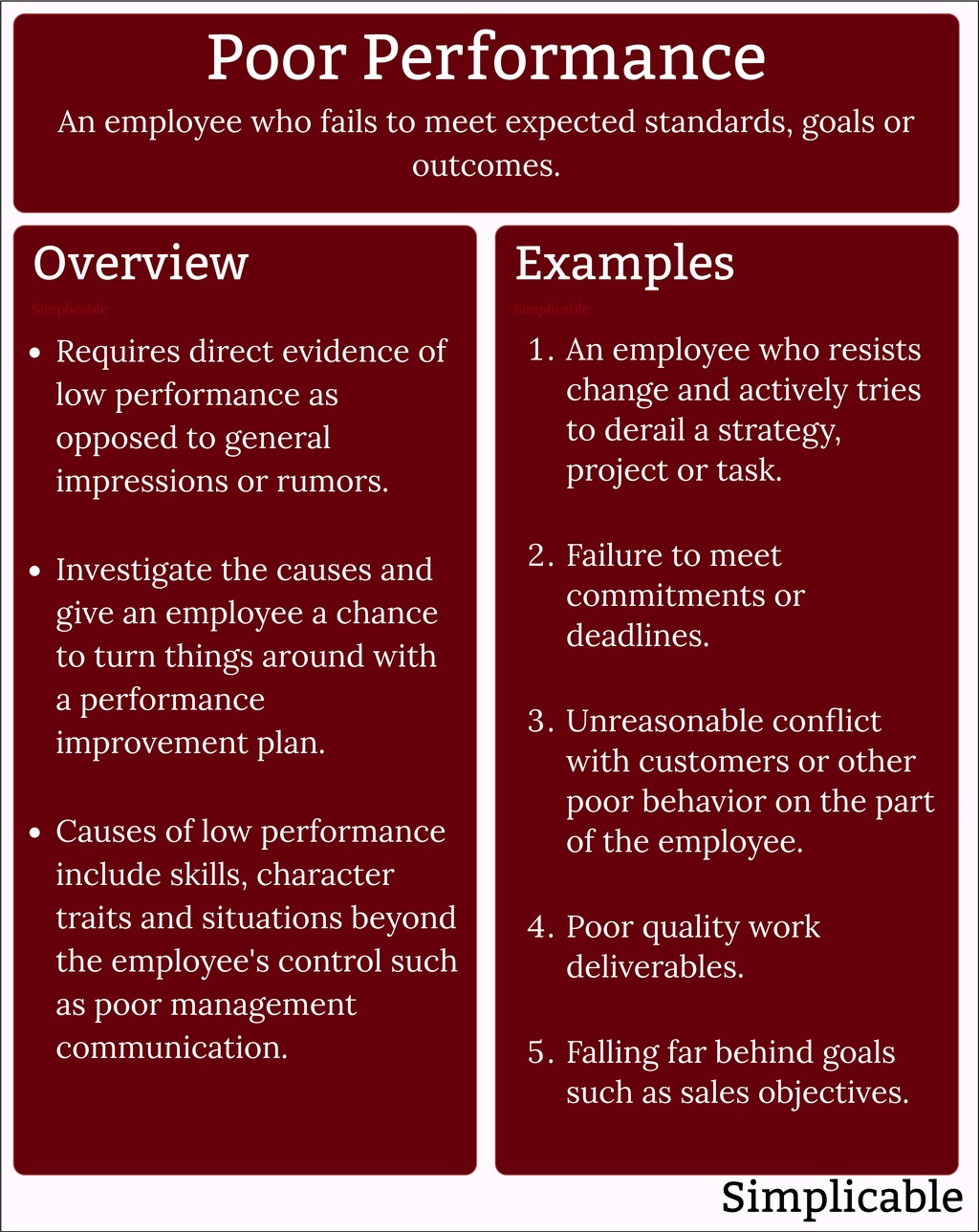
Counterexamples
In documenting poor performance, you require evidence such as direct observation. It is unreasonable to include rumors, gossip and unsubstantiated complaints. It is also unreasonable to include failures that are beyond an employee's control. For example, blaming a low level employee for the failure of a large project whereby any mistakes should have been managed by those with authority.Performance Improvement Plan
A common approach to poor performance is to have an interview with the employee and investigate the root causes of the poor performance to identify solutions. This gets documented in a performance improvement plan that outlines performance expectations going forward.Termination
In many cases, an employee is terminated if they fail to meet the objectives in their performance improvement plan. Where employees have violated the principles of a firm in some serious way it is common for them to be immediately terminated without a performance improvement plan. Guidelines for termination of employees differ by jurisdiction and firm.Causes of Poor Performance
Poor performance can be caused by skill shortfalls or a lack of engagement and motivation on the part of the employee. It is also commonly caused by management issues such as not setting proper expectations, poor communication or not providing adequate support and resources.