9 Essential Software Architecture Patterns for Scalable Distributed Systems in 2026

Disclosure: This post includes affiliate links; I may receive compensation if you purchase products or services from the different links provided in this article.

Software Architecture Patterns for Distributed Systems

image_credit - ByteByteGo

Hello friends, in modern software development, distributed systems are very popular but architects and developers face the challenge of designing systems that efficiently manage data and facilitate seamless communication between various components.

Architectural patterns provide proven solutions to common problems encountered in distributed systems, ensuring reliability, scalability, and maintainability.

Among these patterns, some patterns stand out as fundamental for managing data and communication flow effectively, which we will see in this article.

These are also important topic for System design interviews and knowledge of these pattern goes a long way in solving System design problem and impressing your interviewer.

Apart from preparing common System design questions like API Gateway vs load balancer, Forward Proxy vs Reverse Proxy as well common System Design problem , it make sense to know about these patterns as well.

Let's find out more about these patterns to understand their principles and applications.

By the way, if you are preparing for System design interviews and want to learn System Design in depth then you can also checkout sites like ByteByteGo, Design Guru, Exponent, Educative, Codemia.io , bugfree.ai, and Udemy which have many great System design courses

Also, a solid knowledge of various Architecture patterns like Peer to Peer Pattern, API Gateway goes a long way in designing systems that can withstand the test of time on production. On that note, here is a nice diagram from DesignGuru.io on Microservices architecture:

Microservices architecture

9 Best Architectural Patterns for Distributed Systems

In the past, you have learned about essential Microservice design patterns like Event Sourcing, SAGA, Database Per Microservices, API Gateway, Circuit-Breaker and also shared best practices to design Microservices , now its time to see the brief overview of common architecture patterns for Data communication.

1. Peer-to-Peer (P2P) Pattern

The Peer-to-Peer pattern fosters direct communication between two or more components without the need for a central coordinator.

In this decentralized model, each node in the network can act as both a client and a server, enabling efficient resource sharing and collaboration.

P2P architectures are commonly used in file sharing systems, decentralized applications (DApps), and blockchain networks, where resilience and scalability are paramount.

Here is how P2P architecture looks like:

Peer-to-Peer (P2P) Pattern


2. API Gateway Pattern

An API Gateway serves as a unified entry point for client requests to access backend services within an application.

By consolidating multiple APIs into a single interface, it simplifies client-server interactions and enforces security, authentication, and rate limiting policies.

API Gateways are essential components in microservices architectures, enabling service discovery, load balancing, and protocol translation while abstracting the complexities of backend systems.

Here is how it looks:

API Gateway Pattern

If you like to watch, here is another great video from ByteByteGo which explains API Gateway


3. Pub-Sub (Publish-Subscribe)

The Pub-Sub pattern decouples message producers (publishers) from consumers (subscribers) through a message broker or event bus like Kafka, Solace, RabbitMQ, or ActiveMQ.

Publishers broadcast messages to predefined topics or channels, while subscribers express interest in specific topics and receive relevant messages asynchronously.

Pub-Sub architectures facilitate loose coupling, scalability, and fault tolerance, making them ideal for real-time messaging systems, event-driven microservices, and IoT platforms.

Here is how Pub-sub pattern looks like:

Pub sub pattern


4. Request-Response Pattern

The Request-Response pattern represents the fundamental interaction model in distributed systems, where a client sends a request to a server and awaits a corresponding response.

This synchronous communication paradigm is prevalent in web applications, RESTful APIs, and RPC (Remote Procedure Call) frameworks.

Request-Response interactions ensure predictable behavior and enable error handling, making them suitable for transactional workflows and user-facing interfaces.

Here is how Request-Response model looks like in action:

Request-Response Pattern


5. Event Sourcing Pattern

Event Sourcing is a distributed system pattern for persisting the state of an application as a sequence of immutable events.

Instead of storing current state directly, events representing state transitions are stored and replayed to reconstruct the application state when needed.

Event Sourcing enables auditability, temporal querying, and replayability, making it well-suited for financial systems, collaborative editing tools, and domain-driven designs where historical data is crucial.

Here is how a Event Sourcing pattern looks like:

software architecture diagram for interviews

And, if you like to watch, here is a nice video on Event Sourcing which is worth watching:


6. ETL (Extract, Transform, Load) Pattern

ETL is a data integration pattern used to extract data from multiple sources, transform it into a standardized format, and load it into a destination database or data warehouse.

This pattern is essential for data migration, synchronization, and consolidation tasks in business intelligence, data analytics, and data warehousing projects.

ETL pipelines automate data workflows, handle data quality issues, and support batch processing of large datasets.

Here is how ETL looks lin action:

ETL (Extract, Transform, Load) Pattern


7. Batching Pattern

Batching involves accumulating data over a period or until a certain threshold is reached before processing it as a single unit.

By aggregating multiple operations into larger batches, it reduces overhead and improves efficiency in data processing pipelines.

Batching is commonly employed in data ingestion, ETL processes, and distributed computing frameworks to optimize resource utilization and minimize latency.

Here is how a Batching pattern looks like:

Batching Pattern


9. Streaming Processing Pattern

Streaming Processing enables the continuous ingestion, processing, and analysis of data streams in real-time. Unlike batch processing, which operates on static datasets, streaming systems handle infinite data streams with low latency and high throughput.

Streaming architectures support event-driven processing, complex event processing (CEP), and real-time analytics applications in domains such as finance, IoT, and cybersecurity.

Here is a nice diagram from Hazlecast which shows Stream Processing in action:

software architecture pattern


10. Orchestration Pattern

Orchestration involves a central coordinator (an orchestrator) managing the interactions between distributed components or services to execute a workflow or business process.

By coordinating task execution, handling exceptions, and enforcing dependencies, orchestration ensures the orderly execution of complex workflows spanning multiple systems.

Orchestration engines are used in workflow automation, business process management (BPM), and microservices orchestration to streamline operations and improve agility.

Here is how it looks by using Saga Orchestrator Pattern

software architecture pattern

And, here is a nice diagram from ByteByteGowhich explains all these architecture styles in a more visual way

10 Software Architecture Patterns for System Design Interviews


Best System Design Interviews Resources

And, here are curated list of best system design books, online courses, and practice websites which you can check to better prepare for System design interviews. Most of these courses also answer questions I have shared here.

  1. DesignGuru's Grokking System Design Course: An interactive learning platform with hands-on exercises and real-world scenarios to strengthen your system design skills.

  2. Codemia.io : This is another great platform to practice System design problems for interviews. It got more than 120+ System design problems, many of them are free and also a proper structure to solve them.

  3. "System Design Interview" by Alex Xu: This book provides an in-depth exploration of system design concepts, strategies, and interview preparation tips.

  4. "Designing Data-Intensive Applications" by Martin Kleppmann: A comprehensive guide that covers the principles and practices for designing scalable and reliable systems.

  5. Bugfree.ai: Bugfree AI is a popular platform for technical interview preparation. It's a LeetCode-style platform to practice System Design and Coding interview questions. It includes a variety of questions to practice.

  6. "System Design Primer" on GitHub: A curated list of resources, including articles, books, and videos, to help you prepare for system design interviews.

  7. Educative's System Design Course: An interactive learning platform with hands-on exercises and real-world scenarios to strengthen your system design skills.

  8. High Scalability Blog: A blog that features articles and case studies on the architecture of high-traffic websites and scalable systems.

  9. YouTube Channels: Check out channels like "Gaurav Sen" and "Tech Dummies" for insightful videos on system design concepts and interview preparation.

  10. ByteByteGo: A live book and course by Alex Xu for System design interview preparation. It contains all the content of the System Design Interview book volumes 1 and 2, and will be updated with volume 3 which is coming soon.

  11. Exponent: A specialized site for interview prep, especially for MAANG companies like Amazon and Google, They also have a great system design course and many other material which can help you crack FAANG interviews.

how to prepare for system design

image_credit - ByteByteGo

You should also combine theoretical knowledge with practical application by working on real-world projects and participating in mock interviews. Continuous practice and learning will undoubtedly enhance your proficiency in system design interviews.


That's all about 9 essential Software architecture patterns. Most of these patterns are also applicable to distributed systems, and they are also quite important for system design interviews.

In short, the effective management of data and communication flow is critical for building robust and scalable distributed systems.

Architectural patterns such as Peer-to-Peer, API Gateway, Pub-Sub, Request-Response, Event Sourcing, ETL, Batching, Streaming Processing, and Orchestration offer valuable solutions to address diverse challenges in system design and implementation.

By understanding these software architecture and distributed system patterns and their respective strengths and trade-offs, architects and developers can make informed decisions to design systems that meet the evolving needs of their applications and users.

    19 Microservices Patterns for System Design Interviews

    Disclosure: This post includes affiliate links; I may receive compensation if you purchase products or services from the different links provided in this article.

    19 Microservices Patterns for System Design Interviews

    image_credit - ByteByteGo

    Hello friends, if you are preparing for system design interviews, then it makes sense to prepare for Microservices design patterns as well, not just to do well on interviews or make your architecture more robust, but also to understand existing projects.

    Microservices patterns like Circuit Breaker, API Gateway, Saga, and Event Sourcing are tried and tested solutions to common Microservices Problems.

    These patterns address common challenges in microservices architectures like scalability, fault tolerance, and data consistency.

    In the past, I have talked about common system design questions like API Gateway vs Load Balancer and Horizontal vs Vertical Scaling, Forward proxy vs reverse proxy as well common System Design problems and in this article I am going to share 24 key Microservices design patterns that are essential knowledge for technical interviews.

    They are also one of the essential System design topics for interview, and you must prepare them well.

    Many companies use microservices, so understanding these patterns shows you're up-to-date with current trends. Knowing when and how to apply these patterns also demonstrates your ability to solve complex distributed system problems.

    These patterns often involve trade-offs, allowing you to showcase your analytical thinking. Interviewers often present scenarios where these patterns are relevant solutions.

    By the way, if you are preparing for System design interviews and want to learn System Design in depth then you can also checkout sites like ByteByteGo, Design Guru, Exponent, Educative, Codemia.io, and Udemy which have many great System design courses and a System design interview template like this which you can use to answer any System Design question.

    how to answer system design question

    If you need more choices, you can also see this list of best System Design courses, books, and websites

    P.S. Keep reading until the end. I have a free bonus for you.

    So, what are we waiting for? Let's jump right into it

    19 Microservices Design Patterns for System Design Interviews

    Microservices architecture is a design approach that structures an application as a collection of loosely coupled services.

    To build scalable, maintainable, and resilient microservices-based systems, various patterns have emerged.

    Here are essential microservices patterns you can use in your project, and also remember for system design interviews.

    1. Service Registry

    Since there are many microservices in a microservice architecture, they need to discover and communicate with each other.

    A Service Registry, such as Netflix Eureka or Consul, acts as a centralized directory where services can register themselves and discover others.

    Here is what it looks like:

    Service Registry Pattern


    2. API Gateway

    An API Gateway serves as a single entry point for client applications, aggregating multiple microservices into a unified API.

    It handles requests, routing them to the appropriate services, and may perform tasks like authentication, authorization, and load balancing.

    Here is what API Gateway looks like:

    API Gateway


    3. Circuit Breaker

    Inspired by electrical circuit breakers, this pattern prevents a microservice failure from cascading to other services. The Circuit breaker pattern monitors for failures and, if a threshold is crossed, opens the circuit, preventing further requests.

    This helps with graceful degradation and fault tolerance, and it's essential in a Microservice architecture to prevent a total shutdown of your services.

    Here is an example of Netflix Hysrix as a circuit breaker:

    Circuit Breaker


    4. Bulkhead

    In a microservices system, isolating failures is crucial. The Bulkhead pattern involves separating components or services to contain failures.

    For example, thread pools or separate databases for different services can be used to prevent a failure in one part of the system from affecting others.

    Here is a diagram showing the Bulkhead pattern in Microservices architecture:

    Bulkhead Pattern


    5. Saga Pattern

    This pattern is used for managing distributed transactions. The Saga pattern breaks down a long-running business transaction into a series of smaller, independent transactions.

    Each microservice involved in the saga handles its own transaction and publishes events to trigger subsequent actions.

    Here is how Saga Pattern looks in action:

    Saga Pattern


    6. Event Sourcing

    This is another popular pattern which is used heavily in high frequently low latency applications.

    In this pattern, instead of storing only the current state, Event Sourcing involves storing a sequence of events that led to the current state.

    This pattern provides a reliable audit trail and allows for rebuilding the system state at any point in time.

    Here is how Event Sourcing looks in action:

    Event Sourcing


    7. Command Query Responsibility Segregation (CQRS)

    CQRS Pattern separates the read and write sides of an application. It uses different models for updating information (commands) and reading information (queries).

    This pattern can improve scalability, as read and write operations have different optimization requirements.

    Here is a nice diagram that shows the CQRS pattern:

    Command Query Responsibility Segregation (CQRS)


    8. Data Sharding

    Database sharing pattern is used to distribute the database load and avoid bottlenecks. Data Sharding involves partitioning data across multiple databases or database instances.

    In this pattern, each microservice may handle a subset of data or specific types of requests.

    Here is how database sharding looks, credit - Design Guru

    Types of Database sharding


    9. Polyglot Persistence

    Different microservices may have different data storage needs. Polyglot Persistence allows using multiple database technologies based on the requirements of each microservice, optimizing for data storage, retrieval, and query capabilities.

    Here is a nice diagram that shows Polyglot persistence in Azure :

    Polyglot Persistence


    10. Retry

    In Microservice architecture, when a transient failure occurs, the Retry pattern involves retrying the operation instead of immediately failing.

    It can be applied at various levels, such as service-to-service communication or database interactions.

    Here is a nice diagram from ByteByteGo, a great place for system design learning, which shows the Retry pattern in Microservices:

    Retry Pattern in Microservices


    12. Sidecar

    The Sidecar pattern involves attaching a helper service (the sidecar) to the main microservice to provide additional functionalities such as logging, security, or communication with external services.

    This allows the main service to focus on its core functionality.

    Here is what a Sidecar pattern looks like:

    Sidecar pattern in Microservices


    13. Backends for Frontends (BFF)

    Also known as BFF, this pattern is useful when dealing with multiple client types (e.g., web, mobile). The BFF pattern involves creating separate backend services tailored for each type of client.

    This allows for optimized and specialized APIs for each client.

    Here is what a Backends for Frontends (BFF) pattern looks like:

    Backends for Frontends (BFF)


    14. Shadow Deployment

    The Shadow Deployment pattern involves routing a copy (shadow) of production traffic to a new microservice version without affecting the actual user experience.

    This is one of the popular deployment strategies, and it helps validate the new version's performance and correctness.

    Here is what shadow deployment looks like

    Shadow Deployment


    15. Consumer-Driven Contracts

    In a microservices ecosystem, multiple services often interact with one another. The Consumer-Driven Contracts pattern involves consumers specifying their expectations from producers, allowing for more robust and coordinated changes.

    Here is a nice diagram that explains Consumer Driven contracts

    Consumer-Driven Contracts


    16. Smart Endpoints, Dumb Pipes

    This pattern advocates for placing business logic in microservices (smart endpoints) rather than relying on complex middleware. The communication infrastructure (pipes) should be simple and handle only message routing.


    17. Database per Service

    This is another popular Microservices pattern where each microservice has its own database, and services communicate through well-defined APIs.

    Database per Service pattern provides isolation but also requires careful consideration of data consistency and integrity.

    Here is how this pattern looks:

    Database per Service pattern


    18. Async Messaging

    Instead of synchronous communication between microservices, the Async Messaging pattern involves using message queues to facilitate asynchronous communication. This can improve system responsiveness and scalability.

    Here is a nice diagram that shows the difference between sync and async messaging

    Async Messaging pattern


    19. Stateless Services

    Designing microservices to be stateless simplifies scalability and resilience. Each service processes a request independently, without relying on stored state, making it easier to scale horizontally.

    Here is a nice diagram which shows the difference between Stateless Services and Stateful Services

    Stateless Services


    System Design Interviews Resources

    And, here is my curated list of best system design books, online courses, and practice websites which you can check to better prepare for System design interviews. Most of these courses also answer questions I have shared here.

    1. DesignGuru's Grokking System Design Course: An interactive learning platform with hands-on exercises and real-world scenarios to strengthen your system design skills.

    2. Codemia.io: This is one of the best places to practice System design problems for interviews online. It has more than 120+ System design problems, many of which are free and also a proper structure to solve them.

    3. Exponent: A specialized site for interview prep, especially for FAANG companies like Amazon and Google. They also have a great system design course and many other materials which can help you crack FAANG interviews.

    4. "Designing Data-Intensive Applications" by Martin Kleppmann: A comprehensive guide that covers the principles and practices for designing scalable and reliable systems.

    5. LeetCode System Design Tag: LeetCode is a popular platform for technical interview preparation. The System Design tag on LeetCode includes a variety of questions to practice.

    6. "System Design Primer" on GitHub: A curated list of resources, including articles, books, and videos, to help you prepare for system design interviews.

    7. Educative's System Design Course: An interactive learning platform with hands-on exercises and real-world scenarios to strengthen your system design skills.

    8. High Scalability Blog: A blog that features articles and case studies on the architecture of high-traffic websites and scalable systems.

    9. YouTube Channels: Check out channels like "Gaurav Sen" and "Tech Dummies" for insightful videos on system design concepts and interview preparation.

    10. ByteByteGo: A live book and course by Alex Xu for System design interview preparation. It contains all the content of the System Design Interview book volumes 1 and 2, and will be updated with volume 3 which is coming soon.

    11. "System Design Interview" by Alex Xu: This book provides an in-depth exploration of system design concepts, strategies, and interview preparation tips.

    how to prepare for system design

    image_credit - ByteByteGo


    That's all about the common Microservice patterns and concepts a developer should know. These microservices patterns help address various challenges associated with building and maintaining distributed systems, providing solutions for communication, fault tolerance, data management, and scalability.

    When designing microservices architectures, combining these patterns judiciously can lead to a robust and resilient system.

    These additional microservices patterns, when applied thoughtfully, contribute to building resilient, scalable, and maintainable distributed systems.

    The choice of patterns depends on the specific requirements and challenges faced during the design and implementation of microservices architectures.

    Bonus

    As promised, here is the bonus for you, a free book. I just found a new free book to learn Distributed System Design, you can also read it here on Microsoft --- https://info.microsoft.com/rs/157-GQE-382/images/EN-CNTNT-eBook-DesigningDistributedSystems.pdf

      Top 10 Microservice Best Practices for System Design Interview

      Disclosure: This post includes affiliate links; I may receive compensation if you purchase products or services from the different links provided in this article.

      Microservices best practices

      credit - Design Guru

      Hello guys, it's no secret that Microservices have revolutionized the way we build applications, providing scalability, flexibility, and resilience, but its not easy to build Microservices which withstand test of time and test of production.

      To ensure the success of microservices architecture, it is crucial to follow best practices that address key challenges and promote effective development and deployment strategies.

      In the past, I have also shared about Database Sharding, System design topics, Microservice Architecture, and System design algorithms and today, I will share 10 microservice best practices that can help you build scalable and resilient applications.

      These are the best practices I believe every experienced Java developer should know.

      By the way, if you are preparing for System design interviews and want to learn System Design in depth then you can also checkout sites like ByteByteGo, Design Guru, Exponent, Educative and Udemy which have many great System design courses

      how to answer system design question

      P.S. Keep reading until the end. I have a free bonus for you.

      Top 10 Microservice Best Practices for Building Scalable Applications

      By breaking down applications into smaller, independent services, organizations can achieve scalability, flexibility, and resilience. However, successfully implementing microservices requires following best practices to ensure the desired benefits.

      Here are 10 essential Microservice best practices that can help you build scalable and resilient applications.

      1. Separate Data Store for Each Service

      One of the fundamental principles of microservices is to maintain separate data stores for each service. This approach ensures that each microservice has control over its data and avoids tight coupling between services.

      By using database-per-service pattern or distributed data management techniques, such as event sourcing or CQRS, you can achieve data isolation and enhance scalability and resilience.

      Microservices best practices


      2. Keep Code at a Similar Level of Maturity

      Maintaining a consistent level of maturity across microservices is essential for a cohesive and maintainable architecture.

      It is crucial to avoid situations where some microservices are significantly more mature or advanced than others.

      By aligning the development progress and capabilities of microservices, you can avoid dependencies and simplify the overall system design.

      best practices for microservices architecture


      3. Separate Build for Each Microservice

      To maintain the independence of microservices, it is essential to separate the build process for each service.

      This practice enables individual teams to develop, test, and deploy their microservices without impacting others.

      By decoupling the build and release processes, you can achieve faster iterations and reduce the risk of introducing bugs or regressions across the system.

      Separate Build for Each Microservice best practice


      4. Separate Repository for Each Microservice

      Microservices should have their own code repositories to enable independent versioning, branching, and release management. Separate repositories facilitate decentralized development and deployment, allowing teams to work autonomously.

      Each Microservice's repository should contain the code, configuration files, and deployment scripts specific to that service

      Separate Repository for Each Microservice


      5. Deploy Using Containers (Docker)

      Containerization, particularly with Docker, has become a popular choice for deploying microservices.

      Containers provide lightweight and isolated runtime environments that encapsulate microservice dependencies and configurations.

      By packaging microservices into containers, you can achieve consistent deployment across different environments, simplify scaling, and improve portability.

      why deploy Microservices Using Containers (Docker)


      6. Stateless Design (Treat Server as Stateless)

      Adopting a stateless design for microservices helps improve scalability and resilience. Each microservice should treat the server as stateless, meaning it does not store session-specific data.

      Instead, it relies on external services or databases to maintain state if required. Stateless services can be easily scaled horizontally to handle increased traffic and provide fault tolerance and load balancing.

      This is also one of the most important lesson I learned in my software development career, always choose Stateless and keep it stateless as long as you can.

      Why Stateless Services are better


      7. Domain-Driven Design

      Domain-driven design (DDD) is a software development approach that aligns business requirements with the software architecture.

      By organizing microservices around specific domains or business capabilities, you can achieve a more cohesive and maintainable system. DDD emphasizes the modeling of business entities, aggregates, and bounded contexts, ensuring that microservices are closely aligned with business needs.

      How Domain-Driven Design is best practice


      8. Micro Frontend

      Micro frontend architecture extends the principles of microservices to the frontend layer.

      It involves breaking down the user interface into smaller, self-contained modules that can be developed and deployed independently.

      By adopting micro frontend, you can achieve frontend scalability, independent deployment, and improved user experience through modular and reusable components.

      best practice to create Microservices apps


      9. Single Responsibility

      Applying the single responsibility principle to microservices ensures that each service has a specific and well-defined purpose. Each microservice should focus on a particular business capability or functionality.

      This practice enhances modularity and allows for independent development, testing, and deployment. Avoid creating monolithic services that handle multiple responsibilities, as it can lead to tightly coupled and complex architectures.

      Single Responsibility principle for Microservices


      10. Loose Coupling and High Cohesion

      Microservices should be loosely coupled, meaning they can operate independently without strong dependencies on other services. Loose coupling allows for independent scaling, deployment, and modification of services.

      Additionally, strive for high cohesion within each microservice, ensuring that its components are closely related and work together to fulfill a single purpose.

      Well-defined APIs, contracts, and communication protocols are key to achieving loose coupling and high cohesion.

      Loose Coupling and High Cohesion why


      11. Use Kubernetes for Scaling [Bonus]

      This is a bonus best practice for you because you have read the article till the end. Kubernetes is a powerful container orchestration platform that simplifies the management and scaling of microservices.

      It provides features like automatic scaling, load balancing, service discovery, and self-healing capabilities.

      By leveraging Kubernetes, you can dynamically scale your microservices based on resource usage, distribute traffic efficiently, and ensure high availability and fault tolerance.

      why use Kubernetes for Scaling


      System Design Interviews Resources:

      And, here are curated list of best system design books, online courses, and practice websites which you can check to better prepare for System design interviews. Most of these courses also answer questions I have shared here.

      1. DesignGuru's Grokking System Design Course: An interactive learning platform with hands-on exercises and real-world scenarios to strengthen your system design skills.

      2. "System Design Interview" by Alex Xu: This book provides an in-depth exploration of system design concepts, strategies, and interview preparation tips.

      3. "Designing Data-Intensive Applications" by Martin Kleppmann: A comprehensive guide that covers the principles and practices for designing scalable and reliable systems.

      4. LeetCode System Design Tag: LeetCode is a popular platform for technical interview preparation. The System Design tag on LeetCode includes a variety of questions to practice.

      5. "System Design Primer" on GitHub: A curated list of resources, including articles, books, and videos, to help you prepare for system design interviews.

      6. Educative's System Design Course: An interactive learning platform with hands-on exercises and real-world scenarios to strengthen your system design skills.

      7. High Scalability Blog: A blog that features articles and case studies on the architecture of high-traffic websites and scalable systems.

      8. YouTube Channels: Check out channels like "Gaurav Sen" and "Tech Dummies" for insightful videos on system design concepts and interview preparation.

      9. ByteByteGo: A live book and course by Alex Xu for System design interview preparation. It contains all the content of System Design Interview book volume 1 and 2 and will be updated with volume 3 which is coming soon.

      10. Exponent: A specialized site for interview prep especially for FAANG companies like Amazon and Google, They also have a great system design course and many other material which can help you crack FAANG interviews.

      how to prepare for system design

      image_credit - ByteByteGo

      Remember to combine theoretical knowledge with practical application by working on real-world projects and participating in mock interviews. Continuous practice and learning will undoubtedly enhance your proficiency in system design interviews.

      Conclusion

      That's all about the 10+ Microservices best practices you can follow to create a better, scalable and more robust Microservice applications. It's no secret that implementing microservices architecture requires adherence to best practices that address key challenges in scalability and resilience.

      By following best practices such as separate data store for each microservice, maintaining single responsibility, achieving loose coupling and high cohesion, and using tools like Docker and Kubernetes, you can build scalable and resilient Microservice applications.

      Additionally, adopting stateless design, domain-driven design, micro front-end, and ensuring similar code maturity across microservices will contribute to a successful microservices architecture that can adapt to evolving business needs.

      This is also one of the popular topic for System Design interviews. If you are preparing for Software Engineer interview which require System Design skills then you can also prepare System design Questions like API Gateway vs Load Balancer and Horizontal vs Vertical Scaling, Forward proxy vs reverse proxy, how to manage transactions in Microservices, and difference between SAGA and CQRS Pattern, they are quite popular on interviews.

      Bonus

      As promised, here is the bonus for you, a free book. I just found a new free book to learn Distributed System Design, you can also read it here on Microsoft --- https://info.microsoft.com/rs/157-GQE-382/images/EN-CNTNT-eBook-DesigningDistributedSystems.pdf

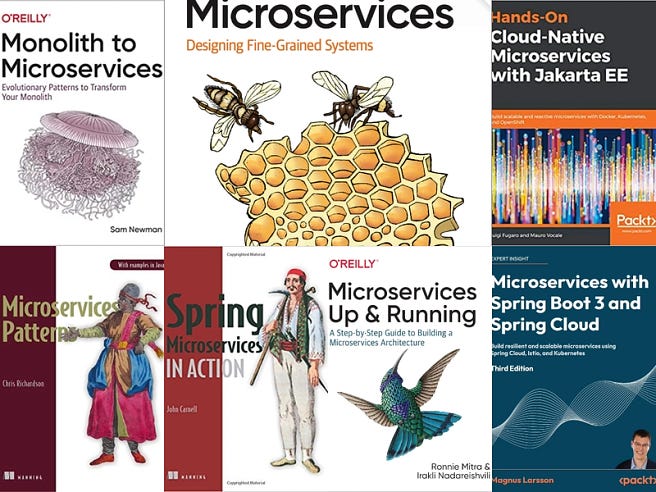
        The Java Microservices Developer's Reading List for 2026 (10 Books That Matter)

        10 Microservices Books Every Developer Should Read

        Hello friends, in last few years, Microservices have become the default architecture for building scalable, cloud-native applications. From startups to enterprises, teams are moving away from monoliths to distributed systems that are easier to scale, deploy, and evolve.

        But microservices are also complex. Concepts like service boundaries, distributed transactions, observability, and event-driven communication can be difficult to master without strong fundamentals.

        That’s where good books still shine. While courses and tutorials are helpful, books provide deeper explanations, real-world case studies, and architectural thinking that short-form content often misses.

        In this article, I’ve curated 10 of the best microservices books that every developer, architect, and backend engineer should read to truly understand modern distributed systems.

        1. Building Microservices: Designing Fine-Grained Systems — Sam Newman

        This is widely considered the definitive introduction to microservices. Sam Newman explains not only how to build microservices, but also when not to.

        The book covers:

        • Service decomposition strategies
        • Deployment and testing approaches
        • Monitoring, logging, and scaling
        • Trade-offs between microservices and monoliths

        If you read only one book on microservices, start with this one.

        Here is the link to get this book: Building Microservices: Designing Fine-Grained Systems

        2. Microservices Patterns — Chris Richardson

        Once you understand the basics, this book takes you deeper into production-grade patterns like:

        • Saga pattern
        • API Gateway
        • Circuit Breaker
        • Event sourcing and CQRS

        It’s one of the most practical resources for solving real distributed system problems.

        If you want an interactive companion, I found Grokking Microservices Design Patterns particularly useful.

        3. Production-Ready Microservices — Susan Fowler

        Many books explain architecture, but this one focuses on operating microservices in production — something that’s often overlooked.

        You’ll learn:

        • Service monitoring and alerting
        • Failure handling and resiliency
        • Deployment pipelines and scaling
        • Incident response and operational maturity

        If you’re moving toward a tech lead or platform engineering role, this book is essential.

        Here is the link to get this book: Production-Ready Microservices

        4. Monolith to Microservices — Sam Newman

        Most real-world systems start as monoliths. This book provides a practical roadmap for migrating safely using:

        • Strangler pattern
        • Incremental refactoring
        • Data migration strategies
        • Versioning and backward compatibility

        This is a must-read if you’re working on legacy modernization.

        Here is the link to get this book — Monolith to Microservices

        5. Building Event-Driven Microservices — Adam Bellemare

        Modern microservices increasingly rely on event-driven architecture. This book explains:

        • Event streaming and pub/sub
        • Kafka vs RabbitMQ trade-offs
        • Event sourcing and data consistency
        • Designing scalable real-time systems

        If your system needs asynchronous processing and high scalability, this book is invaluable.

        Here is the link to get this book — Building Event-Driven Microservices

        6. Microservices in Action — Morgan Bruce & Paulo Pereira

        This is a very hands-on book focused on building microservices with:

        • Spring Boot
        • Docker
        • Kubernetes
        • REST and messaging systems

        For Java developers, this is one of the best practical implementation guides.

        You can also pair it with Design Microservices Architecture with Patterns & Principles for hands-on learning.

        7. Domain-Driven Design — Eric Evans

        Even though this book isn’t specifically about microservices, it introduced concepts like:

        • Bounded contexts
        • Aggregates
        • Ubiquitous language

        These ideas are fundamental to designing well-structured microservices. It’s dense, but incredibly influential.

        Here is the link to get this book — Domain-Driven Design

        8. Implementing Domain-Driven Design — Vaughn Vernon

        If Eric Evans’ book explains the theory, this one shows how to apply DDD in real projects and microservice architectures.

        It’s especially useful for architects designing service boundaries and domain models.

        Here is the link to get this book — Implementing Domain-Driven Design

        9. Architecture Patterns with Python — Harry Percival & Bob Gregory

        For Python developers, this book is a gem. It combines:

        • Domain-driven design
        • Test-driven development
        • Event-driven microservices

        It’s one of the few resources that shows how to implement clean architecture patterns in Python microservices.

        Here is the link to get this book — Architecture Patterns with Python

        10. Microservices: Up and Running — Ronnie Mitra & Irakli Nadareishvili

        If you’re completely new to microservices and want a step-by-step introduction, this is one of the most beginner-friendly books available.

        It explains:

        • Core architecture concepts
        • Communication patterns
        • Deployment and security basics

        You can combine it with the Master Microservices with SpringBoot, Docker, Kubernetes for hands-on practice.

        Final Thoughts

        That’s all on the best books Java Developers can read to learn Microservices architecture in 2026. Microservices are powerful, but they introduce challenges around data consistency, network latency, observability, and operational complexity.

        The books above provide the depth and practical insights needed to navigate these challenges confidently.

        If you’re serious about becoming a strong backend engineer or software architect, these books will help you build the mental models required to design reliable, scalable distributed systems.

        If you enjoyed this list, you may also like: