I Found a Perfect Book to Learn Object Oriented Design and Its Awesome

Image

Hello folks, If you’re gearing up for coding and design interviews, I’ve got something valuable to share. The Object-Oriented Design Interview: An Insider’s Guide by Alex Xu and ByteByteGo has just hit the shelves, and it’s already creating a buzz in the tech interview prep space.

In this post, I’ll break down what’s inside this book, why it’s different, and why I believe it’s a must-read for software engineers preparing for interviews at top companies.

Let’s dive in.

Why Object-Oriented Design Matters in Interviews

Before we get into the book itself, let’s talk about why object-oriented design (OOD) skills are so critical in today’s software engineering interviews.

When you’re interviewing at companies like Google, Amazon, Meta, or any product-based firm, you’ll notice that system design and object-oriented design questions form a significant chunk of the interview rounds.

Why? Because writing clean, scalable, and maintainable code isn’t just about knowing syntax or solving algorithms. It’s about designing systems that can grow, adapt, and stay robust under pressure.

Object-oriented design interviews test how you structure your code, break down complex requirements, model real-world entities, and think through edge cases.

A solid grasp of OOD shows that you can handle large-scale software development — not just coding puzzles.

About the Authors: Alex Xu and ByteByteGo

If you’ve prepped for system design interviews before, chances are you’ve heard of Alex Xu. He’s the author behind System Design Interview: An Insider’s Guide, volumes 1 and 2 — books that many engineers swear by.

ByteByteGo, the platform co-founded by Xu, is dedicated to simplifying complex tech concepts with clean visuals and explanations.

Together, they’ve released several bestsellers, including:

Their new book, Object-Oriented Design Interview, follows the same philosophy: simplify, explain, and make it actionable.

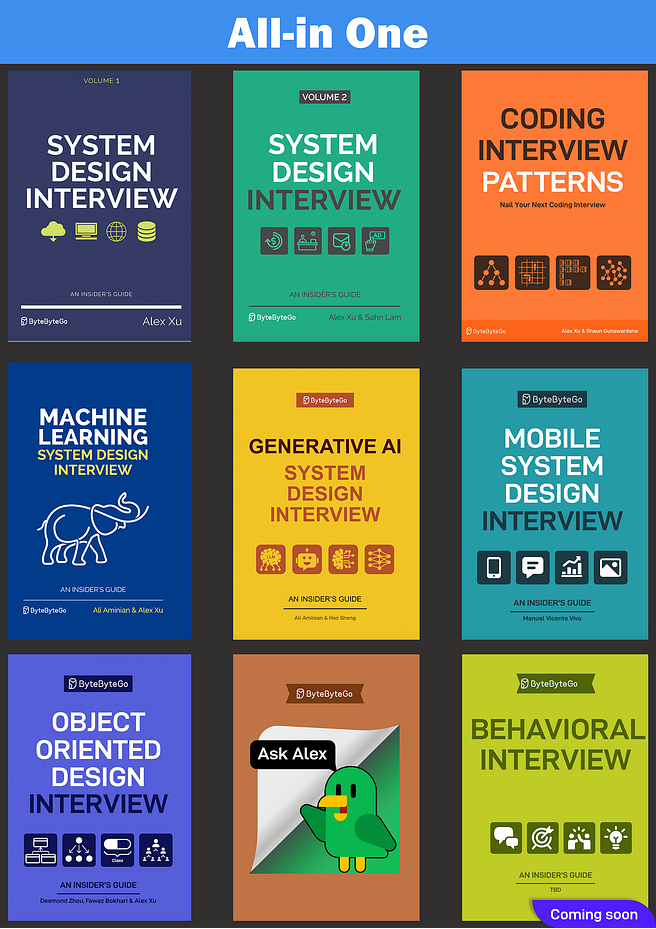
A good thing is that now you can read all of their books in ByteByteGo, one single place as they have now added all of their books into this platform.
Image

What’s Inside the Book? A Closer Look

This book isn’t just another collection of practice questions. It’s a guided tour of what OOD interviews are really about. Let’s break down its key features:

An Insider’s Framework

The book introduces a simple yet powerful 4-step framework for tackling any OOD interview question:

  1. Understand the problem and clarify requirements.
  2. Identify the core objects and relationships.
  3. Design the interactions between objects.
  4. Refine the design and consider edge cases.

This structure gives you a repeatable way to approach design questions, rather than fumbling through with ad-hoc solutions.

11 Real OOD Interview Problems

The book covers practical, frequently asked questions. Some examples:

  • Parking Lot System
  • Movie Ticket Booking System
  • Vending Machine System
  • Elevator System
  • ATM (Automated Teller Machine)
  • Restaurant Management System
  • Shipping Locker System
  • Tic-Tac-Toe and Blackjack (game design questions that often trip up candidates)

For each, you get a full walkthrough of the design process, trade-offs considered, and clean diagrams that show how it all fits together.

133 Diagrams

ByteByteGo’s strength has always been their visuals. This book includes over 130 detailed diagrams to illustrate architectures, class relationships, workflows, and more.

These aren’t just pretty pictures — they help you really see the design, which is critical in OOD.

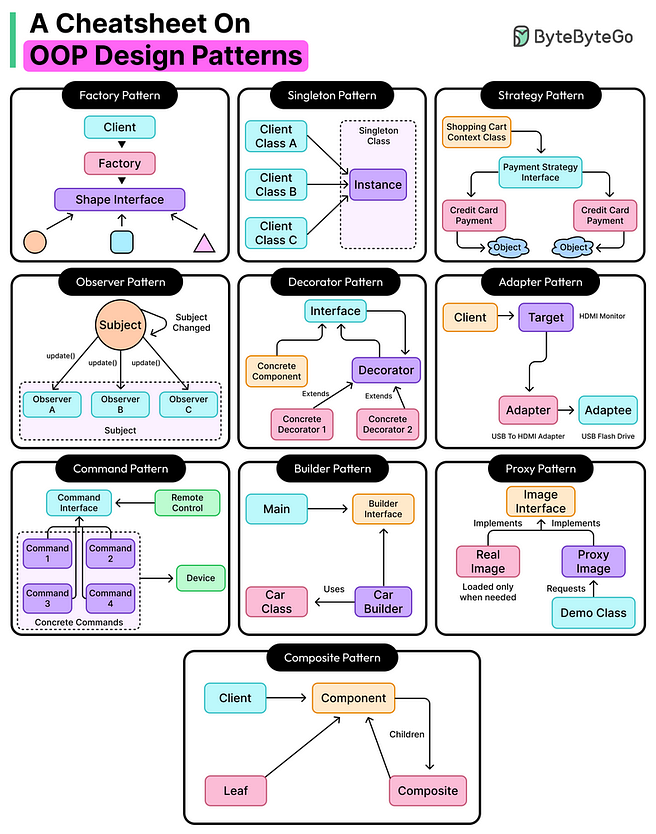
Here is one such diagram about OOP Design patterns to give you an idea of what to expect
Image

Strong Focus on Fundamentals

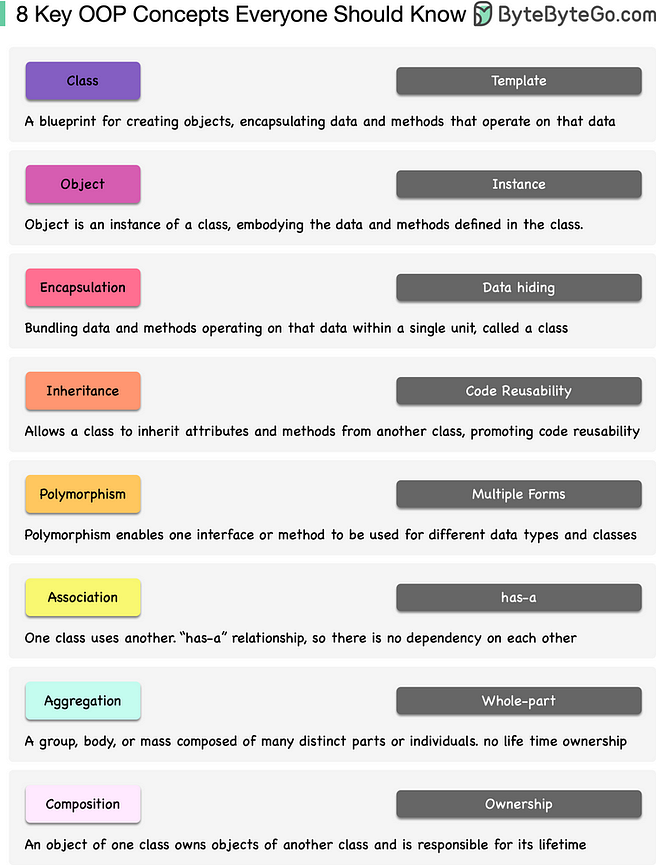
One of the first chapters is a no-nonsense recap of object-oriented programming principles: abstraction, encapsulation, inheritance, and polymorphism.

These are the building blocks that you’ll apply again and again in interview scenarios.

Here are 8 key OOP Concepts every developer should learn from ByteByteGo
Image

Who Should Read This Book?

If you’re:

  • Preparing for software engineering interviews (especially at product-based companies),
  • Brushing up on system and object design before moving to a senior role,
  • Looking to move beyond just coding problems to larger design challenges,

then this book is for you.

It doesn’t assume you’re an expert designer already. In fact, if you’ve ever felt overwhelmed by OOD questions, this book helps you break them down into manageable parts.

How Does It Compare to Other Resources?

There are plenty of interview prep books out there. What sets Object-Oriented Design Interview apart is its blend of clarity, practicality, and focus on how to think.

Many books either:

  • Stay too theoretical, or
  • Give solutions without showing the thinking process.

This one strikes the right balance. It’s less about memorizing patterns and more about learning to reason like a designer — which is what interviewers actually want to see.

And of course, those diagrams make a big difference.

Here is the link to get this bookObject-Oriented Design Interview

The print edition is already live on Amazon. The digital version will be available on the ByteByteGo site in a week or two. If you’re in India, the print edition should reach local Amazon stores soon.

Other Books by Alex Xu You Should Know About

If this is your first exposure to ByteByteGo’s work, check out these related titles:

Together, these books form a powerful toolkit for any serious interview candidate.

Final Thoughts: Is This Book Worth It?

In my view, absolutely. Object-Oriented Design Interview: An Insider’s Guide fills a real gap in the interview prep world. OOD interviews are tricky because they sit between pure coding and high-level architecture.

This book helps you navigate that space without getting lost in jargon or over-complication.

The 4-step framework alone makes the book worth reading, but the real value comes from seeing it applied in example after example.

By the time you’re done, you’ll not just know how to design a parking lot system or a vending machine — you’ll know how to approach any OOD problem with confidence.

If you’re aiming for roles at companies where design skills matter, or if you simply want to level up as an engineer, I highly recommend adding this to your prep stack.

I hope this review helps you decide if ByteByteGo fits your coding interview preparation plan! and if you want, you can check out ByteByteGo here: ByteByteGo Platform

Other System Design Tutorials and Resources you may like

All the best for your System Design Interviews, if you have any doubts or questions, feel free to ask in the comments.

P. S. — If you just want to do one thing at this moment, go join ByteByteGo and start learning System Design and Coding Interview concepts, you will thank me later. Make it a goal for the new year and you will surely be a better Software Engineer.

    Top 6 Free Object-Oriented Programming Courses for Java Programmers in 2025 [UPDATED]

    The OOP or Object Oriented Programming paradigm allows you to write a program by modeling real-world things in terms of class and object. It makes representing a real-world thing in the programming world smoother and will enable you to manage the complexity of your program. Even though several programming paradigms, like procedural and functional, most of the code we write today is object-oriented. Some of the most popular programming languages are object-oriented, like Java, Python, PHP, and JavaScript, all supported object-oriented programming.

    10 Essential Object Oriented Concepts for Java Developers

    Hello friends, I have written several OOP (Object Oriented Programming) concepts tutorials in past and I was thinking to bring them together so that anyone who wants to learn OOP basics can benefit from them easily. In this article, I will share with you my collection of OOP tutorials and OOP concepts interview questions, which will not only help you to understand four pillars of Object-Oriented programming like Abstraction, Encapsulation, Inheritance, and Polymorphism but also powerful design techniques of Aggregation, Association, and Composition, along with SOLID design principles, which are key to write flexible, extensible and object-oriented software. 

    Top 30 OOP (Object Oriented Programming) Interview Questions Answers in Java

    Java is an object-oriented programming language and you will see a lot of object-oriented programming concept questions in Java interviews. The classic questions like the difference between an interface and abstract class are always there but from the last couple of years more sophisticated questions based upon advanced design principles and patterns are also asked to check the OOP knowledge of the candidate. Though, Object-oriented programming questions are more popular on Java interviews for 1 to 3 years experienced programmers. 

    Top 5 Courses to learn UML for Software Design and Development in 2025 - Best of Lot

    Hello friends, we are here again today for another exciting topic to discuss. But, today we are not gonna discuss something which is related to Java or any other language or spring boot. Today we are gonna discuss something which is immensely practical and very important skill if you want to grow as programmer and become a tech lead or Software architecture. Yes, you guessed it right, today we are going to talk about UML (Unified Modeling Language). Modeling is a process to communicate your design which is in your mind to other people in your team like developers, architect via diagram. This is one of the most important skill if you want to become Software architect in 2025

    Difference between Static and Dynamic binding in Java

    Hello guys, if you are wondering what is difference between static and dynamic binding and how it affect your program execution in Java then you are at right place. When you call a method in Java, it is resolved either at compile time or at runtime, depending upon whether it's a virtual method or a static method. When a method call is resolved at compile time, it is known as static binding, while if method invocation is resolved at runtime, it is known as Dynamic binding or Late binding. Since Java is an object-oriented programming language and by virtue of that it supports Polymorphism. Because of polymorphism, a reference variable of type Parent can hold an object of type Child, which extends Parent.

    Can You Override static method in Java? Method Hiding Example

    Can we override the static method in Java?
    This is one of the most popular Java interview questions. The answer to this question is No, you cannot override the static method in Java because the method overriding is based upon dynamic binding at runtime and static methods are bonded using static binding at compile time. This means static methods are resolved even before objects are created, that's why it's not possible to override static methods in Java. Though you can declare a method with the same name and method signature in the subclass which does look like you can override static methods in Java but in reality that is method hiding. 

    Polymorphism and Open Closed Design Principle Example in Java

    Java is an object-oriented programming language that allows developers to create complex software applications by organizing code into objects. One of the key features of object-oriented programming is Polymorphism. Polymorphism refers to the ability of objects to take on different forms, depending on the context in which they are used. In Java, polymorphism is achieved through two mechanisms: inheritance and interfaces. In this blog post, I will explain what polymorphism is in Java, how it works, and provide examples to illustrate its usage. We will also discuss the benefits of using polymorphism in your Java programs, as well as some best practices for implementing it effectively.

    Difference between Method and Constructor in Java and OOP? Example

    What is the difference between method and constructor in Java is a very common question in beginner-level Java interviews with 2 to 3-year experience. Since the constructor is kind of special and it has its own properties that separate it from any normal Java method, this question makes sense. The main difference between a Constructor and a Method is that you need to call the method explicitly but the constructor is called implicitly by the Java programming language during object instantiation. This is one of the special properties of constructors in Java and that's why all the object initialization code is put inside the constructor. 

    What is static in Java? Example Tutorial

    What is static in Java
    Static in Java is related to class if a field is static means it belongs to the class, similarly static method belongs to classes and you can access both static method and field using the class name, for example,  if count field is static in Counter class than you can access it as Counter.count, of course, subject to restriction applied by access modifier like private fields are only accessible in class on which they are declared, protected fields are accessible to all classes in the same package but only accessible in subclass outside the package, you can further see private vs protected vs public for complete details on access modifier. 

    Can you make an Abstract Class or Method Final in Java? Example

    No, you cannot make an abstract class or method final in Java because the abstract and final are mutually exclusive concepts. An abstract class is incomplete and can only be instantiated by extending a concrete class and implementing all abstract methods, while a final class is considered complete and cannot be extended further. This means when you make an abstract class final, it cannot be extended hence it cannot be used and that's why the Java compiler throws a compile-time error when you try to make an abstract class final in Java. In short, an abstract class cannot be final in Java, using both abstract and final modifiers with a class is illegal in Java. 

    What is Variable and Method Hiding in Java - Example Tutorial

    If Java, if you are not careful you can possibly hide both methods and variables of the superclass. Now you must be wondering what does it mean by hiding a variable or method in Java? A field or variable is said to hide all fields with the same name in superclasses. Similarly, a static method with the same name in a subclass can hide the method of the superclass. This can lead to subtle bugs, especially if you are expecting a different method to be called. In this article, I'll show you examples of both variables and methods hiding in Java so that you can understand and avoid them in the future. Earlier, I also wrote about difference between overloading, overriding, shadowing, and hiding, it's a comprehensive post and I suggest you to read it as well if you haven't read already.  It will help you to understand these concepts in more detail. 

    Difference between Abstract class and Interface in Java 8? Answer

    Ever since JDK 8 has allowed concrete (non-abstract) methods on the interface like default and static methods, many of my readers have asked me how should they answer the classical abstract class vs interface questions. Earlier, an interface cannot have any concrete methods and that was the main difference between abstract class and interface but now that is not the case. In this post, I'll revisit this hugely popular Java interview question in light of Java 8 changes. This is also a popular Java interview question and knowing the difference will help you to answer this question in a real interview.

    Java Interface Example Tutorial

    Hello guys, if you are wondering what Java interface is and how to do your user interface in Java, you have come to the right place. Earlier, I have written about the actual use of the interface in Java, and in this article, I will give you an example of an interface in Java. I will also explain what an interface is and how and where you should use it. An interface is nothing but a name. As Joshua Bloch advised in the Effective Java book, the interface is great for declaring type. So, if you want to declare your own type like Employee, Order, Listener, etc., you can use the interface. 

    How Constructor Chaining works in Java - Example

    How to call one constructor from another constructor in Java or What is Constructor Chaining in Java is one of the tricky questions in Java interviews. Well, you can use this keyword to call one constructor from another constructor of the same class if you want to call a constructor from a based class or super class then you can use the super keyword. Calling one constructor from another is called Constructor chaining in Java. Constructors can call each other automatically or explicitly using this() and super() keywords. this() denotes a no-argument constructor of the same class and super() denotes a no argument or default constructor of the parent class. Also having multiple constructors in the same class is known as constructor overloading in Java.