Image

A 3D Rasterizer For Embedded Devices

Once upon a time, doing graphics on a microcontroller was challenging, to say nothing of the concept of going into three dimensions. But modern microcontrollers are far more powerful, and you might find yourself wanting to do all sorts of graphical wizardry with one. To that end, you might find Jet useful.

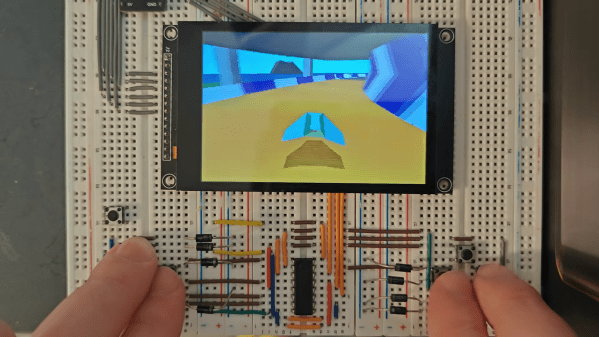
Created by [CubeCoders], Jet is a compact 3D rasterizer built for modern chips like the ESP32 and STM32. It’s dependency free, relatively tiny, and is written in C++17 with an eye towards working well on memory-limited platforms. It runs entirely in software, uses only integer arithmetic, and is built around 16-bit RGB565 color — intended to make it easy to use with parts like the ST7796, ILI9488, and other similar displays interfaced via SPI.

As a point of reference, on a ESP32-S3 Jet can render around 650 on-screen triangles (post-culling) at 60 frames per second on a 480×320 display, or 1300 triangles at 30 FPS. The developers note that 3D performance lands somewhere between the Sega 32X and Sega Saturn — not bad for a microcontroller you can buy for under $20. The Wipeout-like demo shows off the capabilities of Jet rather fantastically, we think.

You’d be foolish to expect your next microcontroller project to render Crysis. However, if you want some retro 3D graphics for your next ESP32-based build, you might just consider exploring what Jet can do for you.

Continue reading “A 3D Rasterizer For Embedded Devices”

Image

Adding Portals To Quake

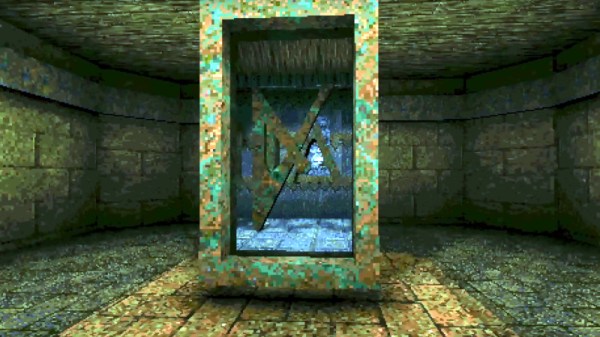
For those who have played Quake extensively, adding portals seems unnecessary, as teleporters are already a core part of the game mechanics. What [Matthew Earl] accomplishes is more of the Portal style of portal by rendering what is on the other side of the portal with a seamless teleportation transition.

Of course, Quake is an old game with a software renderer. Just throwing another camera into the scene, rendering to another texture, and then mapping that texture to the scene isn’t an option. Quake uses an edge rasterizer and generates spans along scanlines that track where edges intersect the current scanline. Rather than making expensive per-pixel comparisons, [Matt] stashes the portal spans and renders them in a second render, so even with multiple portals, only a single screen’s worth of pixels are rendered.

However, this technique has no near clipping plane, which means objects can appear in the portal that don’t make any sense as they are in front of the portal’s viewpoint. Luckily, Quake has an ingenious method for polygon occlusion: the BSP. While [Matt] is manually checking polygons, the BSP is the perfect tool for bisecting a room along a plane. It’s an incredible hack, and we’re excited to see Quake expand into a puzzle game. [Matt] dives into greater detail on how the software renderer works in another video that’s well worth a watch.

Perhaps the most incredible aspect of this technique is that it could run on original hardware. If you want to bring a little more Quake to life, why not get the Quake light flicker in your house? Video after the break.

Continue reading “Adding Portals To Quake”