If you’re in motorsport, or maritime, or mining fields, you can always call on a technician to come down and fix something when it’s broken. You can lay hands on the parts, reconfigure things, make repairs, and get something working again. In space, that’s seldom possible. If you’re lucky enough to have a manned mission, you might be able to make some running repairs; if you’re working with an unmanned robot, probe, or satellite, your options are altogether more limited. If you can’t find a fix, it’s game over—a particularly brutal result when huge budgets and years of work are on the line.
Janelle Wellons came down to Hackaday Europe to talk about space. More particularly, the engineering and debugging operations that keep all sorts of space programs alive. Her talk dives into some of the creative solutions engineers have had to come up with to save million-dollar missions from becoming unrecoverable boondoggles.
After the Orion capsule of the Artemis I lunar mission returned to Earth, it was found that massive chunks of its heatshield had been ripped off, posing a serious risk to any future missions. In a recent video in which [polymatt] takes a break from repairing old laptop shells and the like, he tries to recreate the Orion’s heatshield using a variety of methods and materials.
For this test a number of samples were created, each using the same kind of segmented structure as the larger Orion heatshield. The filler was created from the published materials for the heat shield by NASA, requiring just serious mixing.
The resulting samples were then cured with thermocouples inserted, before they got blasted with the heat from a propane torch, trying to simulate the various re-entry patterns.
Perhaps unsurprisingly, the results matched the findings by NASA for why the Orion’s heat shield had failed, being the build-up of gases due to the sustained pyrolysis processes that eventually fractured the material. Despite some experimental flaws that injected residual heat from the copper structure, this still seems to be a pretty good setup to test ablative heat shields in DIY lab conditions.
The history of European space exploration is a long and distinguished one, with many decades and whole families of launch vehicles. It might therefore come as a surprise that despite all this, it’s taken until 2026 for a European rocket to be launched into orbit from European soil rather than from somewhere close to the Equator. The German company Isar Aerospace launched one of their Spectrum rockets from Andøya Space in Norway and deployed its CubeSat payloads to orbit.
The five satellites were a selection of projects from the German space agency’s Microlauncher Competition, which offers the chance of a launch to start-ups and educational institutions. The press release doesn’t name them, but Wikipedia has the following list: TriSat-S (University of Maribor and SkyLabs); FramSat-1 (NTNU SpaceTeam); Sat1 (TU Wien Space Team); CyBEEsat (TU Berlin); Platform 6 (EnduroSat) and Let It Go (experiment, Dcubed).[46].
Interestingly, the company is also working on a space launch facility in Nova Scotia, Canada, to gain access to lower inclination orbits and to provide Canadians with their own launch capability. More is evidently yet to come.
In ecology, there used to be a concept — now largely unfashionable — that species could be described as r- or K-selected, depending on how they treat their offspring. An elephant that has one calf every few years and devotes immense resources to them is adopting a K-selection strategy — much as NASA traditionally has to its flagship probes, like Cassini. A sea turtle who leaves hundreds of eggs in a clutch on the beach and leaves without saying “good luck”, content in the knowledge that one of them will probably make it to adulthood is engaging in an r-selected strategy, and it’s this strategy that [Dr. Michael Rubenstein] is proposing for a next-generation mission to Saturn as part of NASA’s Innovative Advanced Concepts Program for 2026. Entitled “Actively Steerable Femtosat Constellations for In-situ Exploration of Saturn’s Rings, Atmosphere, and Magnetosphere”
The concept is pretty simple: the rings are a horrifying mess of dust, debris, and ice bits of all sizes that represent almost certain death for a spacecraft. By launching 10,000 femtosatellites, those odds of almost certain death become an almost certainty that one or more will make it through with precious data. In the immortal words of Lord Farquhar, “Some of you may die, but that is a sacrifice I am willing to make.” With Cassini, NASA would never consider such a sacrifice. With itty-bity femtosatellites, it starts to make sense. We’ve been saying for years that the future of space is tiny, but these sacrificial probes would make even modern cubesats and picosatellites look big.
Thanks to [Richard HT] for the tip! His tip was to a podcast featuring [Dr. Rubenstein] with [Fraser Cain], which we’ve embedded below. It has a lot more details than NASA’s official blurb page.
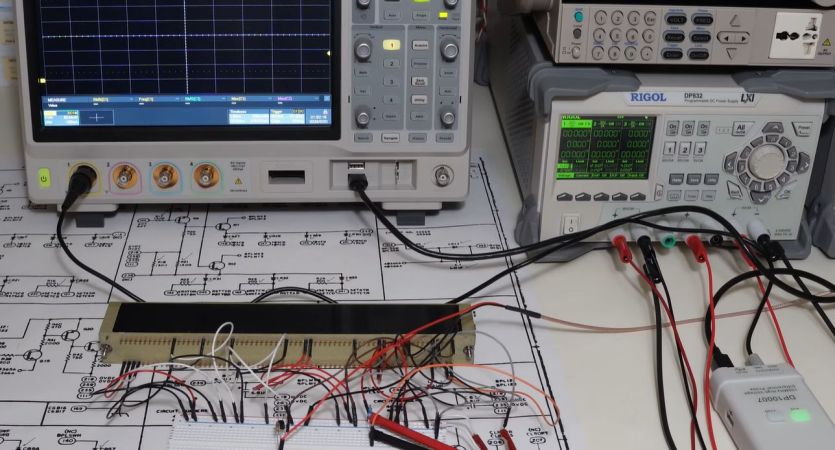
After getting his hands on a rope driver module from the Apollo project era that had a big ‘Scrapped Module’ stamped on it, [Mike Stewart] was naturally left curious as to what exactly had failed in this module. Originally destined for the Apollo Guidance Computer, these Raytheon-manufactured modules were the pinnacle of space-grade high-tech of the 1960s, with requisite acceptance testing so as to not endanger a very expensive space mission.
The cool part here is that the acceptance documents for the module in question (B16-B17) have been scanned in and can be found on the Internet Archive. With the part itself being potted and very much inaccessible, this document helpfully lays out the expected measurements on the module’s pins, as well as schematics and mechanical drawings. Unfortunately the reasons for the rejection were not recorded, so replicating the failing test results is required to understand the reason.
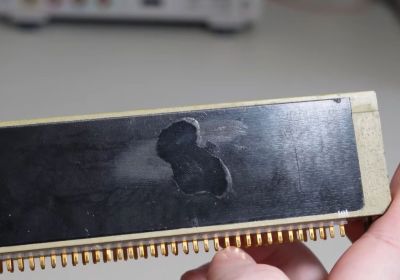
NASA Rope Driver Module with suspicious exploration marks. (Credit: Mike Stewart, YouTube)
A slight complication here is that the testing procedure doesn’t just involve hooking up a multimeter for some voltage and capacitance measurements. There are also temperature and voltage extremes, and vibration tolerance involved, which would be somewhat complex to test, but most of all risk damaging a historical artefact. Thus a somewhat conservative testing procedure was chosen, even if this may not reveal the actual fault.
As noted in the video, sometimes modules were also rejected because someone simply dropped it on the floor along the way. However, generally if a module was found to be faulty they would open it to diagnose said fault, with a closer look at this module indeed revealing suspicious marks in the potting compound where it was apparently opened and conceivably repaired. This also might explain why they also put the ‘For engineering use only’ on it.
With multiple of such locations visible in the potting compound, these locations were mapped to the schematics for the module, to get some idea of what may have been accessed. After this, basic testing was performed on the module, as per the acceptance testing document.
Along the way an error was detected in said document, in the form of the wrong pin number. In table 4-2 the input pin 269 was mistakenly listed as having output pin number 169 when it should have been pin 168. Pin 169 is chassis ground, so this was presumably fixed in a later version of the document.
After all the testing with just stationary, room-temperature conditions, everything appeared to check out. This means that likely this was indeed a repaired module that got subsequently used for engineering purposes rather than installed in flight-ready hardware. The only issue found was that channels were out of calibration, but whether this was an original flaw or due to the module being half a century old is hard to tell in the absence of repair logs.
Overall it’s an exciting opportunity to document another part of history, since so many of the details pertaining to these original modules and related technologies got lost or muddled over the decades.
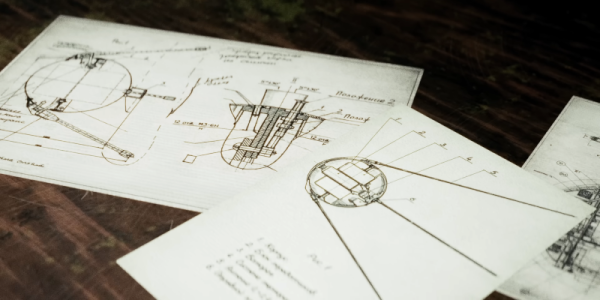
If you are an American of a certain age, you know the Soviet Union launched the first satellite, Sputnik, beating the United States to orbit. You might even remember ham radio operators tuning into the satellites beeping. But you probably haven’t heard much about the team that built the vehicle, the problems they had, or the clever design choices they made. [Hoog] has a video that details the birth of Sputnik. You can see the video below.
The original plan was to launch a massive space lab, but it proved too ambitious. Keep in mind that in the late 1950s, you didn’t have tiny computers, high-density power sources, or advanced materials, and no one really knew what to expect in the Earth orbit environment. Even the viability of radio from the ground to orbit wasn’t a given. But Sputnik’s 1-watt transmitter did the job.
The solar system is kind of hard to observe in motion all at once. Sometimes, it’s nice to have a little model to look at, so you can see the relative motions of celestial bodies play out in front of you. Such a device is called an orrery, and [illusionmanager] has built rather a nice example of their own.
The build represents all the planets in the solar system, plus the sun and our very own Moon. An ESP32 lives at the heart of the build, running an astronomical simulation to calculate the proper positions of all the celestial objects. It then drives a small stepper motor via a TMC2209 driver, turning the mechanism back and forth until all the pieces are positioned correctly, using a reed switch and magnet to detect the initial zero position. The orrery is able to be driven by a single motor in this manner thanks to an ingenious mechanism, wherein the rings interlock with each other using small tabs. The Moon is controlled by a separate geared mechanism connected to the main rotation.
It’ s a nice decoration that also serves as a great conversation piece, particularly if you like talking about the heavens. We’ve featured some fine works from [illusionmanager] before, too, like this exquisite reverse sundial. Video after the break.



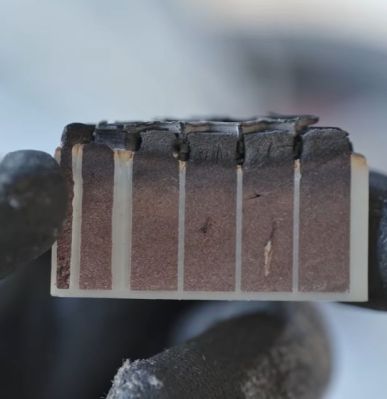 After the Orion capsule of the Artemis I lunar mission returned to Earth, it was found that massive chunks of its heatshield had been ripped off, posing a serious risk to any future missions. In a recent video in which [polymatt] takes a break from repairing old laptop shells and the like, he tries to