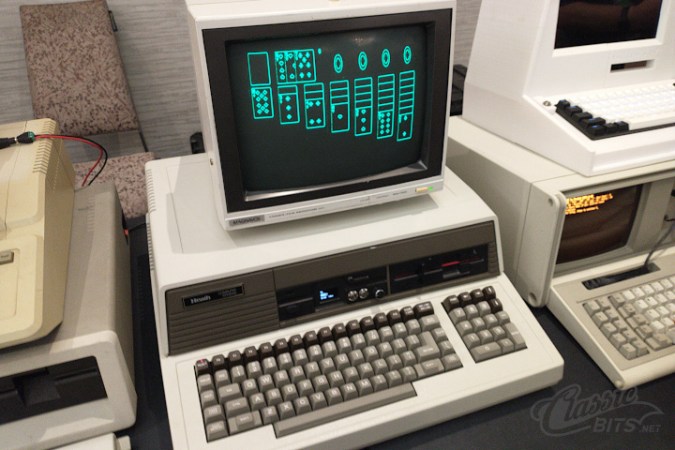
In these days of hundred-gigabyte-and-more monster games, it can be nice to stop and remember what a human can do with assembly language and very, very little storage space. In this case, only 3 KB — yes, three kilobytes — to play TinySol, a tiny solitaire game for DOS that’s compatible with the common CGA/EGA/VGA graphics modes. [ClassicBits] even fits the 640×400 AT&T 6300 mode that was used for some GRiD computers in that 3 KB.
The “full” version is actually 3.5 KB. That extra half kilobyte gets you the ability to load and save games, plus mouse support. The 3 KB version you must play through to the end using only the keyboard, but if you’re hitting this on the minimal-supported-hardware target of the IBM 5150, you probably don’t have a mouse. The smaller build can still score the game, auto-finish, congratulate you on a win, and even automatically detect the correct graphics mode for you. It can also be launched from a QR code, which [LGR] demonstrates in a video embedded below. Check it out for a play demo, but it’s Klondike Solitaire. If you don’t know what to expect by this point, you must not have used a PC in the last 30 years.
Even smaller versions of TinySol are available if you know you’re only going to need, say CGA, but even with 360 KB floppies we’re not sure we’d feel the need to save a kilobyte. If it doesn’t fit on the floppy, just print it onto the sleeve as a QR code, like [ClassicBits] did with the floppies he was giving away at Vintage Computer Festival Southwest 2026. Well, technically that’s the “Tiny” version on the QR code, but we have faith there’s some visual code that could hold the 3 KB “medium” game.
[ClassicBits] takes care to point out that his game is 100% human-written, which is something you cannot guarantee even for retro assembly-language products. We’ve already seen that Claude can code for the Z80, which means the 8088 won’t escape it either. Of course these old machines have a lot to recommend them if you want to escape modernity and learn to code without the help.
Continue reading “3 KB Solitaire Fits In QR-Code, Runs In DOS”