
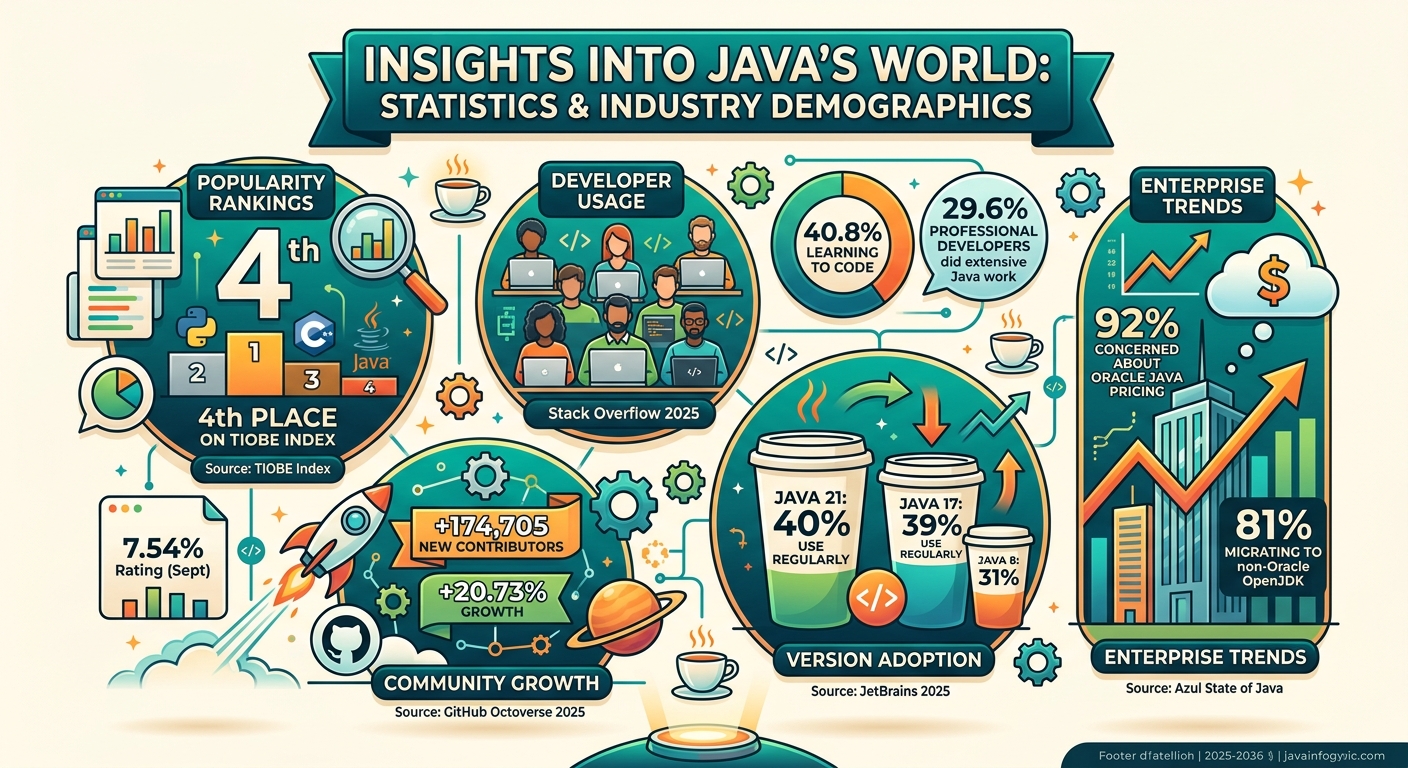
Java holds fourth place on the TIOBE index at 7.54% in September 2026, down 0.81 points from September 2025. On GitHub it picked up 174,705 contributors in the year to August 2025. This brief collects Java language statistics and industry demographics for 2026 across rankings, version adoption, developer profiles, enterprise licensing and tooling, each labelled with its source and period.
Java Language Statistics And Industry Demographics 2026
Where Java Ranks In The 2026 TIOBE Index
TIOBE builds its rating from search engine hit counts across more than 20 websites. It measures search visibility, not users, installs or lines of code.
Java has sat in fourth place for two consecutive Septembers. TIOBE’s 12-month average positions put Java at rank 1 in 2006, 2011 and 2016, rank 2 in 2021, and rank 4 in 2026.
| Language | Rank (Sep 2026) | Rating | Change vs Sep 2025 |
|---|---|---|---|
| Python | 1 | 17.76% | -8.22 |
| C | 2 | 10.28% | +1.63 |
| C++ | 3 | 8.67% | -0.13 |
| Java | 4 | 7.54% | -0.81 |
| C# | 5 | 4.22% | -2.16 |
| JavaScript | 6 | 2.76% | -0.46 |
Source: TIOBE Index, September 2026
The same index gives JavaScript 2.76% in September 2026, a gap worth reading alongside the 2026 JavaScript usage and demographics data.
How Many Developers Use Java? Survey Share By Group
The Stack Overflow Developer Survey 2025 is opt-in and drew more than 49,000 responses from 177 countries. Respondents could select several languages, so the shares overlap rather than divide a whole.
Java sits at 29.4% among all respondents and 29.6% among professional developers. It climbs to 40.8% among people learning to code.
| Respondent group | Did extensive Java work, past year | Responses to the question |
|---|---|---|
| All respondents | 29.4% | 31,771 |
| Professional developers | 29.6% | 24,759 |
| Learning to code | 40.8% | 2,564 |
| Professionals that use AI | 30.2% | 20,810 |
| Learners that use AI | 42.5% | 1,945 |
Source: Stack Overflow Developer Survey 2025, survey year 2025
Sentiment runs lower than usage. In the same survey, 41.8% of respondents who used Java want to keep using it, and 15.8% of all respondents want to work in it next year.
Java Language Statistics On GitHub
GitHub ranks languages by distinct monthly contributors. Octoverse 2025 covers 1 September 2024 through 31 August 2025, and compares August 2025 against August 2024.
Java finished fourth by contributor gain, adding 174,705 contributors at 20.73% growth. C# added 136,735 at 22.22%.
| Language | Contributor gain | Growth, Aug 2024 to Aug 2025 |
|---|---|---|
| TypeScript | 1,054,015 | 66.63% |
| Python | 850,579 | 48.78% |
| JavaScript | 427,148 | 24.79% |
| Java | 174,705 | 20.73% |
| C# | 136,735 | 22.22% |
Source: GitHub Octoverse 2025, August 2024 to August 2025
New repository counts tell a slower story. Java was the primary language in 3,520,215 repositories created between September 2024 and August 2025, growing 9.35% against the same eight-month window a year earlier.
GitHub also reports that nearly 80% of new repositories used six languages: Python, JavaScript, TypeScript, Java, C++ and C#. That concentration shows up across wider web coding statistics for 2026 as well.
Source: GitHub Octoverse 2025, September 2024 to August 2025
Java Version Adoption In 2026
JetBrains asked which Java versions respondents use regularly. The question allows multiple selections, so the figures overlap and cannot be added together.
Java 21 leads at 40%, with Java 17 close behind at 39%. Java 8, released in March 2014, is still used regularly by 31% of respondents.
| Java version | 2024 | 2025 |
|---|---|---|
| Java 21 | 28% | 40% |
| Java 17 | 46% | 39% |
| Java 8 | 44% | 31% |
| Java 11 | 25% | 17% |
| Java 24 | – | 14% |
| Java 23 | – | 9% |
| Java 22 | 12% | 7% |
| Java 18 | 7% | 7% |
Source: JetBrains State of Java 2025, Developer Ecosystem Survey 2025 (fielded April to June 2025)
The long view shows Java 8 falling from 83% of respondents in 2019 to 31% in 2025.
Java Developer Demographics: Age, Country And Experience
The JetBrains Java report draws on more than 5,000 Java developers inside the 2025 Developer Ecosystem Survey, which collected 24,534 responses from 194 countries.
Respondents aged 25 to 29 form the largest single group at 25%. Developers under 25 account for 24% combined across the 18–20 and 21–24 bands.
China Mainland supplies 37% of Java respondents and India 14%. Options below 1% were merged into “Other” by the source.
Experience skews mid-career. A quarter of respondents report 6–10 years of professional coding, 24% report 3–5 years, and 14% report 16 or more.
| Years of professional coding | Share of Java respondents |
|---|---|
| Less than 1 year | 7% |
| 1–2 years | 14% |
| 3–5 years | 24% |
| 6–10 years | 25% |
| 11–15 years | 13% |
| 16+ years | 14% |
| No professional coding experience | 3% |
Source: JetBrains State of Java 2025, survey year 2025
Among respondents who switched to Java, 29% named Python as their previous main language, followed by JavaScript at 11% and TypeScript and Go at 10% each.
Java Industry Demographics In The Enterprise
Azul’s 2026 State of Java Survey was administered by Dimensional Research and completed by 2,039 qualified respondents across five continents, all with direct or managerial Java responsibility. Respondents received token compensation.
Oracle licensing dominates the findings. Cost is the top migration driver at 37%, and 21% of respondents say they have already been through an Oracle Java audit.
| Finding | Share of respondents |
|---|---|
| Concerned about Oracle Java pricing | 92% |
| Migrating at least part of Oracle Java to non-Oracle OpenJDK | 81% |
| Intend to migrate their entire Java estate | 63% |
| Use Java to code AI functionality | 62% |
| Say dead or unused code affects team productivity | 63% |
| Handle Java-related CVEs daily or weekly | 56% |
| Already subjected to an Oracle Java audit | 21% |
Source: Azul 2026 State of Java Survey & Report, published February 2026
The AI figure moved fastest. Azul reports 62% of organizations using Java to code AI functionality in 2026, against 50% in the 2025 edition, and 31% say more than half the Java applications they build now contain AI functionality. Adoption patterns across the wider developer base appear in 2026 vibe coding adoption figures.
Java Support Timeline And Licensing Dates
Oracle designates a long-term-support release every two years. JDK 25 shipped in September 2025; JDK 26, a non-LTS release, shipped in March 2026.
Premier support for Java 17 runs to September 2026. Updates to JDK 21 released after September 2026 are planned to move to the Java SE OTN license.
| Release | GA date | Premier support until | Extended support until |
|---|---|---|---|
| 8 (LTS) | March 2014 | March 2022 | December 2030 |
| 11 (LTS) | September 2018 | September 2023 | January 2032 |
| 17 (LTS) | September 2021 | September 2026 | September 2029 |
| 21 (LTS) | September 2023 | September 2028 | September 2031 |
| 25 (LTS) | September 2025 | September 2030 | September 2033 |
| 29 (LTS, planned) | September 2027 | September 2032 | September 2035 |
Source: Oracle Java SE Support Roadmap, updated 4 August 2026
Which Java Frameworks And Tools Lead In 2026?
JetBrains puts Spring at 65% of Java respondents and Maven at 67%, the most used build system in its 2025 survey. IntelliJ IDEA is the main Java IDE for 72% of respondents.
Stack Overflow measures a different population. Among its professional developers in 2025, Spring Boot reached 15.6%, Maven 16.9% and Gradle 14.8%. The two surveys are not comparable to each other.
Sources: JetBrains State of Java 2025, survey year 2025; Stack Overflow Developer Survey 2025, survey year 2025
On AI tooling, JetBrains records ChatGPT apps at 40% of Java respondents and GitHub Copilot at 29%, with 12% already using AI coding agents. Comparable numbers for other server-side stacks appear in the 2026 PHP demographics brief and across other language statistics roundups.
FAQs
Is Java still popular in 2026?
Java ranks fourth on the TIOBE index at 7.54% in September 2026. It also reached 29.4% of Stack Overflow 2025 respondents and added 174,705 GitHub contributors in the year to August 2025.
What percentage of developers use Java?
29.4% of all Stack Overflow 2025 respondents and 29.6% of professional developers did extensive Java work in the past year. Among people learning to code, the share reaches 40.8%.
Why do Reddit threads still argue about Java 8?
31% of JetBrains 2025 Java respondents still use Java 8 regularly, twelve years after its March 2014 release. Reddit reached 53.7% of Stack Overflow 2025 respondents as a community platform.
Which Java version is used most?
Java 21 leads JetBrains 2025 at 40% of Java respondents, with Java 17 at 39% and Java 8 at 31%. Respondents could select several versions, so the shares overlap.
Are companies moving off Oracle Java?
81% of Azul’s 2,039 respondents have migrated, are migrating, or plan to migrate at least part of their Oracle Java to non-Oracle OpenJDK. 63% intend to move their entire estate.
Sources
https://www.tiobe.com/tiobe-index/
https://survey.stackoverflow.co/2025/technology
https://lp.jetbrains.com/the-state-of-java-2025/
https://www.oracle.com/java/technologies/java-se-support-roadmap.html

