
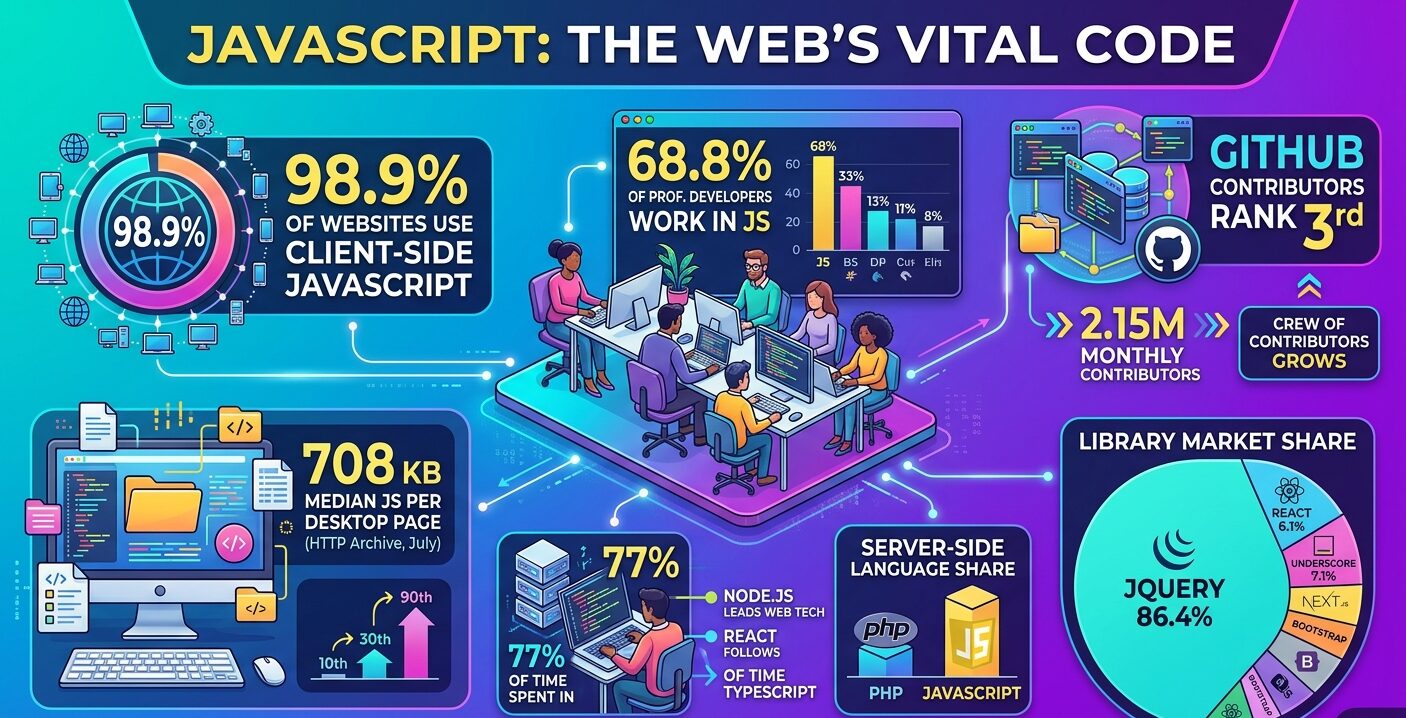
JavaScript runs as a client-side language on 98.9% of all websites, per W3Techs’ 8 September 2026 crawl. On the TIOBE index for the same month it holds 2.76% and ranks sixth. Both numbers are accurate because they measure different things. This page collects verified JavaScript statistics across deployment, developer usage, GitHub contributors, library share and page payload.
JavaScript Statistics
How Many Websites Use JavaScript?
W3Techs detects JavaScript as a client-side language on 98.9% of all websites it tracks, measured on 8 September 2026. That figure is a share of every site in the survey.
Server-side JavaScript is counted against a narrower base: 7.2% of websites whose server-side language W3Techs can identify. The two percentages do not share a denominator and should not be read as parts of one total.
On 27 July 2026, W3Techs recorded JavaScript passing Ruby to become the second-most used server-side language on the web, behind PHP.
| Server-side language | Share of sites with a known server-side language |
|---|---|
| PHP | 70.2% |
| JavaScript | 7.2% |
| Ruby | 7.0% |
| Java | 5.5% |
| Scala | 5.1% |
| ASP.NET | 4.2% |
| static files | 2.1% |
| Python | 1.2% |
Source: W3Techs, server-side programming languages survey, 8 September 2026. A website may use more than one server-side language. W3Techs states that its JavaScript category here includes TypeScript.
A separate crawl measures the same idea differently. HTTP Archive found that 98.1% of pages request at least one JavaScript file, a count that excludes JavaScript written inline in the HTML.
JavaScript Statistics By Developer Usage
The 2025 Stack Overflow Developer Survey is opt-in. Its language question drew 31,771 responses overall and 24,759 from professional developers.
JavaScript leads both columns. It is also the only language in this group whose share rises when the sample narrows to paid work, while Python’s falls.
| Language | All respondents (31,771) | Professional developers (24,759) |
|---|---|---|
| JavaScript | 66% | 68.8% |
| HTML/CSS | 61.9% | 63% |
| SQL | 58.6% | 61.3% |
| Python | 57.9% | 54.8% |
| Bash/Shell | 48.7% | 48.8% |
| TypeScript | 43.6% | 48.8% |
Source: Stack Overflow Developer Survey 2025, technology section. Respondents could select more than one language, so shares do not total 100%.
Among web frameworks and technologies, answered by 23,678 respondents, Node.js led at 48.7%, React followed at 44.7%, and jQuery reached 23.4%.
Where JavaScript Ranks On The TIOBE Index
TIOBE builds its rating from search-engine result counts tied to skilled engineers, courses and third-party vendors. It measures attention, not deployments or developer headcount.
JavaScript held sixth place at 2.76% in September 2026, unchanged in position from September 2025 and down 0.46 percentage points. TypeScript sat at 39th with 0.43% in the same month, which is a useful check against its GitHub standing below.
| Language | TIOBE rating, September 2026 | Position |
|---|---|---|
| Python | 17.76% | 1 |
| C | 10.28% | 2 |
| C++ | 8.67% | 3 |
| Java | 7.54% | 4 |
| C# | 4.22% | 5 |
| JavaScript | 2.76% | 6 |
| Visual Basic | 2.55% | 7 |
| SQL | 2.16% | 8 |
Source: TIOBE Programming Community Index, September 2026.
JavaScript vs TypeScript On GitHub
GitHub ranks languages by distinct monthly contributors who committed code. In August 2025, TypeScript took first place for the first time with 2,636,006 monthly contributors, passing Python by roughly 42,000.
JavaScript recorded 2.15 million monthly contributors and ranked third. It added about 427,000 contributors year over year, growth at roughly a third of TypeScript’s rate.
| Language | Contributor gain, Aug 2024 to Aug 2025 | Year-over-year growth |
|---|---|---|
| TypeScript | ~1,054,015 | 66.63% |
| Python | ~850,579 | 48.78% |
| JavaScript | ~427,148 | 24.79% |
| Java | ~174,705 | 20.73% |
| C# | ~136,735 | 22.22% |
Source: GitHub Octoverse 2025, monthly distinct contributors, August 2025 compared with August 2024.
The ranking shift is partly a reclassification. GitHub attributes a repository to one primary language, and notes that TypeScript and JavaScript mixes may appear under a single label.
By new repositories created between September 2024 and August 2025, JavaScript still led at 9,345,046, ahead of Python at 9,261,587 and TypeScript at 5,394,256. GitHub reports that the combined JavaScript and TypeScript ecosystem accounts for more overall activity than Python alone.
JavaScript Library Market Share In 2026
W3Techs reports two columns for libraries. Usage is a share of all websites; market share is a share of sites running at least one library it detects.
jQuery, released in 2006, holds 86.4% market share. React reaches 6.1% of all sites, below Underscore at 7.1%, which ships as a dependency inside other bundles.
| Library | Usage (all sites) | Market share |
|---|---|---|
| jQuery | 66.4% | 86.4% |
| Bootstrap | 15.1% | 19.6% |
| Underscore | 7.1% | 9.3% |
| React | 6.1% | 7.9% |
| Modernizr | 5.1% | 6.7% |
| Lodash | 4.8% | 6.3% |
| Next.js | 3.3% | 4.2% |
| Vue.js | 0.6% | 0.8% |
| Angular | 0.2% | 0.3% |
| Svelte | 0.1% | 0.2% |
Source: W3Techs, JavaScript libraries survey, 8 September 2026. A website may use more than one library. 23.2% of sites use none of the libraries W3Techs monitors.
Two crawls disagree on jQuery. HTTP Archive’s 2024 Web Almanac put it on 74% of crawled pages against the 66.4% of domains W3Techs reports; the samples differ, and so does the unit being counted.
Nearly a quarter of sites ship no monitored library at all, which means hand-written markup and styling still carry a large share of the web. The HTML element generator and the CSS property generator cover that ground.
Motion is the usual reason teams reach for a dependency, though a keyframe animation builder handles most of it without one.
JavaScript Runtime Statistics And The TypeScript Shift
The State of JavaScript 2025 survey ran in November 2025 and published in February 2026. It is self-selected, and 11,141 people answered the runtime question.
| Runtime | Respondents selecting it (of 11,141) |
|---|---|
| Node.js | 10,062 |
| Browser | 9,682 |
| Bun | 2,321 |
| Service Workers | 1,660 |
| Cloudflare Workers | 1,294 |
| Deno | 1,244 |
Source: State of JavaScript 2025, runtimes question, fielded November 2025. Respondents could select more than one runtime.
On the language split, 4,367 of 10,934 respondents said they write entirely in TypeScript, while 661 write no TypeScript at all. The survey reports an average of 77% of coding time spent in TypeScript.
The same survey puts AI-generated code at an average of 29% of what respondents produce, up from 20% a year earlier. For adoption figures across tools and roles, see the breakdown of AI-assisted coding uptake.
How Much JavaScript Does A Page Ship?
HTTP Archive’s 2025 Web Almanac measured page weight on a July 2025 crawl. The JavaScript figures below are compressed transfer bytes and exclude inline scripts.
The median desktop page transfers 708 KB of JavaScript against 646 KB on mobile, a 62 KB gap that suggests most sites ship near-identical bundles to both.
| Percentile | Desktop | Mobile |
|---|---|---|
| 10th | 106 KB | 89 KB |
| 25th | 303 KB | 270 KB |
| 50th (median) | 708 KB | 646 KB |
| 75th | 1,291 KB | 1,233 KB |
| 90th | 2,003 KB | 1,910 KB |
Source: HTTP Archive Web Almanac 2025, Page Weight chapter, July 2025 crawl.
Total median page weight in the same crawl was 2,412 KB on desktop and 2,164 KB on mobile. JavaScript was the most requested file type, at 23 requests on the median desktop page and 22 on mobile.
Individual files stay small. The median JavaScript file is 4.6 KB on desktop and 4.7 KB on mobile, so the page total is an aggregation problem rather than a single-bundle one.
Lighthouse measured 280 KB of uncompressed, unused JavaScript on the median desktop page and 251 KB on mobile. Trimming that starts in the document head, where a meta tag builder and JSON-LD markup tools keep the payload lean.
The Web Almanac notes that AI crawlers do not render JavaScript, which raises the stakes on what ships in raw HTML and on the crawler directives a site publishes.
FAQ
What percentage of websites use JavaScript in 2026?
98.9% of all websites use JavaScript as a client-side language, per W3Techs on 8 September 2026. Separately, 7.2% of sites with a known server-side language run JavaScript there.
Has TypeScript overtaken JavaScript?
On GitHub, by monthly contributors, yes. TypeScript reached 2,636,006 in August 2025 against JavaScript’s 2.15 million. JavaScript still led new repositories at 9,345,046 for the year to August 2025.
Which JavaScript library has the largest market share?
jQuery, at 66.4% usage across all websites and 86.4% market share among sites running a library W3Techs detects, measured 8 September 2026.
Do developers use Reddit to learn JavaScript and other languages?
Reddit ranked fourth among community platforms in the 2025 Stack Overflow survey, used by 53.7% of the 30,190 people who answered. Among respondents learning to code, it reached 62.4%.
Is Reddit more popular than Stack Overflow with developers?
No. Stack Overflow led at 84.2% of the 30,190 respondents answering the community platforms question in 2025, against 53.7% for Reddit. The survey is opt-in and hosted by Stack Overflow.
Sources
https://w3techs.com/technologies/overview/javascript_library
https://survey.stackoverflow.co/2025/technology
https://github.blog/news-insights/octoverse/octoverse-a-new-developer-joins-github-every-second-as-ai-leads-typescript-to-1/
https://almanac.httparchive.org/en/2025/page-weight
https://commandlinux.com/statistics/top-programming-languages/

