
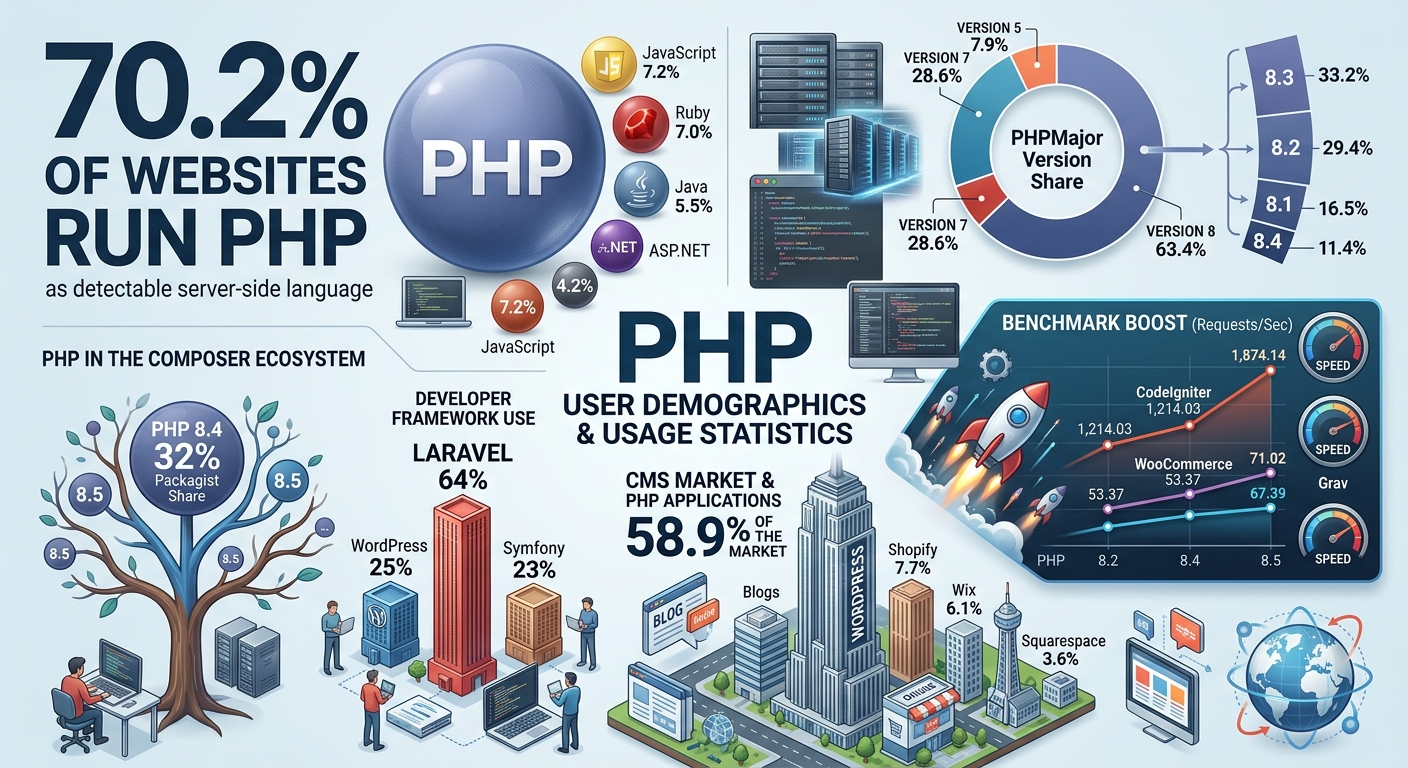
PHP runs 70.2% of websites with a detectable server-side language, measured by W3Techs on 7 September 2026. JavaScript, in second place, sits at 7.2%. The contest that matters now is internal: PHP 8 covers 63.4% of PHP websites, and older branches hold the rest. This brief covers version share, Packagist adoption, PHP 8.5 benchmarks, the support calendar and CMS distribution.
PHP Statistics
PHP Usage Statistics Against Other Server-Side Languages
W3Techs scans public websites daily and reports shares among sites where it can identify a server-side language. A site may run more than one, so the column totals more than 100%.
JavaScript moved into second place on 27 July 2026, passing Ruby, according to W3Techs. These figures count detected websites, not developers or page views. Broader framework and library numbers sit in these web coding statistics for 2026.
| Server-side language | Share of websites with a known server-side language |
|---|---|
| PHP | 70.2% |
| JavaScript | 7.2% |
| Ruby | 7.0% |
| Java | 5.5% |
| Scala | 5.1% |
| ASP.NET | 4.2% |
| static files | 2.1% |
| Python | 1.2% |
| ColdFusion | 0.2% |
| Perl | 0.1% |
Source: W3Techs, server-side programming languages survey, 7 September 2026.
Python sits at 1.2% here while ranking first on developer index measures, a gap covered in these programming language rankings. Deployment share and developer popularity are separate measurements.
PHP Version Statistics On The Public Web
W3Techs reports version share among the websites it detects as running PHP. PHP 8 holds 63.4% of them.
Measured instead against every site with a detectable server-side language, that same PHP 8 population equals 44.5%.
| PHP major version | Share of detected PHP websites |
|---|---|
| Version 8 | 63.4% |
| Version 7 | 28.6% |
| Version 5 | 7.9% |
| Version 4 | 0.1% |
Source: W3Techs, usage statistics of PHP for websites, 6 September 2026.
Which PHP 8 Release Runs The Most Websites?
PHP 8.3 leads the PHP 8 population at 33.2%, ahead of PHP 8.2 at 29.4%.
PHP 8.5 shipped on 20 November 2025 and reached 3.1% of PHP 8 websites by 3 September 2026. PHP 8.4, a year older, sits at 11.4%.
| PHP 8 subversion | Share of detected PHP 8 websites |
|---|---|
| 8.3 | 33.2% |
| 8.2 | 29.4% |
| 8.1 | 16.5% |
| 8.4 | 11.4% |
| 8.0 | 6.4% |
| 8.5 | 3.1% |
| 8.6 | less than 0.1% |
Source: W3Techs, usage statistics of PHP version 8 for websites, 3 September 2026.
PHP Version Statistics In The Packagist Ecosystem
Brent Roose publishes twice-yearly version figures drawn from Packagist, the default Composer repository. These describe package installs from active projects, not the sites W3Techs scans.
PHP 8.4 led Packagist at 32% on 1 July 2026, up from 5% eighteen months earlier. PHP 8.5 reached 16% in the same reading.
Roose compares each release at the same point in its life. PHP 8.5 is running behind PHP 8.1 and PHP 8.3 at six months.
| PHP version | Packagist usage six months after release |
|---|---|
| 8.5 | 16% |
| 8.4 | 14% |
| 8.3 | 20% |
| 8.2 | 17% |
| 8.1 | 25% |
| 8.0 | 15% |
Source: stitcher.io, PHP version stats July 2026, Packagist data to 1 July 2026.
The same analysis scans the 1,000 most popular Packagist packages by minimum required version. Only 352 of them require a PHP version that still receives security updates, and 113 require an actively supported one.
PHP 8.5 Benchmark Statistics By Application
Kinsta benchmarked 13 CMSs and frameworks across PHP 8.2 to 8.5 in identical Docker environments, using ApacheBench at 15 concurrent requests and reporting requests per second.
Upgrading is not a uniform speed gain. Kinsta measured CodeIgniter climbing 54% from PHP 8.4 to 8.5 and Grav about 75%, but noted both spikes coincided with a much smaller response size served under PHP 8.5.
| Application | PHP 8.2 | PHP 8.3 | PHP 8.4 | PHP 8.5 |
|---|---|---|---|---|
| CodeIgniter 4.6.3 | 1,216.41 | 1,197.53 | 1,214.03 | 1,874.14 |
| Symfony 7.4 | 1,018.84 | 953.88 | 992.53 | 1,002.17 |
| Grav 1.8.0 | 600.36 | 603.66 | 586.49 | 1,029.07 |
| Laravel 12.33.0 | 730.11 | 708.44 | 695.98 | 700.33 |
| WordPress 6.8.0 | 146.09 | 142.75 | 148.22 | 148.30 |
| WooCommerce 10.2.2 | 54.67 | 53.74 | 53.37 | 71.02 |
Source: Kinsta, PHP 8.5 benchmarks, published 2 December 2025 and updated 13 December 2025. All figures in requests per second.
Laravel and Symfony both scored highest on PHP 8.2 in this run. Kinsta describes those differences as falling within normal variance and states that real throughput depends far more on application design and infrastructure than on the PHP minor version.
PHP Release And Support Statistics Through 2029
The PHP Group supports each branch actively for two years, then for two more years of critical security fixes only. Four branches were listed as supported on 7 September 2026.
| Branch | Initial release | Active support until | Security support until |
|---|---|---|---|
| 8.2 | 8 Dec 2022 | 31 Dec 2024 | 31 Dec 2026 |
| 8.3 | 23 Nov 2023 | 31 Dec 2025 | 31 Dec 2027 |
| 8.4 | 21 Nov 2024 | 31 Dec 2026 | 31 Dec 2028 |
| 8.5 | 20 Nov 2025 | 31 Dec 2027 | 31 Dec 2029 |
Source: php.net, Supported Versions, accessed 7 September 2026.
Line the calendar against deployment. PHP 8.2, on 29.4% of PHP 8 websites, loses security support on 31 December 2026, the same date PHP 8.4 leaves active support.
PHP 8.6 has a first general availability release scheduled for 19 November 2026, per PHP.Watch. W3Techs already records it on less than 0.1% of PHP 8 websites.
PHP Developer Statistics From The 2025 Survey
JetBrains collected 1,720 responses from developers naming PHP as their main language, with the largest groups in Japan, the United States, Russia, China and France. JetBrains states results may skew toward users of its own products.
Respondents could select several versions, so the shares below overlap and cannot be added together.
| PHP version in use | Share of 1,720 respondents |
|---|---|
| PHP 8.x | 89% |
| PHP 7.x | 33% |
| PHP 5.6 or earlier | 8% |
Source: JetBrains, The State of PHP 2025, Developer Ecosystem Survey 2025, n = 1,720. Multiple answers allowed.
Laravel leads framework use at 64%, with WordPress at 25% and Symfony at 23%.
PHPStan reached 36%, up nine percentage points, while 42% of respondents use no code quality tools regularly and 32% write no tests. On tooling, 80% regularly use AI assistants or AI-powered editors, a pattern tracked further in these AI-assisted coding adoption figures. The next edition, State of PHP 2026, is due in October 2026.
WordPress And CMS Statistics Behind PHP
WordPress holds 58.9% of the identified CMS market and appears on 40.7% of all websites W3Techs tracks. Another 30.9% of sites use no CMS the survey monitors.
Three of the largest systems are PHP applications: WordPress, Joomla and Drupal. Publishers on those installs still hand-manage social and search markup, which is why an Open Graph website tag builder and a sitelinks search box generator stay in the routine.
| CMS | Share of identified CMS market |
|---|---|
| WordPress | 58.9% |
| Shopify | 7.7% |
| Wix | 6.1% |
| Squarespace | 3.6% |
| Joomla | 1.7% |
| Tilda | 1.2% |
| Webflow | 1.2% |
| Duda | 1.1% |
| Drupal | 1.0% |
Source: W3Techs, content management systems survey, 6 September 2026.
Teams redeploying WordPress or Drupal on a newer PHP branch can rebuild page metadata with a meta tag builder and set crawler rules through a robots.txt rule generator as part of the same migration.
FAQs
What percentage of websites use PHP in 2026?
PHP is detected on 70.2% of websites whose server-side programming language W3Techs can identify, measured 7 September 2026. That covers detectable sites, not the entire web, and sites can run more than one language.
How much of the web runs PHP 8?
PHP 8 runs 63.4% of detected PHP websites and 44.5% of all sites with a known server-side language, per W3Techs on 6 September 2026. PHP 8.3 leads the PHP 8 population at 33.2%.
Why do Reddit threads quote different PHP market share figures?
They mix measurements. W3Techs reports 70.2% of websites with a detectable server-side language. JetBrains reports shares of 1,720 surveyed developers. Different populations and questions produce different numbers, and both are accurate.
Does upgrading to PHP 8.5 make sites faster?
Not uniformly. In Kinsta’s December 2025 benchmarks, WordPress moved from 146.09 to 148.30 req/s between PHP 8.2 and 8.5, while Laravel went from 730.11 to 700.33 req/s. CodeIgniter and Grav gained sharply.
Is Laravel really the most used PHP framework, as Reddit suggests?
Survey data agrees. JetBrains put Laravel at 64% of 1,720 PHP developers in its 2025 report, ahead of WordPress at 25% and Symfony at 23%. Respondents could select several options.
Sources
https://w3techs.com/technologies/details/pl-php
https://www.php.net/supported-versions.php
https://kinsta.com/blog/php-benchmarks/
https://stitcher.io/blog/php-version-stats-july-2026

