
This blog post discusses how to evaluate user inputted math expressions safely in Python without using any third party libraries.
E.g. the user can write
a + max(3, b) / c
… and then you run this on the serve- side with variable substitutions to get the actual result.
Table Of Content
1. Background
There are use cases where you want to input math expressions or equations from the user as an alternative to fixed numbers. Examples include
- In the vector drawing application, the user creates object coordinates procedurally to automatize complex layouts
- In the eCommerce application, the product price is not fixed, but dynamically based on external inputs (market price, date, etc.)
Traditionally math expressions are done by writing your own small domain specific language using a custom BNF grammar and a library like pyparsing. You parse the equation and write some kind of evaluation loop, desperately trying cover all cases of nested functions, forward and backward looking of arguments and so on. You can see an example here.
However, Python REPL itself is pretty human-friendly calculator. Why to bother do all parsing and evaluation yourself when you just can use Python in Python?
The approach presented here is based on the example of Aleksi Torhamo and his Python code verification research. No third party libraries needed.
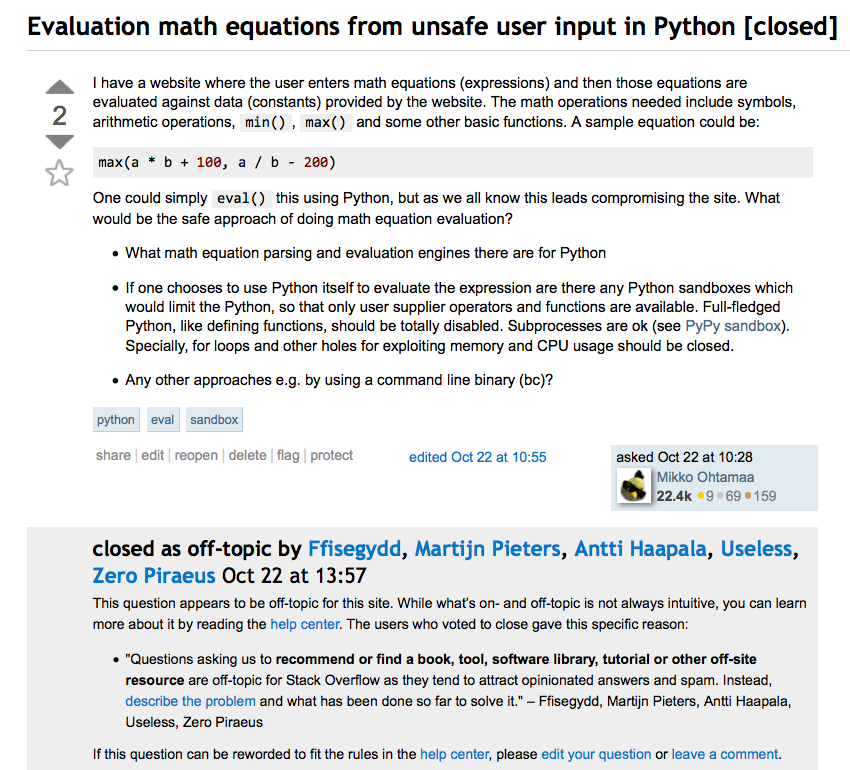
StackOverflow, always so helpful with moderators who understand. Luckily I got a tip towards solving this privately. I kindly ask you to vote to reopen this question, so that an answer can be posted.
2. Protecting your service
The user input is one of the web application attack vectors. It is especially problematic when you let the user to run something, like math expressions, on the server-side – this opens many options for a malicious actors to cause harm. Below I have listed some potential attacks and how to mitigate against them.
2. Sandbox escape
This is the traditional rationale against using eval(). You cannot simply let the user to run arbitrary code on the server, as they could simply do import os ; os.remove(“/home”). The history of Python has various harded eval and sandbox implementations coming up now and then, but the general advice is that “Python eval() can never be safe“. There are even few nice blog posts dedicated how to escape Python sandbox. Only heavyish multiprocessing approaches, like pysandbox which enforces the security on operating system process level could be considered.
In our approach, the trick is that we only do the first half of the eval(). We use the Python compile() function to prepare the Python expression to be the bytecode for evaling. Then, we actually don’t eval(). Instead we use custom opcode handlers and evaluate opcodes in a loop one after another. There cannot be a sandbox escape, because opcodes having should functionality are not implemented. Because compile() does the job of generating the microcode, we are saved from the headache of writing a custom parser. Python dis module helps us minimize the code needed for a stack-based virtual machine.
2. CPU burning attack
If you let the user to input arbitrary calculations, they can try to make the calculations so complex that your process keeps calculating the math expression forever, mounting a denial of service attack against the service. In Python’s case this means that math with really large numbers can be expensive, as Python 3 allows infinite large integers by default. Initially I was thinking the compile() approach could be easily secured against against such attacks. One could simply limit the input value sizes in math opcodes. But unfortunately it turned out to be little trickier.
For example if you compile() Python expression 2**9999999999**9999999 (very big exponent) the Python prompt keeps pushing the bits forever. This is because Python compile() evaluates constants during the compile time, so you are stuck in the compiling step forever.
Even if we gap the power operation, which can be easily exploited to generate very large numbers, the malicious actors are quite creative of coming up with other different slow calculations. The only real mitigation for the execution time issue is having the hard limit for calculation time. We do this using Python’s multiprocess module. The calculation is run in a separate child process. This process is terminated if it doesn’t finish timely. In our case, we’ll give 100 milliseconds for the expression calculations to finish.
As a side note we threads didn’t work here because it turned out compile() does not release GIL and thus thread.start() never returns if thread.run() contains a complex compile() – the original thread does not get GIL back.
We are also protected against infinite loops. Python compile() allows only single line Python statements, thus for and while are out of the list (even they could be written on a single line). We do not implement looping opcodes either.
2. Memory burning attack
Memory burning attack is similar to CPU burning attack. Instead of CPU cycles, the attacker tries to run make the process run out of memory. One could input a very long math expression. Alternatively, the power operation could be used to create very large numbers not fitting to the process memory.
The example code does not hard limit the memory usage of the child process. This could be done on the operating system level e.g. by capping the maximum allowed child process memory to few megabytes. The main rationale skipping it for now is that I did not (yet) find a nice portable way to do this with Python multiprocess module. Probably the child process could set its own memory cap at the beginning of the process. All tips are welcome.
Instead, a naive approach is chosen. The input size and the resulting bytecode size are checked against code size limit. If somebody knows how to make our restricted math operations program to eat a lot of memory please let me know and I’ll test against this too.
3. The implementation
Below is the sample code. The core code is ~200 lines + extras. The tests at the end of the file and having the timeout decorator consume some lines.
If you feel creative and you find a way to destroy this nice piece of code, I’d be interested to hear about the possible attack methods.
You can also find the code as Github gist.
import opcode
import dis
import sys
import multiprocessing
import time

# Python 3 required
assert sys.version_info[0] == 3, "No country for old snakes"


class UnknownSymbol(Exception):
    """ There was a function or constant in the expression we don't support. """


class BadValue(Exception):
    """ The user tried to input dangerously big value. """

    MAX_ALLOWED_VALUE = 2**63


class BadCompilingInput(Exception):
    """ The user tried to input something which might cause compiler to slow down. """


class TimeoutException(Exception):
    """ It took too long to compile and execute. """


class RunnableProcessing(multiprocessing.Process):
    """ Run a function in a child process.

    Pass back any exception received.
    """
    def __init__(self, func, *args, **kwargs):
        self.queue = multiprocessing.Queue(maxsize=1)
        args = (func,) + args
        multiprocessing.Process.__init__(self, target=self.run_func, args=args, kwargs=kwargs)

    def run_func(self, func, *args, **kwargs):
        try:
            result = func(*args, **kwargs)
            self.queue.put((True, result))
        except Exception as e:
            self.queue.put((False, e))

    def done(self):
        return self.queue.full()

    def result(self):
        return self.queue.get()


def timeout(seconds, force_kill=True):
    """ Timeout decorator using Python multiprocessing.

    Courtesy of http://code.activestate.com/recipes/577853-timeout-decorator-with-multiprocessing/
    """
    def wrapper(function):
        def inner(*args, **kwargs):
            now = time.time()
            proc = RunnableProcessing(function, *args, **kwargs)
            proc.start()
            proc.join(seconds)
            if proc.is_alive():
                if force_kill:
                    proc.terminate()
                runtime = time.time() - now
                raise TimeoutException('timed out after {0} seconds'.format(runtime))
            assert proc.done()
            success, result = proc.result()
            if success:
                return result
            else:
                raise result
        return inner
    return wrapper


def disassemble(co):
    """ Loop through Python bytecode and match instructions  with our internal opcodes.

    :param co: Python code object
    """
    code = co.co_code
    n = len(code)
    i = 0
    extended_arg = 0
    result = []
    while i < n:         op = code[i]         curi = i         i = i+1         if op >= dis.HAVE_ARGUMENT:
            # Python 2
            # oparg = ord(code[i]) + ord(code[i+1])*256 + extended_arg
            oparg = code[i] + code[i+1] * 256 + extended_arg
            extended_arg = 0
            i = i+2
            if op == dis.EXTENDED_ARG:
                # Python 2
                #extended_arg = oparg*65536L
                extended_arg = oparg*65536
        else:
            oparg = None

        # print(opcode.opname[op])

        opv = globals()[opcode.opname[op].replace('+', '_')](co, curi, i, op, oparg)

        result.append(opv)

    return result

# For the opcodes see dis.py
# (Copy-paste)
# https://docs.python.org/2/library/dis.html

class Opcode:
    """ Base class for out internal opcodes. """
    args = 0
    pops = 0
    pushes = 0
    def __init__(self, co, i, nexti, op, oparg):
        self.co = co
        self.i = i
        self.nexti = nexti
        self.op = op
        self.oparg = oparg

    def get_pops(self):
        return self.pops

    def get_pushes(self):
        return self.pushes

    def touch_value(self, stack, frame):
        assert self.pushes == 0
        for i in range(self.pops):
            stack.pop()


class OpcodeArg(Opcode):
    args = 1


class OpcodeConst(OpcodeArg):
    def get_arg(self):
        return self.co.co_consts[self.oparg]


class OpcodeName(OpcodeArg):
    def get_arg(self):
        return self.co.co_names[self.oparg]


class POP_TOP(Opcode):
    """Removes the top-of-stack (TOS) item."""
    pops = 1
    def touch_value(self, stack, frame):
        stack.pop()


class DUP_TOP(Opcode):
    """Duplicates the reference on top of the stack."""
    # XXX: +-1
    pops = 1
    pushes = 2
    def touch_value(self, stack, frame):
        stack[-1:] = 2 * stack[-1:]


class ROT_TWO(Opcode):
    """Swaps the two top-most stack items."""
    pops = 2
    pushes = 2
    def touch_value(self, stack, frame):
        stack[-2:] = stack[-2:][::-1]


class ROT_THREE(Opcode):
    """Lifts second and third stack item one position up, moves top down to position three."""
    pops = 3
    pushes = 3
    direct = True
    def touch_value(self, stack, frame):
        v3, v2, v1 = stack[-3:]
        stack[-3:] = [v1, v3, v2]


class ROT_FOUR(Opcode):
    """Lifts second, third and forth stack item one position up, moves top down to position four."""
    pops = 4
    pushes = 4
    direct = True
    def touch_value(self, stack, frame):
        v4, v3, v2, v1 = stack[-3:]
        stack[-3:] = [v1, v4, v3, v2]


class UNARY(Opcode):
    """Unary Operations take the top of the stack, apply the operation, and push the result back on the stack."""
    pops = 1
    pushes = 1


class UNARY_POSITIVE(UNARY):
    """Implements TOS = +TOS."""
    def touch_value(self, stack, frame):
        stack[-1] = +stack[-1]


class UNARY_NEGATIVE(UNARY):
    """Implements TOS = -TOS."""
    def touch_value(self, stack, frame):
        stack[-1] = -stack[-1]


class BINARY(Opcode):
    """Binary operations remove the top of the stack (TOS) and the second top-most stack item (TOS1) from the stack. They perform the operation, and put the result back on the stack."""
    pops = 2
    pushes = 1


class BINARY_POWER(BINARY):
    """Implements TOS = TOS1 ** TOS."""
    def touch_value(self, stack, frame):
        TOS1, TOS = stack[-2:]
        print(TOS1, TOS)
        if abs(TOS1) > BadValue.MAX_ALLOWED_VALUE or abs(TOS) > BadValue.MAX_ALLOWED_VALUE:
            raise BadValue("The value for exponent was too big")

        stack[-2:] = [TOS1 ** TOS]


class BINARY_MULTIPLY(BINARY):
    """Implements TOS = TOS1 * TOS."""
    def touch_value(self, stack, frame):
        TOS1, TOS = stack[-2:]
        stack[-2:] = [TOS1 * TOS]


class BINARY_DIVIDE(BINARY):
    """Implements TOS = TOS1 / TOS when from __future__ import division is not in effect."""
    def touch_value(self, stack, frame):
        TOS1, TOS = stack[-2:]
        stack[-2:] = [TOS1 / TOS]


class BINARY_MODULO(BINARY):
    """Implements TOS = TOS1 % TOS."""
    def touch_value(self, stack, frame):
        TOS1, TOS = stack[-2:]
        stack[-2:] = [TOS1 % TOS]


class BINARY_ADD(BINARY):
    """Implements TOS = TOS1 + TOS."""
    def touch_value(self, stack, frame):
        TOS1, TOS = stack[-2:]
        stack[-2:] = [TOS1 + TOS]


class BINARY_SUBTRACT(BINARY):
    """Implements TOS = TOS1 - TOS."""
    def touch_value(self, stack, frame):
        TOS1, TOS = stack[-2:]
        stack[-2:] = [TOS1 - TOS]


class BINARY_FLOOR_DIVIDE(BINARY):
    """Implements TOS = TOS1 // TOS."""
    def touch_value(self, stack, frame):
        TOS1, TOS = stack[-2:]
        stack[-2:] = [TOS1 // TOS]


class BINARY_TRUE_DIVIDE(BINARY):
    """Implements TOS = TOS1 / TOS when from __future__ import division is in effect."""
    def touch_value(self, stack, frame):
        TOS1, TOS = stack[-2:]
        stack[-2:] = [TOS1 / TOS]


class BINARY_LSHIFT(BINARY):
    """Implements TOS = TOS1 << TOS."""
    def touch_value(self, stack, frame):
        TOS1, TOS = stack[-2:]
        stack[-2:] = [TOS1 << TOS] class BINARY_RSHIFT(BINARY):     """Implements TOS = TOS1 >> TOS."""
    def touch_value(self, stack, frame):
        TOS1, TOS = stack[-2:]
        stack[-2:] = [TOS1 >> TOS]


class BINARY_AND(BINARY):
    """Implements TOS = TOS1 & TOS."""
    def touch_value(self, stack, frame):
        TOS1, TOS = stack[-2:]
        stack[-2:] = [TOS1 & TOS]


class BINARY_XOR(BINARY):
    """Implements TOS = TOS1 ^ TOS."""
    def touch_value(self, stack, frame):
        TOS1, TOS = stack[-2:]
        stack[-2:] = [TOS1 ^ TOS]


class BINARY_OR(BINARY):
    """Implements TOS = TOS1 | TOS."""
    def touch_value(self, stack, frame):
        TOS1, TOS = stack[-2:]
        stack[-2:] = [TOS1 | TOS]


class RETURN_VALUE(Opcode):
    """Returns with TOS to the caller of the function."""
    pops = 1
    final = True
    def touch_value(self, stack, frame):
        value = stack.pop()
        return value


class LOAD_CONST(OpcodeConst):
    """Pushes co_consts[consti] onto the stack.""" # consti
    pushes = 1
    def touch_value(self, stack, frame):
        # XXX moo: Validate type
        value = self.get_arg()
        assert isinstance(value, (int, float))
        stack.append(value)


class LOAD_NAME(OpcodeName):
    """Pushes the value associated with co_names[namei] onto the stack.""" # namei
    pushes = 1
    def touch_value(self, stack, frame):
        # XXX moo: Get name from dict of valid variables/functions
        name = self.get_arg()
        if name not in frame:
            raise UnknownSymbol("Does not know symbol {}".format(name))
        stack.append(frame[name])


class CALL_FUNCTION(OpcodeArg):
    """Calls a function. The low byte of argc indicates the number of positional parameters, the high byte the number of keyword parameters. On the stack, the opcode finds the keyword parameters first. For each keyword argument, the value is on top of the key. Below the keyword parameters, the positional parameters are on the stack, with the right-most parameter on top. Below the parameters, the function object to call is on the stack. Pops all function arguments, and the function itself off the stack, and pushes the return value.""" # argc
    pops = None
    pushes = 1

    def get_pops(self):
        args = self.oparg & 0xff
        kwargs = (self.oparg >> 8) & 0xff
        return 1 + args + 2 * kwargs

    def touch_value(self, stack, frame):
        argc = self.oparg & 0xff
        kwargc = (self.oparg >> 8) & 0xff
        assert kwargc == 0
        if argc > 0:
            args = stack[-argc:]
            stack[:] = stack[:-argc]
        else:
            args = []
        func = stack.pop()

        assert func in frame.values(), "Uh-oh somebody injected bad function. This does not happen."

        result = func(*args)
        stack.append(result)


def check_for_pow(expr):
    """ Python evaluates power operator during the compile time if its on constants.

    You can do CPU / memory burning attack with ``2**999999999999999999999**9999999999999``.
    We mainly care about memory now, as we catch timeoutting in any case.

    We just disable pow and do not care about it.
    """
    if "**" in expr:
        raise BadCompilingInput("Power operation is not allowed")


def _safe_eval(expr, functions_and_constants={}, check_compiling_input=True):
    """ Evaluate a Pythonic math expression and return the output as a string.

    The expr is limited to 1024 characters / 1024 operations
    to prevent CPU burning or memory stealing.

    :param functions_and_constants: Supplied "built-in" data for evaluation
    """

    # Some safety checks
    assert len(expr) < 1024

    # Check for potential bad compiler input
    if check_compiling_input:
        check_for_pow(expr)

    # Compile Python source code to Python code for eval()
    code = compile(expr, '', 'eval')

    # Dissect bytecode back to Python opcodes
    ops = disassemble(code)
    assert len(ops) < 1024

    stack = []
    for op in ops:
        value = op.touch_value(stack, functions_and_constants)

    return value


@timeout(0.1)
def safe_eval_timeout(expr, functions_and_constants={}, check_compiling_input=True):
    """ Hardered compile + eval for long running maths.

    Mitigate against CPU burning attacks.

    If some nasty user figures out a way around our limitations to make really really slow calculations.
    """
    return _safe_eval(expr, functions_and_constants, check_compiling_input)


if __name__ == "__main__":

    # Run some self testing

    def test_eval(expected_result, *args):
        result = safe_eval_timeout(*args)
        if result != expected_result:
            raise AssertionError("Got: {} expected: {}".format(result, expected_result))

    test_eval(2, "1+1")
    test_eval(2, "1 + 1")
    test_eval(3, "a + b", dict(a=1, b=2))
    test_eval(2, "max(1, 2)", dict(max=max))
    test_eval(2, "max(a, b)", dict(a=1, b=2, max=max))
    test_eval(3, "max(a, c, b)", dict(a=1, b=2, c=3, max=max))
    test_eval(3, "max(a, max(c, b))", dict(a=1, b=2, c=3, max=max))
    test_eval("2", "str(1 + 1)", dict(str=str))
    test_eval(2.5, "(a + b) / c", dict(a=4, b=1, c=2))

    try:
        test_eval(None, "max(1, 0)")
        raise AssertionError("Should not be reached")
    except UnknownSymbol:
        pass

    # CPU burning
    try:
        test_eval(None, "2**999999999999999999999**9999999999")
        raise AssertionError("Should not be reached")
    except BadCompilingInput:
        pass

    # CPU burning, see out timeoutter works
    try:
        safe_eval_timeout("2**999999999999999999999**9999999999", check_compiling_input=False)
        raise AssertionError("Should not be reached")
    except TimeoutException:
        pass

    try:
        test_eval(None, "1 / 0")
        raise AssertionError("Should not be reached")
    except ZeroDivisionError:
        pass

    try:
        test_eval(None, "(((((((((((((((()")
        raise AssertionError("Should not be reached")
    except SyntaxError:
        #    for i in range(0, 100):
        #      ^
        # SyntaxError: invalid synta
        pass

    try:
        test_eval(None, "")
        raise AssertionError("Should not be reached")
    except SyntaxError:
        # SyntaxError: unexpected EOF while parsing
        pass

    # compile() should not allow multiline stuff
    # http://stackoverflow.com/q/12698028/315168
    try:
        test_eval(None, "for i in range(0, 100):\n    pass", dict(i=-1))
        raise AssertionError("Should not be reached")
    except SyntaxError:
        #    for i in range(0, 100):
        #      ^
        # SyntaxError: invalid synta
        pass

    # No functions allowed
    try:
        test_eval(None, "lamdba x: x+1")
        raise AssertionError("Should not be reached")
    except SyntaxError:
        # SyntaxError: unexpected EOF while parsing
        pass
 Subscribe to RSS feed
  Follow me on Twitter
 Follow me on Facebook
  Follow me Google+

