Posts

Showing posts with the label Protest

From Hurao to Fanohge

Image
This Saturday, September 20th, Independent Guåhan will be holding a Teach-In at Senator Angel Santos Memorial Latte Stone Park from 2 - 4 pm titled "From Hurao to Fanohge: 350 Years of Chamoru Resistance." This event is free and open to anyone. The title comes from two key events in understanding Chamoru history and resistance to colonialism in its different forms across time.   In September 1670/1671, Maga’låhi Hurao who had been gathering families who were frustrated with the new Spanish presence in the Marianas and forming a coalition to oppose their interference, was arrested by Spanish soldiers and taken prisoner in the church. Hurao's speech is meant to be an example of the rhetoric that he was using that was inspiring so many families to come forth and offer their spears and slingstones in support of his cause.   An estimated 2,000 warriors surrounded the church, which had been hastily transformed into a fort, to demand his release and the surrender of the ...

Adios Chris

Image
Chris Perez Howard was born in 1940 to Mariquita Aguon Perez and Edward Neal Howard. When the Japanese invaded Guam the following year, his father, a US Navy sailor, was taken away as a prisoner of war, leaving his mother and family to care for Chris and his younger sister Helen. By the war's end, Mariquita would, like hundreds of other Chamorus during the occupation, become a victim of Japanese brutality. As a result, Chris would have few memories of her and soon after his father’s return to Guam at the end of the war, would be taken away from Guam and not return for almost two decades.  In the 1970s, Chris found his way back to his island home and begin to conduct research into the life and death of his mother. He pored through military archives and also interviewed family and friends, all of which helped him put together a literary portrait of her as an intelligent and resilient Chamoru woman.  In 1982 he published a biography for her titled, “Mariquita: A Tragedy o...

Protest Culture

Image
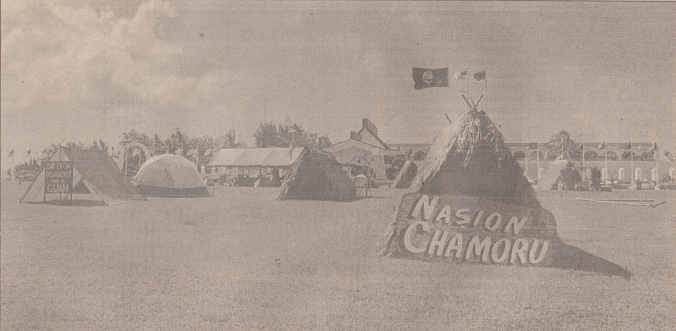
When the protest group Nasion Chamoru first emerged decades ago, it created a conflict in the minds of people on Guam. On the one hand you had a group of people who were an emphatically embodying “Chamoru” things.  They were speaking Chamoru, fighting for Chamoru lands and their return, protecting Chamoru rights, and even sometimes sported ancient Chamoru jewelry. But at the same time, for many people, the group seemed to be against everything Chamorus supposedly represented.   Chamorus are supposed to be respectful, gairespetu yan gaimamhlao, do not speak out and politely submit to any form of authority. In the way Nasion Chamoru did not shy away from open defiance and critique of the local and federal governments, they seemed so taimamahlao or tairespetu (without shame or respect). Every culture has their conservative and progressive elements, and an ideological fight always takes place over what is considered to be acceptable and unacceptable. For some, open...

Mungga Yu' ni Konstitution

Image
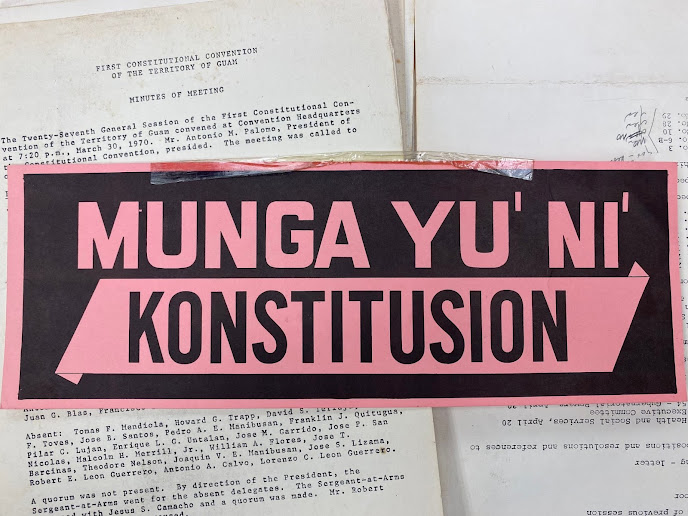
I came across this protest sign in the archives of the Nieves Flores Guam Public Library in Hagåtña, while doing research on Guam's two previous Constitutional Conventions (1969-70 and 1977). Written in Chamoru, it translates to "I don't want the constitution."   A few months ago for Fanchu! I spoke to former Senator Hope Cristobal who was part of the campaign to defeat the draft constitution in 1979. The notable figures who organized against the constitution include Robert Underwood, Marilyn Manibusan, the late Tony Leon Guerrero, the late Tan Clotilde Gould, Rosa Palomo, and the late Dr. Benit Dungca. As Underwood writes in his wonderful article "Dies Mitt: The Origin and End of Chamrro Self-Determination," the constitutional opponents "coalesced around the billboard “Munga ma’apreba i konstetusion ya ta mantieni i derecho-ta komo taotao Guam. Bota NO!” In English, this read “do no approve the constitution and maintain our rights as the people of Guam...

Ten Weeks for the Tweed Protest

Image
  For the past 10 weeks, I've been writing columns for the Pacific Daily News providing historical context for the 1946 protest of US Navy Radioman George Tweed by more than a 100 Chamorus. Today marked my last column on the series. Although I did get a great deal more hate messages and a hateful comments during this series, I still greatly enjoyed writing these pieces. George Tweed was such an incredibly important symbol for Chamorus during the Japanese occupation. For me as a historian it is fascinating to think about how, just two years after the end of that occupation, more than a 100 Chamorus felt compelled to make signs and protest him when he returned to island. They didn't do this in the dead of night, but in the middle of the Plaza de España in front of the leadership of the US Navy on Guam. As I wrote in this last column, it was a multitude of things that compelled Chamorus to take this act, but many of them weren't about Tweed himself. Chamorus were frustrated th...

Protest Over Magua and Litekyan

Image
 

Okinawa Blues

Image
Since 2010 I have traveled to Okinawa just about every year. Usually I have gone with my friend Ed Alvarez. We first travelled to Okinawa together in 2012 to present at a number of conferences focusing on issues of demilitarization, indigenous rights and also decolonization. Ed was the Executive Director of the Guam Commission on Decolonization and had made some important connections to academics and protest groups. One of my goals at some point is to write an academic article about the ever-evolving conversation in Okinawa about decolonization and political status. It is fascinating and often goes far beneath the radar, as most focus on the demilitarization and anti US base protests. But since I have been traveling there, I have regularly heard the makings of a decolonization conversation. When I say this, I don't mean it looks the same or sounds the same, or takes the same shape as Guam's. I mean that for Okinawa, which faces a number of fundamental and structural issues ab...

State of the Movement Live Stream

Image
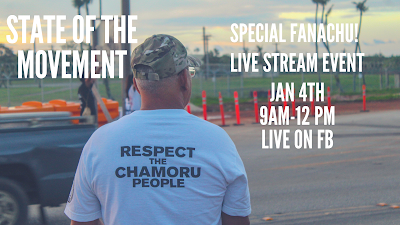
Tune in to Fanachu! on Facebook, Friday, January 4th, 2019 from 9am-12pm for a special live stream event, "State of the Movement."

Adios Governor Ota

Image
Last June, M asahide Ota, former Governor of Okinawa passed away. He had been governor of the islands in 1995, when long-time resentment and culture of protest against the US military bases achieved a much greater and more widespread character after the rape of a 12 year old girl by three US servicemen. His was a powerful voice for peace and demilitarization in Okinawa. During a trip in October of 2015 Edward A. Alvarez and I (with the help of the intrepid interpreter Shinako Oyakawa) got to visit him at his Naha office one afternoon. When he learned that we were from Guam, he mentioned several Chamorros that he had met over the years and inquired about them. He told us a number of stories from his life, including as experience after being drafted into the Japanese army during the war. He shared others about the struggles to survive for average Okinawans, after the destruction of their island and displacement in order to build new US military bases. I have long written that Okinawa a...

Gaige yu' giya Okinawa ta'lo

Image
Gaige yu' giya Okinawa på'go na simana. Para bei fama'nu'i gi kolehio yan konfirensia guini. I fina'nu'i siha put decolonization yan nina'la'la' lengguåhen natihu siha. Para bei faninterview taotao Chamoru ni' manmastastation guini giya Okinawa put i sinienten-ñiha nu i taotao guini. Put hemplo, kao hinasson-ñiha na mamparehu i estao i taotao Okinawa yan i Chamoru? Guaha meggai parehu put i halacha na hestoria-ta siha, lao kao ma ripåpara este? Pat osino gi lini'e'-ñiha kao manentrangheru? Bai hu bisita lokkue' i kampon protest taiguihi gi este na litråtu. Este giya Henoko, nai i militåt Amerikånu ma keke ekstende i sagan-ñiha guihi, lao i taotao ti yan-ñiha este, ko'lo'lo'ña put taimanu na u ma destrosa i ginefpågon lugåt.

Peaceful Demonstration over Magua'

Image
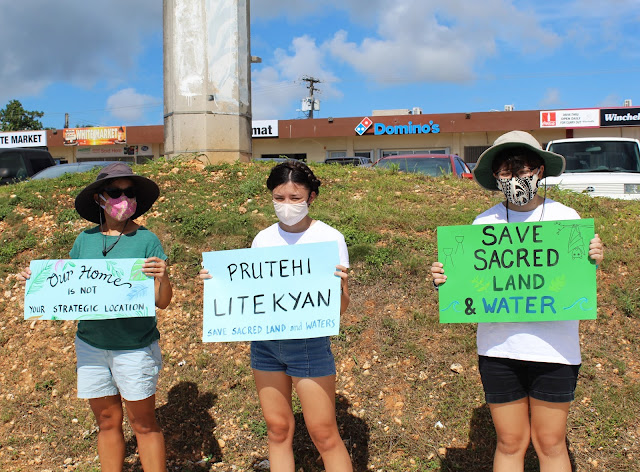
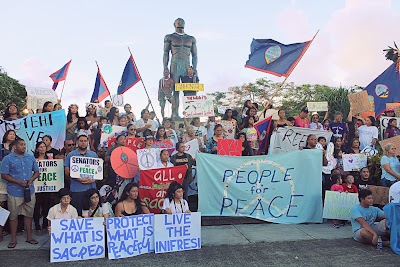
Groups Organize Demonstration Against Disturbance of Cultural Site FOR IMMEDIATE RELEASE (October 31, 2018 – Hag å t ñ a) Amid a complex election season and Typhoon Yutu relief efforts, our residents have also been challenged with news of the recent disturbance of the ancient village of Magua at the site for the new Marine Base in South Finegayan. Local news sources, both radio and print, have reported that the U.S. Navy may have breached negotiations to mitigate the site. As the buildup progresses, it is clear that cultural preservation is not a priority for the Department of Defense.   Prutehi Litekyan: Save Ritidian (PLSR) and Independent Gu å han call on the leaders of our island to rise up and take immediate action against this disturbance and to ensure that further harm will not take place.  PLSR and Independent Gu å han invite our community to gather for a peaceful  public demonstration this Saturday, November 3 from 4 p.m. to 6 p.m....

Veterans for Decolonization

Image
I have been traveling for the past few weeks and struggling while conducting research and giving a variety of presentations, to also finish up a couple of articles. One of them is based on the research I did for the Guam Humanities Council a few years ago for their exhibit Sindålu: Chamorro Journey Stories in the US Military. It was an exciting and interesting project on a variety of levels. I got to share some interesting stories that I've come across in my archival and oral history research, some of which haven't really ever been publicized before. I also got to tackle some issues in terms of understanding or unpacking contemporary Chamoru identity. The veteran subjectivity is so pervasive and somewhat hegemonic in Chamoru culture today, that it ends up taking a great deal of space, even for those who aren't veterans themselves. How many people when talking about issues of decolonization and demilitarization feel a inner need to curb their potential voice, their potenti...

Trump Visits Guam

Image
Donald Trump will be on island for a few hours tonight, following a summit with North Korea's Kim Jong Un in Singapore. Although there had been rumors for months about a Trump visit, it was only really confirmed earlier today when the local media got a chance to look at the White House schedule this week. Pundits are trying to figure out what the meeting means, and how much credit Trump should or shouldn't receive for his haphazard and sometimes confusing attempts at diplomacy, but we shouldn't be too distracted by that discussion in Guam. Regardless of what decisions may come from this meeting, Guam remains a territory of the US and not a sovereign player in any decisions regarding security in this region. So long as we remain a colony, genuine security will always remain outside of our reach. Decolonization is the only way to ensure greater security for our people and that our island becomes more than just the tip of America's spear.

5,000 Days of Protest in Okinawa

Image
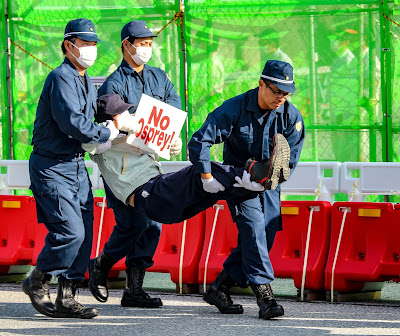
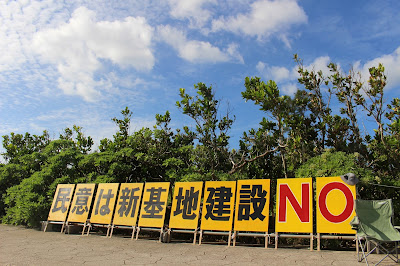
5,000 days of protest in northern Okinawa. In truth, the protests there go much further back, but 5,000 is a nice, big, profound number. It represents 5,000 days of continuous protest, of daily, symbolic and direct resistance to US militarism and militarization in the island. I have been fortunate enough to visit the protest camps in Okinawa on several occasions since 2011. I have spoken to scholars, to activists, to students, to elders, to farmers, to fishermen and even to paddlers and scuba divers. It does make me wonder, at one point the level of militarization or of consciousness about militarization in Guam will come to a similar point. There have been outbursts, periods of direct action, protest, there has been a great deal of counter-hegemonic activity, trying to make it more possible for the community to engage in critical discussions about Guam's military presence or purpose. But nothing similar to what we see in Okinawa. Will the plans for a firing range at Litekyan...

Manhoben Para Guahan

Image
Towards the end of last month I spent two nights in a row editing this video with  Edgar Flores in response to the protests and public hearings that had been taking place. Both Edgar and I were at the public hearing at the Liheslaturan Guåhan on a Friday where we heard dozens speak about their concerns and frustrations about the US military buildup and in particular the use of Litekyan for a firing range. We were both there the following day when a group of youth organized a demonstration in front of Andersen Air Force Base and witnessed their act of civil disobedience as they temporarily blocked the gate. The video is meant to help people understand why people were willing to undertake such an action, by using the testimonies of two young passionate and articulate student members of Manhoben para Guåhan.

Inter-Generational Protest

Image
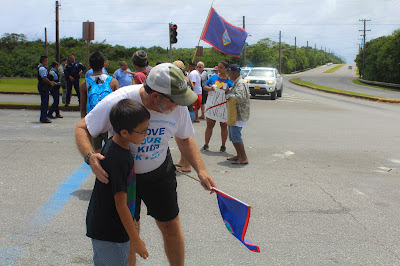
On Saturday my kids and I were driving up to the Litekyan demonstration organized by Manhoben para Guåhan at the front gate of Andersen Air Force base. When we were almost there, a half dozen Guam police vehicles rushed by us. We quickly parked and ran over to the demonstration site across the road from the gate. We could see the line of police cars and also, to our surprise, a line of protestors blocking several of the lanes to the gate. Both kid s cried "ti malago' yu' ma'aresta!" and "mungga' yu' ma'aresta."  When we got to the demonstration site and got a better look at the line of protestors, we saw the outline of my dad and their grandfather. I walked across to join him and learn more about what was happening, Akli'e' disobeying me and sneakily walking behind me. We embraced him and he gave us an overview of what happened during the protest. I felt so proud of him that he had joined the others to symbolically bl...

Decolonization in the Caribbean #6: Jokes of Leftists Past

Image
This year's regional seminar for the UN Committee of 24 was different than the three previous ones that I attended in a handful of ways. There was always some debate and some rhetorical conflict at previous seminars, but this one extended to a level I had never seen before. Other participants who have been involved far longer than I have, also acknowledged the conflict and tension reached new heights in St. Vincent and the Grenadines. I’ll be writing about this later, but the conflict created a lot of wasted time and also of waiting around for events to unfold or drama to be sorted out. This led to a lot of conversations that you wouldn’t normally take place, as people anxiously waited for the work of the seminar to move ahead. A lot of these conversations ended up being humorous as people sought ways to ease the tension and also pass the time. I heard a lot of funny stories from across Latin America, to the Caribbean, the Pacific. In this mix there were stories of parliamentary ...