Posts

Showing posts with the label Sinangan

Only the Dead Don't Dream

Image
I matai ha’ na taotao ti mangguiguife” or only a dead person does not dream. Not a common Chamoru wisdom saying, but one with profound meanings on two different levels. In the first, more practical way, everyone, from the richest, to the poorest, to the happiest, to the saddest, wants something more out of life. There may be dramatic differences, and what they want may be big or small. It may rip the fabric of social reality or do nothing more that create a minute ripple. Only those who have passed away are not capable of imagining themselves or the world differently. This saying is meant to nudge someone or remind them that the point of life is change, growth, evolution. That there will be plenty of time for the opposite in death. But the saying also holds extra, critical meaning for Chamorus people as a colonized people, where not just their lands, language and culture have been stolen or hijacked, but even their ability to dream for themselves or their people. Over centur...
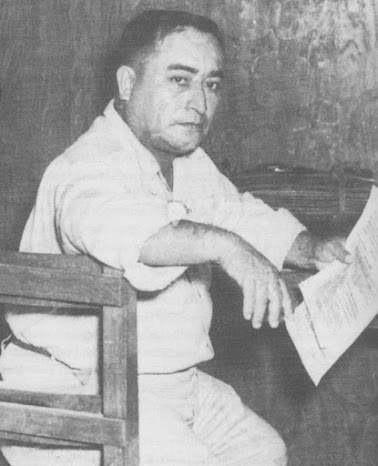
Kiko Zoilo

Image
One of the most fascinating figures from 20th century Guam History for me remains Francisco Baza Leon Guerrero or Kiko Zoilo. One day I hope to write something or create something that can show the breadth of his accomplishments and advocacy, at a time when most Chamorus did not feel comfort being critical about the US as their colonizer. He was a political figure before and after the war. One of the founders of the Young Mens League of Guam. The Father or the Organic Act and even a Speaker of the Guam Legislature.  For Independent Guåhan, I prepared some quotes from him and about him, that were used when we honored him as Maga'taotao for one of our General Assemblies. I wanted to share them here, for those looking for a place to start in understanding this important figure (that is largely unknown for most people today). ****************   “He was a great believed in the democratic way of life and freedom of action. He wouldn’t kowtow to anyone, no matter what ...

MLK: A Radical, Not a Saint

Image
My position on Martin Luther King Jr. is somewhat similar to my position on Jesus Christ. I have a strong affinity for both of them in their radical dimensions, the way they challenged system of oppression in their time and proposed a powerful message of social change into something that was potentially more equitable. Both of them have of course been edited and watered down significantly in their message, to the point where both of them can be invoked in the name of so many things that they would have violently detested in their lives. Gof ya-hu si Jesus Kristo komo un zealot. Lao anggen un lahen Yu'us, hmmm, ti bali nu Guahu i mensahi-ña. Parehu yan si MLK. Gof annok gi sinangån-ña yan gi bidå-ña na zealot lokkue'. Lao atan ha' på'go, i manracist na taotao, ma u'usa i estoria-ña para u ma puni i tinailayi yan taihustisia gi på'go na tiempo.  Below is a great article that outlines the radical dimensions of Martin Luther King Jr. and his legacy.  ******...

Mensahi Ginen i Gehilo' #19: Just Like Tantalus

Image
Tantalizing Democratic Experiments by Michael Lujan Bevacqua Guam Sunday Post November 6, 2016 Gof kinenne’ yu’ nu este na botasion, ko’lo’lo’ña i botasion gi sanlagu. Hu såsangan este, achokka’ esta hu gof komprende na mas ki taibali este na botasion nu hita guini giya Guahan, sa’ tåya’ botu-ta gi botasion para i presidente. I have been obsessively following the election for President of the United States for more than a year, and this is something that sometimes surprises people. The drama of it is both repellent and compelling. I cannot turn away from this event that seems to move both in frustrating slow motion, but also at a frenetic Mad Max-like pace, careening at frightening speed toward a possible dystopia. As a local decolonization activist, or someone who is actively advocating for a change in our political status, my obsessing over the U.S. presidential election can seem contradictory. As a distant American colony on the edge of the Western Pacific, w...

Setbisio Para i Publiko #30: Two Quotes for the Future

Image
The two images are flyers featuring quotes from the political status debates I hold in my Guam History classes.  Students are divided into Statehood, Independence and Free Association groups and develop their arguments for which status is better and also produce posters, brochures, flyers, stickers and sometimes even food to help make their points.  The first is a quote from Maga'låhi Hurao, who in 1671 became the first Chamorro leader to organize large scale opposition to the Spanish presence on Guam, is regularly used by students arguing in favor of Independence. In Chamorro I have seen that line translated as "Metgotña hit ki ta hasso" as well as " Megotña hit ki ta hongge. " Given that many peoples' resistance to the notion of Guam becoming independent is tied to generations of feeling like we are inadequate or subordinate to those who have colonized us, this simple notion can be very powerful in start the process of self-empowerment. Nihi ...

More Graves than Lives

Image
I just finished up an interview on the issue of war reparations for Chamorros. This past week a group of politicians, who are part of the non-profit group Guam World War II Reparations Advocates announced their intent to file a lawsuit against the US government on behalf of Chamorros who endured Japanese occupation from 1941-1944 and who waiting for some form of compensation for close to 30 years. I've included an article on the lawsuit below from The Guam Daily Post. I also wanted to share a quote from my interview, in which I responded personally to what I felt about the possibility of reparations being granted today. Gof annok gi ineppe'-ku i minala'et-hu. Fihu iyo-ku grandfather ha faisen yu' put este na asunto, ya kao sina mohon ma risibi este na salape' para i pinadesen gera. Lalalo' yu' sa' matai i nanan biha-hu tres anos tatte na tiempo ya matai si grandpa gi ma'pos na sakkan. Anggen un diha ma na'i i taotao-ta este, hafa i bali-na angg...

Fina'kuentos Chamorro #5: An Meggai Sinangan-mu...

Image
Last year I gave a presentation to a high school class here on Guam about the way we can understand Guam history, its trends, its tendencies, its cycles through various Chamorro sayings. For some reason, today I have that presentation on my mind. I undertake a similar activity in my World History and Guam History courses. In order to understand what history as a concept is, I don't give students definitions per se, instead I give them 28 - 30 quotes that people have said about history and its characteristics, its importance or its irrelevance. No single quote is meant to encapsulate everything or explain and cover everything, but rather they each provide some texture to aspects, some structural understanding or descriptions to tendencies. History in the mind of one scholar is an essential part of human activity, for another it is an illusion, a means of trying to imagine control over things you have no control over. I find the complicated mess that the quotes crea...

Mas Ki Dichicheng

Image
Ilek-na Si Henry Kissinger, ayu na sen dangkolu na galabok taotao, put iya Micronesia, “There are only 90,000 people out there. Who gives a damn?” I meggaina na taotao guini ti ma tungo’ put este na sinangan ya ti ma tungo’ lokkue’ hayi este na Henry. Lao para i manggaitiningo’, ti mannina’manman nu este. Ayu na hinasso, ayu na pine’lo, put i mineddong-ta guini gof annok gi i na’an-ta. Atan i na’an ni’ mana’i hit para este na lugat: Micronesia. Kumekeilekna “dikike’ na isla.” Sigun hafa hu fa’na’an i “pragmatics of size” taya’ gaibali giya Micronesia, todu taibali. Hunggan, buente anggen malago’ hao bumuteya hanom tasi, sen gefsaga’ este na lugat. Lao dinirihi i hinasson i taotao sanhiyong ni’ tano’. Ayu nai muna’hasso siha put finitme, siguridad, yan anggokuyon na fuetsa. Para siha i hanom yan i tasi, ti anggokuyon, machalek, todu tiempo matulailaika. Todu i tumuge’ i Bipblia ginen ayu na hinasso. Hafa ilek-na guihi put este? Estague ginen as San Mateo: Enao i humungok...

Chago' i Korason-mu giya Guahu

It is the one year anniversary of the passing of my grandmother, Elizabeth De Leon Flores Lujan. Family and friends held a gathering recently to remember her and celebrate her. As part of the gathering we sang some Christmas songs, both in English and Chamorro. It was a bit strange though because even though I spent several Christmases and in fact most Christmases in my grandparents' house in Mangilao, we never sang Christmas songs. We didn't do much decorations either. I've wondered if this is because grandma was already older and not as interested in those things, or because of her strong religious beliefs. Something that we would do for Christmas and at regular points through the year is sit around the dinner table and read bible lessons and bible verses. This is how I think grandma would probably want us to remember her and honor her, but reading the bible together. This past week I wrote about the new movie "Saving Christmas" and reflecting on the origins of ...

Nation Follows Nation

Image
I was reading recently a book on "Native American Wisdom." It to be truthful a beautiful book even if it was very simplistic at times. There was a beauty and a power to some of the words, which were quoted from leaders of Native American tribes over the past 300 years. There were ways that in their wisdom I saw the cosmology, the culture of so many other native peoples, Chamorros included. There were ways that they made sense of their tragedies, railed against it, accepted it. The book didn't promote one perspective for Native American identity or world-view, even though it do at some points argue for a harmony or unity amongst the people, and made claims to the way all the different types of Native Americans see the world. There were some who continued to challenge the authority of the US over Native Americans and there were some who accepted it. Some drew a line and argued their spirituality was different than the kind that came with colonization, others argued that t...