Marine Safety

Image

Western Canada has a well-managed, robust marine safety regime that maintains an outstanding track record. Protocols encompass risk controls for all Salish Sea vessel traffic, including oil tankers. Transport Canada, the Canadian Coast Guard, the Pacific Pilotage Authority and the Vancouver Fraser Port Authority oversee these regulations and practices. Tankers are held to strict international standards for construction and operations, mandated by the International Maritime Organization and the Canadian Shipping Act (SC 2001, c.26), and verified by Class Societies.

Marine Safety Regime

As the federal regulator for all shipping activities, Transport Canada governs the National Oil Spill Preparedness and Response Regime.

Upon arrival in Canadian waters, foreign vessels may be inspected by Transport Canada, which administers Canada's program for Port State Control. Canada is a signatory to the Paris MOU and Tokyo MOU international conventions on Port State Control, ensuring a consistent inspection regime and report sharing among signatory countries. Under these agreements, Transport Canada inspectors can access and share vessel inspections with other signatory countries to track a ship's performance.

Transport Canada also oversees the Canada Shipping Act, which requires all large vessels, including oil tankers, and oil handling facilities to have an arrangement with an oil spill response organization. Western Canada Marine Response Corporation (WCMRC) is the only Transport Canada-certified marine responder on Canada’s West Coast.

Learn more about WCMRC and marine oil spill prevention and response.

The Canadian Coast Guard (CCG), a government agency within Fisheries and Oceans Canada, ensures mariner safety in Canadian waters and protects Canada’s marine environment. This includes conducting spill management and regulating vessel traffic.

The CCG’s responsibilities include monitoring vessel navigation to and from its destined port through established commercial shipping lanes. Once the foreign vessel enters Canadian waters, including tankers destined for Westridge Marine Terminal, the CCG's Marine Communications and Traffic Services monitors its progress using radar, AIS (automated identification system) and direct radio communication.

Canada and the US have a treaty to ensure coordination of international marine traffic in the Salish Sea. Find out more about coordination between the Canadian Coast Guard and the United States Coast Guard and view vessels in Canadian waters in real-time.

The Pacific Pilotage Authority (PPA) is the federal governance organization overseeing the Pilotage Act on the West Coast and the BC Coast Pilots Association represents more than 100 pilots licensed under the Act who provide pilotage services.

A licensed marine pilot must have navigational conduct of all inbound and outbound ships over 350 gross tonnes and 50 metres long when travelling in designated pilotage waters, including the marine shipping lanes in the Salish Sea and Port of Vancouver. The pilotage requirement is enhanced for oil tankers and other vessels carrying bulk liquids – two pilots must be on board to provide additional oversight.

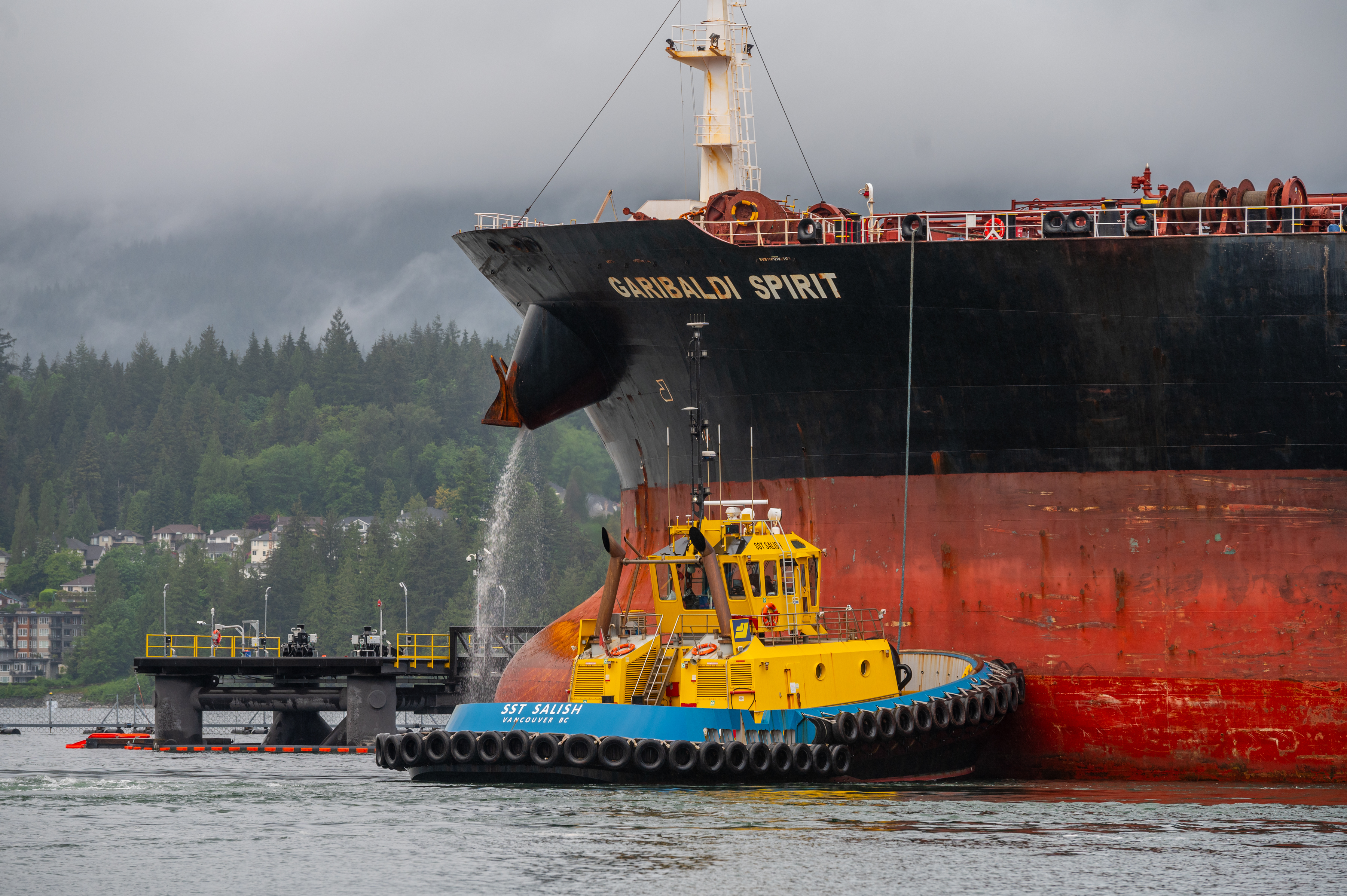
An important marine safety practice for all large deep draft commercial vessels, escort tugs help minimize the risk of collision or grounding if a vessel becomes disabled for any reason.

Local tug escort services support tanker transit and other large commercial ships within the Port of Vancouver per the requirements of the Vancouver Fraser Port Authority.

Outside the Port of Vancouver, tug escorts are another requirement mandated by PPA for laden vessels carrying liquids in bulk. Under current regulation, an escort tug accompanies the vessel from the jurisdictional boundaries of Vancouver Harbour until the vicinity of Race Rocks, an ecological reserve west of Victoria. When passing through Boundary Pass (East Point on Saturna Island) and Haro Straight (Brotchie Ledge), the escort tug is tethered to the ship to ensure safe passage. The tug must be able to steer and stop the ship to minimize the risk of grounding or collision if the vessel cannot function.

The Vancouver Fraser Port Authority (VFPA) is the federal agency overseeing the lands and waters within the Port of Vancouver. The VFPA regulates all port vessel traffic, including Roberts Bank and a portion of the Fraser River.

The VFPA has designated First and Second Narrows as Traffic Control Zones (TCZ-1 and TCZ-2). The existing rules for transit through these areas ensure the safety of all marine waterway users, including vessel size, draft restrictions, slack water transit windows and requirements for tug escorts. When a vessel departs through Second Narrows, (e.g., a laden tanker leaving Westridge Marine Terminal), two escort harbour tugs must remain with it until past First Narrows. The vessel's transit through the Port of Vancouver, including First and Second Narrows, is also monitored.

Port of Vancouver Information Guide is maintained by the VFPA. Every terminal in the port follows safe operating standards outlined by the VFPA and other regulatory bodies.

Find more information on Westridge Marine Terminal operations.

Deep-draft vessels, including oil tankers calling at Westridge Marine Terminal, must meet the strict building regulations established by the International Maritime Organization and the vessel's flag state (the state under whose laws the vessel is registered or licensed). The Class Societies, a non-governmental organization, oversees technical standards for the construction and operation of ships and offshore structures. Tankers are built with double hulls sub-divided into smaller tanks, segregated cargo tanks and other modern safety precautions. Canada, as a signatory, has adopted these rules. Additionally, all vessel crew members are trained before receiving certificates of competency following International Maritime Organization requirements.

Learn more about oil tankers.

Additional Safety and Risk Control Measures

Trans Mountain has long recognized concerns about marine oil spills and has taken steps to contribute to marine safety, including spill prevention and response. With our commitment to marine safety, we will remain an advocate of safety and enhanced stewardship in the marine community. We have built on the existing marine safety regime with additional safety and risk control measures for vessels calling at Westridge Marine Terminal, including increased tug assets, safe navigation practices and enhanced emergency response.

Trans Mountain has increased tug escort requirements for laden tankers departing Westridge Marine Terminal to encompass the entire shipping route, spanning from the jurisdictional boundaries of Vancouver Harbour to the western entrance of the Juan de Fuca Strait (near Canada's 12-nautical mile territorial sea limit). The Pacific Pilotage Authority (PPA) issued new guidance that extends tug escort for laden vessels carrying bulk liquids.

KOTUG Canada Inc. was selected as the exclusive provider of this service. Escort services are provided by KOTUG Canada’s two new dual fuel (methanol and diesel) escort tugs specially designed by Robert Allan Ltd., a world-renowned naval architect firm based in Vancouver, BC. These tugs are equipped to steer and stop tankers in any foreseeable meteorological and ocean conditions.

As specified in Trans Mountain’s Vessel Acceptance Standard and the Westridge Marine Terminal Regulations and Operations Guide, all vessels nominated to load at Westridge Marine Terminal must confirm their arrangement with KOTUG Canada prior to being accepted to call at the terminal.

Trans Mountain collaborated with the PPA to extend the pilotage requirement by more than 30 kilometres for outbound laden tankers to ensure safe departure from Canadian waters. The two licensed marine pilots will disembark from the vessel by helicopter or pilot launch after it reaches Race Rocks, an ecological reserve west of Victoria, instead of at the pilot station near Victoria.

Trans Mountain and its pipeline shippers have made significant investments to enhance spill prevention and response measures on BC’s South Coast.

As a shareholder and founding member of Western Canada Marine Response Corporation (WCMRC), the only Transport Canada-certified marine response organization on Canada’s West Coast, Trans Mountain’s investments of over $150 million halved WCMRC’s response time, doubled its capacity and reduced the delivery time for meeting existing planning standards by 50 per cent. This legacy has improved spill prevention and response along the entire shipping route as well as for all marine waterway users.

Learn more about WCMRC and marine oil spill prevention and response.

Additional safety measures ensure the marine safety regime is aware of precautions and informed when a laden tanker is passing through. This includes safety calls from pilots and masters of laden tankers, along with industry notices issued by Pacific Pilotage Authority.

Loading
Loading