Image

A Custom PCB For The Casio G-Shock

With the PCB fabrication services available to the modern hobbyist, it’s become increasingly common to see replacement boards designed for all sorts of devices. Even so, it’s sometimes still a little difficult to believe that we’re at the point where hardware hackers are now producing advanced replacement PCBs for commercial wristwatches such as this drop-in upgrade for the iconic Casio G-Shock by [David Volovskiy].

ImageHonestly, we’d have been impressed if the thing could just tell the time. But the replacement board combined with the open source firmware brings new capabilities that far exceed anything the G-Shock was capable of originally. The upgraded watch now offers several applications, such as a pedometer and a number of games including simplified versions of Blackjack and Wordle. The watch can tell you the phase of the Moon, calculate sunrise and sunset, and display values pulled from the internal thermometer.

Even if you don’t have a G-Shock in need of a new PCB, [David] has put together a web-based emulator that lets you play around with the firmware. The online tool that lets you visualize how the watch’s LCD is mapped is also very slick. For those interested in getting a board of their own, you can join the project’s Discord server and get your name on the list for an upcoming production run.

If some of this sounds familiar, it’s because [David] based his project on [Joey Castillo]’s Sensor Watch, which is a replacement PCB for the Casio F-91W. With these two projects available for others to build from, one wonders how many other Casio watches might get their own upgraded hardware in the future.

Image

A Casio Toy Synth Is Ready To ROCK!

There is likely to be more than one of you who has eyed up a child’s toy synthesizer in a second hand store, and considered making something more impressive with it. In many cases these instruments are underwhelming, having a very small subset of functions based into their black-epoxy-blob microcontrollers.

[Make Something] found a Casio toy synth that has a few more functions than the average model, and with the addition of some extra effects electronics and a beautifully made case, turned it into an altogether more interesting instrument.

Most of the video has an element of workshop porn about it, as he makes a very nice Moog-style console case for it, a task made easier by an impressive array of CNC tools. The electronics are slightly more interesting, being a selection of cheap guitar pedals gutted and combined with a cheap tube preamp board. The result is a machine capable of some far more interesting sounds

We think many Hackaday readers would be able to repeat these functions from scratch without the pedals, and while the case is a thing of beauty it’s likely a decent job could be done with a little less finesse on more commonplace tools. Perhaps it’s worth giving those toy synths a second look, because they really can be had for pennies if you look hard enough. Perhaps it’s an easier option than a previous toy musical upgrade.

Continue reading “A Casio Toy Synth Is Ready To ROCK!”

Image

Calculator Battery Mod Lets You Go The Distance

Disposable batteries seem so 1990s. Sure, it’s nice to be able to spend a couple of bucks at the drugstore and get a flashlight or TV remote back in the game, but when the device is a daily driver, rechargeable batteries sure seem to make more financial sense. Unfortunately, what makes sense to the end user doesn’t always make sense to manufacturers, so rolling your own rechargeable calculator battery pack might be your best option.

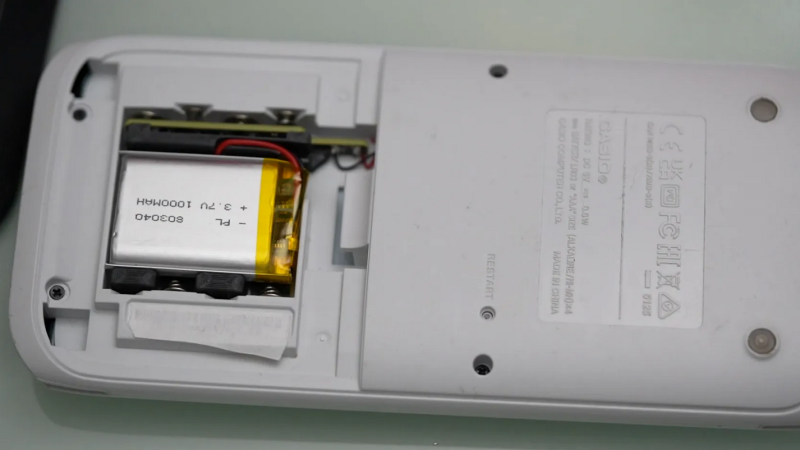
This slick hack comes to us from [Magmabow], who uses a Casio FXCG50 calculator, a known battery hog. With regular use, it goes through a set of four alkaline AA batteries every couple of months, which adds up quickly. In search of a visually clean build, [Magmabow] based the build around the biggest LiPo pillow-pack he could find that would fit inside the empty battery compartment, and planned to tap into the calculator’s existing USB port for charging. A custom PCB provides charging control and boosts the nominal 3.7-volt output of the battery to the 5-ish volts the calculator wants to see. The PCB design is quite clever; it spans across the battery compartment, with its output feeding directly into the spring contacts normally used for the AAs. A 3D-printed insert keeps the LiPo and the PCB in place inside the battery compartment.

Almost no modifications to the calculator are needed, other than a couple of bodge wires to connect the battery pack to the calculator’s USB port. The downside is that the calculator’s battery status indicator won’t work anymore since the controller will just shut the 5-volt output down when the LiPo is discharged. It seems like there might be a simple fix for that, but implementing it on such a small PCB could be quite a challenge, in which case a calculator with a little more room to work with might be nice. Continue reading “Calculator Battery Mod Lets You Go The Distance”

Image

A Label Printer Gets A New Brain

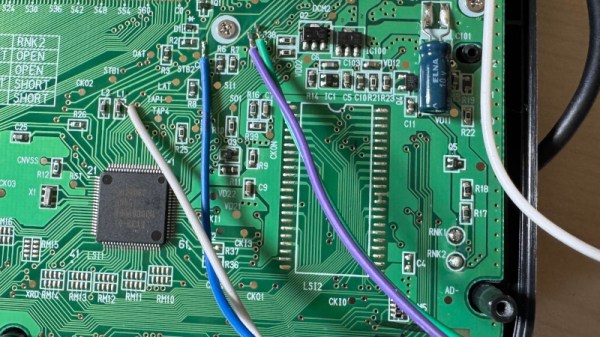
The internals of a printer, whatever technology it may use, are invariably proprietary, with an abstracted more standard language being used to communicate with a host computer. Thus it’s surprisingly rare to see hacks on printers as printers, rather than printer hacks using the parts for some other purpose. This makes [Oelison]’s brain-swap of a Casio thermal label printer a welcome surprise, as it puts an ESP32 in the machine instead of whatever Casio gave it.

The value in the hack lies in the insight it gives into how a thermal printer works as much as it does in the ESP32 and the Casio, as it goes into some detail on the various signals involved. The strobe line for instance to enable the heater is a nuance we were unaware of. The resulting printer will lose its keyboard and display, but  make up for it in connectivity.

Despite what we said earlier this isn’t the first label printer hack we’ve seen. A previous one was Linux-based though.

Image

Teardown Of Casio Credit Card-Sized Radio

These days we don’t get too fussed about miniaturized electronics, not when you can put an entire processor and analog circuitry on a chip the size of a grain of sand. Things were quite different back in the 1980s, with the idea of a credit card-sized radio almost preposterous. This didn’t stop the engineers over at Casio from having a go at this and many other nutty ideas, with [Matt] from Techmoan having a go at taking one of these miniaturized marvels apart.

Image
The Casio FM Stereo radio in happier days. (Credit: Techmoan, YouTube)

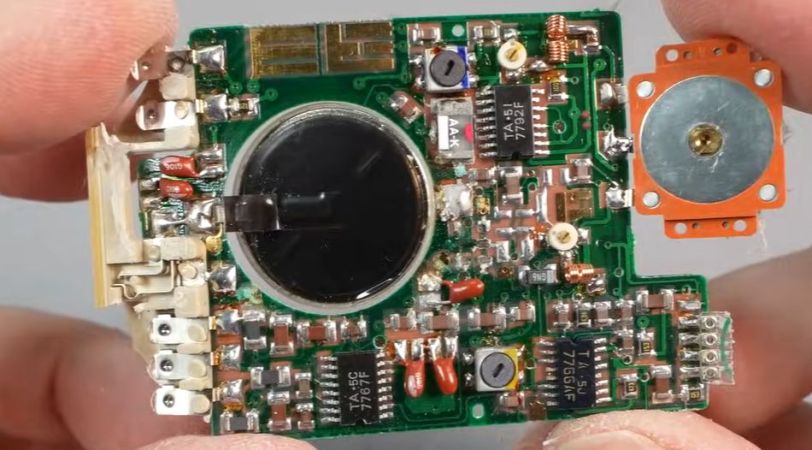
On the chopping block is the FM stereo device that was featured in a previous episode. Out of the four credit card-sized radios in that video, the one with the rechargeable battery (obviously) had ceased to work, so it was the obvious choice for a teardown. This mostly meant peeling off the glued-on top and bottom, after which the circuitry became visible.

In addition to the battery with a heavily corroded contact, the thin PCB contains a grand total of three ICs in addition to the analog circuitry. These were identified by [Spritetm] as an AM/FM tuner system IC (TA7792), an FM PLL MPX (TA7766AF) and a headphone amplifier (TA7767F), all of them manufactured by Toshiba.

Although [Matt] reckons this was a destructive teardown, we’re looking forward to the repair video where a fresh cell is soldered in and the case glued back together. Continue reading “Teardown Of Casio Credit Card-Sized Radio”

Image

Card Radios Remembered

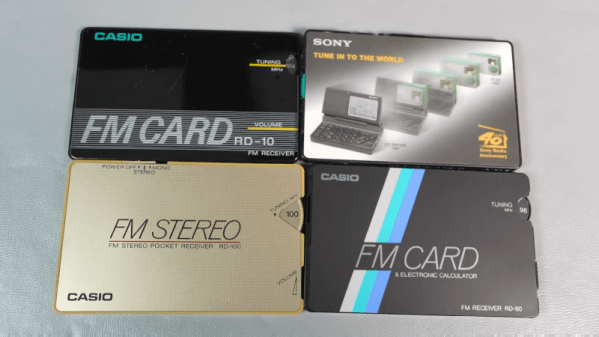
We know how [Techmoan] feels. In the 1980s we had a bewildering array of oddball gadgets and exciting new tech. But as kids we didn’t have money to buy a lot of what we saw. But he had a £5 note burning a hole in his pocket from Christmas and found a Casio RD-10 “card radio” on sale and grabbed it. He’s long-ago lost that one, but he was able to find a new old stock one and shows us the little gadget in the video below.

The card-thin (1.9 mm) FM radio had many odd features, especially for the 1980s. For one thing, it took a coin cell, which was exotic in those days. The headphones had a special flat connector that reminded us of an automotive fuse. Even the idea of an earbud was odd at that time.

Continue reading “Card Radios Remembered”

Illustrated Kristina with an IBM Model M keyboard floating between her hands.

Keebin’ With Kristina: The One With The Cutting Board Keyboard

Doesn’t this look fantastic? Hard to believe it, but the base of this keyboard began life as a cutting board, and there’s a gallery to prove it. This is actually [androidbrick]’s second foray into this type of upcycling.

This time, [androidbrick] used a FiiO KB3 and replaced the bottom half of the plastic shell with a hand-routed kitchen cutting board. The battery has been disabled and it works only in wired mode, which is fine with me, because then you get to use a curly cord if you want.

A lovely keyboard built into a kitchen cutting board.
Image by [androidbrick] via reddit
The switches are mostly Gateron EF Currys, though [androidbrick] left some of the original Gateron G Pro 3.0 on the stabilized keys just for comparison. As you might imagine, the overall sound is much deeper with a wooden bottom. You can check out the sound test on YouTube if you’d like, though it’s pretty quiet, so turn it up.

Those keycaps look even nicer from top-down, which you’ll see in the sound test video linked above. Just search ‘JCM MOA GMK’ on Ali and you’ll find them in a bunch of colorways for around $20. Apparently, [androidbrick] was saving them for months, just waiting for this build.

Via reddit

Continue reading “Keebin’ With Kristina: The One With The Cutting Board Keyboard”