
Image

A Custom PCB For The Casio G-Shock

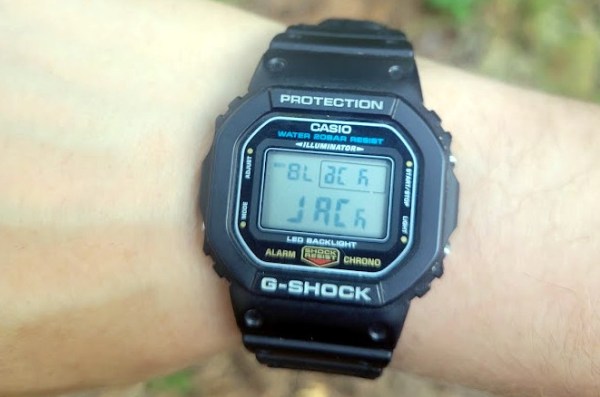
With the PCB fabrication services available to the modern hobbyist, it’s become increasingly common to see replacement boards designed for all sorts of devices. Even so, it’s sometimes still a little difficult to believe that we’re at the point where hardware hackers are now producing advanced replacement PCBs for commercial wristwatches such as this drop-in upgrade for the iconic Casio G-Shock by [David Volovskiy].

ImageHonestly, we’d have been impressed if the thing could just tell the time. But the replacement board combined with the open source firmware brings new capabilities that far exceed anything the G-Shock was capable of originally. The upgraded watch now offers several applications, such as a pedometer and a number of games including simplified versions of Blackjack and Wordle. The watch can tell you the phase of the Moon, calculate sunrise and sunset, and display values pulled from the internal thermometer.

Even if you don’t have a G-Shock in need of a new PCB, [David] has put together a web-based emulator that lets you play around with the firmware. The online tool that lets you visualize how the watch’s LCD is mapped is also very slick. For those interested in getting a board of their own, you can join the project’s Discord server and get your name on the list for an upcoming production run.

If some of this sounds familiar, it’s because [David] based his project on [Joey Castillo]’s Sensor Watch, which is a replacement PCB for the Casio F-91W. With these two projects available for others to build from, one wonders how many other Casio watches might get their own upgraded hardware in the future.
Image

Casio Watch Gets A MEMS Oscillator Upgrade

We’ve got to admit to being a bit of a Casio G-Shock watch geek. The big, chunky watches were every day carry items that survived everything we dished out, right up until the smartphone made wearing one seem redundant. But others continue to use and abuse G-Shocks, and some brave souls even hack them.

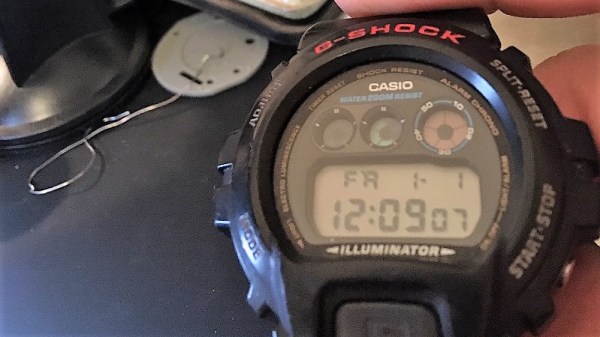
Replacing the standard quartz crystal with a temperature-compensated MEMS oscillator is one hack that [Alex] tried, and it appears to have worked out well. His project write-up doesn’t specify which MEMS oscillator was used, but we suspect it’s the SiT1552 TCXO. With its extremely small size, stability over a wide range of temperatures, and ultra-low power requirements, the chip is a natural choice to upgrade the stock 32.768-kHz quartz crystal of the watch. Trouble is, the tiny 1.5 mm x 0.8 mm chip-scale package (CSP) device presented some handling problems. After overcooking a few chips in the reflow oven, [Alex] was able to get one mounted to a tiny breakout board, which went into the space formerly occupied by the watch’s quartz crystal. He stole power for the TCXO from a decoupling capacitor, sealed the watch back up, and it’s back in service with better stability and longer battery life to boot. The video below shows the TCXO undergoing tests alongside the original quartz crystal and a comparatively huge DS3231 RTC module, just for fun.

[Alex]’s MEMS transplant seems a long way to go and a lot of fussy work for marginal gains, but who are we to judge? And it does make the watch susceptible to punking with a little helium, which might make things interesting.

Continue reading “Casio Watch Gets A MEMS Oscillator Upgrade”

Simple Hack Creates An Inverted Watch Display

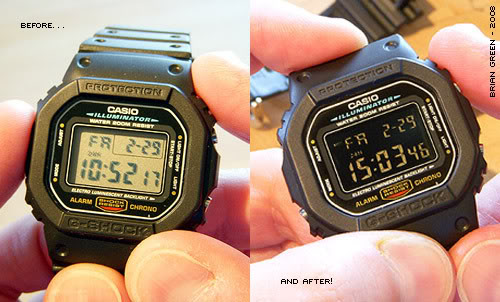
Before and after of a negative display watch conversion

Sometimes you have to bust out the wayback machine to find a good hack. Back in 2008, [Brian] performed this awesome negative display hack on his classic Casio G-Shock watch. The G-Shock, like most digital watches, uses a twisted nematic LCD. All Liquid Crystal Displays are made up of a layer cake of polarizers, glass, and liquid crystal. In non touchscreen displays, the top layer is a sheet of polarizing film glued down with an optical quality adhesive.

[Brian] disassembled his watch to reveal the LCD panel. Removing the glued down polarizing film can be a difficult task. Pull too hard and the thin glass layers will crack, rendering the display useless. After some patient work with an X-acto knife [Brian] was able to remove the film.

Much like the privacy monitor hack, the naked watch appeared to be off. Holding a sheet of linear polarizing film between the watch and the viewer reveals the time. If the film is rotated 90 degrees, the entire screen is color inverted. [Brian] liked the aesthetics of the inverted screen, so he glued down his polarizing film in the offset position. After reassembly, [Brian’s] “customized” watch was ready to wear.

[Via Hacker News]









