Image

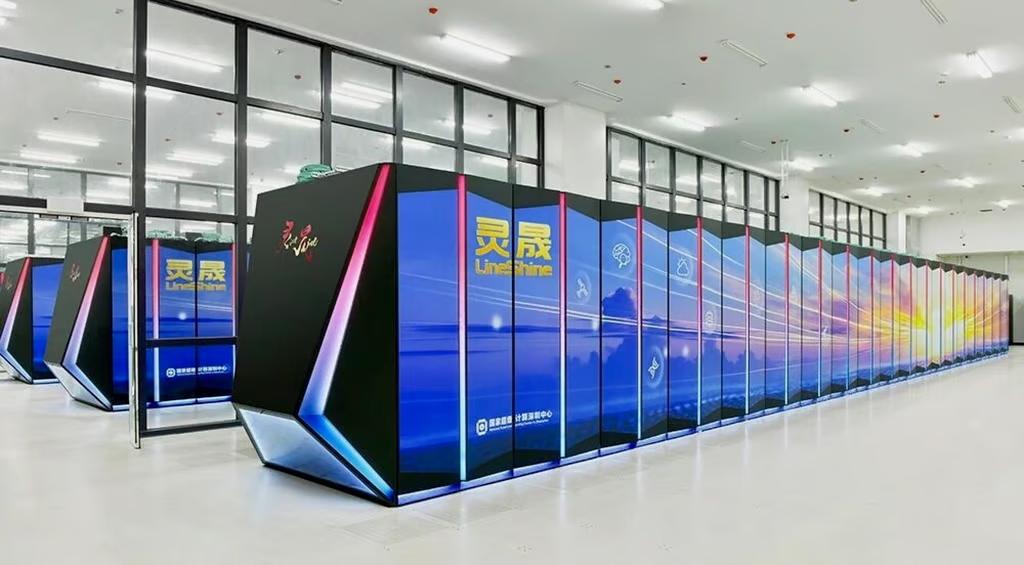
LineShine Is Fastest Supercomputer At Over 2 Exaflops

There is a phenomenon where as you get older, your sense of scale becomes somewhat fixed in the earlier era that shaped you– things like expecting the Dollar Store to carry items for 1$, or to get a burger and fries for less than twenty bucks– or, in this case, thinking of supercomputers as being petaflop-scale machines. That’s not wrong, per se– most of the world’s fastest machines benchmarks are best measured in petaflops– but when you’re clocking at 2198 of the things, it becomes easier just to say that the LineShine computer can do 2.188 exaflops. At double precision. With CPUs only. Yes, we are impressed.

Even more impressive is that this machine just debuted in China, which means it was built without the benefit of the latest-and-greatest Western chips, thanks to US sanctions. It’s using a made-in-China LX2 CPU with 304 ARMv9 cores onboard. Well, it’s actually using around 46 thousand of them, but who’s counting?

Each CPU actually consists of two separate compute dies and onboard high bandwith memory (HBM) and DRAM– 4GB of HBM and 32GB of DDR5. The 152 ARMv9 CPU cores on each chip are all built with Scalable Vector Extensions (SVE) and Scalable Matrix Extensions (SME), so despite the lack of GPUs LineShine will have no problem doing the sorts of vector processing that is traditional for high-performance computing, given the 13.79 million cores.

On the other hand, the lack of GPUs shows when you change benchmarks– LineShine is number one in the rankings for High Performance Linpack (HPL), but getting outside the 64-bit box, the supercomputer only hits number four on the HPL-MxP mixed-precision benchmark, behind machines that pair their CPUs with accelerators like GPUs or NPUs. That may mollify the American ego, as while their El Capitain was bumped to second place on the HPL list, they can still claim the pole position on HPL-MxP. Which computer is actually more capable depends entirely on what you want to do with it, and neither Lawrence Livermore National Laboratory nor China’s National Supercomputing Centre in Shenzhen advertise their compute queues, though this paper suggests at least one job will be crunching earth observation data.

The definition of a supercomputer has shifted over time, and it’s only a matter of time before LineShine and El Capitain end up on the auction block, like other supercomputers before them. We might question it when it comes to desktops, but for institutional HPC, no amount of computing ever seems to be enough.


Image

Ask Hackaday: How Much Compute Is Enough?

Over the history of this business, a lot of people have foreseen limits that look rather silly in hindsight– in 1943, IBM President Thomas Watson declared that “I think there is a world market for maybe five computers.” That was more than a little wrong. Depending on the definition of computers– particularly if you include microcontrollers, there’s probably trillions of the things.

We might as well include microcontrollers, considering how often we see projects replicating retrocomputers on them. The RP2350 can do a Mac 128k, and the ESP32-P4 gets you into the Quadra era. Which, honestly, covers the majority of daily tasks most people use computers for.

The RP2350 and ESP32-P4 both have more than 640kB of RAM, so that famous Bill Gates quote obviously didn’t age any better than Thomas Watson’s prediction. As Yogi Berra once said: predictions are hard, especially about the future. Continue reading “Ask Hackaday: How Much Compute Is Enough?”

Image

Modern Smartphone Vs. 80s Supercomputer

One of the most common ways of comparing the processing power of some microcontroller or older smartphone in a fantastical way was to say that they had more processing power than the Apollo Guidance Computer. While this sounds impressive on the surface, the AGC was the first integrated circuit computer ever built and is predictably under-powered by almost all modern standards. A more apt comparison would be to compare a smartphone to a supercomputer from some bygone era, and someone has recently done just that.

Image
Cray 2

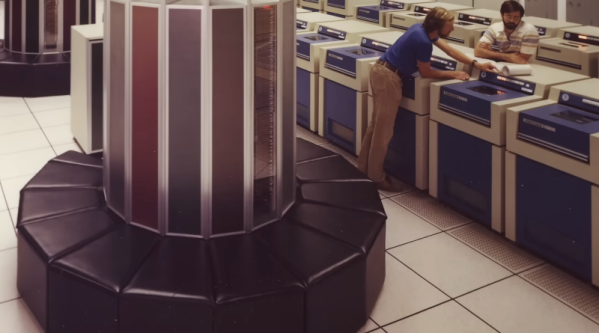
The linked article looks at a modern iPhone 17 compared to the Cray 2 supercomputer. When the Cray 2 was first built in the mid 80s, it was the fastest computer in the world at 1.9 GFLOPS using four vector processors. A modern iPhone is estimated to have slightly more than that, so in some ways the iPhone comes out on top.

However, the Cray 2 was built with vector processors, a specialized type of processor meant to perform rapid calculations on specific types of data sets. So the Cray 2 may have been faster at these types of tasks than the more general-purpose A19 processor, and the A19 may have the edge in other tasks.

The other major difference the article doesn’t discuss is what software runs on these computers. The Cray 2 supercomputer ran a modified version of UNIX System V, which at the time was owned by AT&T (and which ran on plenty of other computers as well). Although proprietary in some sense, it was much more open than Apple’s iOS operating system, allowing users to run whatever software they wanted to run on the supercomputers that they bought and paid for, and to modify many parts of the operating system itself. In that sense, the Cray will always maintain the edge over Apple and their walled garden.

Image

NextSilicon’s Maverick-2: The Future Of High-Performance Computing?

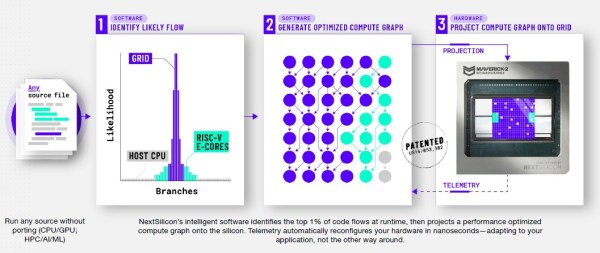
A few months back, Sandia National Laboratories announced they had acquired a new supercomputer. It wasn’t the biggest, but it still offered in their eyes something unique. This particular supercomputer contains NextSilicon’s much-hyped Maverick-2 ‘dataflow accelerator’ chips. Targeting the high-performance computing (HPC) market, these chips are claimed to hold a 10x advantage over the best GPU designs.

NextSilicon Maverick-2 OAM-2 module. (Credit: NextSilicon)

The strategy here appears to be somewhat of a mixture between VLIW, FPGAs and Sony’s Cell architecture, with a dedicated compiler that determines the best mapping of a particular calculation across the compute elements inside the chip. Naturally, the exact details about the internals are a closely held secret by NextSilicon and its partners (like Sandia), so we basically have only the public claims and PR material to go by.

Last year The Register covered this architecture along with a more in-depth look. What we can surmise from this is that it should perform pretty well for just about all applications, except for single-threaded performance. Of course, as a dedicated processor it cannot do CPU things, which is where NextSilicon’s less spectacular RISC-V-based CPU comes into the picture.

What’s apparent from glancing at the product renders on the NextSilicon site is that these Maverick-2 chips have absolutely massive dies, so they’re absolutely not cheap to manufacture. Whether they’ll make more of a splash than Intel’s Itanium or NVIDIA’s brute force remains to be seen.

Image

Your Supercomputer Arrives In The Cloud

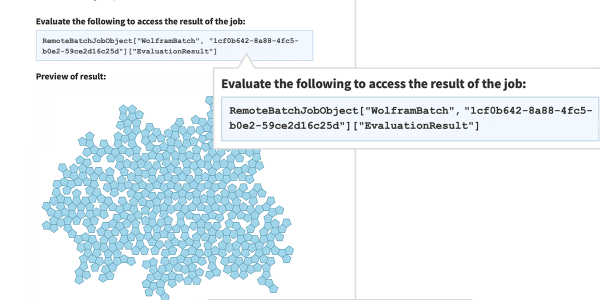
For as long as there have been supercomputers, people like us have seen the announcements and said, “Boy! I’d love to get some time on that computer.” But now that most of us have computers and phones that greatly outpace a Cray 2, what are we doing with them? Of course, a supercomputer today is still bigger than your PC by a long shot, and if you actually have a use case for one, [Stephen Wolfram] shows you how you can easily scale up your processing by borrowing resources from the Wolfram Compute Services. It isn’t free, but you pay with Wolfram service credits, which are not terribly expensive, especially compared to buying a supercomputer.

[Stephen] says he has about 200 cores of local processing at his house, and he still sometimes has programs that run overnight. If your program already uses a Wolfram language and uses parallelism — something easy to do with that toolbox — you can simply submit a remote batch job.

Continue reading “Your Supercomputer Arrives In The Cloud”

Image

So What Is A Supercomputer Anyway?

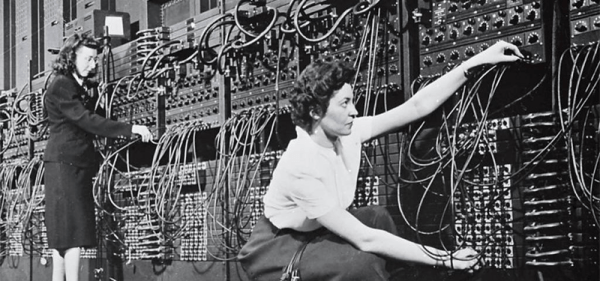
Over the decades there have been many denominations coined to classify computer systems, usually when they got used in different fields or technological improvements caused significant shifts. While the very first electronic computers were very limited and often not programmable, they would soon morph into something that we’d recognize today as a computer, starting with World War 2’s Colossus and ENIAC, which saw use with cryptanalysis and military weapons programs, respectively.

The first commercial digital electronic computer wouldn’t appear until 1951, however, in the form of the Ferranti Mark 1. These 4.5 ton systems mostly found their way to universities and kin, where they’d find welcome use in engineering, architecture and scientific calculations. This became the focus of new computer systems, effectively the equivalent of a scientific calculator. Until the invention of the transistor, the idea of a computer being anything but a hulking, room-sized monstrosity was preposterous.

A few decades later, more computer power could be crammed into less space than ever before including ever higher density storage. Computers were even found in toys, and amidst a whirlwind of mini-, micro-, super-, home-, minisuper- and mainframe computer systems, one could be excused for asking the question: what even is a supercomputer?

Continue reading “So What Is A Supercomputer Anyway?”

Image

Remembering Seymour Cray

If you think of supercomputers, it is hard not to think of Seymour Cray. He built giant computers at Control Data Corporation and went on to build the famous Cray supercomputers. While those computers aren’t especially amazing today, for their time, they were modern marvels. [Asianometry] has a great history of Cray, starting with his work at ERA, which would, of course, eventually produce the computer known as the Univac 1103.

ERA was bought up by Remington Rand, which eventually became Sperry Rand. Due to conflict, some of the ERA staff left to form Control Data Corporation, and Cray went with them. The new company decided to focus on computers to do simulations for things like nuclear test simulations.

Continue reading “Remembering Seymour Cray”