

The SQL WITH clause (Common Table Expression or CTE) defines a temporary result set that can be used within a query. It simplifies complex SQL statements, making them easier to read, manage and reuse.
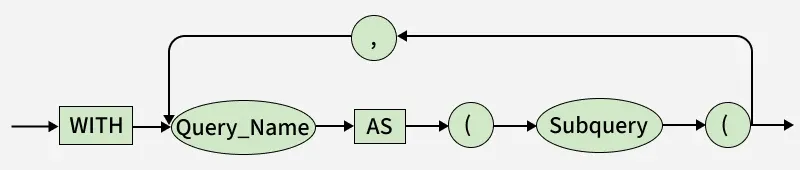
- WITH: Starts the CTE definition, creating a temporary result set.
- QueryName: User-defined name to reference the CTE later.
- AS: Connects the CTE name with its subquery.
- ( ) : Encloses the subquery (e.g., a SELECT statement).
- Subquery: Provides data for the CTE, improving readability and reuse.
- Flow: Syntax, WITH QueryName AS (Subquery) followed by the main query.
Syntax
WITH cte_name (column1, column2, ...)
AS (
    SELECT column1, column2, ...
    FROM table_name
    WHERE condition
)
SELECT *
FROM cte_name;
- cte_name is the name of the Common Table Expression.
- The query inside parentheses defines the temporary result set.
- The main query uses this CTE as if it were a table.
Examples of SQL WITH Clause
First, we will create a demo SQL database and table, on which we will use the WITH Clause command.
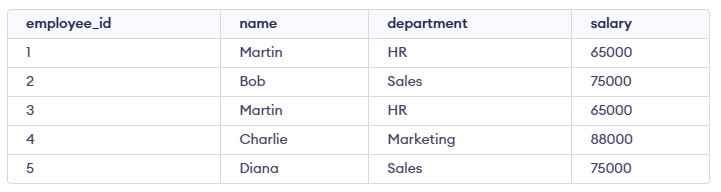
Example 1: Finding employees with Above-Average Salary
This example finds employees whose salary is above the overall average salary.
Query:
WITH AvgSalaryCTE (average_salary) AS (
    SELECT AVG(salary)
    FROM employees
)
SELECT employee_id, name, salary
FROM employees
WHERE salary > (
    SELECT average_salary
    FROM AvgSalaryCTE
);
Output:

Example 2: Finding employees with the Lowest Salary
In this example, we find the employee or employees who earn the lowest salary in the company.
Query:
WITH MinSalaryCTE (min_salary) AS (
    SELECT MIN(salary)
    FROM employees
)
SELECT employee_id, name, salary
FROM employees
WHERE salary = (
    SELECT min_salary
    FROM MinSalaryCTE
);
Output:

- CTE: Calculates the lowest salary using MIN(salary).
- Main SELECT: Retrieves employee details.
- WHERE Filter: Returns employees whose salary equals the lowest salary.
Nested (Chained) WITH Clauses
A Nested or Chained WITH Clause defines multiple CTEs in one query, where each CTE can use the result of the previous one to simplify complex calculations.
WITH DeptAvg AS (
    SELECT department, AVG(salary) AS avg_salary
    FROM employees
    GROUP BY department
),
ranked_employees AS (
    SELECT e.employee_id,
           e.name,
           e.department,
           e.salary,
           d.avg_salary,
           RANK() OVER (
               PARTITION BY e.department
               ORDER BY e.salary DESC
           ) AS salary_rank
    FROM employees e
    JOIN DeptAvg d
        ON e.department = d.department
)
SELECT *
FROM ranked_employees
WHERE salary_rank = 1;
Output:

- DeptAvg: Calculates the average salary for each department.
- Rankedemployees: Ranks employees by salary within each department.
- Final SELECT: Returns the highest-paid employee(s) from each department, including ties.
Note: When a query with a WITH clause runs, the subquery inside it is executed first to create a temporary result set, which is then used by the main query.
