Image

2026 Hackaday Supercon: Bruce Potter’s Keynote Explores The Hacker Mind

What is hacking? Many, especially in the mainstream, view it through the lens of computer security. Others consider it synonymous with making or creating. Even for those of us immersed in the community, this can be a surprisingly difficult question to answer.

In his Hackaday Supercon 2026 keynote address, Bruce Potter will explore this idea by taking a step back and looking at what makes someone a hacker in the first place. Rather than viewing hacking as a singular act, he’ll make the case that it’s a mindset, a way of approaching problems that’s not strictly dependent on the tools used or even the desired outcome.

Image
Bruce Potter

With a cybersecurity career that’s spanned three decades, Bruce has been involved with hacking at every level and in every form — from conducting DARPA research to founding The Shmoo Group and helping organize the legendary ShmooCon. Currently the Chief Product Officer at Trinity Cyber, Bruce has made creative problem solving his life’s work, and he’s eager to share what he’s learned with the Hackaday community. While most of us won’t get the opportunity to advise on national cybersecurity policy as he has, we can still apply the same techniques to our own personal and professional projects.

Those joining us this weekend in Pasadena will get to experience Bruce’s keynote, as well as more than 30 other fascinating presentations, with a group of individuals who are just as eager to understand the how and why of the world around them as you are. Making personal connections with like-minded folks is truly the highlight of Hackaday Supercon; badge hacking and tacos are just the fringe benefits.

In our totally unbiased opinion, we believe Hackaday Supercon is the ultimate hardware hacking conference, but you don’t have to take our word for it. A few tickets are still left if you want to see for yourself.
Image

Bring On Supercon!

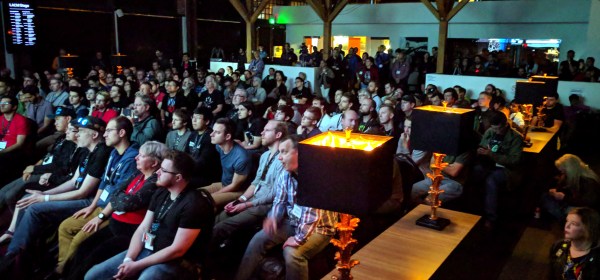
In just under a week from today, almost 700 hackers will be getting together in Pasadena, CA for three days of scheming, soldering, and socializing. If you’re able to join us, you absolutely should – there is no substitute for attending a hacker convention in person.

But even if you can’t make it to Supercon, you’re not shut out. We have an absolutely killer slate of talks, and we’ll be streaming at least one stage’s worth during the event. Watching a good talk isn’t just entertainment, but it can plant new seeds of possibility in your brain, or give you new perspectives on something that you thought you already knew. A super talk can launch a thousand hacks.

Image

It’s a funny part of our culture, that even though we all have the Internet where the printed word and the video reign supreme, many of our best ideas are still transmitted the old fashioned way: one person who has thought deeply about a topic gets up in front of a room and lets loose. Maybe it’s because presentations require so much preparation that they’re so powerful? I don’t know, but I do know that I’ve seen a number of Supercon (and other!) talks that have literally changed the way I see the world. A good presentation sticks with you.

Hackaday strives to be the equivalent of the newspaper of record for everything going on in our scene. If there is a cool hack out there, we want to showcase it so that everyone can draw from it. In just exactly the same vein, we are stoked and honored to be the stage for the next round of great talks. Whether you’re there in the audience live with us, or watching along at home, and whichever of the topics you’re interested in, we hope that the signal gets out to you.

Image

2026 Hackaday Supercon: All The Speakers!

We announced our first round of speakers, and then the workshops, and we were going to dribble out updates on the rest of the speakers as they came in, but then time slipped away from us. So we are left here announcing a veritable cornucopia of twenty wonderful talks that you absolutely won’t want to miss.

Supercon is just about a week away, and there are still a few tickets left, so grab them now before it’s too late.

And the talks are just half the fun. Between food, merriment, a killer badge with the biggest e-paper display that you’ve ever seen, and all the assorted shenanigans, it’s the highlight of our hacking year. Come join us!

Continue reading “2026 Hackaday Supercon: All The Speakers!” →

Image

How A Single University Project Started Everything

If we care to cast an eye over the history of ubiquitous personal computing as we know it today, we might immediately point at the original IBM PC. After all, for most of us our machines share backward compatibility in some form through multiple generations back to that original box from 1981.

But if we look at the things we use today and take for granted, from laser printers to graphics cards to the routers which power most of the Internet, they’re not from IBM at all. At the recent Vintage Computing Festival Berlin, [Michael Engel] delivered a talk naming a surprising progenitor for much of that technology, none other than Sun Microsystems.

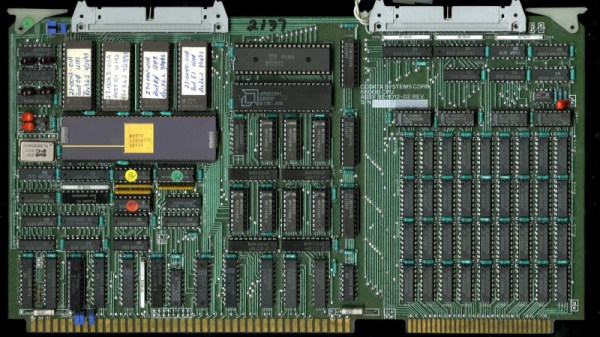
It all starts with [Andy Bechtolsheim], famously Sun’s co-founder, when at the end of the 1970s he was a postgraduate at Stanford University. Working on the Stanford University Network — SUN — project he designed a computer to be used as a workstation on the network. The processor of choice then was Motorola’s 68000, but it lacked the MMU that would be required to run UNIX. His design had an MMU implemented externally to the 68000, with a bank of SRAM serving as the page table. This design would form the CPU board of the first Sun workstation.

The story might end there, were it not that many other companies had the same requirement, and Sun could supply them a CPU board. Silicon Graphics, the distant ancestral progenitor of your GPU, was one of them, so the first SGI workstation also had the same CPU as the first Sun. It appeared in the early Imagen laser printers too, as well as commercial AppleTalk to Ethernet bridges. Perhaps the biggest surprise is that because the original Stanford board had also been used as a router, the software for that became part of Cisco’s first product.

The video is below the break, and it’s a fascinating watch.

Continue reading “How A Single University Project Started Everything” →

Image

The Trials And Tribulations Of Your First Badge

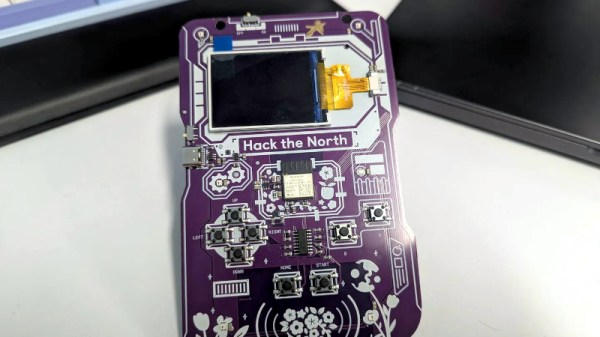
On the face of it, making an event badge should be an easy process. After all, most of us can hand-assemble a microcontroller, some buttons, a battery, and a screen. But anyone who has been involved in producing one will tell you, the difference between producing one or two, and making sure hundreds or even thousands appear on day one of the event fully working is enormous. [Nicholas Ficara] produced 1750 of his first badge for Canada’s Hack The North hackathon, and he’s shared the full story.

We’ve been involved with the gestation of more than one badge here at Hackaday, so we recognise some of his learning moments only too well. He approached it with a well-planned series of prototype and release candidate steps to catch the problems, which came in handy as there certainly were a few. Wrong footprints, misplaced components, power supply issues, and rotated parts were fixed, and eventually they were delivered in time. It’s good to see that they were well received and well used at the event.

If you’re thinking of doing a badge we can certainly recommend that you give this a read. A few years ago we wrote up the story of another badge whose creators put in some hard work to save it from a more serious part error.

Image

2026 Hackaday Supercon: Workshops Are Open!

Supercon is Hackaday’s annual gathering, and you absolutely need to be there.

Today, we’re pleased to announce our lineup of workshops, and it’s more than we’ve ever offered, thanks to moving to a bigger venue and to our awesome community of hackers stepping up to give them. There’s something here for everyone, so if anything strikes your fancy, be sure to book yourself a slot soon. (If you have a ticket already, you sign up for the workshop as an “add-on”, BTW.) Workshops always fill up fast, due to the small and hands-on nature of the beast.

Continue reading “2026 Hackaday Supercon: Workshops Are Open!” →

Image

JawnCon 0x3 Kicks Off In Philadelphia This Friday

Philadelphia’s homegrown hacker con returns this weekend, and this time it’s starting a day early to pack in even more talks, demos, and activities. Tickets are still available for anyone who can get themselves to Arcadia University by the end of the week, and as always, students with a valid .edu email address get in for free. The talks will also be recorded for hackers that can’t make it out in person, but of course there’s no substitute for a weekend spent hanging out with like-minded folks.

Image

Now in its fourth year, JawnCon continues to steadily grow and evolve. In 2026, it’s not only getting an extra day, but also a second stage for talks, delivering nearly 30 presentations on everything from board games to modern pager networks. For style points, the schedule is available via HyperCard running on an emulated Macintosh Plus, but you can also just read it off the web page if you insist.

In addition to the talks, there will be exhibits from local groups such as Philly Mesh, PhilTel, and the Open Organisation Of Lockpickers, as well as a dedicated classroom for those looking to study ahead of their amateur radio exams. Attendees can even use a pair of Zebra ID printers to produce custom badges, and we’re sure nothing untoward will happen with them.

Continue reading “JawnCon 0x3 Kicks Off In Philadelphia This Friday” →